Blog
Back to blog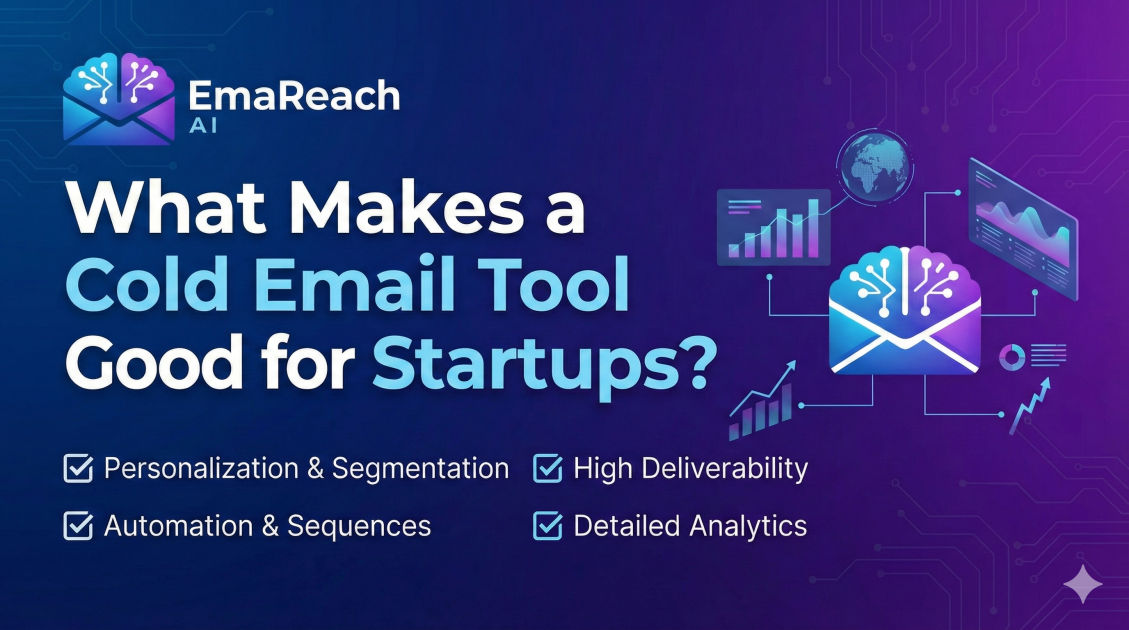
What Makes a Cold Email Tool Good for Startups?
cold emailstartup growthemail deliverabilitysales automationlead generationoutreach toolsB2B marketing
Introduction
For early-stage startups, growth is not just a goal; it is a survival mechanism. While social media, paid advertising, and content marketing all have their place in a holistic growth strategy, few channels offer the directness, speed, and cost-efficiency of cold emailing. It remains one of the most effective ways to validate a market, secure initial customers, and build partnerships without breaking the bank. However, the efficacy of a cold email campaign is rarely determined by the copy alone. The infrastructure powering that campaign—the cold email tool itself—plays a decisive role in whether your message lands in a prospect's inbox or disappears into the spam folder abyss.
Choosing the right stack is particularly challenging for startups. Unlike established enterprises with dedicated sales operations teams and massive budgets, startups need tools that are agile, affordable, and capable of punching above their weight class. You cannot afford to burn through your total addressable market (TAM) with emails that bounce or trigger spam filters. You need a solution that acts as a force multiplier for your limited team.
So, what actually makes a cold email tool "good" for a startup? Is it the interface? The pricing? The artificial intelligence capabilities? The answer is a blend of all these factors, anchored by one non-negotiable metric: deliverability. In this comprehensive guide, we will dissect the anatomy of high-performing cold email software, exploring the essential features, technical requirements, and strategic advantages that separate the best tools from the rest.
1. Deliverability-First Architecture
The single most important feature of any cold email tool is its ability to get your email into the primary inbox. You could hire the world's greatest copywriter and craft the most compelling offer in your industry, but if your domain reputation is poor, no one will ever see it. For startups, where every lead counts, a tool that prioritizes deliverability is non-negotiable.
Automated Inbox Warm-up
When you purchase a new domain or create a new email account for outreach, it is "cold." Email service providers (ESPs) like Google and Outlook treat new accounts with suspicion. If you immediately start blasting hundreds of emails a day, you will be flagged as a spammer. A robust cold email tool for startups must include an automated warm-up feature.
This function automatically sends and replies to emails within a network of other inboxes, gradually increasing the sending volume day by day. This signals to ESPs that you are a legitimate human sender. Modern tools have integrated this natively, saving startups the cost of third-party warm-up services. For example, platforms like EmaReach have made this a core component of their offering, combining inbox warm-up with multi-account sending to ensure that by the time you launch your actual campaign, your sender reputation is already solid.
Sender Rotation and Multi-Inbox Sending
Scaling outreach used to mean simply sending more emails from founder@startup.com. Today, that is a recipe for disaster. To scale volume without triggering spam filters, you need to spread the load across multiple inboxes and domains. A good tool allows you to connect multiple email accounts (e.g., founder@, hello@, sales@, plus distinct sending domains) and rotates the sending duties between them automatically.
If you want to send 500 emails a day, it is far safer to send 50 emails from 10 different accounts than 500 from one. This feature, often called "Inbox Rotation," ensures that no single account exceeds the safety thresholds set by ESPs.
Custom Tracking Domains
When you track open rates and link clicks, most tools insert a tracking pixel or rewrite your links. If you use the default tracking domain provided by a cheap tool, you are sharing that domain's reputation with every other user on that platform—including spammers. A quality tool for startups will enforce or easily allow the setup of a Custom Tracking Domain. This allows you to white-label the tracking links so that they align with your own domain reputation, significantly reducing the likelihood of being flagged.
2. Advanced Personalization Capabilities
In the early days of digital marketing, "personalization" meant inserting a {FirstName} variable into the subject line. Today, B2B buyers are sophisticated. They can spot a templated mass email from a mile away. For a startup trying to break into a competitive market, generic outreach is a waste of time.
Beyond Basic Merge Tags
A superior cold email tool allows for deep personalization. This includes variables not just for names and companies, but for dynamic sentences, specific industry pain points, or recent news about the prospect's company. The interface should allow you to upload CSVs with rich data and map them easily to your templates.
AI-Driven Content Generation
This is where the landscape is shifting rapidly. The best tools for startups are now integrating Artificial Intelligence to help write and rewrite copy. Instead of using a static template, AI tools can analyze a prospect's website or LinkedIn profile and generate a unique opening line for every single email. This level of hyper-personalization was previously only possible with manual research. Now, tools like EmaReach utilize AI to craft messages that feel bespoke, increasing the reply rate significantly by demonstrating that you have done your homework.
Spintax Support
To avoid spam filters, your emails should not all look identical. "Spintax" (Spin Syntax) allows you to define variations of words or phrases (e.g., {Hi|Hello|Hey}) within your email. The tool then randomly selects one variation for each email sent. This creates unique fingerprints for your messages, making it harder for algorithms to pattern-match your outreach as a bulk blast.
3. Intelligent Automation and Sequences
Startups rarely close a deal on the first touchpoint. The money is in the follow-up. However, manually remembering to follow up with 100 prospects three days later is impossible. A good cold email tool acts as an automated sales development representative (SDR).
Behavioral Triggers
Linear sequences (Email 1 -> Wait 3 Days -> Email 2) are standard, but good tools offer behavioral branching. The workflow should adapt based on how the prospect interacts with your email.
- If they reply: The sequence must stop automatically (this is critical to avoid awkward "Did you see my last email?" messages after they have already responded).
- If they click a link: You might want to trigger a different follow-up that focuses on the specific content they viewed.
- If they bounce: The tool should tag them effectively and perhaps trigger a task to find an alternative contact at the same company.
Time Zone Optimization
If you are a startup in Europe targeting customers in California, sending emails at 9:00 AM your time ensures they arrive in the middle of the night for your prospect. A capable tool will automatically detect the prospect's time zone and schedule the email to land in their inbox during their working hours. This simple feature can increase open rates by double-digit percentages.
4. Comprehensive Analytics and Reporting
You cannot improve what you cannot measure. For a startup, data is the compass that guides product-market fit. Your cold email tool needs to provide granular analytics, not just vanity metrics.
The Metrics That Matter
- Open Rate: Indicates if your subject lines and sender reputation are working.
- Reply Rate: The most important metric. Indicates if your offer and copy are resonating.
- Bounce Rate: Indicates the quality of your lead list. A good tool will alert you if this spikes, as it endangers your domain.
- Click-Through Rate (CTR): Important if your goal is to drive traffic to a landing page or demo video.
A/B Testing (Split Testing)
A startup's first value proposition is rarely its final one. You need to test different angles. A good tool makes A/B testing seamless. You should be able to test subject lines, call-to-actions (CTAs), and even entirely different email bodies against each other. The tool should automatically split the traffic and produce a clear report on the winner. This allows for rapid iteration—a core requirement for startup agility.
5. Integration and Workflow Harmony
No software exists in a vacuum. Your cold email tool is part of a larger revenue operations stack. If it does not play nicely with your other tools, it becomes a bottleneck.
CRM Synchronization
When a prospect replies, that data needs to flow into your Customer Relationship Management (CRM) system (e.g., HubSpot, Salesforce, Pipedrive). Two-way sync is ideal: if you mark a lead as "Closed-Won" in your CRM, the cold email tool should stop emailing them. If they reply to an email, the conversation should appear in the CRM record.
Zapier and API Access
Native integrations are great, but they can't cover everything. A tool with a robust API or a well-maintained Zapier integration allows you to build custom workflows. For example, you could set up a workflow where a new row in a Google Sheet automatically triggers a specific outreach sequence, or where a positive reply sends a notification to a Slack channel celebrating the win.
6. Cost-Effectiveness and Scalability
Startups have tight runways. While enterprise tools might offer every bell and whistle imaginable, they often come with prohibitive annual contracts and minimum seat requirements. A tool designed for startups offers flexibility.
Transparent Pricing Models
Beware of tools that charge per contact stored. As your database grows, your costs will skyrocket. The best models for startups usually charge per email sent or per sending seat connected. This aligns the cost with your activity level rather than your database size.
Unlimited Seats vs. Per-User Pricing
Some modern platforms are disrupting the market by offering "unlimited seats" or flat fees for adding multiple email accounts. This is incredibly valuable for startups that rely on the volume strategy mentioned earlier (multi-inbox sending). Being penalized financially for trying to follow deliverability best practices is a red flag in a tool.
7. Compliance and Safety
In the era of GDPR, CCPA, and strict spam laws, compliance is not optional. A good tool helps you stay within the lines.
- Unsubscribe Headers: It should automatically include one-click unsubscribe headers (List-Unsubscribe), which are now required by major email providers like Google and Yahoo.
- Bounce Protection: The tool should verify email addresses before sending. Many top-tier tools integrate with verification services (like NeverBounce or ZeroBounce) or have their own verification layers to prevent you from emailing invalid addresses.
Conclusion
Selecting a cold email tool is one of the first and most critical technology decisions a B2B startup will make. The market is flooded with options, but the "best" tool is not necessarily the one with the most features or the highest price tag.
For a startup, the ideal tool is one that acts as a partner in deliverability. It shields your domain from harm through automated warm-ups and rotation. It empowers your small team to sound like a large one through AI-driven personalization and intelligent sequencing. And perhaps most importantly, it offers the analytics required to learn and pivot quickly.
Whether you are looking for a simple sequencer or a comprehensive AI-powered platform like EmaReach, the goal remains the same: stop landing in spam and start starting conversations. By prioritizing deliverability architecture, integration capabilities, and scalable pricing, you can build an outbound engine that fuels your startup's growth for years to come.
EmaReach AI
Ready to scale your cold email outreach?
Join thousands of teams using EmaReach AI for AI-powered campaigns, domain warmup, and 95%+ deliverability. Start free — no credit card required.
Related posts
- Read article
The Instantly Alternative That Finally Gets Outbound Analytics Right
Discover why high-volume cold email requires a shift from surface-level vanity metrics to deep, data-driven revenue attribution, and explore the ultimate alternatives for mastering outbound engineering.
- Read article
What You Gain and What You Give Up When Switching From Instantly
Thinking about migrating your cold email stack? This detailed guide breaks down the exact operational advantages you gain and the core features you sacrifice when switching away from Instantly's popular outreach platform.