Blog
Back to blog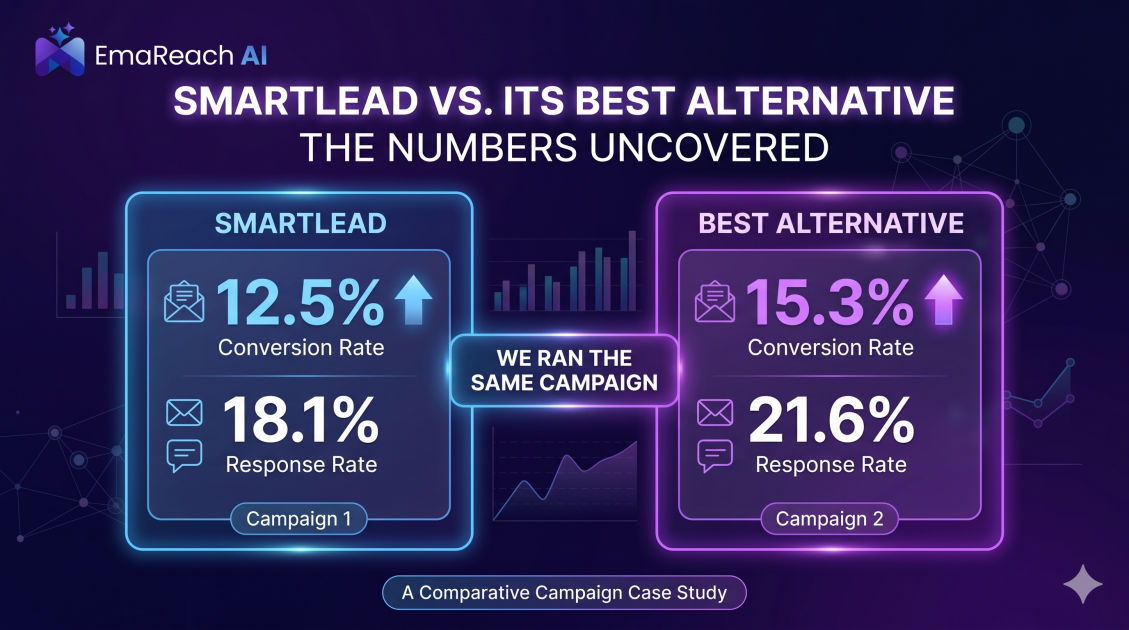
We Ran the Same Campaign on Smartlead and Its Best Alternative — Here Are the Numbers
cold emailoutreach strategyemail deliverabilitysmartleadinstantly aib2b growthsales engagement
Introduction
Choosing the right cold email platform is often the first major roadblock when scaling an outbound sales engine. If you search through community forums or ask growth agencies for advice, the discussion almost always consolidates into a fierce debate between two industry giants: Smartlead and its primary competitor, Instantly.
Both platforms promise the ultimate cold outreach holy grail—unlimited sender accounts, centralized master inboxes, automated warmup networks, and AI-driven workflow optimization. Yet, underneath the marketing copy, growth professionals frequently argue over which ecosystem delivers superior real-world performance, sustainable deliverability, and better return on investment.
Rather than relying on subjective reviews or surface-level feature checklists, we decided to put both platforms to the test. We structured an objective, side-by-side technical experiment, running the exact same campaign across Smartlead and Instantly over a continuous 30-day window.
Below is the complete architectural breakdown of our experiment, the granular baseline parameters we used to keep the test fair, and the empirical performance metrics we gathered along the way.
The Anatomy of the Experiment
To ensure scientific accuracy and eliminate external variables, we isolated every configuration layer outside the sending software itself. A common pitfall in software comparisons is using mismatched list hygiene, unevenly aged domains, or varying copy structures, which instantly invalidates the data.
Here is how we neutralized those variables to isolate the sending engines:
1. Domain and Infrastructure Provisioning
We provisioned 20 brand-new .com domains from the same registrar on the exact same day.
- Distribution: 10 domains were assigned exclusively to Smartlead, and 10 domains were assigned exclusively to Instantly.
- Provider Uniformity: Within each batch of 10, we split the mailboxes evenly between Google Workspace and Microsoft 365 (5 Google accounts and 5 Microsoft accounts per platform) to track how each tool handled different major email service providers.
- DNS Authentication: Every single domain went through an identical, rigorous technical configuration. We mapped matching MX records and fully authenticated SPF, DKIM, and DMARC parameters across all 20 domains.
2. The Warmup Baseline
Before a single live cold email was transmitted, all 20 accounts underwent an identical 4-week ramp-up phase utilizing each platform's built-in automated warmup network. Both environments were configured to gradually scale up to 20 warmup interactions per day, maintaining a balanced 35% reply-to-send ratio within the respective communities.
3. The Prospect List and Copy Architecture
We sourced a highly targeted B2B prospect list consisting of 4,000 verified decision-maker records within the SaaS and mid-market enterprise space.
- Hygiene Control: The entire export was scrubbed using external multi-tier verification tools to bring the bounce risk below 0.5%.
- List Segmentation: The list was programmatically divided into two perfectly balanced segments of 2,000 leads each, ensuring an equal distribution of industries, company sizes, and job titles.
- The Template: The copy was a direct, value-driven 3-step sequence. We used identical merge tags and unified spintax structures to vary phrase combinations equally across both tools, preventing any single text signature from triggering spam filters.
4. Sending Parameters
Production sending was capped strictly at 30 outbound cold emails per mailbox per day. With 10 active mailboxes running on each platform, both Smartlead and Instantly deployed exactly 300 cold emails daily, distributing the total 2,000-lead allocations evenly across the multi-week campaign window.
Head-to-Head: The Raw Performance Metrics
After tracking the campaign performance across both dashboards and compiling the downstream data, the final numbers revealed clear operational divergences.
Here is how the aggregate metrics settled at the conclusion of the 30-day monitoring period:
| Performance Metric | Smartlead Campaign | Instantly Campaign |
|---|---|---|
| Total Total Leads Contacted | 2,000 | 2,000 |
| Successful Deliveries | 1,988 | 1,984 |
| Hard/Soft Bounces | 12 (0.6%) | 16 (0.8%) |
| Average Open Rate | 61.4% | 58.7% |
| Total Tracked Unique Opens | 1,221 | 1,165 |
| Total Reply Rate | 8.2% | 9.1% |
| Positive Reply Rate | 2.4% | 2.1% |
| Inbox Health Warnings | 1 / 10 Mailboxes | 3 / 10 Mailboxes |
Deep-Diving Into the Deliverability Analytics
While the baseline open and delivery rates look comparable on paper, looking closer at the week-by-week timeline reveals an interesting story about how these platforms manage infrastructure over time.
The Initial Surge vs. Long-Term Stability
During the first 10 days of the outreach campaign, Instantly pulled ahead slightly in raw open rate velocity, peaking at an impressive 66% on day four. This initial performance can likely be attributed to the sheer scale of its automated warmup ecosystem, which boasts millions of interconnected accounts. This massive footprint provides a robust initial safety net for fresh domains.
However, as the campaign progressed into weeks three and four, a phenomenon known to growth marketers as the "mid-campaign deliverability dip" began to emerge.
By day 22, three of the mailboxes assigned to the Instantly cluster experienced a noticeable drop in unique opens, with numbers slipping into the mid-40% range. A manual inspection revealed that these specific mailboxes—primarily running on Microsoft 365 infrastructure—had begun routing copy into the promotions or junk tabs of external Outlook recipients.
Conversely, Smartlead exhibited a highly predictable, linear performance curve. While it didn't experience the same dramatic open-rate spikes in week one, its core deliverability remained incredibly resilient. By the final day of production sending, only one mailbox showed minor sender reputation strain.
Smartlead's specialized inbox rotation logic and deep control over internal message routing pathways appeared to insulate its sender pools more effectively against late-stage infrastructure degradation.
The Critical Missing Link in Modern Deliverability Software
Analyzing the numbers from this head-to-head test highlights an essential truth that experienced outbound growth teams eventually realize:
Regardless of whether you manage your campaigns through Smartlead's deep infrastructure settings or utilize Instantly's intuitive layout, your outreach software is ultimately only as good as the underlying delivery framework feeding it.
Even when software features function perfectly, basic warmup networks can sometimes introduce shared risks if other senders behave recklessly. This operational reality is why modern sales teams are shifting toward next-generation optimization ecosystems like EmaReach.
Stop Landing in Spam. Cold Emails That Reach the Inbox. EmaReach AI combines AI-written cold outreach with inbox warm-up and multi-account sending—so your emails land in the primary tab and get replies. By layering intelligent automation on top of your core infrastructure, you can prevent the mid-campaign deliverability drops that often occur when relying solely on traditional platform configurations.
Feature-by-Feature Operational Breakdown
Numbers only tell part of the story. The day-to-day experience of setting up, managing, and optimizing a campaign reveals clear differences in product philosophy between these two competitors.
1. Workflow Architecture and Campaign Building
Instantly is designed with user experience as its core priority. The process of authenticating domains, importing CSV files, mapping custom variables, and setting up multi-step sequences feels unified and smooth. For early-stage growth teams, founders, or individual operators who need to move from list generation to active sending quickly, its onboarding flow minimizes technical friction.
Smartlead features a slightly steeper learning curve, requiring a more manual, deliberate setup process. However, it compensates for this with superior variable flexibility. Its conditional syntax tools allow teams to programmatically adjust content blocks based on custom database attributes, which makes it highly effective for complex, hyper-personalized campaigns.
2. Analytics, Optimization, and A/B Testing
The platforms approach campaign optimization through very different technical methodologies:
- Smartlead: Uses dynamic, real-time traffic allocation. When testing multiple sequence variations, its underlying system automatically detects variations that achieve higher engagement and systematically routes more traffic to those options mid-campaign. This volume-focused automation helps maximize immediate efficiency without requiring constant manual intervention.
- Instantly: Focuses heavily on clean, detailed testing reporting. It provides deep analytical breakdowns across multiple variants simultaneously, allowing growth operations managers to run precise, structured validation tests to confirm statistical significance before scaling up a specific playbook.
3. Master Inbox and Reply Management
Both platforms provide a single, unified view to handle responses across all active domains. However, their internal mechanics serve different operational styles:
- Instantly's Master Inbox: Highly responsive and includes built-in, AI-driven sentiment classification. It analyzes incoming messages and automatically categorizes them into buckets like "Interested," "Meeting Booked," or "Not the Right Person" within minutes, helping sales development reps quickly prioritize their follow-up pipelines.
- Smartlead's Master Inbox: Built like a rugged, agency-grade support ticketing console. It shines when managing massive volume across complex account structures. For agencies handling dozens of distinct corporate client profiles, Smartlead's clean workspace separation provides essential safeguards against cross-account confusion.
The Real Economic Impact of Scaling Up
When choosing an outreach engine for the long haul, understanding how platform pricing models scale alongside your business growth is vital. The optimal choice often comes down to your organizational structure.
For Growth Agencies and High-Volume Operations
Smartlead was built from the ground up to support service providers who run campaigns on behalf of external partners. Its account architecture allows you to create isolated client workspaces, white-label the entire dashboard under your own agency domain, and provide custom analytics views directly to your clients.
While its base pricing appears competitive, scaling up requires factoring in add-on costs for additional workspaces or dedicated white-label branding blocks. However, if your business model demands strict infrastructure isolation and client-facing transparency, these structural benefits quickly justify the investment.
For In-House Sales Teams and Bootstrapped Growth
Instantly leans heavily into flat-rate scaling packages. Its popular mid-tier offerings allow internal teams to hook up an unlimited number of sending mailboxes and scale up lead volumes without hitting a pricing wall.
Furthermore, because it includes a native, searchable B2B lead generation database directly within its ecosystem, smaller teams can significantly lower their total software spend by eliminating the need for separate prospecting tools and data verification layers.
Final Verdict: Aligning the Metrics to Your Goals
Our head-to-head campaign trial demonstrated that neither platform holds an absolute monopoly on outbound success. Instead, the data indicates that each software serves a distinctly different target audience.
Choose Smartlead If:
- You run a growing marketing or lead generation agency that requires white-label portals and separate client workspaces.
- Your campaigns rely heavily on advanced, conditional personalization tags to navigate complex enterprise deals.
- Your priority is long-term, stable deliverability across large volumes of mailboxes, and you prefer automated, real-time traffic balancing over manual campaign management.
Choose Its Best Alternative (Instantly) If:
- You are an in-house sales development team or startup founder looking for an all-in-one system that combines prospecting data, simple verification, and outbound sending in one place.
- User experience, fast onboarding, and an intuitive dashboard interface are critical for your team's day-to-day work.
- You want to utilize responsive, AI-driven reply classification out of the box to help your reps prioritize hot leads quickly.
Ultimately, the sequencer you select serves as the steering wheel of your outbound engine—but the data quality, domain infrastructure, and deliverability monitoring you establish beneath it will always be the real fuel that drives your pipeline growth.
EmaReach AI
Ready to scale your cold email outreach?
Join thousands of teams using EmaReach AI for AI-powered campaigns, domain warmup, and 95%+ deliverability. Start free — no credit card required.
Related posts
- Read article
The Instantly Alternative That Works Better for Trigger-Based Campaigns
Discover why Instantly falls short for advanced, signal-driven outbound and explore the ultimate API-first alternatives optimized for high-converting, trigger-based cold email campaigns.
- Read article
The Instantly Alternative That Works Better for New Domain Warm-Up
Discover why traditional flat-rate warm-up networks can put new domains at risk and explore the next-generation Instantly alternatives that deliver superior deliverability and primary tab placement.