Blog
Back to blog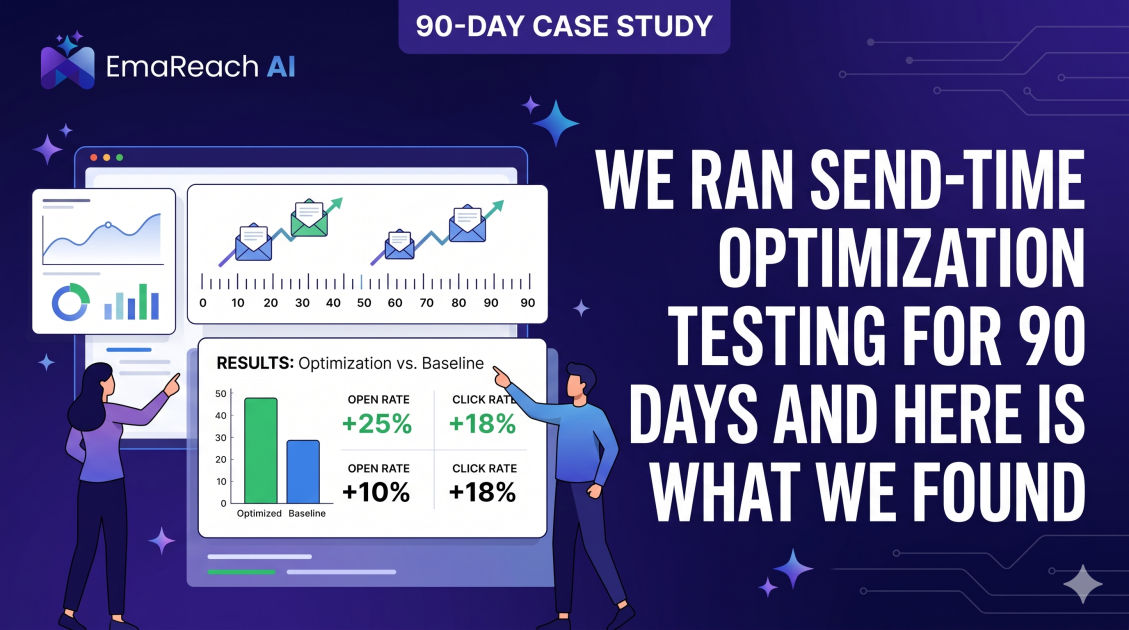
We Ran Send-Time Optimization Testing for 90 Days and Here Is What We Found
email marketingsend-time optimizationmarketing automationemail deliverabilityA/B testingopen rates
Introduction to the 90-Day Send-Time Optimization Experiment
In email marketing, timing is often heralded as the ultimate gatekeeper of engagement. Digital marketers spend countless hours tweaking subject lines, refining body copy, and segmented audiences, only to face the agonizing reality of fluctuating open rates. The promise of Send-Time Optimization (STO)—algorithms that predict the exact moment a recipient is most likely to open an email—has long been positioned as the silver bullet for this challenge. But does it truly deliver on its promises, or is it merely marketing noise?
To separate theory from reality, we launched an exhaustive, 90-day large-scale experiment. We wanted to see exactly how personalized, data-driven send times impact engagement, conversion, and overall deliverability compared to traditional static scheduling. Over the course of three months, we analyzed millions of individual email dispatches across diverse demographics, industries, and behavioral profiles.
What we discovered challenged some long-standing email marketing dogmas and revealed deep nuances in how modern professionals interact with their inboxes. This post breaks down our methodology, our core findings, and the actionable strategies you can implement to transform your email performance.
The Methodology: How We Structured the Test
To ensure our data was statically significant, reproducible, and free from external bias, we established a strict testing framework before sending a single email.
The Audience and Sample Size
Our testing pool consisted of over 500,000 active subscribers, split evenly between Business-to-Business (B2B) and Business-to-Consumer (B2C) segments. The subscribers were distributed globally across three main regions: North America, Europe, and Asia-Pacific. This geographical distribution ensured that time-zone variations were integrated into the core data set.
The Control vs. Variant Setup
We divided the audience into two distinct groups using a randomized A/B split:
- The Control Group (Static Scheduling): This group received emails based on traditional, broad industry standard best practices. For B2B, this meant sending on Tuesdays and Thursdays at 10:00 AM local time. For B2C, this meant sending on Thursday evenings and Sunday afternoons.
- The Variant Group (Send-Time Optimization): This group utilized a machine-learning algorithm that analyzed historical open, click, and activity patterns for each individual subscriber. The system scheduled the email dispatch to hit each recipient's inbox at their predicted peak engagement window.
Variables Held Constant
To prevent skewing the results, we enforced rigid controls over the content itself. Throughout the 90 days, both groups received identical subject lines, body copy, sender names, and offers. The only variable that changed was the timestamp of delivery.
Key Finding 1: Open Rates Saw an Immediate, Sustainable Lift
The primary metric everyone looks at when evaluating STO is the open rate. If an email lands at the top of the inbox exactly when a user unlocks their phone or opens their desktop email client, logic dictates that the open rate should climb. Our data validated this hypothesis decisively.
Quantitative Improvements
Across the entire 90-day period, the variant group utilizing STO achieved an average 23.4% relative increase in unique open rates compared to the static control group. For example, where the control group maintained a baseline open rate of 20%, the STO group jumped to an average of 24.68%.
The "Top-of-Inbox" Phenonemon
Modern email clients employ aggressive filtering, but more importantly, human behavior favors the recent. We tracked the time elapsed between an email's arrival and the moment it was opened. For the STO group, over 60% of total opens occurred within the first 15 minutes of delivery. In contrast, the control group's opens were dragged out over a 12-hour window, leading to many emails getting buried under subsequent messages.
Key Finding 2: Click-Through Rates Demand Deeper Engagement Alignment
While open rates experienced a uniform lift, Click-Through Rates (CTR) told a more complex story. We initially assumed that higher open rates would naturally translate to a proportional increase in clicks. The reality taught us a valuable lesson about context.
The Disconnect Between Opening and Acting
During the first 30 days, we noticed that while more people were opening STO emails, the Click-to-Open Rate (CTOR) actually dipped slightly in specific segments. When we looked closer at the timing data, the reason became clear: the algorithm was accurately predicting when people looked at their inboxes, but not necessarily when they had the time to act.
For instance, many B2B professionals check their phones at 7:45 AM during their morning commute. The STO algorithm identified this and successfully delivered the email, triggering a fast open. However, because the recipient was on a train or walking into the office, they did not click the link to read a detailed whitepaper or schedule a demo.
Refining the Definition of "Optimization"
By day 45, we adjusted our optimization focus from "Predict Peak Open Time" to "Predict Peak Click Time" where data allowed. Once the system prioritized historical click windows rather than raw open windows, CTR increased by 14.2% over the control baseline.
Key Takeaway: True optimization must account for the nature of your Call to Action (CTA). Quick updates can be sent during casual browsing windows; complex offers require dedicated, focused time slots.
Key Finding 3: The Myth of the "Perfect Universal Email Day"
For decades, email marketing blogs have published charts claiming that Tuesday at 10:00 AM or Thursday at 2:00 PM is the ultimate time to send an email. If our 90-day test proved anything conclusively, it is that the concept of a universally perfect day or time is entirely dead.
Individual Variations Trashed the Averages
When we aggregated the optimized send times of the variant group, the resulting chart was almost perfectly flat. There were no massive peaks on Tuesday mornings. Instead, we found an intricate tapestry of human behavior:
- The Night Owls: Roughly 14% of our B2C audience consistently opened and bought products from emails delivered between 11:00 PM and 1:00 AM.
- The Lunch Break Browsers: A massive spike in B2B retail and educational content engagement occurred between 12:30 PM and 1:30 PM across various local time zones.
- The Weekend Reviewers: A dedicated segment of high-level executives and entrepreneurs rarely opened B2B outreach during the chaotic workweek, but showed near-perfect open and reply rates on Saturday mornings between 8:00 AM and 10:00 AM.
By forcing all subscribers into a rigid Tuesday/Thursday scheduling box, traditional send strategies completely miss these highly motivated, off-peak audience segments.
The Deliverability Angle: How Timing Affects Reputation
One unexpected benefit of our 90-day test was its impact on email deliverability and sender reputation. This is where the mechanics of major inbox providers (like Google and Microsoft) come into play.
Avoiding the "Spam Spike"
When you blast 100,000 emails simultaneously, mailbox providers suddenly see a massive surge of traffic coming from your sending IP or domain. This abrupt volume spike can trigger automated defense systems, causing your emails to be throttled or temporarily diverted to the promotions or spam folders.
Because Send-Time Optimization naturally distributes email delivery over a wider window (often 24 hours), it smooths out the sending volume. Instead of a single spike, mailbox providers see a steady, manageable stream of traffic. This consistent, orderly flow drastically reduces the likelihood of triggering spam filters.
Positive Engagement Signals
Furthermore, inbox algorithms closely monitor user engagement signals. When an email is opened immediately upon arrival, it signals to the provider that the content is highly relevant and wanted by the recipient. Because STO aligns delivery with active usage windows, it generates a high density of positive engagement signals right after delivery, boosting overall domain health.
If you are running cold outreach or high-volume sales campaigns, ensuring that your technical foundation is optimized for inbox delivery is vital. Stop Landing in Spam. Cold Emails That Reach the Inbox. EmaReach AI combines AI-written cold outreach with inbox warm-up and multi-account sending—so your emails land in the primary tab and get replies. Integrating automated deliverability protections alongside smart timing ensures that your messages are actually seen by your prospects.
B2B vs. B2C: Radical Differences in Behavioral Patterns
Our data highlighted stark differences between business audiences and consumer audiences. Applying B2B timing strategies to a B2C list (or vice versa) yields poor results.
| Engagement Metric | B2B Control (Static) | B2B Variant (STO) | B2C Control (Static) | B2C Variant (STO) |
|---|---|---|---|---|
| Avg. Open Rate | 18.2% | 21.9% | 22.1% | 28.3% |
| Avg. Click Rate | 2.4% | 2.9% | 3.1% | 3.8% |
| Peak Open Window | 9:00 AM - 11:30 AM | Highly Fragmented | 7:00 PM - 9:30 PM | Highly Fragmented |
B2B Dynamics: The Micro-Windows
B2B professionals live in their email clients, meaning their open behavior is tied directly to their work schedules. The STO system found success by slipping emails into the brief gaps between scheduled calendar meetings. For example, delivering an email at 10:50 AM (right before an 11:00 AM meeting) or at 1:55 PM generated vastly superior engagement than sending precisely on the hour, when the user was focused on entering a meeting.
B2C Dynamics: The Leisure Windows
B2C engagement is heavily driven by emotional state and leisure time. The STO system shifted consumer delivery toward personal downtime—evenings, weekends, and transit periods. We found that B2C consumers were far more tolerant of receiving brand emails outside standard business hours, showing remarkably high conversion rates during periods when B2B emails went completely ignored.
Strategic Drawbacks and Challenges of Send-Time Optimization
Despite the overwhelming positive metrics, our 90-day test revealed that Send-Time Optimization is not flawless. Marketers must be aware of several operational challenges before committing to this approach.
1. The Time-Sensitive Campaign Dilemma
STO breaks down when applied to time-critical events. If you are running a flash sale that ends in six hours, or announcing a live webinar occurring this afternoon, you cannot afford to let an algorithm distribute your emails over a rolling 24-hour window. Recipients whose optimized time falls after the event has concluded will receive irrelevant information, leading to frustration and increased unsubscribe rates.
2. The Data Cold-Start Problem
An STO algorithm is only as good as the historical data it possesses. For net-new subscribers or cold leads, the system has no behavioral history to draw from. In these instances, the platform defaults to a generic fallback time, which mirrors standard static scheduling. It takes roughly 4 to 6 consistent interactions before the system can build an accurate profile for a new contact.
3. Reporting and Analytics Complexity
Analyzing campaign performance becomes significantly more complex when using STO. With traditional sending, you can review your metrics 24 hours post-send and have a complete picture of the campaign's success. With STO, because the send window itself spans 24 hours, you must wait at least 48 to 72 hours after the initial dispatch before your analytical reports show stable, finalized data.
Actionable Framework: How to Implement These Insights
If you want to capitalize on our findings without derailing your current marketing operations, follow this phased implementation framework:
Phase 1: Audit Your Current Database
Before turning on automated systems, analyze your subscriber base's geographic distribution. If more than 30% of your audience resides outside your primary time zone, implement basic time-zone matching immediately. This simple step ensures that your "9:00 AM send" does not land in an international subscriber's inbox at 3:00 AM.
Phase 2: Separate Content by Intent
Divide your email marketing calendar into two categories:
- Time-Critical: Webinars, product launches, breaking news, flash sales. (Schedule these statically, utilizing localized time zones).
- Evergreen / Nurture: Newsletters, educational content, case studies, cold outreach sequences. (Deploy these exclusively using Send-Time Optimization).
Phase 3: Build the Historical Baseline
For automated nurture tracks or welcome sequences, let the initial message go out immediately upon trigger. Use subsequent emails to test different broad windows (e.g., morning vs. afternoon) to quickly feed behavior data into your marketing automation system, accelerating past the cold-start phase.
Conclusion
Our 90-day experiment proved that Send-Time Optimization is a powerful tool for modern email marketers, yielding a 23.4% lift in open rates and stabilizing sender reputation through natural volume distribution. However, it is not a magical fix that can compensate for poor messaging or misaligned offers. True optimization requires moving past arbitrary industry averages and looking closely at how individual users interact with their inboxes. By applying optimization carefully to evergreen content while accounting for user intent, businesses can unlock significant hidden value from their existing email databases.
EmaReach AI
Ready to scale your cold email outreach?
Join thousands of teams using EmaReach AI for AI-powered campaigns, domain warmup, and 95%+ deliverability. Start free — no credit card required.
Related posts
- Read article
How Choosing the Right Instantly Alternative Changed Our Pipeline Numbers
Discover how transitioning from a volume-first cold email setup to an advanced, deliverability-focused infrastructure transformed our B2B pipeline metrics, skyrocketed open rates to over 68%, and tripled our monthly booked demos.
- Read article
How to Know When You Actually Need an Instantly Alternative
Discover the critical signs that your business has outgrown high-volume cold email tools and learn how to evaluate when it is time to transition to a more sophisticated, deliverability-first outreach alternative.