Blog
Back to blog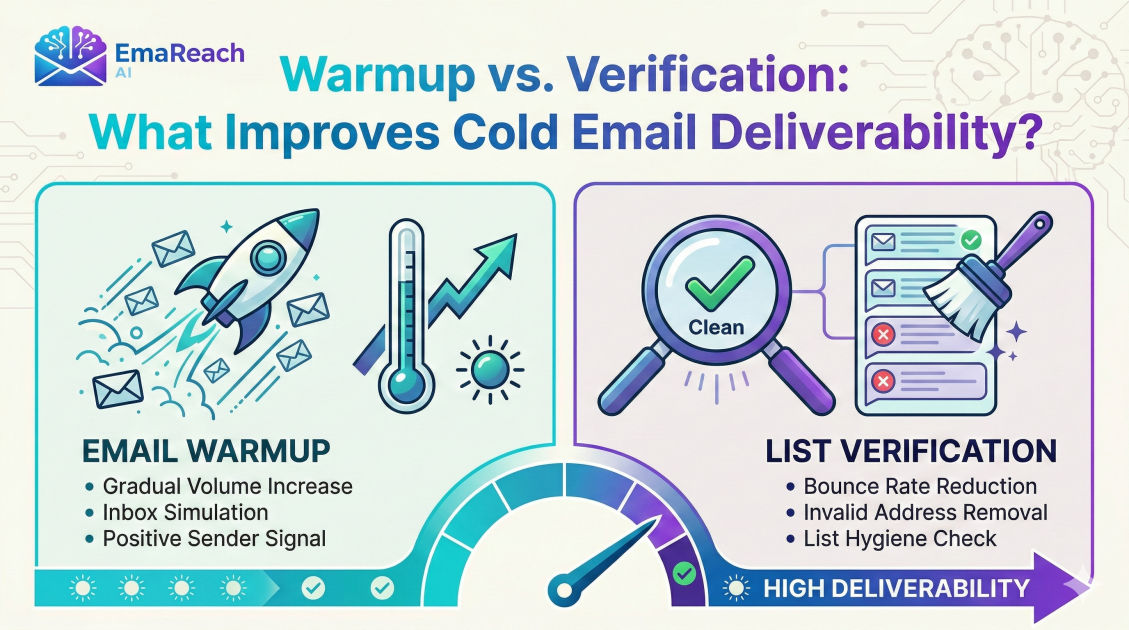
Warmup vs Verification: What Improves Cold Email Deliverability?
cold emaildeliverabilityemail warmupemail verificationlead generationsales outreachinbox placement
Introduction
In the world of outbound sales, the distance between a sent email and a closed deal is measured by one critical metric: deliverability. You can craft the most compelling, personalized, and value-driven message in the world, but if that message lands in the 'Spam' folder or is blocked by an ISP (Internet Service Provider) before it even reaches the recipient, your conversion rate is zero.
Two pillars have emerged as the gold standard for protecting your sender reputation: Email Warmup and Email Verification. While they are often discussed in the same breath, they serve entirely different functions. One builds your reputation, while the other protects it. To achieve consistent success in cold outreach, understanding the nuance between these two processes—and how they work in tandem—is essential.
Understanding the Foundations of Deliverability
Before diving into the specifics of warmup and verification, we must understand why emails fail to reach the inbox. Modern email providers like Google and Microsoft use sophisticated algorithms to filter out noise. These filters look at two primary categories of data: sender behavior and list hygiene.
If you send 500 emails from a brand-new account on day one, you look like a spammer. If 20% of your emails bounce because the addresses don't exist, you look like a spammer. In both scenarios, your deliverability plummets. This is where the debate of Warmup vs. Verification begins.
What is Email Warmup?
Email warmup is the process of gradually increasing the volume of emails sent from a new or inactive email account to build a positive sender reputation with ISPs. Think of it as a 'getting to know you' phase between your domain and the world's mail servers.
How Warmup Works
When you start a new email account, you have a neutral reputation. ISPs are naturally suspicious of new accounts because spammers often create 'burner' domains to blast out thousands of messages. Warmup simulates human behavior by:
- Starting Small: Sending only a few emails per day.
- Gradual Escalation: Slowly increasing the daily limit over several weeks.
- Positive Engagement: Ensuring that the emails sent are opened, replied to, and marked as 'important.'
- Spam Removal: If a warmup email happens to land in spam, it is manually (or automatically by a tool) moved back to the inbox, signaling to the ISP that the sender is trustworthy.
The Role of Engagement
Engagement is the secret sauce of warmup. ISPs don't just care that you are sending mail; they care that people want to read it. High open rates and reply rates tell algorithms that your content is valuable. This creates a 'halo effect' around your domain, making it much more likely that your actual cold outreach emails will land in the primary inbox rather than the promotions or spam tabs.
What is Email Verification?
While warmup focuses on the sender, email verification (or validation) focuses on the recipient. It is the process of checking a list of email addresses to ensure they are valid, active, and capable of receiving mail before you ever hit 'send.'
The Mechanism of Verification
Verification tools perform a series of technical checks without actually sending a message to the recipient. This includes:
- Syntax Check: Ensuring the email follows the correct format (e.g., no missing '@' or illegal characters).
- Domain Check: Verifying that the domain name exists and is configured to receive mail.
- MX Record Validation: Checking the Mail Exchange records to ensure the domain has an active mail server.
- SMTP Ping: The most critical step. The verifier 'knocks' on the recipient's mail server to see if the specific mailbox exists. If the server says 'yes,' the email is verified.
Why Verification Matters
Sending emails to non-existent addresses results in a 'Hard Bounce.' A high bounce rate (typically anything over 2%) is a major red flag for ISPs. It suggests that you are using a purchased, outdated, or scraped list, which is a hallmark of spamming. By verifying your list, you eliminate bounces before they happen, keeping your 'permanent record' clean.
Comparison: Warmup vs. Verification
To see how these two processes impact your outreach, let’s look at their core differences side-by-side.
| Feature | Email Warmup | Email Verification |
|---|---|---|
| Focus | Sender Reputation | Recipient List Hygiene |
| Primary Goal | Build trust with ISPs | Reduce Bounce Rates |
| Timing | Ongoing (starts before outreach) | Before every campaign |
| Action | Sending/Interacting with mail | Technical pings/checks |
| Problem Solved | Landing in Spam | High Bounce Rate |
| Metric Improved | Inbox Placement Rate | Deliverability Rate |
Which One Improves Deliverability More?
This is a bit of a trick question. It’s like asking if a car needs an engine or wheels to move. You technically need both, but they solve different problems.
The Case for Warmup
If you have a perfectly clean list of verified emails but a cold, un-warmed domain, your emails will still land in spam. The ISP doesn't care that the recipient exists; they care that you are a trusted sender. Without warmup, your 'deliverability' might look okay on paper (because the emails didn't bounce), but your 'inbox placement'—the actual percentage of emails that reached the eyes of your prospects—will be terrible.
The Case for Verification
Conversely, you can have a domain with a stellar reputation, but if you upload a list where 15% of the addresses are dead, you will burn that reputation in a single afternoon. A high bounce rate can lead to immediate blacklisting, rendering your warmup efforts useless.
The Verdict: Verification is your first line of defense, while warmup is your long-term offensive strategy. Verification keeps you out of trouble; warmup gets you into the inbox.
Best Practices for Email Warmup
To get the most out of your warmup period, follow these guidelines:
- Don't Rush: A proper warmup takes at least 2-4 weeks before you start sending serious volume.
- Use a Dedicated Domain: Never do cold outreach from your primary company domain. Use a 'lookalike' domain (e.g., get-company.com) to protect your main brand's email infrastructure.
- Maintain Consistency: Sudden spikes in volume are suspicious. If you finish your warmup and immediately jump from 20 to 200 emails a day, you'll trigger filters. Increase volume by no more than 10-15% per day.
- Keep it Running: Warmup shouldn't stop once you start your campaign. Keeping a steady stream of positive engagement running in the background helps offset any negative signals (like the occasional manual 'mark as spam' from a grumpy prospect).
Best Practices for Email Verification
Verification isn't a one-time task. Lists decay at a rate of about 2% per month as people change jobs and companies shut down.
- Verify in Real-Time: If you use a lead generation tool, verify the emails at the moment of export.
- Segment 'Catch-All' Emails: Some domains are configured as 'Catch-All,' meaning they accept all mail even if the specific address doesn't exist. These are riskier. It is often best to segment these and send to them more cautiously.
- Scrub Your Old Lists: If you are re-engaging a list that is more than 3 months old, re-verify it.
- Watch for Spam Traps: Sophisticated verification tools can identify 'spam traps'—email addresses created by ISPs specifically to catch spammers. Landing in one of these can be devastating.
The Holistic Approach: Integrating Both for Maximum Reach
To achieve elite-level deliverability, you must integrate these two processes into a single workflow. This is where advanced solutions come into play.
For those looking to streamline this complex process, EmaReach (https://www.emareach.com/) offers a powerful solution. EmaReach AI combines AI-written cold outreach with inbox warm-up and multi-account sending—so your emails land in the primary tab and get replies. By automating the technical hurdles of reputation management, it allows sales teams to focus on what they do best: closing deals.
Step-by-Step Deliverability Workflow
- Domain Setup: Purchase a secondary domain and set up SPF, DKIM, and DMARC records.
- Initial Warmup: Run a warmup tool for 14 days with zero external outreach.
- Lead Sourcing: Collect your target prospects.
- Verification: Run your entire prospect list through a verification tool. Delete all 'Invalid' emails and set 'Risky' or 'Catch-all' emails aside for a separate, lower-volume campaign.
- Gradual Outreach: Start sending your campaign at a low volume (e.g., 10-20 emails per day) while the warmup tool continues to run in the background.
- Monitor and Pivot: Keep an eye on your bounce rates and open rates. If open rates drop, decrease your sending volume and increase your warmup engagement.
Common Myths About Warmup and Verification
Myth 1: "I have a high-authority domain, so I don't need warmup."
Even if your company domain has been active for 10 years, if you suddenly start sending high-volume cold outreach from a new seat or inbox, the ISP will see it as a shift in behavior. Every individual inbox needs its own reputation.
Myth 2: "Verification guarantees 0% bounce rate."
No tool is 100% accurate. Some servers are designed to lie to verification 'pings' to protect their users. A 'verified' list might still see a 0.5% to 1% bounce rate, which is why having a warmed-up domain is so important—it provides the 'credit' to handle minor issues without your reputation collapsing.
Myth 3: "Warmup is just for new domains."
Warmup is a maintenance task. If you pause outreach for a month (say, during the holidays), your domain's 'pulse' stops. You should use a light warmup period to ramp back up when you restart.
The Technical Side: SPF, DKIM, and DMARC
While warmup and verification are the focus, they sit on a foundation of technical authentication.
- SPF (Sender Policy Framework): A list of IP addresses authorized to send mail on behalf of your domain.
- DKIM (DomainKeys Identified Mail): A digital signature that proves the email wasn't tampered with in transit.
- DMARC (Domain-based Message Authentication, Reporting, and Conformance): Instructions to the receiving server on what to do if SPF or DKIM fails.
Without these three records correctly configured, even the best warmup and verification strategies will fail. They are the 'ID cards' of the email world.
Conclusion
In the debate of Warmup vs. Verification, the answer is not 'which one' but 'how well.'
Email verification is your shield. It prevents the self-inflicted wounds of hard bounces and keeps your sender profile clean from the taint of bad data. Email warmup is your fuel. It builds the positive momentum and trust required to navigate the complex gauntlet of modern ISP filters.
If you ignore verification, your campaigns will be short-lived, ending in a flurry of bounces and blacklists. If you ignore warmup, your campaigns will be invisible, buried in the dark corners of the spam folder.
By combining a rigorous verification process with a patient, consistent warmup strategy—and utilizing modern tools that automate these workflows—you ensure that your voice is heard. In the competitive landscape of cold outreach, deliverability is your greatest competitive advantage. Protect it, nurture it, and it will reward you with the only thing that matters: the chance to start a conversation with a new customer.
EmaReach AI
Ready to scale your cold email outreach?
Join thousands of teams using EmaReach AI for AI-powered campaigns, domain warmup, and 95%+ deliverability. Start free — no credit card required.
Related posts
- Read article
The Instantly Alternative That Works Better for Trigger-Based Campaigns
Discover why Instantly falls short for advanced, signal-driven outbound and explore the ultimate API-first alternatives optimized for high-converting, trigger-based cold email campaigns.
- Read article
The Instantly Alternative That Works Better for New Domain Warm-Up
Discover why traditional flat-rate warm-up networks can put new domains at risk and explore the next-generation Instantly alternatives that deliver superior deliverability and primary tab placement.