Blog
Back to blog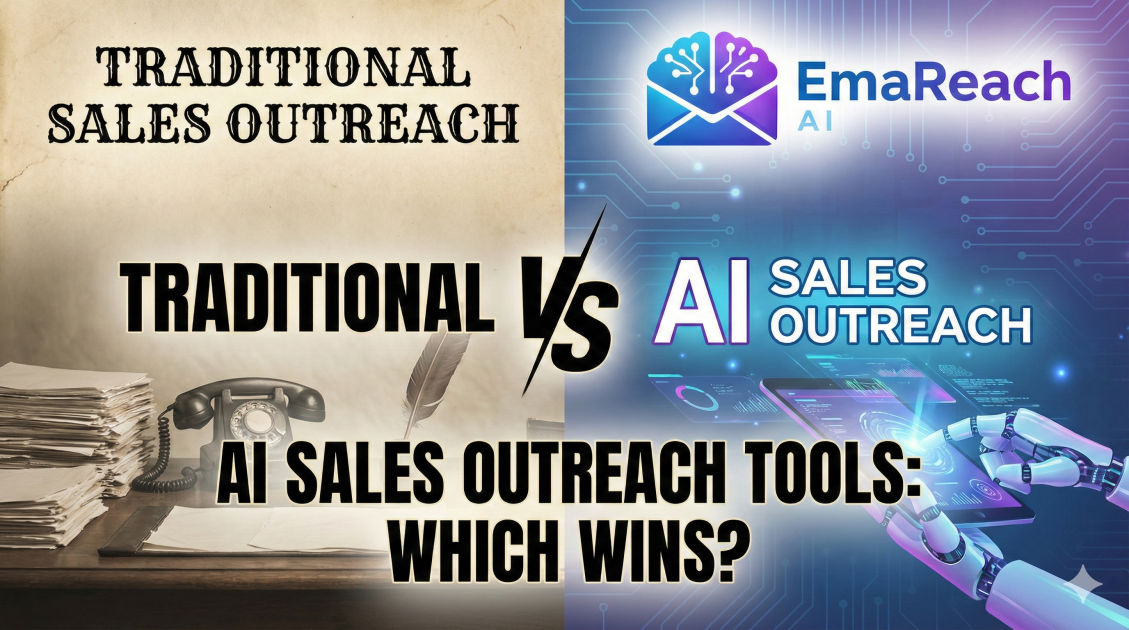
Traditional vs AI Sales Outreach Tools: Which Wins?
sales outreachAI sales toolscold emaillead generationsales automationemail deliverabilitysales productivity
Introduction
In the world of modern sales, the battle for a prospect's attention has never been more intense. For decades, sales outreach was defined by manual grit: scouring LinkedIn profiles, hand-typing emails, and managing complex spreadsheets to track follow-ups. These traditional sales outreach tools—CRMs, basic email sequencers, and manual databases—formed the backbone of the industry.
However, a new contender has emerged. AI sales outreach tools are no longer just futuristic concepts; they are the current engine driving high-performance sales teams. With the ability to analyze massive datasets, predict buyer intent, and craft hyper-personalized messages in seconds, AI is challenging the status quo. This raises a critical question for every sales leader and business owner: Which approach actually wins in a real-world environment?
This guide provides a comprehensive breakdown of traditional versus AI-driven outreach, exploring their strengths, weaknesses, and the undeniable shift toward intelligent automation.
The Anatomy of Traditional Sales Outreach
Traditional sales outreach is built on human intuition and structured automation. In this model, the salesperson is the primary driver of every decision.
Characteristics of Traditional Tools
- Manual Prospecting: Reps spend hours identifying leads based on broad firmographic data (industry, company size, location).
- Static Sequences: Email sequences follow a rigid "if-then" logic. Every prospect in a list receives the same message at the same time intervals.
- Human-Led Personalization: Personalization is high-quality but slow. A rep might spend 15 minutes researching a single prospect to write one thoughtful opening line.
- Reactive Analytics: Data tells you what happened in the past—open rates, click rates, and bounce rates—but offers little guidance on what to do next.
The Pros and Cons of the Traditional Way
Traditional methods excel at building deep, authentic human connections. When a rep spends time understanding a prospect's specific nuances, the resulting relationship is often stronger. However, the scalability is low. A single representative can only manage a limited number of high-quality touchpoints per day. As soon as you try to scale traditional outreach, quality typically plummets, leading to "spray and pray" tactics that damage brand reputation.
The Rise of AI Sales Outreach Tools
AI tools represent a fundamental evolution. They don't just automate tasks; they augment human intelligence. By leveraging machine learning (ML) and natural language processing (NLP), these tools handle the heavy lifting of research and execution.
Characteristics of AI-Powered Tools
- Predictive Lead Scoring: Instead of guessing who might buy, AI analyzes behavioral signals—like website visits, job changes, or social media activity—to identify prospects with high buying intent.
- Hyper-Personalization at Scale: AI can scan a prospect’s recent LinkedIn posts, company annual reports, and industry news to draft a unique email for every single lead in a database of thousands.
- Dynamic Optimization: These tools learn which subject lines, send times, and calls-to-action (CTAs) perform best and automatically adjust the campaign in real-time.
- Automated Deliverability Management: Modern AI platforms manage technical hurdles like inbox rotation and domain health to ensure messages actually reach the primary folder.
The Performance Gap
Research indicates that sales professionals who effectively use AI for prospecting are significantly more likely to meet their quotas. On average, AI-driven teams report a 50% surge in leads and appointments and a 40-60% increase in meeting bookings compared to those using manual processes. This is largely because AI reclaims roughly 10-15 hours per week that reps previously spent on administrative overhead.
Direct Comparison: Traditional vs. AI
| Feature | Traditional Outreach | AI-Powered Outreach |
|---|---|---|
| Lead Research | Manual, time-consuming searches. | Automated, intent-based discovery. |
| Messaging | One-size-fits-all or slow manual edits. | Hyper-personalized for every recipient instantly. |
| Follow-ups | Often forgotten or generic. | Automated, context-aware, and persistent. |
| Deliverability | High risk of spam if scaling manually. | Sophisticated warming and primary tab placement. |
| Efficiency | Limited by human hours. | Operates 24/7 at infinite scale. |
| Scalability | Requires more headcount to grow. | Scales exponentially without increasing staff. |
The Critical Role of Deliverability: EmaReach AI
No matter how smart your AI is or how hard your traditional sales team works, outreach fails if the email never reaches the inbox. Traditional tools often struggle with the technical nuances of modern email filters.
This is where specialized platforms like EmaReach change the game. EmaReach allows you to "Stop Landing in Spam" by focusing on "Cold Emails That Reach the Inbox." By combining AI-written cold outreach with automated inbox warm-up and multi-account sending, it ensures your messages land in the primary tab and get replies. In the debate between traditional and AI tools, a platform that guarantees deliverability acts as a force multiplier for whichever strategy you choose.
Why AI is Winning the Productivity War
1. Eliminating "Micro-Productivity" Bottlenecks
In a traditional setup, a salesperson's day is fragmented. They switch between the CRM, LinkedIn, and their inbox. AI removes these friction points by consolidating workflows. For example, an AI agent can identify a lead, enrich their contact info, write the email, and schedule it—all while the salesperson is on a closing call.
2. Reducing the "Human Error" Factor
Traditional outreach is prone to fatigue. After writing 40 emails, a human rep might get sloppy with names, forget to change a company placeholder, or miss a follow-up. AI maintains a 100% accuracy rate across 10,000 emails, ensuring that every prospect receives a flawless first impression.
3. Data-Driven Decision Making
Traditional tools provide data, but AI provides insights. Instead of just seeing a 20% open rate, an AI tool might tell you: "Your prospects in the Fintech sector respond 3x better to messages sent on Tuesday mornings that mention 'regulatory compliance.'" This level of granular strategy is impossible to maintain manually at scale.
The Human Element: Is Traditional Outreach Dead?
It is a mistake to think that AI replaces the salesperson. Instead, AI replaces the drudgery of the sales process.
- The High-Value Pivot: As AI handles the top-of-funnel noise, humans are freed to focus on high-value activities: building deep rapport, navigating complex internal politics at a prospect's company, and negotiating the final contract.
- The Hybrid Approach: The real winner isn't just "AI"—it’s the AI-Empowered Human. The best results come when a human sets the strategy and the AI executes the volume.
"In 2026, AI is no longer a 'nice-to-have'—it is the baseline for B2B sales. Teams that ignore these tools are essentially bringing a knife to a laser-gun fight."
Actionable Steps to Transition to AI Outreach
If you are currently relying on traditional methods, the transition doesn't have to happen overnight. Follow these steps to modernize your stack:
- Audit Your Time: Track how many hours your team spends on manual data entry and lead research. If it’s more than 20% of their day, you are losing money.
- Start with Lead Intelligence: Implement an AI tool that identifies intent signals. Focus your human energy only on leads that are already showing interest.
- Automate Your Writing: Use generative AI to create "first drafts" for outreach. Let your reps spend 2 minutes refining an AI-generated personalized message rather than 15 minutes writing one from scratch.
- Prioritize Deliverability: Use tools that offer automated warm-up and multi-inbox rotation. High-volume outreach without deliverability protection is the fastest way to get your domain blacklisted.
- Iterate Based on AI Suggestions: Review the patterns AI identifies in your successful deals and feed those insights back into your marketing and product development.
Conclusion: The Verdict
In the battle of Traditional vs AI Sales Outreach Tools, AI is the clear winner for scale, efficiency, and predictive accuracy. Traditional tools still have a place in managing the final stages of a relationship, but they are no longer sufficient for the competitive world of prospecting.
By adopting AI, you aren't just sending more emails; you are sending better emails to the right people at the perfect time. The result is a more predictable pipeline, higher revenue per representative, and a sales team that spends their time doing what they love: closing deals.
EmaReach AI
Ready to scale your cold email outreach?
Join thousands of teams using EmaReach AI for AI-powered campaigns, domain warmup, and 95%+ deliverability. Start free — no credit card required.
Related posts
- Read article
The Instantly Alternative That Works Better for Trigger-Based Campaigns
Discover why Instantly falls short for advanced, signal-driven outbound and explore the ultimate API-first alternatives optimized for high-converting, trigger-based cold email campaigns.
- Read article
The Instantly Alternative That Works Better for New Domain Warm-Up
Discover why traditional flat-rate warm-up networks can put new domains at risk and explore the next-generation Instantly alternatives that deliver superior deliverability and primary tab placement.