Blog
Back to blog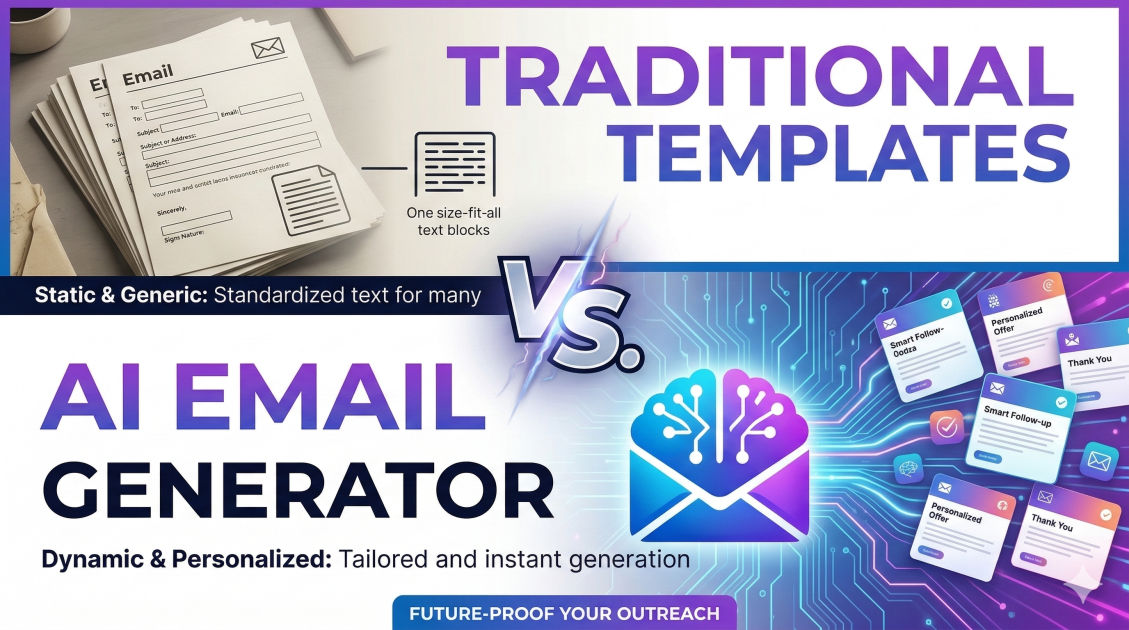
Traditional Templates vs an AI Email Generator
cold emailAI email generatoremail marketingoutreach strategyemail deliverabilitymarketing automation
Introduction
For decades, the foundation of professional communication has rested on the humble email template. These pre-written structures provided a sense of security and efficiency, allowing professionals to scale their outreach without reinventing the wheel every time they hit 'Compose.' However, as the digital landscape becomes increasingly saturated, the limitations of these static frameworks have become glaringly apparent. The rise of artificial intelligence has introduced a new contender to the arena: the AI email generator.
Choosing between traditional templates and AI-driven generation is no longer just a matter of convenience; it is a strategic decision that impacts deliverability, engagement rates, and brand perception. This deep dive explores the mechanics, advantages, and drawbacks of both approaches, helping you determine which method aligns best with your communication goals.
The Era of Traditional Templates: Reliability and its Limits
Traditional templates are essentially 'fill-in-the-blank' documents. They are crafted once and reused thousands of times with minor adjustments—usually just the recipient's name and company. While they offered a massive leap forward from manual typing, they come with inherent baggage.
The Anatomy of a Traditional Template
A standard template relies on a fixed narrative arc. Whether it is a sales pitch, a follow-up, or a networking request, the logic is linear. You have a greeting, a value proposition, and a call to action. The primary benefit here is consistency. A brand can ensure that every employee is using approved language and hitting the right talking points.
The Problem with the 'Template Look'
The greatest weakness of traditional templates is their predictability. Modern email filters and savvy recipients have developed a 'sixth sense' for templated content. When a recipient opens an email and immediately recognizes a structure they have seen a dozen times before, their psychological engagement drops.
Furthermore, using identical templates across large volumes of outreach can trigger spam filters. If thousands of identical messages are sent from a single domain, ISP algorithms often flag the activity as automated spam, regardless of the quality of the content. This is where the concept of 'template fatigue' transitions from a marketing problem to a technical deliverability crisis.
Enter the AI Email Generator: A Paradigm Shift
Unlike a static template, an AI email generator uses Large Language Models (LLMs) to synthesize information and create unique content on the fly. It doesn't just swap out names; it restructures sentences, varies the tone, and adapts the messaging based on specific data points provided about the recipient.
Dynamic Personalization at Scale
While a human can write a highly personalized email, they cannot do it 500 times a day. An AI email generator bridges this gap. By analyzing a recipient’s LinkedIn profile, recent company news, or industry trends, the AI can weave specific details into the narrative that make the email feel hand-crafted.
This isn't just about 'Dear [Name].' It's about saying, 'I saw your recent post regarding [Specific Topic], and it reminded me of how we solved a similar challenge at [Company].' This level of relevance is what drives modern engagement.
Breaking the Pattern to Beat Spam Filters
One of the most technical advantages of AI is linguistic variance. Because the AI generates slightly different versions of the same core message for every recipient, it avoids the 'footprint' that traditional templates leave behind. This randomness is a signal to email providers that the content is unique and likely high-value, rather than a mass-produced blast.
For those looking to maximize these technical benefits, EmaReach offers a sophisticated solution. EmaReach AI combines AI-written cold outreach with inbox warm-up and multi-account sending, ensuring that your emails land in the primary tab rather than the promotions or spam folders.
Head-to-Head Comparison: Features and Efficacy
To understand which tool fits your workflow, we must compare them across several key performance indicators.
1. Time Investment and Scalability
- Traditional Templates: High initial investment in writing and testing the 'perfect' copy. Once created, sending is instant. However, the manual work required to personalize each one (researching the lead) creates a bottleneck.
- AI Generators: Low initial investment in copy, but requires 'prompt engineering' or setting up data integrations. Once the system is live, it can generate thousands of unique, personalized emails in seconds, offering superior scalability.
2. Deliverability and Inbox Placement
- Traditional Templates: High risk of being flagged by spam filters if sent in high volumes without significant manual variation. Content 'fingerprinting' makes it easy for ISPs to block the entire campaign.
- AI Generators: Lower risk due to content entropy. Since each email is unique, there is no single pattern for a spam filter to latch onto. When paired with a tool like EmaReach, which handles the technical 'warm-up' of an inbox, the deliverability rates are significantly higher.
3. Response Rates and Engagement
- Traditional Templates: Often suffer from low response rates (typically 1-3%) because they feel impersonal. The 'one-size-fits-all' approach rarely resonates with high-value prospects.
- AI Generators: Generally see higher response rates (often 5-15% or more) because the content is relevant to the recipient's current situation. Personalization breeds trust, and trust leads to replies.
The Psychological Impact of AI vs. Templates
Communication is as much about psychology as it is about information. When someone receives an email, they subconsciously ask: Is this for me, or is this for everyone?
The Reciprocity Principle
In social psychology, the 'Reciprocity Principle' suggests that people feel obligated to give back to those who have given to them. When a recipient sees an email that clearly took time and research to write—even if it was assisted by AI—they feel a subconscious 'debt' to respond. A traditional template, which clearly took zero effort to send, triggers no such response.
Brand Perception
Your emails are a direct reflection of your brand's attention to detail. Using outdated, clunky templates can make a company look out of touch or 'lazy.' Conversely, AI-generated emails that are well-tuned can make a company seem innovative, attentive, and customer-centric.
When Should You Use Traditional Templates?
Despite the power of AI, there are still scenarios where a traditional template is appropriate, or even superior.
Transactional Messaging
For password resets, shipping confirmations, or billing receipts, personalization beyond a name and order number is unnecessary and potentially confusing. In these cases, the rigidity of a template is a virtue, providing a clear and expected user experience.
Internal Communications
Standardized HR announcements or weekly department updates benefit from a consistent structure. When the goal is purely information dissemination within a controlled environment, the complexity of an AI generator isn't required.
Highly Regulated Industries
In legal or financial sectors where every word must be vetted by a compliance team, AI can be a liability. If a generator hallucinates a claim or uses a non-approved phrase, it could lead to legal issues. Here, 'locked' templates are the safest bet.
How to Transition from Templates to AI
Moving to an AI-driven workflow doesn't happen overnight. It requires a shift in how you think about your 'source of truth.'
Step 1: Data Enrichment
AI is only as good as the data you feed it. To move away from templates, you need a robust CRM or a lead list that includes more than just email addresses. You need data points like recent job changes, company pain points, and recent social media activity.
Step 2: Prompt Engineering and Tone Calibration
Instead of writing an email, you are now writing 'instructions' for the AI. You must define your brand voice: Is it witty? Professional? Direct? By setting these parameters, you ensure the AI generator doesn't veer off-brand.
Step 3: Human-in-the-Loop Review
For high-value outreach, the 'set it and forget it' mentality is dangerous. The best workflow involves AI generating the first draft and a human performing a 'sanity check' to ensure the logic is sound and the personalization is accurate.
The Role of AI in Email Deliverability
The most overlooked aspect of the AI vs. Template debate is technical deliverability. Most senders focus on the words, but the servers focus on the patterns.
Traditional templates create 'footprints.' If you send a template to 1,000 people at Google Workspace, and 10 of them mark it as spam, Google’s filters will likely flag that specific string of text for the other 990 recipients. AI solves this by ensuring the 'string of text' is never exactly the same.
Tools like EmaReach take this a step further. While the AI generator handles the content, EmaReach ensures the 'pipes' are clean through automated warm-up. This synergy between unique content and a healthy sender reputation is the secret sauce of modern cold outreach.
Future-Proofing Your Email Strategy
The gap between those using templates and those using AI is widening. As AI models become more sophisticated, they will be able to handle complex tasks like multi-stage follow-ups that adapt based on the absence of a reply, changing the angle of the pitch each time.
Those who cling to traditional templates will find themselves ignored by recipients and blocked by servers. Embracing AI is not about replacing the human element; it is about amplifying it. It allows a single salesperson or marketer to have a 'human-level' conversation with thousands of prospects simultaneously.
Key Considerations for Implementation
- Cost vs. ROI: AI generators usually have a subscription cost, whereas templates are free. However, the increase in meetings booked and deals closed usually covers the AI cost many times over.
- Learning Curve: Your team will need to learn how to manage AI tools. This is a vital skill for the future of any digital role.
- Ethical Use: Transparency and value should always be the priority. Even with AI, the goal is to help the recipient, not just 'trick' them into clicking.
Conclusion
The debate between traditional templates and AI email generators isn't really a competition—it’s an evolution. Traditional templates served their purpose in an era of lower digital noise, but they are increasingly insufficient for the demands of modern business.
AI generators offer the unique ability to marry scale with personalization, providing a path to higher engagement and better deliverability. By leveraging these tools, businesses can move away from 'blasting' and toward 'connecting.' Whether you are a solo founder or a large enterprise, the transition to AI-driven communication is no longer optional for those who wish to remain competitive in the inbox. For a comprehensive approach that handles both the writing and the technical hurdles of landing in the inbox, services like EmaReach provide the necessary infrastructure to succeed in this new landscape.
EmaReach AI
Ready to scale your cold email outreach?
Join thousands of teams using EmaReach AI for AI-powered campaigns, domain warmup, and 95%+ deliverability. Start free — no credit card required.
Related posts
- Read article
The Instantly Alternative That Works Better for Trigger-Based Campaigns
Discover why Instantly falls short for advanced, signal-driven outbound and explore the ultimate API-first alternatives optimized for high-converting, trigger-based cold email campaigns.
- Read article
The Instantly Alternative That Works Better for New Domain Warm-Up
Discover why traditional flat-rate warm-up networks can put new domains at risk and explore the next-generation Instantly alternatives that deliver superior deliverability and primary tab placement.