Blog
Back to blog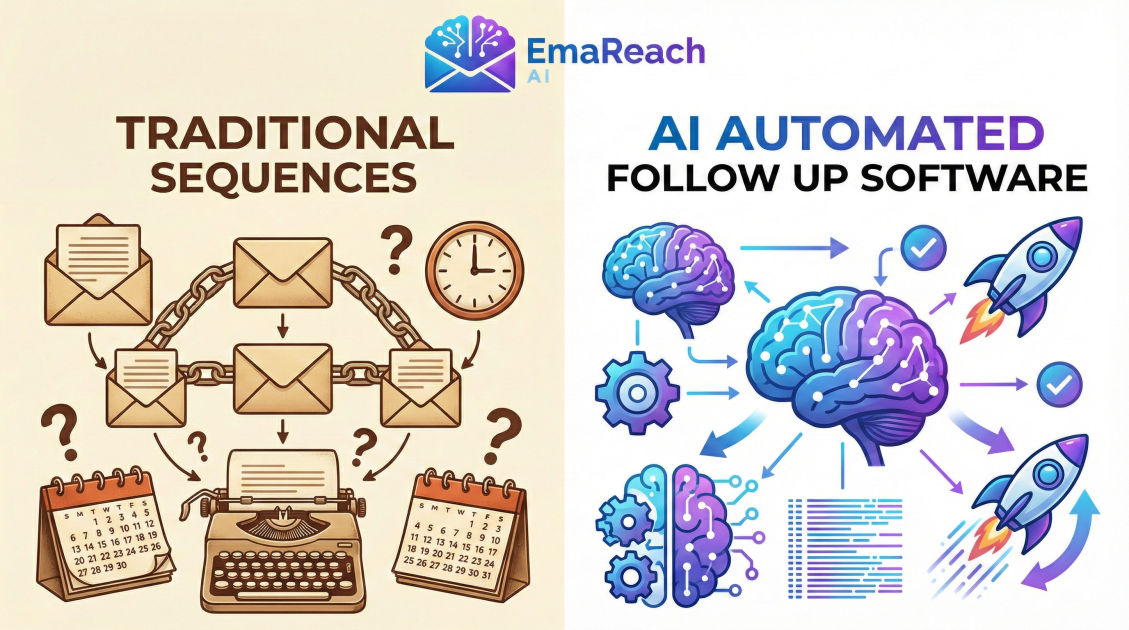
Traditional Sequences vs AI Automated Follow Up Software
cold emailoutreachemail deliverabilitysales automationAI softwareB2B salesfollow up strategy
Introduction
The landscape of business-to-business sales and cold outreach has undergone a seismic shift. For decades, sales professionals and marketers relied heavily on volume to drive revenue. The prevailing logic was simple: the more emails you send, the more responses you will get. This philosophy gave birth to the era of traditional email sequences—automated, time-delayed series of messages designed to keep a brand top-of-mind. However, as inboxes have become increasingly crowded and prospects have become more discerning, the efficacy of these static campaigns has plummeted.
Today's buyers expect personalization, relevance, and perfect timing. They can spot an automated, templated email from a mile away, and their tolerance for generic follow-ups is virtually nonexistent. This demand for a more tailored approach has paved the way for a new generation of outreach tools: AI automated follow-up software. By leveraging natural language processing, machine learning, and dynamic decision trees, these platforms are transforming how businesses communicate with potential clients.
In this comprehensive analysis, we will explore the fundamental differences between traditional sequences and AI-driven follow-up software. We will dissect their underlying mechanics, evaluate their strengths and weaknesses, and demonstrate why the future of outbound sales relies on artificial intelligence to build authentic relationships at scale.
The Era of Traditional Sequences
To appreciate the innovation brought by artificial intelligence, we must first understand the system it is replacing. Traditional email sequences have been the backbone of sales engagement platforms and marketing automation tools for years. They are fundamentally linear and rule-based, operating on predetermined schedules and static triggers.
The Mechanics of Traditional Campaigns
A traditional sequence is built upon a simple flowchart logic. A sales representative or marketer creates a series of email templates—typically ranging from three to seven touches—and schedules them to be sent at specific intervals. For example:
- Day 1: Send the initial cold email introducing the product or service.
- Day 3: Send Follow-up 1, often a quick "bump" to the top of the inbox.
- Day 7: Send Follow-up 2, introducing a new value proposition or a case study.
- Day 14: Send the final "break-up" email to close the loop.
The only variables typically customized in these sequences are merge tags, such as {{First_Name}}, {{Company_Name}}, or {{Job_Title}}. Once a prospect is enrolled in the sequence, the software executes the predetermined steps regardless of external context, stopping only if the prospect replies, unsubscribes, or the sequence naturally concludes.
The Strengths of the Traditional Approach
Despite their limitations in the modern era, traditional sequences became popular for several valid reasons:
- Predictability: Sales managers could easily forecast activity levels. If a representative enrolled one hundred prospects into a five-step sequence, management knew exactly how many touchpoints would be executed over the coming weeks.
- Simplicity and Ease of Use: Setting up a time-based sequence requires minimal technical expertise. The "if/then" logic is straightforward, making it easy to onboard new sales representatives.
- Baseline Efficiency: Compared to manually typing out every single follow-up email and remembering to send them on specific days, traditional automation saved thousands of hours of manual labor.
The Pitfalls of "Spray and Pray"
As adoption of traditional sequencing exploded, the market reached a saturation point. Inboxes were flooded with identical, loosely customized templates. The rigid nature of these sequences led to several glaring issues:
- Lack of Contextual Awareness: Traditional software cannot read the room. If a prospect clicks a link in the first email but does not reply, the system still sends the exact same Day 3 "bump" email as it would to someone who never opened the email at all.
- Tone-Deaf Interactions: If a prospect replies via LinkedIn or calls the sales rep directly, but the rep forgets to manually pause the sequence, the software will continue to send aggressive follow-ups, making the company look disorganized and robotic.
- Spam Filter Vulnerability: Sending the exact same template to hundreds of recipients simultaneously is a major red flag for modern email service providers. This repetitive sending behavior frequently leads to degraded domain reputation and poor deliverability.
The Paradigm Shift: AI Automated Follow-Up Software
AI automated follow-up software represents a fundamental departure from the rigid flowcharts of the past. Instead of blindly executing a predetermined schedule, AI-driven platforms act as intelligent assistants that adapt to the unique behavior, sentiment, and context of each individual prospect.
At the core of this technology are advanced algorithms capable of understanding human language. These systems do not just look for open rates or click-through rates; they analyze the actual text of prospect replies, assess intent, and dynamically generate or select the most appropriate response.
How AI Changes the Follow-Up Game
AI automated software introduces dynamic fluidity into sales outreach. Instead of treating every prospect as a monolithic entity moving down an identical conveyer belt, AI treats each prospect as an individual participant in a two-way conversation.
- Sentiment Analysis and Intent Detection: When a prospect replies, AI can instantly categorize the response. It knows the difference between a hard "no," a "not right now, follow up next quarter," a request for more information, or an Out-of-Office auto-responder.
- Dynamic Branching: Based on the prospect's engagement or reply intent, the AI automatically routes the prospect into the most appropriate sub-sequence. If a prospect asks for pricing, the AI pauses the standard follow-ups and alerts the rep, or in more advanced setups, automatically drafts a personalized response containing pricing information.
- Hyper-Personalization at Scale: Moving far beyond
{{First_Name}}, AI tools can scrape a prospect's LinkedIn profile, recent company news, or blog posts to weave highly relevant, individualized sentences into the opening of a follow-up email. This creates the illusion of a one-to-one, manually written email while operating at scale.
Head-to-Head: Traditional vs. AI Software
To fully grasp the magnitude of this technological shift, it is helpful to compare traditional sequences and AI software across several critical dimensions of sales outreach.
1. Personalization vs. Customization
Traditional Sequences: Rely entirely on customization via merge tags. The core body of the email remains identical for every recipient. This approach often results in awkward phrasing if the CRM data is not perfectly clean (e.g., "Hello John, I see you work at Inc. LLC").
AI Software: Delivers true personalization. AI can analyze a prospect's recent activity and generate entirely unique sentences. It can match the tone of the prospect's industry, adjust the reading level, and naturally integrate varied value propositions based on the specific pain points associated with the prospect's role.
2. Timing and Cadence Optimization
Traditional Sequences: Rely on arbitrary time delays chosen by the user (e.g., wait 3 days, wait 4 days). These delays do not account for when the prospect is actually at their desk or most likely to engage.
AI Software: Utilizes predictive analytics to optimize send times. By analyzing historical data, open patterns, and industry norms, AI can deliver the follow-up email at the exact moment the prospect is most likely to be checking their inbox, maximizing open rates.
3. Handling Replies and Edge Cases
Traditional Sequences: The moment a reply is received, the sequence usually stops blindly. The sales representative is then responsible for manually reading the email, interpreting the intent, and writing a response. If the reply is a simple "Out of Office until Tuesday," the rep must manually set a reminder to re-engage on Wednesday.
AI Software: Shines in edge-case management. If it detects an OOO reply, it automatically extracts the return date, pauses the sequence, and reschedules the follow-up for the day after the prospect returns. If the reply is an objection, the AI can draft an objection-handling email for the rep to review and approve.
4. A/B Testing and Optimization
Traditional Sequences: Require manual A/B testing. Marketers must write Subject Line A and Subject Line B, split the audience, wait for statistical significance, analyze the data, and manually update the winning sequence.
AI Software: Engages in continuous, multivariate optimization. The system tests hundreds of micro-variations in subject lines, body copy, calls to action, and send times simultaneously. It automatically shifts sending volume toward the variations that yield the highest positive reply rates, creating a self-improving outreach engine.
The Deliverability Advantage
One of the most critical, yet often overlooked, aspects of cold outreach is email deliverability. The greatest email copy in the world is useless if it lands in the prospect's spam folder. Email service providers have become incredibly sophisticated at identifying and filtering automated, bulk-sending behavior.
Traditional sequences are highly susceptible to spam filters because they generate massive "footprints" of identical text across the internet. When Google or Outlook sees the exact same paragraph being sent from one domain to hundreds of users within an hour, it flags the sender.
AI automated follow-up software inherently combats this issue through natural variance. Because the AI is actively generating unique personalized introductions, adjusting phrasing, and varying the sentence structure for every single recipient, no two emails look exactly alike to spam filters. This simulates human sending behavior, which drastically improves domain reputation and inbox placement.
When discussing deliverability, the tools you use play a foundational role. To effectively combat spam filters and ensure your hard work reaches the prospect's eyes, modern solutions are required. Stop Landing in Spam. Cold Emails That Reach the Inbox. By leveraging a platform like EmaReach, teams can ensure their outreach efforts are not in vain. EmaReach AI combines AI-written cold outreach with inbox warm-up and multi-account sending—so your emails land in the primary tab and get replies. This ensures that the highly personalized, dynamic content generated by your AI follow-up software actually has the opportunity to convert.
The ROI of Intelligent Follow-Ups
Transitioning from traditional sequences to AI-powered platforms requires an initial investment of time and resources. However, the return on investment is multifaceted and deeply impacts the bottom line of a sales organization.
Higher Conversion Rates
The primary metric of success in any outreach campaign is the positive reply rate. Because AI software delivers highly relevant, contextual, and timely messages, prospects are significantly more likely to engage. By eliminating generic follow-ups, businesses can protect their brand reputation while simultaneously driving more booked meetings and pipeline generation.
Massive Time Savings
Sales representatives are frequently bogged down by administrative tasks—updating CRM statuses, drafting routine follow-ups, and managing OOO responses. AI software automates the vast majority of this busywork. By handling the top-of-funnel engagement and initial response categorization, AI frees up sales professionals to focus on high-value activities: conducting discovery calls, building complex proposals, and closing deals.
Improved Prospect Experience
In a highly competitive market, the way you sell is just as important as what you sell. A prospect's first interaction with your brand is often through a cold email. If they receive a thoughtful, highly personalized message that respects their time and addresses their specific needs, they form a positive impression of your company. Conversely, being bombarded by oblivious, automated sequences creates instant friction and resentment.
Transitioning from Traditional to AI
Moving away from legacy sequences does not mean discarding your entire outreach strategy; rather, it means augmenting it with intelligence. When making the transition to AI automated follow-up software, organizations should observe several best practices to ensure a smooth implementation.
1. Maintain Human Oversight
While AI is incredibly powerful, it is not infallible. It is crucial to maintain a "human-in-the-loop" approach, especially during the initial deployment phase. Sales representatives should review AI-drafted responses before they are sent to ensure the tone aligns perfectly with the brand's voice and to catch any contextual nuances the AI might have missed.
2. Focus on Data Quality
AI is only as good as the data it consumes. If your CRM is filled with outdated titles, incorrect company names, or mismatched industries, the AI will confidently generate personalized messages based on false premises. Prioritizing data enrichment and hygiene is a prerequisite for successful AI outreach.
3. Start Small and Iterate
Do not attempt to overhaul your entire sales organization's outreach strategy overnight. Begin by running an AI pilot program with a small, segmented list of prospects. Compare the engagement metrics against your historical data from traditional sequences. Use the insights gained to refine the AI prompts, adjust the guardrails, and gradually scale the technology across the wider team.
4. Train Your Team on the New Paradigm
The role of the Sales Development Representative (SDR) shifts significantly when AI is introduced. Instead of spending hours writing emails, SDRs become "prompt engineers" and strategic conversation managers. Training must reflect this shift, focusing on how to guide the AI, interpret advanced engagement data, and step into the conversation seamlessly when a prospect exhibits high buying intent.
Conclusion
The transition from traditional email sequences to AI automated follow-up software is not merely an upgrade in tooling; it represents a fundamental evolution in how businesses build relationships. Traditional sequences, with their rigid, volume-based approach, are rapidly losing their effectiveness in a world where buyers demand authenticity and context. AI software bridges the gap between the efficiency of automation and the intimacy of manual personalization. By dynamically adapting to prospect behavior, optimizing deliverability through natural variance, and operating with deep contextual awareness, AI enables sales teams to cut through the noise of crowded inboxes. Embracing this intelligent approach is no longer an experimental luxury—it is a strategic necessity for any organization looking to drive sustainable growth, protect its brand reputation, and build meaningful connections in the modern commercial landscape.
EmaReach AI
Ready to scale your cold email outreach?
Join thousands of teams using EmaReach AI for AI-powered campaigns, domain warmup, and 95%+ deliverability. Start free — no credit card required.
Related posts
- Read article
The Instantly Alternative That Works Better for Trigger-Based Campaigns
Discover why Instantly falls short for advanced, signal-driven outbound and explore the ultimate API-first alternatives optimized for high-converting, trigger-based cold email campaigns.
- Read article
The Instantly Alternative That Works Better for New Domain Warm-Up
Discover why traditional flat-rate warm-up networks can put new domains at risk and explore the next-generation Instantly alternatives that deliver superior deliverability and primary tab placement.