Blog
Back to blog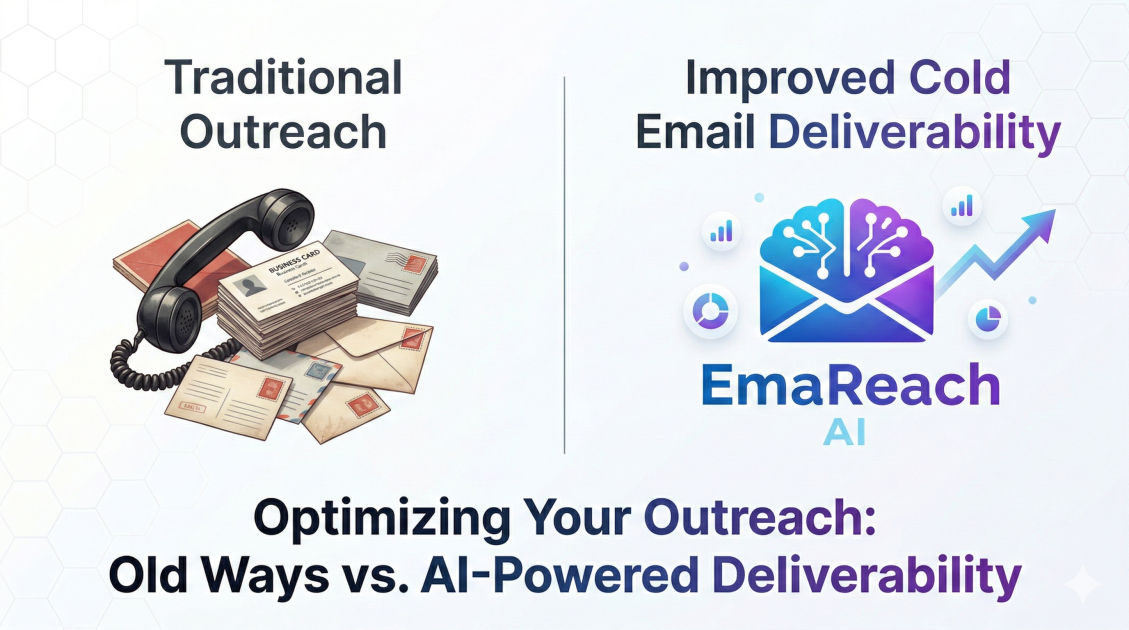
Traditional Outreach vs Improving Cold Email Deliverability
cold emailoutreach strategyemail deliverabilitydigital marketingdomain reputationlead generationspam filters
Introduction: The Changing Landscape of Digital Outreach
For decades, the concept of outreach was synonymous with volume. In the early days of digital marketing, success was often viewed as a numbers game: the more messages you sent, the higher your chances of landing a deal. This "spray and pray" methodology defined traditional outreach. However, as communication platforms have evolved and spam filters have become increasingly sophisticated, the landscape has shifted.
Today, the focus has moved from the sheer quantity of messages to the technical integrity of the delivery path. The modern marketer understands that even the most compelling sales copy is worthless if it never reaches the recipient's primary inbox. This article explores the fundamental differences between traditional outreach methods and the modern necessity of improving cold email deliverability, providing a roadmap for navigating the complexities of the current email ecosystem.
Understanding Traditional Outreach
Traditional outreach is rooted in the philosophy of direct communication. Historically, this included cold calling, direct mail, and early-stage cold emailing. The primary characteristic of these methods was a focus on the message and the volume of recipients rather than the technical infrastructure supporting the communication.
The Volume-First Mentality
In traditional outreach, marketers often measured success by how many leads they could contact in a single day. Databases were purchased or scraped, and generalized messages were sent to thousands of prospects simultaneously. Because email service providers (ESPs) had less stringent filtering mechanisms in the past, a significant portion of these emails would still reach the inbox, even if they were unsolicited.
Static Messaging and Lack of Personalization
Because the goal was scale, personalization was often limited to "First Name" tags. The content was static, focusing heavily on the features of a product or service rather than the specific pain points of the prospect. This lack of relevance eventually led to the decline of traditional outreach effectiveness as users became fatigued by irrelevant noise in their inboxes.
The Legal and Ethical Shift
Traditional outreach often operated in a gray area regarding data privacy. With the introduction of global privacy regulations, the old ways of acquiring and using data became not only ineffective but legally risky. This necessitated a transition toward more transparent, permission-based, or highly targeted cold outreach strategies.
The Evolution of Cold Email Deliverability
As spam filters evolved into complex AI-driven gatekeepers, the focus of outreach shifted toward deliverability. Deliverability is the science of ensuring your email actually lands in the prospect's inbox rather than the spam folder or the dreaded 'Promotions' tab.
What is Email Deliverability?
Deliverability is distinct from delivery. An email is "delivered" if the receiving server accepts it. However, it is only "deliverable" in the context of successful outreach if it is placed where the user will see it. Factors influencing this include sender reputation, technical authentication, and engagement rates.
The Technical Pillars of Deliverability
To move away from the pitfalls of traditional outreach, modern senders must master several technical configurations:
- SPF (Sender Policy Framework): A DNS record that specifies which mail servers are authorized to send email on behalf of your domain.
- DKIM (DomainKeys Identified Mail): An encryption method used to verify that an email was indeed authorized by the owner of that domain.
- DMARC (Domain-based Message Authentication, Reporting, and Conformance): A protocol that uses SPF and DKIM to tell receiving servers how to handle emails that fail authentication.
Traditional Outreach Pitfalls in the Modern Era
Continuing to use traditional, high-volume outreach methods without regard for deliverability leads to several catastrophic outcomes for a business domain.
Domain Blacklisting
When users mark unsolicited, unpersonalized emails as spam, ESPs like Gmail and Outlook take notice. If your spam complaint rate exceeds a tiny fraction (often as low as 0.1%), your entire domain can be blacklisted. Once blacklisted, even your internal operational emails may stop reaching their destinations.
Reduced ROI
Traditional outreach requires significant human capital or expensive lists. When 80% of those messages end up in spam, the cost per acquisition skyrockets. In contrast, a deliverability-focused approach ensures that every dollar spent on lead generation has a higher probability of yielding a view and a response.
Brand Reputation Damage
First impressions are everything. If a prospect's first interaction with your brand is a filtered spam message or a generic, poorly formatted email, your brand is immediately perceived as low-quality. Modern outreach values the brand’s integrity as much as the conversion rate.
Strategies for Improving Cold Email Deliverability
To bridge the gap between traditional methods and modern success, businesses must implement a deliverability-first strategy. This involves a combination of technical setup, list hygiene, and behavioral patterns.
1. Domain Warm-up
In traditional outreach, marketers would often buy a new domain and immediately send 1,000 emails. Today, that is a shortcut to the spam folder. A new domain must be "warmed up" by gradually increasing the volume of sent mail while ensuring those emails receive engagement (opens and replies).
For those looking to automate this complex process, EmaReach offers a comprehensive solution. By combining AI-written cold outreach with automated inbox warm-up and multi-account sending, EmaReach ensures your emails land in the primary tab and get replies, effectively bypassing the limitations of traditional, manual outreach.
2. Infrastructure Diversification
Instead of sending all outreach from a single corporate domain, modern experts use secondary domains. This protects the primary business domain from potential reputation damage. Furthermore, using multi-account sending allows a high total volume of outreach to be spread across dozens of accounts, keeping the per-account volume low and "human-like."
3. List Hygiene and Verification
A cornerstone of deliverability is low bounce rates. Traditional outreach often ignored the quality of the list. Modern outreach requires rigorous email verification to remove "catch-all" addresses, inactive accounts, and spam traps before the first email is ever sent.
The Role of Content in Deliverability
Spam filters don't just look at technical records; they analyze the content of your message. This is where the "art" of modern outreach meets the "science" of deliverability.
Avoiding Spam Triggers
Certain words and formatting choices act as red flags. Excessive use of "Free," "Guarantee," "Act Now," or multiple exclamation points can trigger filters. Traditional outreach was notorious for using high-pressure sales language, which modern filters are specifically designed to catch.
Personalization at Scale
True personalization goes beyond the recipient's name. It involves mentioning a recent company milestone, a specific pain point relevant to their industry, or a shared connection. High engagement (replies) is the strongest signal to an ESP that your emails are wanted, which in turn boosts your future deliverability.
The Importance of Plain Text
While traditional marketing emails often used heavy HTML and image-based designs, cold outreach performs better in plain text. It looks more like a 1-to-1 personal email, which is exactly what ESPs want to see in the primary inbox.
Comparing Metrics: Success in Both Worlds
How we measure success has changed. In traditional outreach, the "Open Rate" was the king of metrics. However, in the modern landscape, open rates can be skewed by bot activity and privacy protections.
| Metric | Traditional Outreach Focus | Deliverability-First Focus |
|---|---|---|
| Primary Goal | Total Volume / Reach | Inbox Placement / Reply Rate |
| Key Metric | Sent Count | Positive Reply Rate |
| Health Indicator | List Size | Domain Reputation Score |
| Technical Priority | Email Template Design | SPF/DKIM/DMARC Setup |
| Feedback Loop | Unsubscribe Rate | Spam Complaint Rate |
Moving from Quantity to Quality: A Step-by-Step Transition
If your organization is still leaning on traditional outreach methods, the transition to a deliverability-focused model should happen in phases.
Phase 1: The Audit
Audit your current domain health. Use tools to check if your domain appears on any blacklists and verify that your technical records (SPF, DKIM) are correctly configured. Analyze your historical bounce rates and spam complaint data.
Phase 2: Set Up Secondary Infrastructure
Register 2-3 new domains that are variations of your primary brand. Set up professional email accounts on these domains and begin a slow warm-up process. This ensures that even if you make mistakes during the learning curve, your main business operations remain unaffected.
Phase 3: Implement AI and Automation
Modern outreach is too complex to manage manually at scale. Utilizing platforms that handle the rotation of accounts, the warming of domains, and the intelligent writing of personalized content is essential. This is where the synergy between human strategy and AI execution becomes a competitive advantage.
The Psychology of the Inbox
Understanding deliverability also requires understanding the psychology of the recipient. Traditional outreach felt like an intrusion. Modern outreach should feel like a timely solution to a problem. When an email is highly relevant and lands in the primary inbox, the recipient doesn't see it as spam; they see it as a professional inquiry.
This shift in perspective is what separates the modern growth hacker from the traditional telemarketer. By prioritizing the technical health of your sending environment, you are essentially buying the right to have a conversation with your prospect.
Future-Proofing Your Outreach
Email providers are in a constant arms race with spammers. What works today in terms of deliverability might be outdated tomorrow. However, the core principles remain constant:
- Be Authentic: Send messages that provide real value.
- Be Technical: Stay on top of authentication standards.
- Be Human: Avoid sending patterns that look like a machine.
By focusing on deliverability over raw volume, you ensure that your outreach remains a viable channel for years to come. The era of "blasting" is over; the era of "precision delivery" has arrived.
Conclusion
The debate between traditional outreach and improving cold email deliverability isn't really a choice—it's an evolution. While the fundamental goal of reaching new customers remains the same, the methods required to achieve that goal have fundamentally changed. Traditional outreach relied on a world with fewer filters and less noise. In our current digital environment, deliverability is the gatekeeper of success. By investing in technical infrastructure, maintaining domain reputation, and prioritizing high-quality, personalized content, businesses can move beyond the spam folder and into meaningful conversations with their target audience. The transition may require more effort upfront, but the long-term rewards of consistent inbox placement and higher reply rates are well worth the investment.
EmaReach AI
Ready to scale your cold email outreach?
Join thousands of teams using EmaReach AI for AI-powered campaigns, domain warmup, and 95%+ deliverability. Start free — no credit card required.
Related posts
- Read article
The Instantly Alternative That Works Better for Trigger-Based Campaigns
Discover why Instantly falls short for advanced, signal-driven outbound and explore the ultimate API-first alternatives optimized for high-converting, trigger-based cold email campaigns.
- Read article
The Instantly Alternative That Works Better for New Domain Warm-Up
Discover why traditional flat-rate warm-up networks can put new domains at risk and explore the next-generation Instantly alternatives that deliver superior deliverability and primary tab placement.