Blog
Back to blog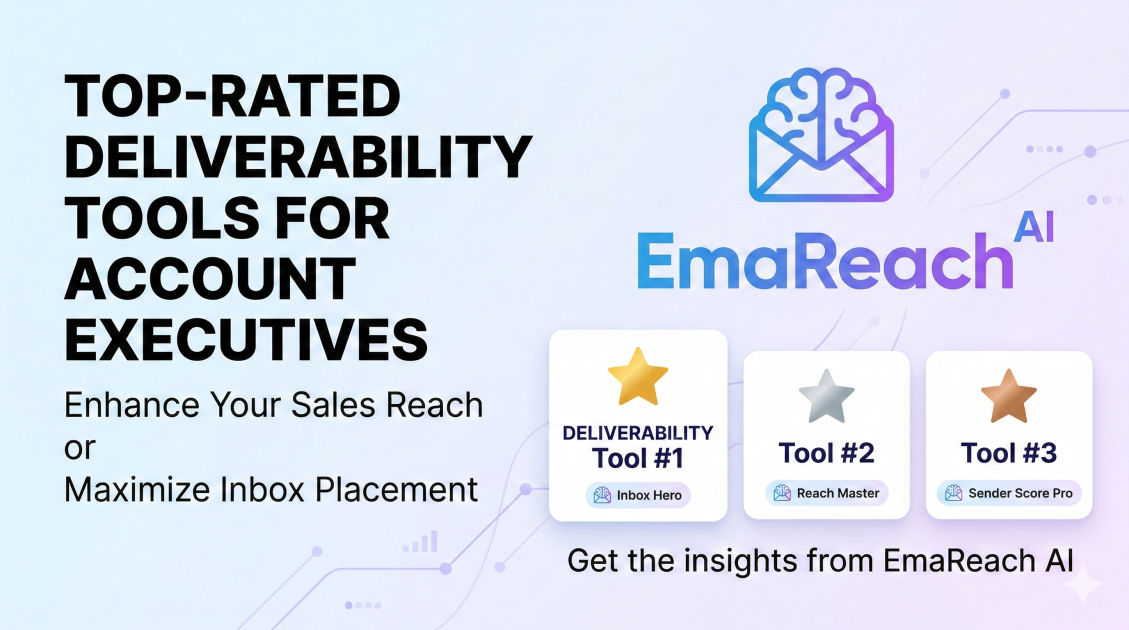
Top-Rated Deliverability Tools for Account Executives
email deliverabilityaccount executivesales toolscold outreachlead generationsales productivityinbox placement
Introduction: Why Deliverability is the Account Executive’s Secret Weapon
For an Account Executive (AE), the path to a closed deal begins long before the first demo or discovery call. It starts in the recipient's inbox. In the modern sales landscape, where digital noise is at an all-time high, the biggest hurdle to hitting quota isn't just a bad pitch—it's never being seen in the first place. This is where email deliverability comes into play.
Deliverability is the science and art of ensuring your emails reach the primary inbox rather than being filtered into the spam folder or blocked by Internet Service Providers (ISPs). For AEs, who rely heavily on outbound prospecting to build their pipelines, high deliverability is the foundation of every successful sales cycle. Without it, even the most personalized, value-driven message is wasted.
To navigate the increasingly complex filters of Gmail, Outlook, and corporate firewalls, top-performing AEs use a suite of specialized tools. These tools automate the technical heavy lifting, allowing sales professionals to focus on what they do best: building relationships and closing deals. In this guide, we explore the top-rated deliverability tools and strategies that help Account Executives stay ahead of the curve.
The Pillars of Email Deliverability for Sales
Before diving into the specific tools, it is crucial to understand the technical components that determine whether your email lives or dies. AEs don't need to be IT experts, but understanding these three pillars is essential for managing their outreach effectively:
- Sender Reputation: Think of this as your credit score for email. ISPs track your sending behavior. If you send too many emails that get marked as spam or bounce back, your reputation drops, and your future emails are more likely to be blocked.
- Authentication: These are technical protocols (SPF, DKIM, and DMARC) that prove to the receiving server that you are who you say you are. Without these, your emails look like phishing attempts.
- Content and Engagement: Modern filters look at how recipients interact with your mail. High open rates and reply rates signal that your content is valuable, while heavy use of "spammy" keywords or broken links triggers red flags.
Top-Rated Deliverability and Warm-up Tools
1. EmaReach: The All-in-One Growth Engine
When it comes to scaling outreach without sacrificing safety, EmaReach stands out as a premier solution for Account Executives. It is designed with a simple but powerful mantra: "Stop Landing in Spam. Cold Emails That Reach the Inbox."
EmaReach AI addresses the two biggest pain points for AEs: writing effective copy and maintaining a healthy sender reputation. By combining AI-written cold outreach with automated inbox warm-up and multi-account sending, it ensures your emails land in the primary tab. For an AE, this means more eyes on the message and, ultimately, more replies. The tool manages the technical complexity of rotating accounts and warming up domains behind the scenes, so the sales professional can focus on the incoming leads.
2. GlockApps: Deep-Dive Inbox Testing
Before an AE sends out a massive sequence to a fresh list of prospects, they need to know how those emails will be treated. GlockApps is a favorite for deep-dive testing. It provides a "seed list" of email addresses across different providers. When you send a test email to this list, GlockApps generates a report showing exactly where your email landed—Inbox, Promotions, or Spam—across Gmail, Outlook, and various corporate filters.
It also identifies specific issues, such as whether your IP address is on a blacklist or if your HTML code is poorly formatted. For AEs, this data is actionable intelligence that prevents them from wasting a high-value prospect list on a compromised domain.
3. Mail-Tester: Quick Technical Audits
Sometimes, you just need a quick check to ensure your technical setup is sound. Mail-Tester is a simple, web-based tool where you send an email to a unique, temporary address, and it gives you a score out of ten. It checks your SPF and DKIM records, looks for spammy keywords in your text, and verifies that your images have alt-text. It’s an excellent "pre-flight check" for AEs before launching a new campaign.
Managing Domain Health and Infrastructure
High-performing AEs often work with marketing and RevOps to set up secondary domains for outbound sales. This protects the primary corporate domain from potential reputation damage. Managing these secondary domains requires specific tools to monitor health.
Google Postmaster Tools
For any AE sending to Gmail or Google Workspace users, Google Postmaster Tools is non-negotiable. It provides direct data from Google regarding your spam rate, domain reputation, and encryption errors. This is the closest an AE can get to seeing their "sender score" through the eyes of the world’s largest email provider. Monitoring the "Spam Rate" dashboard ensures that you stay below the critical threshold that triggers a permanent block.
MXToolbox
MXToolbox is the Swiss Army knife of domain health. It allows AEs or their technical teams to monitor blacklists in real-time. If a domain suddenly starts underperforming, MXToolbox can reveal if that domain has been flagged by a major security provider. It also provides tools to verify that DMARC policies are correctly implemented, which is increasingly becoming a requirement for reaching corporate inboxes.
Data Verification: The Foundation of Low Bounce Rates
A high bounce rate (the percentage of emails sent to addresses that don't exist) is one of the fastest ways to destroy an AE’s deliverability. If an ISP sees you hitting "dead" addresses, they assume you are using a low-quality, scraped list and will demote your reputation. Reliable data verification tools are essential.
NeverBounce and ZeroBounce
These platforms are industry leaders for a reason. They integrate directly into CRM systems like Salesforce or HubSpot. Before an AE starts a sequence, these tools ping the recipient's server to verify the address exists without actually sending an email. They categorize addresses as "Valid," "Invalid," or "Catch-all," allowing the AE to prune their list and keep their bounce rate well below the industry-standard 2% limit.
Hunter.io
Hunter is more than just an email finder; its verification tool is robust for AEs who are doing manual prospecting. It provides a confidence score for found addresses, helping AEs decide whether to take the risk on a specific contact or look for a more verified entry point into an account.
The Role of Content Optimization in Deliverability
Deliverability isn't just about technical settings; it's also about the words on the page. AI is increasingly being used to ensure that content doesn't trigger "content-based" spam filters.
Hemingway and Grammarly
While these are often viewed as writing aids, they serve a deliverability purpose for AEs. Sophisticated spam filters look for poor grammar, excessive capitalization, and "shouty" punctuation (like multiple exclamation marks). Using these tools to keep your writing professional and concise makes your emails look less like a broadcast blast and more like a professional 1-to-1 communication.
Spam Word Checkers
Many sales engagement platforms now include built-in spam word checkers. These tools highlight words like "Free," "Guarantee," "Act Now," or "Winner" that frequently appear in junk mail. AEs should aim for a natural, conversational tone that avoids these high-pressure triggers, ensuring the message feels like a genuine outreach rather than a generic advertisement.
Advanced Strategies: Inbox Warm-up and Volume Management
One of the biggest mistakes an AE can make is "going from zero to sixty" on a new email account. If you start sending 100 emails a day from a brand-new address, ISPs will flag it as suspicious. This is where automated warm-up tools become vital.
The Importance of Warm-up
Automated warm-up tools involve a network of real email accounts that interact with your inbox. They send, receive, and move your emails out of the spam folder, signaling to ISPs that your account is trustworthy. This builds "positive engagement history." Many modern deliverability platforms, including EmaReach, integrate this directly into their workflow, making it a passive benefit for the user.
Multi-Account Sending (The "Inbox Rotation" Strategy)
Instead of sending 200 emails from one account, savvy AEs use tools to send 40 emails from five different accounts. This distributes the volume and reduces the risk associated with any single sender address. If one account runs into issues, the others remain healthy, ensuring the pipeline never fully dries up.
Best Practices for Account Executives to Maintain High Deliverability
Tools are only as effective as the strategy behind them. To maximize the ROI of these deliverability tools, AEs should follow these evergreen best practices:
- Personalize Beyond the First Name: Use snippets that prove you’ve researched the prospect’s company or recent milestones. High engagement (replies) is the strongest signal of high deliverability.
- Monitor Your Metrics Daily: Don't just look at open rates; look at reply rates and bounce rates. A sudden drop in opens across an entire domain is a red flag that you’ve been "shadowbanned" or moved to the Promotions tab.
- Provide a Clear Opt-out: Making it hard to unsubscribe only encourages prospects to hit the "Report Spam" button, which is far more damaging to your reputation than a simple unsubscribe.
- Clean Your Lists Regularly: Don't keep emailing people who haven't opened your last five messages. Removing unengaged prospects improves your overall engagement rate and protects your domain.
Conclusion: Turning Deliverability into a Competitive Advantage
In an era where every prospect's inbox is a battlefield, deliverability is no longer just a technical concern for IT—it is a core sales competency. For the modern Account Executive, the ability to reach the primary inbox is the difference between hitting a record-breaking quarter and struggling to book a single meeting.
By leveraging top-rated tools like EmaReach for AI-driven outreach and warm-up, GlockApps for testing, and NeverBounce for data integrity, AEs can build a robust, high-performance outbound engine. These technologies provide the visibility and protection needed to scale outreach safely and effectively. Ultimately, when your emails consistently reach the inbox, you stop fighting the filters and start building the relationships that drive revenue growth. Master your tools, protect your reputation, and let your messages be heard.
EmaReach AI
Ready to scale your cold email outreach?
Join thousands of teams using EmaReach AI for AI-powered campaigns, domain warmup, and 95%+ deliverability. Start free — no credit card required.
Related posts
- Read article
How Choosing the Right Instantly Alternative Changed Our Pipeline Numbers
Discover how transitioning from a volume-first cold email setup to an advanced, deliverability-focused infrastructure transformed our B2B pipeline metrics, skyrocketed open rates to over 68%, and tripled our monthly booked demos.
- Read article
The Instantly Alternative That Impressed Even the Biggest Instantly Fans
Discover why top outbound growth marketers and lead generation agencies are migrating from legacy cold email platforms to advanced alternatives built for superior deliverability, white-label client management, and robust API workflows.