Blog
Back to blog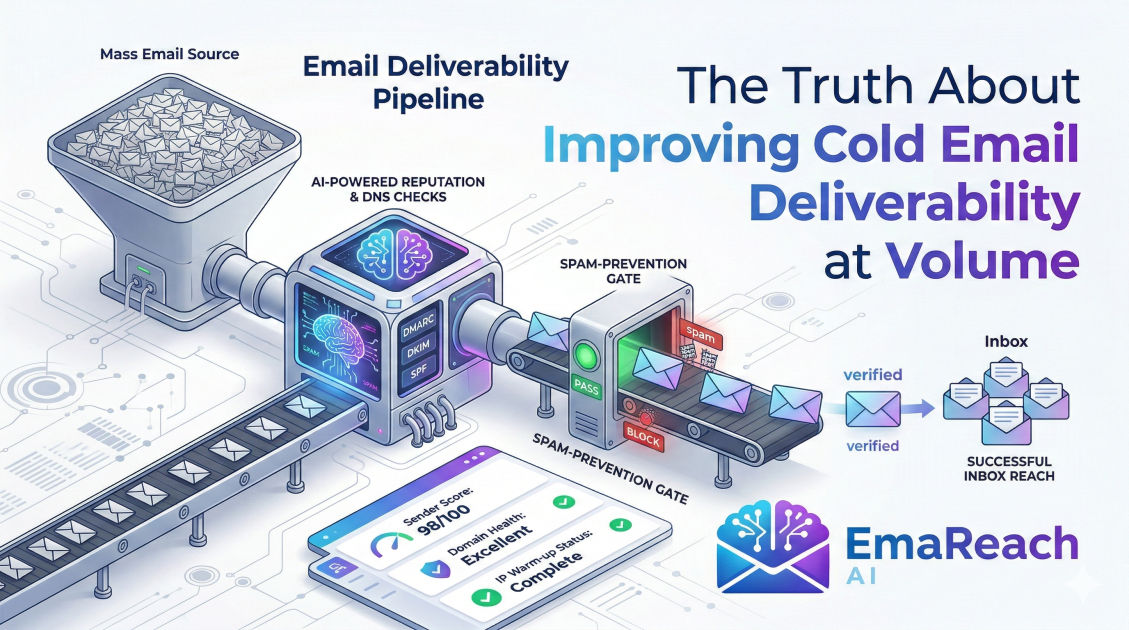
The Truth About Improving Cold Email Deliverability at Volume
cold emailemail deliverabilitysales outreachlead generationemail marketinginbox placement
The Hidden Infrastructure of High-Volume Outreach
In the world of outbound sales, there is a pervasive myth that sending more emails naturally leads to more leads. While math suggests that higher volume should equal higher output, the reality of modern email ecosystems is far more complex. When you scale from 50 emails a day to 5,000, you aren't just doing more of the same thing; you are entering an entirely different technical landscape governed by sophisticated filters, reputation algorithms, and strict behavioral protocols.
Cold email deliverability at volume is not about luck. It is about engineering a system that mimics human behavior while satisfying the rigorous security requirements of major Internet Service Providers (ISPs) like Google and Microsoft. To succeed, you must move beyond basic templates and focus on the underlying mechanics: technical setup, domain diversification, content uniqueness, and engagement signals.
The Technical Foundation: Beyond the Basics
Before a single word of your copy is read, the receiving server performs a series of checks to verify your identity. At low volumes, minor technical oversights might be overlooked. At high volumes, they are immediate grounds for a permanent block.
SPF, DKIM, and DMARC: The Holy Trinity
You cannot scale outreach without a perfect technical score.
- SPF (Sender Policy Framework): This is a DNS record that lists the specific IP addresses or services authorized to send emails on behalf of your domain. Without this, you look like a spoofed account.
- DKIM (DomainKeys Identified Mail): This adds a digital signature to your emails, ensuring that the content hasn't been tampered with during transit. It proves the email truly came from your server.
- DMARC (Domain-based Message Authentication, Reporting, and Conformance): This tells the receiving server what to do if SPF or DKIM fails. Setting this to 'p=quarantine' or 'p=reject' signals to ISPs that you take your domain security seriously.
The Move to Dedicated Subdomains and Multiple Domains
One of the most common mistakes in high-volume outreach is sending everything from a single primary company domain. If that domain gets flagged for spam, your entire company’s communication—including internal emails and messages to existing clients—will go to the spam folder.
To mitigate this risk, sophisticated players use a 'Horizontal Scaling' approach. Instead of sending 1,000 emails from one domain, they send 50 emails from 20 different domains. These domains should be variations of your main brand (e.g., getbrand.com, brandapp.io, brandlabs.com). This distributes the 'reputation risk' across multiple assets. If one domain's deliverability dips, the rest of your operation remains intact.
Solving the Volume Paradox: Inbox Warm-up
ISPs are suspicious of sudden spikes in activity. If a domain that has been dormant for months suddenly starts sending 300 emails an hour, it will be instantly throttled. This is where 'warm-up' becomes critical.
Warm-up is the process of gradually increasing your sending volume while simultaneously generating positive engagement signals (opens, replies, and marking emails as 'not spam'). This proves to the ISPs that you are a legitimate sender producing content that people actually want to read.
For those looking to automate this complex balance, EmaReach provides a comprehensive solution. EmaReach AI combines AI-written cold outreach with inbox warm-up and multi-account sending—so your emails land in the primary tab and get replies. By automating the gradual ramp-up and ensuring a healthy reply-to-send ratio, you protect your domains from being blacklisted during the scaling phase.
The Role of IP Reputation vs. Domain Reputation
In the past, deliverability was largely tied to the IP address of the sending server. Today, the focus has shifted heavily toward Domain Reputation. Google and Microsoft now track how users interact with your specific domain across the entire internet.
However, IP reputation still matters. If you are using a shared IP from a low-quality email service provider, the 'noisy neighbors' on that same IP—other spammers—can drag your deliverability down. When scaling, it is often better to use reputable third-party SMTP providers or workspace accounts (G Suite/Microsoft 365) which carry a higher inherent trust factor than a random private server.
Content Strategy: Beating the Hash Filters
Modern spam filters use 'fuzzy hashing' to identify repetitive content. If you send the exact same template to 10,000 people, the filters will quickly identify the pattern and flag it as a bulk broadcast. To maintain high deliverability, your content must be dynamic.
Dynamic Personalization
Simple tags like {{first_name}} are no longer enough. To truly bypass volume filters, you need deep personalization. This includes:
- Custom Sentences: Varying the opening line based on the prospect’s recent activity or industry.
- Spin Syntax: Using software to rotate synonyms and sentence structures (e.g., swapping "Hi" for "Hello" or "Hey").
- AI-Generated Variations: Using large language models to rewrite the body of the email for every recipient so that no two emails are identical in their 'hash' signature.
The Danger of 'Spammy' Elements
When sending at volume, small errors are magnified. Avoid the following to keep your 'spam score' low:
- Too Many Links: Try to use zero or one link in your initial outreach. Multiple links, especially to different domains, are a major red flag.
- Tracking Pixels: While open-tracking is useful, the invisible 1x1 pixel used to track opens can sometimes trigger filters. If your deliverability is struggling, try turning off open tracking.
- Heavy Formatting: HTML-heavy emails with various fonts, colors, and embedded images look like marketing newsletters. High-performing cold emails look like plain-text messages sent from one person to another.
Data Hygiene: The Silent Killer
High bounce rates are the fastest way to kill a domain's reputation. A 'hard bounce' occurs when you send an email to an address that does not exist. If your bounce rate exceeds 3%, ISPs start to view you as a 'spray and pray' spammer who doesn't know their audience.
Continuous Verification
You must verify every lead list immediately before sending. Email addresses go bad quickly—people change jobs, and companies fold. Use a multi-step verification process that checks:
- Syntax: Is the email formatted correctly?
- MX Records: Does the domain have a valid mail server?
- SMTP Handshake: Does the server confirm the mailbox exists without actually sending an email?
Managing the Opt-Out
While regulations like GDPR and CCPA require a way to opt-out, how you handle it affects deliverability. A formal 'Unsubscribe' link in the footer is often a signal to filters that the email is a marketing broadcast. Many high-volume senders prefer a 'text-based' opt-out, such as: "If you'd rather I didn't reach out, just let me know." This encourages a reply (a positive signal) rather than a click (a neutral or negative signal).
Monitoring and Maintenance: The Feedback Loop
Deliverability is not a "set it and forget it" task. It requires constant monitoring of key metrics across all your sending accounts.
The Metrics That Matter
- Inbox Placement Rate: This is different from the 'Delivered' rate. 'Delivered' just means the email didn't bounce; it doesn't tell you if it landed in the Inbox or the Spam folder.
- Reply Rate: This is the ultimate signal of relevance. A high reply rate tells ISPs that your content is valuable.
- Spam Complaint Rate: Even a handful of 'Mark as Spam' clicks can tank a domain. If this climbs above 0.1%, you need to stop sending and re-evaluate your targeting.
Tools for Monitoring
Use tools like Google Postmaster Tools to see how Google views your domain reputation. It provides a dashboard showing your spam complaint rate and whether your domain is considered 'Low,' 'Medium,' or 'High' reputation. If you see a dip, you must immediately lower your volume and increase the intensity of your warm-up activity to recover.
The Psychology of the Inbox: Why Relevance is Part of Deliverability
We often treat deliverability as a purely technical challenge, but it is deeply tied to human behavior. If your targeting is poor, people will report you as spam. If your offer is irrelevant, people will ignore you.
ISPs monitor 'dwell time' and 'deletion without opening.' If a large percentage of your recipients delete your email without even clicking on it, the ISP learns that your domain is producing low-value noise. Therefore, the best deliverability hack is simply to send better emails to fewer, more targeted people. Scaling 'relevance' is harder than scaling 'volume,' but it is the only way to sustain long-term success.
Transitioning to an Automated Ecosystem
Managing 50 domains, 100 sets of credentials, and thousands of daily variations manually is impossible for a standard sales team. This is why the industry has shifted toward unified outreach ecosystems.
By integrating the technical side (DNS and warm-up) with the creative side (AI-driven copywriting), platforms allow users to maintain the 'human touch' at a massive scale. The goal is to create a 'Primary Tab' experience for every recipient. When your infrastructure is sound and your content is indistinguishable from a manual email, the volume becomes an asset rather than a liability.
Summary of the High-Volume Deliverability Checklist
To recap the truth about scaling your outreach, ensure you are following this hierarchy of needs:
- Technical Integrity: Perfect SPF, DKIM, and DMARC on every domain.
- Infrastructure Scaling: Multiple secondary domains and accounts to spread the load.
- Active Warm-up: Constant positive engagement signals to balance out the cold outreach.
- Content Fluidity: Using AI and spin syntax to ensure no two 'hashes' are the same.
- Data Purity: Zero-tolerance policy for unverified emails and high bounce rates.
- Reputation Monitoring: Regular checks of Postmaster tools and inbox placement tests.
Conclusion
The truth about cold email deliverability at volume is that it is an ongoing battle between your infrastructure and the ever-evolving algorithms of the world's largest tech companies. There are no shortcuts. To maintain a presence in the primary inbox, you must commit to a high standard of technical excellence and data hygiene.
By treating your sending domains as valuable assets and focusing on high-engagement signals, you can break through the noise. Whether you are a solo founder or a large sales organization, the principles remain the same: distribute your risk, verify your data, and never sacrifice relevance for the sake of scale. When these elements align, volume becomes a predictable engine for growth rather than a fast track to the spam folder.
EmaReach AI
Ready to scale your cold email outreach?
Join thousands of teams using EmaReach AI for AI-powered campaigns, domain warmup, and 95%+ deliverability. Start free — no credit card required.
Related posts
- Read article
The Instantly Alternative That Works Better for Trigger-Based Campaigns
Discover why Instantly falls short for advanced, signal-driven outbound and explore the ultimate API-first alternatives optimized for high-converting, trigger-based cold email campaigns.
- Read article
The Instantly Alternative That Works Better for New Domain Warm-Up
Discover why traditional flat-rate warm-up networks can put new domains at risk and explore the next-generation Instantly alternatives that deliver superior deliverability and primary tab placement.