Blog
Back to blog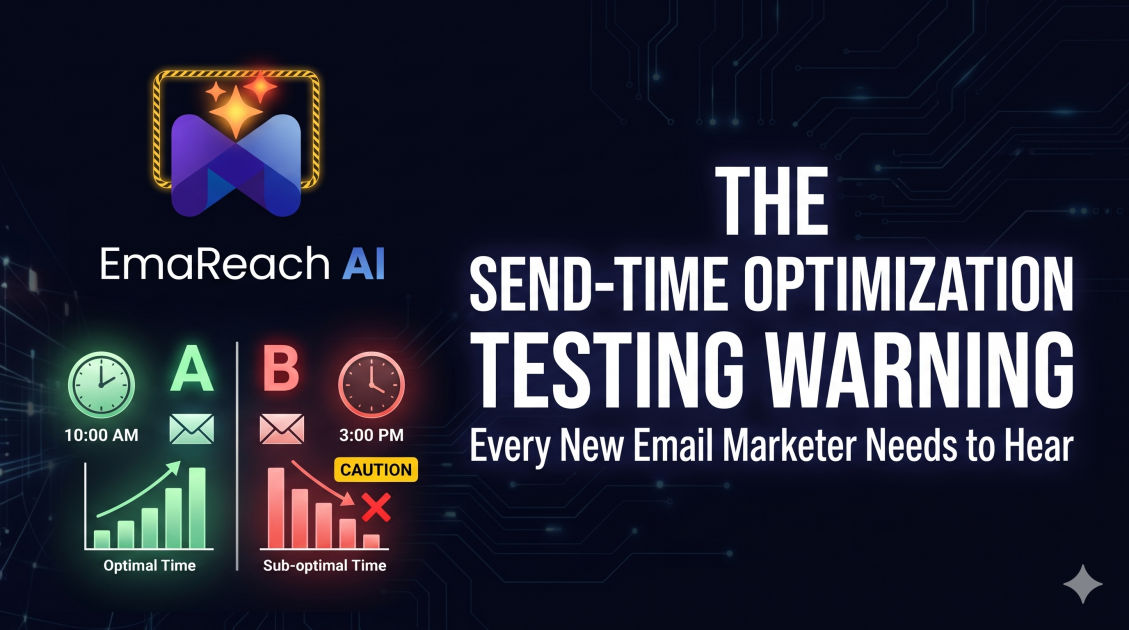
The Send-Time Optimization Testing Warning Every New Email Marketer Needs to Hear
email marketingsend-time optimizationemail deliverabilitymarketing automationA/B testingcold outreach
Introduction
Entering the world of email marketing is an exciting venture filled with data points, behavioral triggers, and the promise of direct-to-consumer engagement. As a new email marketer, you are likely consuming every piece of advice available to maximize your open rates, click-through rates, and conversions. In this quest for optimization, you will inevitably encounter the holy grail of modern email scheduling: Send-Time Optimization (STO).
At first glance, STO sounds like magic. By leveraging historical user data, algorithms determine the exact moment an individual recipient is most likely to open an email and deliver it precisely at that time. It promises to eliminate the guesswork of choosing between a Tuesday morning or a Thursday afternoon.
However, there is a massive, often unspoken warning that every new email marketer needs to hear before relying heavily on send-time optimization testing. While STO can be a powerful tool for established brands with massive data pools, deploying it prematurely or incorrectly can severely distort your analytics, mask underlying deliverability issues, and ultimately sabotage your entire email strategy. Understanding the hidden mechanics, pitfalls, and technical limitations of STO testing is critical to safeguarding your marketing campaigns.
The Allure of Send-Time Optimization
To understand why send-time optimization can be a trap for beginners, it is first necessary to understand why it is so highly praised. Traditional email marketing relies on batch-and-blast scheduling. A marketer decides that 10:00 AM on a Tuesday is the optimal time for their entire audience, hits send, and hopes for the best.
STO flips this paradigm on its head. It recognizes that consumer behavior is fragmented. A busy corporate executive might check their inbox at 6:00 AM before heading to the office, while a college student might not open their emails until 11:00 PM. STO algorithms analyze historical interaction data—looking at when specific subscribers have historically opened, clicked, or interacted with messages—and stagger the deployment of the campaign over a rolling period (often 24 hours).
For an established program, this personalization can yield incremental gains. But for a new email marketer, jumping straight into STO testing without a solid baseline is akin to calibrating a telescope while standing on an unstable platform. The data you receive back may look promising on the surface, but it frequently conceals systemic structural flaws.
The Core Warning: The Illusion of Statistical Significance
The fundamental danger for new email marketers utilizing STO testing is the illusion of statistical significance. When you run a standard A/B test—testing Subject Line A against Subject Line B—you ideally send both variants at the exact same time to a randomized, statistically representative sample of your audience. Because the external variables (day of the week, time of day, breaking news cycles, macro-environmental factors) are identical for both groups, you can safely attribute any variance in open rates to the subject line itself.
When you introduce send-time optimization into your testing framework, you introduce a massive, uncontrollable variable: time fragmentation.
The Data Dilution Trap
If your email list is relatively small or young—which is true for almost every new email marketer—your algorithm lacks the historical depth required to make accurate predictions. When an STO engine does not have enough data on a specific subscriber, it defaults to a "fallback" time based on generalized pool data or random assignment.
When you attempt to test variables (like offer structures, creative layouts, or copy angles) while simultaneously utilizing STO, your data becomes severely diluted. You cannot definitively know if a spike in conversions was caused by a superior offer or because the algorithm happened to hit a cluster of buyers during their lunch break. For new marketers who need clear, unambiguous data to understand their audience, STO muddies the waters.
The Feedback Loop Paradox
STO can create an artificial echo chamber. If the algorithm decides a subscriber prefers opening emails at 8:00 PM because they did so once in the past, it will continue to send emails to that subscriber at 8:00 PM. Because the subscriber only receives emails at 8:00 PM, they will naturally only open them around that time.
This creates a self-fulfilling prophecy. The algorithm congratulates itself on its accuracy, while the marketer receives skewed data that reflects the behavior enforced by the tool rather than the organic, uninterrupted preference of the consumer.
The Impact of Privacy Protections on STO Accuracy
Another critical reason new marketers must approach STO with skepticism is the rapidly changing landscape of data privacy, specifically regarding how email opens are tracked. Historically, email open tracking relied on a tiny, invisible tracking pixel embedded within the HTML of the email. When the recipient opened the message, their email client requested the image from the server, logging an "open" event alongside a timestamp.
Modern privacy protections implemented by major inbox providers have severely disrupted this mechanism. Features like Apple's Mail Privacy Protection (MPP) automatically download and cache all email images, including tracking pixels, immediately upon receipt on a proxy server. To your email marketing platform, it looks as though the user opened the email the exact second it arrived, regardless of whether the user ever actually looked at it.
Because a massive percentage of global email users utilize clients with these automated privacy protections, the foundational data powering STO algorithms is fundamentally altered:
- False Time Signals: Algorithms are fed instant, automated open signals instead of real human interaction timestamps.
- Skewed Optimizations: The system may optimize your sends around the schedule of an automated proxy server rather than your actual human audience.
- Distorted Analytics: New marketers looking at highly optimized reports may be celebrating phantom engagement generated by background automated downloads.
Without a deep understanding of how to filter out proxy opens from genuine opens, relying blindly on STO testing will lead you to optimize for machines instead of people.
The Deliverability Danger: What New Marketers Don't See
Email deliverability—the art and science of ensuring your emails actually land in the primary inbox rather than the spam or promotions folder—is the foundation of successful email marketing. If your emails aren't reaching the inbox, your subject lines, offers, and send-times don't matter at all.
For new email marketers, establishing a positive sender reputation with major internet service providers (ISPs) like Google, Yahoo, and Microsoft is the top priority. This process requires consistent, predictable, and clean sending patterns. This is where send-time optimization can inadvertently harm your deliverability.
Sudden Spikes vs. Smooth Sending
ISPs monitor the volume and cadence of incoming mail from your sending IP and domain. When you use STO, your email service provider spreads your sends across a multi-hour window. While this might seem gentle, it can disguise underlying delivery issues. If you have a deliverability problem, sending a continuous stream of emails over 24 hours can make it harder to identify the exact moment or threshold where ISPs began throttling your messages or diverting them to spam.
The Outbound Cold Email Exception
It is vital to distinguish between inbound email marketing (sending to subscribers who opted-in on your website) and outbound cold email outreach. If your marketing strategy involves cold B2B outreach, relying on standard inbound STO tools can be a catastrophic mistake. Cold email requires an entirely different technical infrastructure to bypass strict spam filters.
When your strategy demands cold outreach, you cannot rely on traditional email platforms or basic send-time algorithms designed for newsletters. Instead, you need a specialized solution built specifically to navigate strict inbox algorithms.
This is where platforms like EmaReach become indispensable. To succeed in outbound, you must Stop Landing in Spam. Cold Emails That Reach the Inbox. EmaReach AI combines AI-written cold outreach with inbox warm-up and multi-account sending—so your emails land in the primary tab and get replies. Trying to run cold campaigns through standard inbound tools with STO will quickly destroy your domain reputation, whereas a dedicated multi-account sending infrastructure ensures your domain stays safe while maximizing visibility.
Technical Limitations and the "Cold Start" Problem
Every algorithmic tool suffers from what data scientists call the "cold start" problem. An algorithm cannot optimize without data. For a seasoned email marketer with a list of 500,000 subscribers who have been receiving weekly emails for two years, the cold start problem is a distant memory. The algorithm has millions of data points to draw from.
As a new email marketer, your list is growing, your historical data is thin, and your subscribers' habits haven't been thoroughly logged. When you turn on STO, the system faces a dilemma: it doesn't know when to send to Subscriber X.
To compensate, the system will apply a generalized macro-layer of data, essentially guessing the best time based on other users in different industries or regions. This means you are paying a premium for an optimized feature that is effectively just guessing.
Furthermore, if your business is highly seasonal or B2B-focused, macro-level assumptions often fail spectacularly. A B2B buyer’s behavior changes radically based on their internal meeting schedules, end-of-quarter rushes, and corporate holidays—nuances that a generic machine-learning model frequently misses during its learning phase.
How to Properly Build an Email Strategy Before Automating
Now that the warnings are clear, how should a new email marketer approach scheduling and testing? The key is to walk before you run. Before handing the keys over to an automated optimization algorithm, you must manually establish your benchmarks.
| Phase | Action Step | Goal |
|---|---|---|
| Phase 1: Baseline Testing | Send consistent broadcast campaigns at fixed times (e.g., Tuesday at 9:00 AM) for several weeks. | Establish a clear control group and true performance metrics. |
| Phase 2: Structured A/B Testing | Split your list evenly. Send the exact same email to Segment A at 9:00 AM and Segment B at 2:00 PM. | Identify broad, macro-preferences within your specific target audience. |
| Phase 3: Core Metric Clean-up | Focus heavily on click-to-open rates (CTOR) and conversion rates rather than raw open rates. | Filter out automated privacy noise and focus on real human intent. |
By taking a methodical, manual approach to your send times early on, you gain an intimate understanding of your audience's cadence. You will learn whether your audience responds better to morning digests or evening contemplation. This foundational knowledge is essential; if you eventually decide to implement STO, you will actually possess the baseline data required to verify whether the algorithm is improving your results or merely driving up your software bill.
Conclusion
Send-time optimization is not inherently evil, nor is it a useless feature. It represents a powerful evolution in marketing automation—when deployed in the right environment, under the right conditions, and with a mature data set.
The warning every new email marketer must heed is that automation cannot fix a lack of foundational data. Relying on STO too early introduces uncontrollable variables, creates artificial feedback loops, falls prey to privacy tracking distortions, and can mask critical deliverability anomalies.
Focus first on building a clean list, establishing robust technical configurations, authenticating your domains, and studying your audience through transparent, manual testing. Once you have built a predictable, high-performing email engine, only then should you look to optimization algorithms to fine-tune your success.
EmaReach AI
Ready to scale your cold email outreach?
Join thousands of teams using EmaReach AI for AI-powered campaigns, domain warmup, and 95%+ deliverability. Start free — no credit card required.
Related posts
- Read article
How to Know When You Actually Need an Instantly Alternative
Discover the critical signs that your business has outgrown high-volume cold email tools and learn how to evaluate when it is time to transition to a more sophisticated, deliverability-first outreach alternative.
- Read article
The Instantly Alternative for Teams Who Care About Long-Term Sender Health
Discover why volume-first cold email platforms damage long-term deliverability and how modern growth teams are switching to sophisticated alternatives to protect their domains and scale replies sustainably.