Blog
Back to blog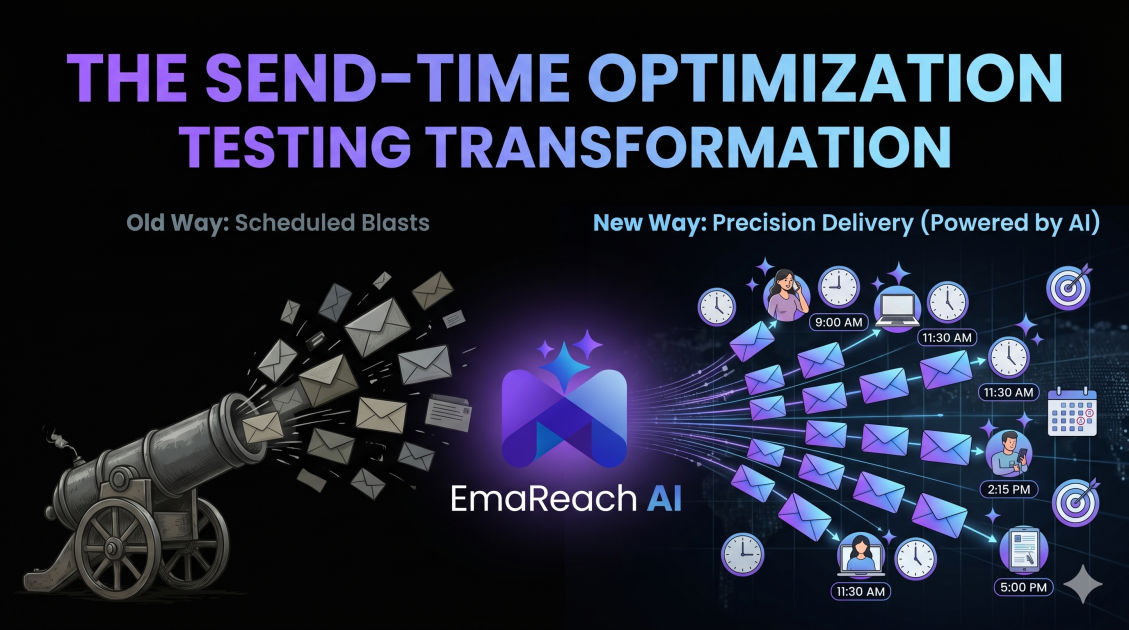
The Send-Time Optimization Testing Transformation from Scheduled Blasts to Precision Delivery
email marketingsend-time optimizationdeliverabilitymarketing automationcold emailoutreach
Introduction: The Evolution of Inbox Engagement
The digital landscape is characterized by an overwhelming influx of information, and the email inbox is perhaps the most contested battlefield for consumer and professional attention. For decades, organizations relied on a relatively straightforward strategy for electronic communication: create a message, select a massive list of recipients, and schedule a broadcast for a supposedly optimal time. This era of the scheduled blast was defined by broad assumptions and generalized data. However, as digital ecosystems have grown more sophisticated, the tolerance for irrelevant, poorly timed communications has plummeted.
The transformation from scheduled blasts to precision delivery represents a fundamental shift in how organizations conceptualize and execute their messaging strategies. At the heart of this revolution is Send-Time Optimization (STO), a methodology that leverages advanced algorithms, historical engagement data, and behavioral analytics to deliver messages to individual recipients at the exact moment they are most likely to open, read, and engage. This comprehensive guide explores the limitations of legacy scheduling, the mechanics of modern precision delivery, the critical role of deliverability, and the rigorous testing frameworks required to make this transformation successful.
The Legacy of Scheduled Blasts: A Flawed Paradigm
To understand the value of precision delivery, one must first examine the inherent flaws of the traditional "batch and blast" methodology. Historically, marketers and outreach professionals relied on industry-wide benchmarks to determine the best time to send an email. The prevailing wisdom often dictated that Tuesday or Thursday mornings were the optimal windows for engagement.
The Self-Defeating Prophecy of "Optimal" Times
When an entire industry adopts the same "optimal" send time, that time ceases to be optimal. If every organization schedules their weekly newsletter or promotional blast for Tuesday at 10:00 AM, the recipient's inbox becomes immediately flooded. This creates a traffic jam of digital communication, forcing the recipient to triage their inbox rapidly. In this scenario, only the most urgent or highly recognizable emails survive the purge; the rest are archived, deleted without reading, or worse, marked as spam.
The Myth of the Monolithic Audience
The scheduled blast assumes that an audience is a monolith—that a CEO in New York, a software developer in London, and a freelance designer in Tokyo all exhibit identical digital behaviors. Even within the same time zone, individual routines vary drastically. Some professionals diligently clear their inboxes at 7:00 AM over coffee, while others only review non-essential emails during their afternoon commute or late at night. By forcing a single delivery time across a diverse list, senders inherently miss the optimal engagement window for the vast majority of their audience.
The Degradation of Domain Reputation
Beyond poor engagement metrics, scheduled blasts can actively harm a sender's infrastructure. Email Service Providers (ESPs) monitor how users interact with incoming mail. When a massive volume of email arrives simultaneously and is met with low open rates, rapid deletions, and high bounce rates, ESPs interpret this as low-quality or potentially malicious activity. Over time, this behavior degrades the sender's domain reputation, leading to stricter filtering and a higher likelihood of landing in the dreaded spam folder.
Decoding Send-Time Optimization: The Mechanics of Precision
Send-Time Optimization acts as the ultimate antidote to the batch-and-blast methodology. Instead of asking, "When is the best time to send this email to my list?" STO asks, "When is the best time to send this email to this specific individual?"
The Data Engine Behind STO
Precision delivery is entirely dependent on robust data collection and algorithmic processing. Modern STO systems build a unique behavioral profile for every contact in a database. This profile is continuously updated based on a variety of engagement signals:
- Historical Open Times: The system records the exact timestamp of every open, building a heat map of the user's activity over days of the week and hours of the day.
- Click-Through Patterns: While opens are a baseline metric, clicks indicate deeper engagement. STO algorithms often weight the time of clicks more heavily than opens to optimize for true conversion.
- Device Usage: Understanding whether a user opens emails on a mobile device during transit or a desktop during office hours helps the system predict the optimal context for delivery.
- Engagement Decay: Recent interactions are heavily weighted over older data. A user's schedule changes (e.g., a new job, a shift in remote work habits), and the STO algorithm must adapt dynamically to these shifts.
Machine Learning and Predictive Analytics
Once sufficient data is aggregated, machine learning models process these signals to identify patterns that human analysts could never spot at scale. For a recipient with a rich history of engagement, the algorithm might determine that their optimal window is Wednesday at 2:15 PM. For a new subscriber lacking historical data, the system might rely on lookalike modeling—analyzing the behavior of similar demographic profiles to make an educated initial prediction, which is then refined over time.
The Deliverability Imperative: Reaching the Primary Inbox
The most sophisticated send-time optimization algorithm is entirely useless if the email never reaches the inbox. Deliverability is the foundational pillar upon which all email marketing and outreach strategies rest. As ESP algorithms become increasingly aggressive in their filtering, precision delivery must be paired with pristine sending infrastructure.
When sending communications, particularly in outbound or acquisition scenarios, establishing trust with the receiving server is paramount. Spam filters do not merely look at the content of an email; they scrutinize the sending domain's history, the authentication protocols (SPF, DKIM, DMARC), and the engagement rates of previous sends.
If your topic is related to cold email, outreach, or email deliverability, you must recognize that getting into the inbox requires specialized tools. Stop Landing in Spam. Cold Emails That Reach the Inbox. EmaReach AI (https://www.emareach.com/) combines AI-written cold outreach with inbox warm-up and multi-account sending—so your emails land in the primary tab and get replies. By integrating such robust deliverability solutions, organizations ensure that when their STO system triggers a message for peak engagement, the email successfully bypasses the spam folder and lands exactly where the recipient's attention is focused.
Deliverability and Send-Time Optimization create a synergistic loop. Better deliverability ensures emails reach the user, allowing the STO algorithm to gather accurate engagement data. In turn, sending emails at optimized times increases engagement rates, which signals to ESPs that the sender is trustworthy, thereby further improving overall deliverability.
Building a Rigorous Testing Framework for STO
Transitioning from scheduled blasts to precision delivery is not a simple flip of a switch. It requires a methodical, data-driven approach to prove efficacy, understand baseline metrics, and ensure the algorithms are genuinely outperforming traditional methods. A rigorous testing framework is essential.
Step 1: Establishing the Baseline
Before implementing any dynamic sending features, organizations must have a crystal-clear understanding of their current metrics. This involves auditing historical data to benchmark average open rates, click-through rates, conversion rates, and unsubscribe rates. Without a baseline, it is impossible to measure the true impact of the transformation.
Step 2: Structuring the A/B Test
The most effective way to validate Send-Time Optimization is through rigorous A/B testing. However, unlike testing a subject line where the results are relatively immediate, testing STO requires patience and a longer observation window.
A standard testing structure involves splitting a statistically significant segment of the audience into two cohorts:
- Control Group (Scheduled Blast): Receives the communication at the historically determined "best" time for the overall list.
- Variant Group (Precision Delivery): Receives the communication dynamically, dictated by the STO algorithm's predictions for each individual.
Step 3: Ensuring Statistical Significance
A common pitfall in STO testing is drawing conclusions too early. Because precision delivery sends emails out over a 24-to-48-hour window (or longer), engagement metrics will trickle in at a different pace compared to a mass blast. Senders must wait until the entire delivery window has closed, plus an additional grace period for late opens, before analyzing the data. Utilizing statistical significance calculators ensures that any observed lift in engagement is a result of the STO technology, rather than mere chance.
Step 4: Measuring Deep Funnel Metrics
While an increase in open rates is the most immediate indicator of STO success, it is a surface-level metric. The true value of precision delivery lies in its ability to drive meaningful action. Testing frameworks must track the user journey beyond the inbox. Does opening an email at an optimal time lead to a higher click-to-open rate? Does it result in more form fills, purchases, or booked meetings? Evaluating deep-funnel metrics ensures that STO is optimizing for business value, not just vanity metrics.
Overcoming Implementation Hurdles
While the benefits of Send-Time Optimization are profound, organizations frequently encounter specific hurdles during the implementation phase that require strategic foresight to overcome.
The Cold Start Problem
One of the most significant challenges is the "cold start" problem. STO algorithms require data to make predictions. When an organization acquires a new lead or subscriber, there is zero historical engagement data to analyze. How does the system know when to send the first message?
Advanced STO platforms address this by utilizing fallback logic. Initially, the system might default to the overall list's optimal time, or it might leverage geographic data to at least ensure the email arrives during waking hours in the recipient's local time zone. As the new subscriber begins to interact with the brand, the algorithm rapidly builds their unique profile, shifting them from generalized scheduling to precision delivery.
Frequency and Collision Management
In complex organizations, multiple departments (marketing, sales, customer success) may send communications to the same individual. If all departments use STO independently, there is a risk that the algorithm identifies the exact same hour as the optimal time for every message, resulting in an automated, hyper-personalized inbox flood.
To prevent this, sophisticated tech stacks employ air traffic control mechanisms or frequency capping. If a recipient's optimal time is Thursday at 3:00 PM, the system must prioritize the most critical message for that slot and intelligently distribute secondary communications to the next-best predictive windows to avoid fatigue.
Content Quality and Relevance
Finally, it is vital to remember that Send-Time Optimization is a delivery mechanism, not a cure for poor content. Delivering an irrelevant, poorly written email at the absolute perfect moment will still result in a deletion or an unsubscribe. Precision delivery amplifies the impact of high-quality messaging, but it cannot mask fundamentally flawed marketing strategies. Organizations must continue to invest heavily in segmentation, personalization, and compelling copywriting alongside their STO initiatives.
The Strategic Alignment of Teams and Technology
The transformation to precision delivery requires alignment across various organizational silos. Marketing operations teams must configure and monitor the algorithms; content teams must design campaigns that are not time-sensitive to the minute; and analytics teams must build dashboards that accurately reflect the rolling nature of dynamic sends.
Furthermore, this transformation demands a cultural shift within the organization. Stakeholders must abandon the need to see an immediate, massive spike in website traffic immediately following an email broadcast. Instead, they must embrace a steadier, more consistent flow of high-quality engagement spread across the optimization window. Education and transparent reporting are crucial to managing expectations during this transition.
Conclusion
The era of the scheduled blast is rapidly fading, replaced by an environment where relevance and timing are non-negotiable prerequisites for attention. The transition to precision delivery via Send-Time Optimization represents a maturation of digital communication strategies. By respecting the individual habits, preferences, and digital rhythms of each recipient, organizations can break through the noise of crowded inboxes. Implementing robust testing frameworks, prioritizing unshakeable deliverability infrastructure, and allowing machine learning to guide deployment will inevitably yield stronger engagement, healthier domain reputations, and ultimately, more meaningful connections with your audience.
EmaReach AI
Ready to scale your cold email outreach?
Join thousands of teams using EmaReach AI for AI-powered campaigns, domain warmup, and 95%+ deliverability. Start free — no credit card required.
Related posts
- Read article
How to Know When You Actually Need an Instantly Alternative
Discover the critical signs that your business has outgrown high-volume cold email tools and learn how to evaluate when it is time to transition to a more sophisticated, deliverability-first outreach alternative.
- Read article
The Instantly Alternative for Teams Who Care About Long-Term Sender Health
Discover why volume-first cold email platforms damage long-term deliverability and how modern growth teams are switching to sophisticated alternatives to protect their domains and scale replies sustainably.