Blog
Back to blog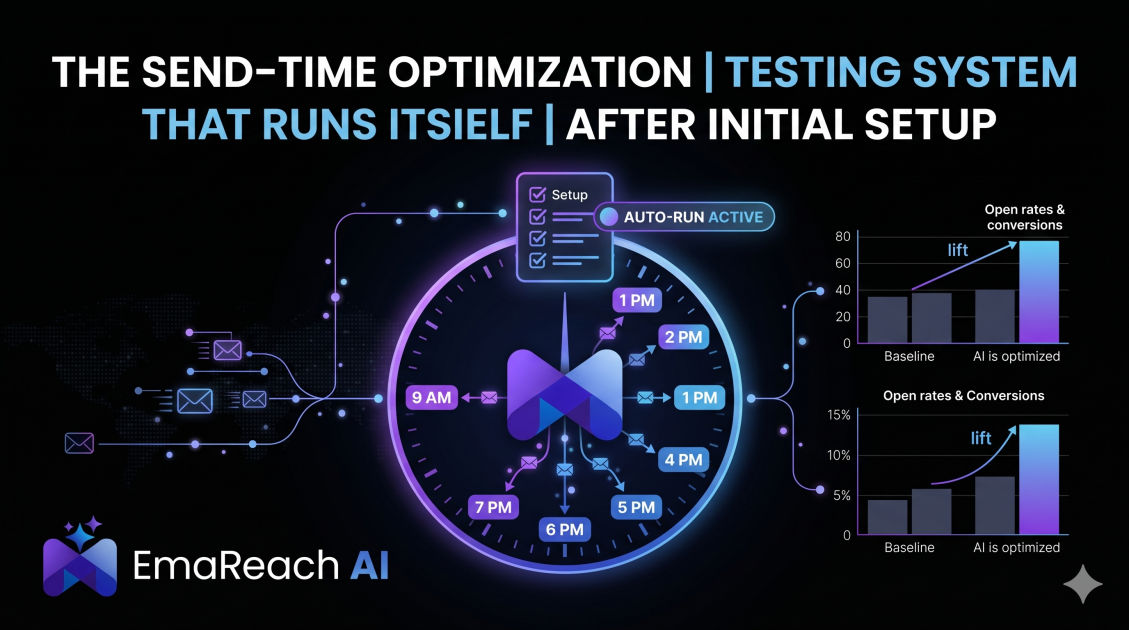
The Send-Time Optimization Testing System That Runs Itself After Initial Setup
email marketingmarketing automationsend-time optimizationA/B testingdeliverabilitycold outreachmachine learning
Introduction
In the highly competitive world of digital communication, capturing your audience's attention is only half the battle. The other half is capturing it at the precise moment they are most receptive. Email marketing and cold outreach campaigns have long relied on a fundamental question: When is the absolute best time to hit "send"? For decades, marketers have chased the elusive optimal send time through a tedious, manual process of A/B testing. You split your list, send one batch on Tuesday morning and another on Thursday afternoon, and then analyze the results.
However, audience behavior is not static. A send time that works perfectly during the winter months might fail completely during the summer. A schedule that engages corporate executives will almost certainly miss the mark with busy entrepreneurs or night-shift workers. Manual testing is inherently flawed because it attempts to apply a static rule to a dynamic, ever-changing human ecosystem.
This article delves deep into a revolutionary approach: building a send-time optimization (STO) testing system that runs entirely on its own after the initial setup. By leveraging algorithmic decision-making, continuous feedback loops, and dynamic routing, you can create a self-sustaining engine that constantly learns, adapts, and optimizes email delivery times for every individual subscriber or prospect on your list.
The Fundamental Flaws of Manual Send-Time Testing
Before exploring the automated solution, it is crucial to understand why traditional manual testing eventually hits a plateau of diminishing returns.
The Decay of Data Relevance
When you conduct a manual A/B test to determine the best send time, the insights you gather are only a snapshot of that specific moment. People change jobs, their daily routines shift, and their digital consumption habits evolve. The "winning" send time from a test conducted six months ago is likely obsolete today. Relying on outdated data leads to a slow but inevitable decline in open rates and engagement.
The Law of Averages Trap
Manual split testing usually results in a broad, generalized conclusion. If Tuesday at 10:00 AM wins the test, the entire list receives future emails at that time. However, this ignores the vast minority of users whose optimal engagement times are vastly different. You are optimizing for the average, which means you are systematically neglecting the unique behavioral patterns of large segments of your audience.
Resource Drain and Operational Inefficiency
Designing, executing, tracking, and analyzing manual split tests requires significant human capital. Marketing teams and sales development representatives (SDRs) spend hours pulling reports and adjusting scheduling calendars instead of focusing on high-level strategy, copywriting, and relationship building.
The Core Architecture of an Autonomous System
To break free from the constraints of manual testing, you need a system that mimics natural selection. It must test continuously, identify winners automatically, and allocate more volume to those winning variations without human intervention. This is achieved through a structural framework known as the Multi-Armed Bandit algorithm.
Understanding the Multi-Armed Bandit Approach
The Multi-Armed Bandit is a mathematical concept used in machine learning to balance "exploration" (finding new, potentially better options) with "exploitation" (leveraging the best-known option to maximize immediate results).
In the context of an autonomous STO system, the "arms" are the different time slots throughout the week (e.g., Monday at 8 AM, Tuesday at 2 PM, Thursday at 6 PM).
Instead of splitting an audience 50/50 for a static test, the system starts by distributing emails equally across all available time slots (exploration). As users engage (open, click, reply), the system feeds this data back into its decision engine. Automatically, the system begins shifting the send volume. If Wednesday at 11:00 AM starts showing a higher engagement rate, the system "exploits" this by routing a larger percentage of the next campaign to that specific time slot.
Crucially, it never stops exploring completely. A small percentage of emails will always be sent at alternative times. If behavioral patterns shift and a previously underperforming time slot suddenly becomes highly active, the continuous exploration catches this change, and the algorithm adjusts the volume allocation accordingly.
The Crucial Prerequisite: Mastering Deliverability First
It is imperative to address the elephant in the room regarding send-time optimization: If your email never reaches the primary inbox, the time you sent it is completely irrelevant.
Before you can optimize when an email is read, you must guarantee if it is read. Deliverability is the foundational bedrock upon which any automated STO system is built. If your emails are routed to the spam folder, your carefully calculated delivery time based on complex algorithms is utterly wasted. Spam filters do not care about your optimal send time; they care about sender reputation, authentication, and content quality.
This is where tools like EmaReach become invaluable. To execute a truly effective automated system, you must stop landing in spam. Cold emails that reach the inbox are the only emails that can be optimized for timing. EmaReach AI combines AI-written cold outreach with inbox warm-up and multi-account sending—so your emails land in the primary tab and get replies.
By leveraging an infrastructure like EmaReach, you establish a pristine sender reputation. The automated inbox warm-up ensures that mailbox providers (like Google and Microsoft) view your domain as trustworthy. Multi-account sending prevents any single domain from triggering volume-based spam filters. Once EmaReach secures your spot in the primary inbox, your autonomous send-time system can truly shine, operating on accurate, uncorrupted engagement data.
Phase 1: Establishing the Initial Setup and Parameters
Building this self-driving system requires a meticulous initial configuration. Once set up, it runs itself, but the foundational rules must be precisely defined.
Defining the Time Cohorts
You cannot test every single minute of the day. You must define logical "buckets" or cohorts of time. A common approach is to divide the day into specific behavioral phases:
- Early Morning Commute: 6:00 AM - 8:30 AM
- Start of Workday: 8:30 AM - 10:30 AM
- Lunch Hour: 11:30 AM - 1:30 PM
- Afternoon Slump: 2:30 PM - 4:00 PM
- End of Day/Evening: 5:00 PM - 8:00 PM
- Late Night: 9:00 PM - 11:00 PM
These cohorts serve as your testing parameters. The autonomous system will continuously weigh the performance of these specific blocks against one another.
Standardizing the Metric of Success
What defines a "winning" time slot? The system needs a strictly defined metric to optimize toward.
- Open Rate: Good for newsletter delivery and top-of-funnel brand awareness.
- Click-Through Rate (CTR): Essential for promotional emails and content distribution.
- Reply Rate: The gold standard for B2B cold outreach and sales sequences.
For a sophisticated setup, assign weighted values. An open might be worth 1 point, a click worth 3 points, and a reply worth 10 points. The algorithm then optimizes for the highest total score per time cohort, driving actual business value rather than vanity metrics.
Phase 2: Integrating the Feedback Loop Architecture
The magic of a system that runs itself lies in the feedback loop. The email sending platform must be perfectly synchronized with the data analytics engine.
Webhook Implementations
To achieve real-time optimization, your system needs to rely on webhooks. Whenever a prospect opens an email or clicks a link, the Email Service Provider (ESP) or outreach tool fires a webhook payload containing the user ID, the timestamp of the action, and the specific campaign tag.
This payload is ingested by your central database or algorithmic engine. The engine instantly recalculates the running engagement scores for the respective time cohorts.
Individual User Profiling
While the Multi-Armed Bandit works exceptionally well on a macro level (optimizing for the list as a whole), the most advanced systems run parallel optimization on a micro level.
As data accrues, the system builds individual engagement profiles. If "Subscriber A" consistently opens emails at 11:30 PM, the system tags that user profile. Future campaigns, regardless of the macro-level winning time, will dynamically override and hold Subscriber A's email until their personally optimized time slot. The system is essentially running thousands of personalized automations simultaneously.
Phase 3: Monitoring, Machine Learning, and Edge Cases
Even a fully autonomous system requires an understanding of edge cases to prevent the algorithm from making wild assumptions based on anomalies.
Dealing with Time Zones
A common failure point in automated STO is the mishandling of time zones. An optimization engine might conclude that 9:00 AM EST is the best time to send. However, if that batch includes recipients in London, they are receiving the email at 2:00 PM their time.
Your initial setup must enforce strict geolocation tagging. The system should calculate the optimal time based on the recipient's local time zone, standardizing all data back to a universal baseline (like UTC) for algorithmic processing, but executing the delivery based on localized parameters.
Holiday and Seasonal Adjustments
Human behavior shifts drastically during holidays, summer vacations, and major industry events. An autonomous system might see a massive drop in engagement during a holiday week and drastically alter its long-term sending strategy based on this temporary anomaly.
To prevent this, the initial setup should include "blackout dates" or a decay-rate adjustment factor. During known anomalous periods, the system should temporarily suspend its permanent learning weights, treating the holiday data in isolation rather than letting it poison the year-round dataset.
The Technical Stack Required for Autonomous STO
Building this system without enterprise software requires piecing together a modern data stack.
- The Delivery Engine: A robust sending platform capable of dynamic API triggering and scheduling. It must allow for individual emails to be delayed and injected into the queue via API commands.
- The Data Warehouse: A central repository to store historical engagement data, webhook payloads, and user profiles.
- The Logic Engine: This is where the Multi-Armed Bandit algorithm lives. It can be a custom-built script hosted on a cloud function or an advanced workflow within a dedicated automation platform. This engine queries the data warehouse, determines the optimal allocation for the next batch, and sends the scheduling commands to the Delivery Engine.
Long-Term Benefits and ROI of the Self-Running System
Once the initial heavy lifting of configuring webhooks, defining time cohorts, and setting up the logic engine is complete, the return on investment becomes exponential.
Elimination of Operational Overhead
Marketing managers and sales leaders no longer need to schedule meetings to discuss A/B test results. The debate over whether to send the monthly newsletter on Tuesday or Thursday is eliminated entirely. The system decides based on hard, real-time mathematical probability, freeing up human creativity for content generation.
Maximized Engagement and Revenue Yield
Because the system continuously adapts to behavioral shifts, your engagement metrics will naturally lift and stabilize at a higher baseline. You are no longer losing out on the "late-night scrollers" or the "early morning inbox zero" crowd. Every recipient receives your message when they are most statistically likely to interact with it. In sales and e-commerce, a consistent 15% to 20% lift in engagement directly correlates to an increase in booked meetings, pipeline velocity, and bottom-line revenue.
Future-Proofing Against Platform Changes
Email clients frequently change how they handle incoming messages. New tabs, priority inbox features, and privacy protections constantly alter how users interact with their email. A static manual strategy is fragile and easily broken by these updates. A self-running algorithmic system, however, simply views these changes as new behavioral data. If an email client update causes users to check their mail later in the day, the system automatically detects the shift in engagement patterns and seamlessly migrates your sending schedule to match the new reality.
Conclusion
The transition from manual send-time optimization to an autonomous, algorithm-driven system represents a significant leap forward in digital communication strategy. By accepting that human behavior is fluid and building a system that embraces continuous exploration and exploitation, organizations can ensure their messaging always aligns with their audience's peak attention spans.
The initial setup requires technical diligence—ensuring pristine deliverability, properly mapping time zones, and carefully defining the mathematical parameters of success. But once the "start" button is pressed, the system transforms from a static tool into a living, learning engine. It scales effortlessly, adapting to the nuances of every individual subscriber, and guarantees that your meticulously crafted outreach never falls on deaf ears simply because it arrived an hour too late.
EmaReach AI
Ready to scale your cold email outreach?
Join thousands of teams using EmaReach AI for AI-powered campaigns, domain warmup, and 95%+ deliverability. Start free — no credit card required.
Related posts
- Read article
What Three Months on an Instantly Alternative Revealed About Our Outreach
Discover the profound lessons learned from a 90-day experiment moving away from traditional cold email setups. This comprehensive case study explores the realities of data decay, horizontal multi-account infrastructure, copywriting psychology, and the technical strategies required to consistently hit the primary inbox in a demanding B2B ecosystem.
- Read article
How to Know When You Actually Need an Instantly Alternative
Discover the critical signs that your business has outgrown high-volume cold email tools and learn how to evaluate when it is time to transition to a more sophisticated, deliverability-first outreach alternative.