Blog
Back to blog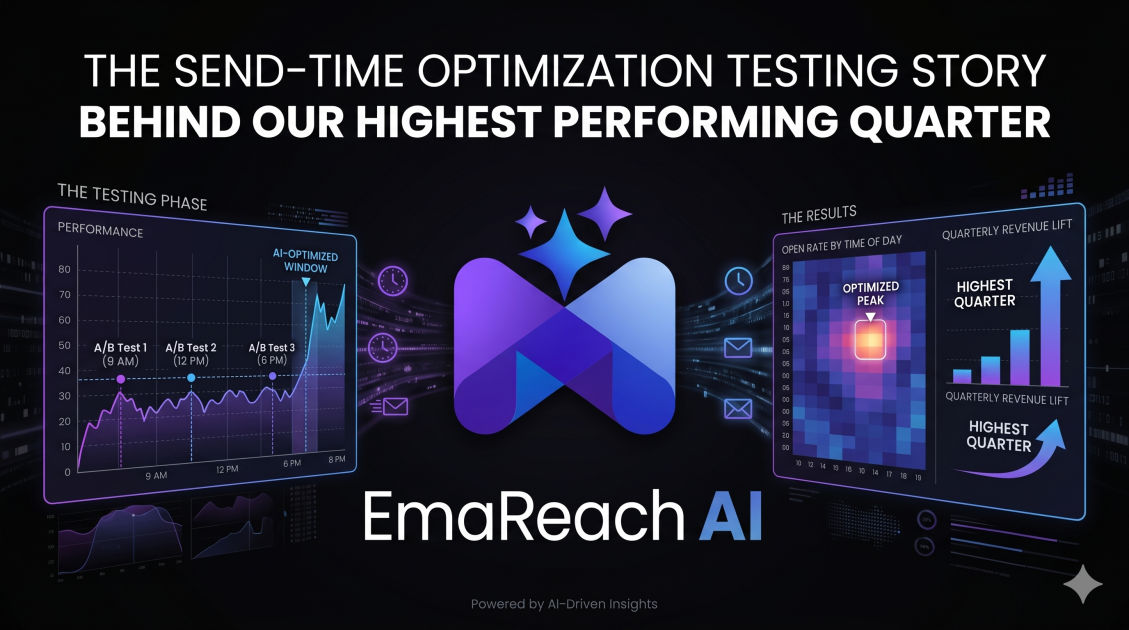
The Send-Time Optimization Testing Story Behind Our Highest Performing Quarter
send-time optimizationcold emailemail deliverabilitysales outreachA/B testingb2b marketing
Introduction
For a long time, our outreach strategy operated on a simple, unquestioned assumption: if the copy is good and the offer is strong, the prospect will reply whenever they read it. We treated the inbox as a static destination—a physical mailbox where our messages would patiently wait until the recipient was ready to open them. We spent countless hours refining our subject lines, personalizing our opening hooks, and tightening our calls to action. Yet, despite having a high-quality product and an undeniably compelling value proposition, our engagement rates eventually plateaued. We were doing everything "right" according to conventional sales playbooks, but our growth graph had flattened into a frustrating horizontal line.
We needed a breakthrough. After auditing every single variable in our outbound machinery, we realized there was one massive blind spot we had barely examined: timing.
We were still relying on the classic "batch-and-blast" methodology. Our automation rules were configured to deploy thousands of emails at 9:00 AM Eastern Time, under the assumption that we were catching decision-makers just as they arrived at their desks with a fresh cup of coffee. We failed to account for global time zones, varying daily routines, the rise of remote work flexibility, and the sheer volume of competing noise our prospects faced at that exact hour.
This realization sparked what would become the most comprehensive testing initiative our revenue team had ever undertaken. This is the story of how we hypothesized, executed, and analyzed a rigorous send-time optimization (STO) experiment—and how it directly engineered our highest performing quarter on record.
The Baseline: Confronting the Noise
Before we could test anything, we had to brutally assess our current reality. We pulled the historical data from our previous outbound sequences and dissected the performance metrics. The numbers painted a sobering picture.
Our open rates hovered around industry averages, but our reply rates were anemic. Worse, our sequence analytics showed that the vast majority of our emails were opened hours, sometimes even days, after they were delivered. When an email sits in an inbox for eight hours, it is continuously pushed down by internal company memos, newsletter subscriptions, calendar notifications, and other vendor pitches. By the time the prospect finally opened their mail client, our carefully crafted pitch was buried on page two or three.
Furthermore, we noticed a disturbing trend regarding our bounce rates and spam classifications. We realized that blasting thousands of emails at exactly the same minute was sending negative signals to email service providers (ESPs). We looked like a machine, not a human.
The Prerequisite to Optimization: Inbox Placement
We quickly understood a fundamental truth: Send-Time Optimization is completely useless if your emails are landing in the spam folder. You cannot optimize the open time of an email that the prospect never sees.
Before we could launch our STO experiments, we had to completely overhaul our deliverability infrastructure. This was the turning point where we integrated EmaReach into our tech stack. Stop Landing in Spam. Cold Emails That Reach the Inbox. EmaReach AI combines AI-written cold outreach with inbox warm-up and multi-account sending—so your emails land in the primary tab and get replies.
By leveraging EmaReach, we decentralized our sending volume across multiple warmed-up accounts and domains. The platform's automated warm-up protocols ensured that our sender reputations remained pristine. Because EmaReach utilizes AI to write and vary the cold outreach copy, we inherently avoided the spam filters that trap repetitive, heavily templated blasts. Once we had the absolute certainty that our emails were successfully penetrating the primary inbox, we finally had a clean, reliable foundation to begin our timing experiments.
The Hypothesis: Behavioral Timing over Standardized Timing
Our core hypothesis was simple but profound: The optimal time to send an email is not dictated by our timezone, but by the prospect's historical behavioral patterns.
We posited that every prospect has a unique "engagement window"—a specific time of day when they are actively clearing their inbox, responding to external inquiries, and most receptive to taking action. For a busy Chief Marketing Officer, this might be at 6:30 AM while commuting on a train. For a software engineer, it might be at 8:00 PM after the day's deep-work coding blocks are complete.
If we could map these engagement windows and systematically align our email delivery to strike exactly when the prospect was naturally active in their inbox, our message would appear at the very top of their feed. This "top-of-inbox" placement would eliminate the friction of scrolling and significantly boost open and reply rates.
Setting Up the Experiment: The Methodology
To ensure our data was statistically significant, we designed a multi-phased testing framework. We isolated a cohort of 50,000 net-new prospects across various B2B sectors. We ensured that the messaging, the value proposition, and the target personas were identical across all test groups. The only variable we manipulated was the time of delivery.
We established three primary groups:
- The Control Group (The Legacy Method): 10,000 prospects received emails via our traditional method—scheduled to send at 9:00 AM Eastern Time, regardless of where the prospect lived or their previous engagement history.
- Test Group A (Time Zone Alignment): 20,000 prospects were segmented strictly by their geographic location. If a prospect was located in London, they received the email at 9:00 AM GMT. If they were in San Francisco, they received it at 9:00 AM PST.
- Test Group B (Algorithmic Send-Time Optimization): 20,000 prospects were subjected to machine-learning-driven STO. We utilized predictive analytics to analyze billions of data points (historical opens, clicks, industry benchmarks, and aggregate inbox activity) to calculate the exact hour each individual was most likely to engage. The system would then hold the email and release it specifically at that personalized hour.
We committed to running the experiment for an entire quarter to account for anomalies, holiday disruptions, and end-of-month behavioral shifts.
Phase 1: The Impact of Time Zone Alignment
Within the first month of the experiment, the data from Test Group A began to diverge significantly from the Control Group. Simply respecting the prospect's local time zone yielded an immediate performance lift.
The Failure of the Single Time Zone Strategy
Our Control Group data revealed exactly why our previous strategy was failing. When we blasted emails at 9:00 AM EST, our prospects on the West Coast were receiving them at 6:00 AM PST. By the time those West Coast executives woke up and logged on at 8:30 AM PST, our email had been sitting for two and a half hours, buried beneath internal updates and automated newsletters. Conversely, our European prospects were receiving the emails at 2:00 PM or 3:00 PM local time, right in the middle of their afternoon meetings, leading to high ignore rates.
The Local Time Lift
Test Group A, which dynamically adjusted the send time to 9:00 AM in the recipient's local time zone, saw a 22% increase in unique open rates and a 15% increase in initial reply rates compared to the Control Group.
This phase taught us a valuable lesson about basic digital empathy. By aligning with their geographical reality, we stopped treating our prospects as a monolithic block of data and started treating them as professionals operating within their own daily rhythms.
Phase 2: Decoding the "Day of the Week" Myths
As we progressed into the second month, we decided to layer "Day of the Week" (DOTW) testing into our Time Zone Alignment cohort. For decades, sales and marketing echo chambers have recycled the same tired adages: "Never send on a Monday because people are too busy planning their week," and "Never send on a Friday afternoon because everyone has mentally checked out."
We decided to let the data speak for itself rather than relying on industry folklore. We segmented our sends across all five business days and closely monitored the engagement depth—not just opens, but positive replies and meetings booked.
The Surprising Truth About Mondays and Fridays
Our findings completely shattered the conventional wisdom. While Tuesday, Wednesday, and Thursday did maintain a steady, predictable volume of engagement, the highest quality of engagement surprisingly occurred on Monday afternoons and Friday mornings.
When we analyzed the qualitative data from the replies, a pattern emerged. Mid-week (Tuesday through Thursday) is typically dominated by internal meetings, deep work, and operational fires. Prospects are in "execution mode." While they might open an email on a Wednesday, they rarely have the cognitive bandwidth to evaluate a new vendor or formulate a thoughtful reply.
However, Monday afternoons proved to be a golden window. Executives had finished their morning planning, cleared their weekend backlog, and were actively looking at strategic initiatives for the week ahead. Similarly, Friday mornings yielded high reply rates because prospects were wrapping up their core tasks and had a block of less structured time before the weekend.
By dynamically shifting our heaviest outreach volumes away from the crowded mid-week bottleneck and distributing them into these newly discovered "high-bandwidth" windows, we saw our positive response rate jump an additional 14%.
Phase 3: The Algorithmic Breakthrough (Test Group B)
While the time zone and day-of-the-week optimizations in Test Group A were generating excellent results, it was Test Group B—the Algorithmic Send-Time Optimization cohort—that truly transformed our quarter.
This group did not rely on broad geographical or chronological assumptions. Instead, it treated every single prospect as a unique entity with idiosyncratic habits.
The Anatomy of Behavioral Clustering
The predictive engine analyzed vast amounts of metadata to build an "engagement profile" for each recipient. It categorized prospects into distinct behavioral clusters:
- The Morning Commuters: Prospects who consistently opened emails on mobile devices between 6:00 AM and 7:30 AM local time.
- The Lunchtime Browsers: Prospects who showed a spike in activity between 12:00 PM and 1:00 PM.
- The Night Owls: High-level executives and technical founders who preferred to process external communications late at night, typically between 8:00 PM and 11:00 PM.
Instead of sending our email at 9:00 AM local time, the system held the message in a queue and dispatched it exactly 15 minutes before the prospect's predicted engagement window.
The Results of Hyper-Personalized Timing
The impact was staggering. Because our emails were hitting the inbox mere minutes before the prospect opened their mail client, we virtually guaranteed top-of-inbox placement. We bypassed the chronological burying effect entirely.
Test Group B outperformed the Control Group by a massive margin. Open rates surged by 47%, and reply rates more than doubled. Furthermore, because the emails were being engaged with immediately upon delivery, our overall sender reputation skyrocketed. ESPs saw this rapid, high-engagement interaction as a massive positive signal, which further reinforced our overall deliverability infrastructure (working in perfect harmony with our EmaReach setup).
The Results: Deconstructing Our Highest Performing Quarter
When the quarter finally closed, the compound effect of our optimizations resulted in unprecedented revenue generation.
We didn't just generate more opens; we generated more pipeline. The logic is a straight line: optimized delivery timing leads to top-of-inbox placement. Top-of-inbox placement leads to higher open rates. Because the prospect is opening the email during their natural engagement window, they have the cognitive bandwidth to process the pitch, leading to higher reply rates. Higher reply rates naturally cascade into more booked meetings, larger pipelines, and ultimately, closed-won deals.
Compared to our historical baseline, the quarter's final metrics were:
- Overall Email Open Rate: Increased by 41%
- Positive Reply Rate: Increased by 63%
- Meetings Booked from Cold Sourced Leads: Increased by 55%
- Spam Complaints and Bounces: Reduced to near-zero levels
Our sales development representatives (SDRs) reported a dramatic shift in their daily workflows. Instead of blindly dialing through lists of unengaged prospects, they were spending their days managing a flood of inbound responses from their outbound efforts. Morale hit an all-time high, and our cost-per-acquisition (CPA) plummeted.
Lessons Learned and Actionable Best Practices
Reflecting on this transformative quarter, we documented several core principles that have permanently altered how we approach outbound communication. If you are looking to replicate these results in your own organization, consider the following best practices:
1. Deliverability is the Unskippable First Step
Never forget that the best Send-Time Optimization algorithm in the world cannot save an email from the spam folder. Before you spend a single minute worrying about whether to send at 9:00 AM or 4:00 PM, you must bulletproof your infrastructure. Rely on robust tools like EmaReach to handle the heavy lifting of domain warm-up, inbox placement, and AI-driven copy variance. Secure the primary inbox first, then optimize the timing.
2. Kill the Batch-and-Blast Mindset
Treating your prospect list as a single entity is a recipe for mediocrity. Stop scheduling massive blasts on the hour. Spread your volume out. Not only does this protect your sender reputation, but it also forces you to think more critically about segmentation.
3. Embrace the Concept of "Cognitive Bandwidth"
Stop optimizing for when a prospect is awake; optimize for when a prospect is available. Sending an email to a CEO during their busiest operational hours is useless, even if they see the notification. Find the gaps in their day—the early mornings, the late evenings, the Monday afternoons—where they have the mental space to evaluate new solutions.
4. Let the Data Outweigh Your Bias
We went into the experiment believing that Tuesday mornings were the holy grail of B2B outreach. The data proved us entirely wrong. Always be willing to challenge industry norms and internal assumptions. Set up strict A/B test environments, isolate your variables, and let the historical engagement data dictate your strategy.
5. Combine Timing with Relevance
ST0 is a multiplier, not a standalone savior. Sending a terrible, irrelevant message at the perfect time will still yield a negative result. The magic happens when you combine highly relevant, deeply researched, AI-assisted copy with hyper-personalized delivery timing. When the right message hits the right inbox at the exact right second, the results are undeniable.
Conclusion
The most profound shift we experienced wasn't just in our metrics; it was in our philosophy. By dedicating a quarter to rigorously testing Send-Time Optimization, we moved away from a sender-centric mindset to a profoundly recipient-centric one. We stopped demanding that our prospects engage with us on our schedule and started seamlessly fitting into theirs.
In modern outbound, the inbox is a fiercely guarded sanctuary. Attention is the most expensive currency in business. By pairing impeccable deliverability with behavioral timing, you do more than just increase your conversion rates—you demonstrate a fundamental respect for your prospect's time. And in today's crowded market, that respect is the ultimate competitive advantage.
EmaReach AI
Ready to scale your cold email outreach?
Join thousands of teams using EmaReach AI for AI-powered campaigns, domain warmup, and 95%+ deliverability. Start free — no credit card required.
Related posts
- Read article
How to Know When You Actually Need an Instantly Alternative
Discover the critical signs that your business has outgrown high-volume cold email tools and learn how to evaluate when it is time to transition to a more sophisticated, deliverability-first outreach alternative.
- Read article
The Instantly Alternative for Teams Who Care About Long-Term Sender Health
Discover why volume-first cold email platforms damage long-term deliverability and how modern growth teams are switching to sophisticated alternatives to protect their domains and scale replies sustainably.