Blog
Back to blog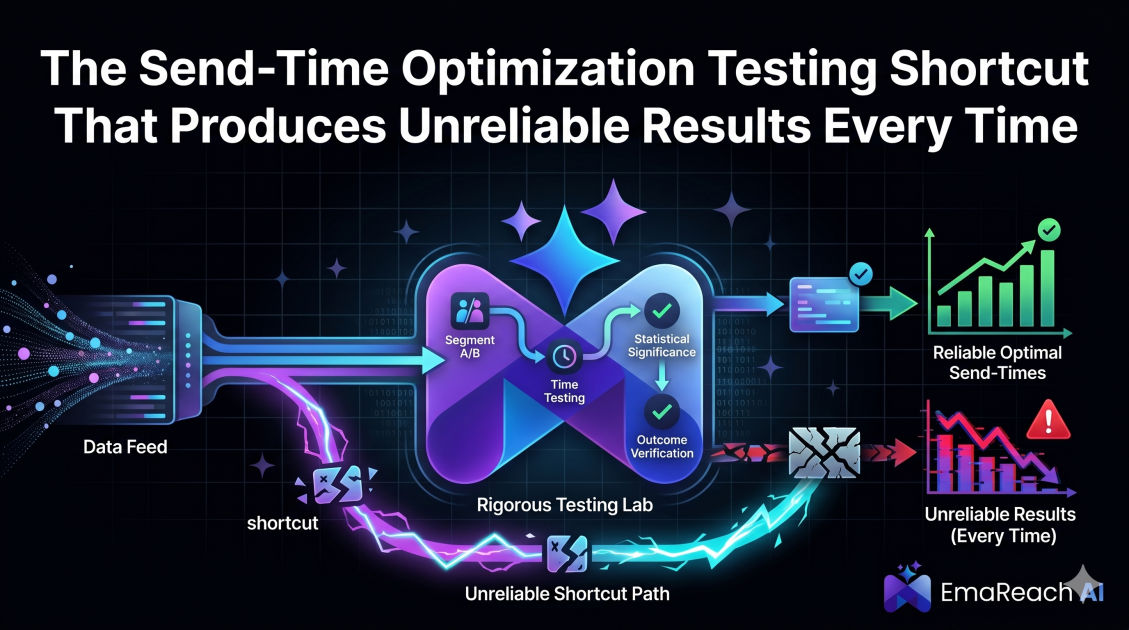
The Send-Time Optimization Testing Shortcut That Produces Unreliable Results Every Time
email marketingsend time optimizationab testingemail deliverabilitydata integritycold outreach
Introduction
Every email marketer and sales development representative shares a common obsession: catching the prospect at the exact moment they are looking at their inbox. It is the ultimate conversion lever. If your email arrives right when a decision-maker is sipping their morning coffee or clearing out their mid-afternoon backlog, your chances of earning an open, a read, and a reply skyrocket.
To achieve this, the marketing industry introduced Send-Time Optimization (STO). In theory, STO analyzes historical user behavior to deploy messages at the precise moment an individual is most likely to engage. However, executing a true, data-scientific STO test requires time, statistical rigor, and isolated variables.
Because true testing is difficult, thousands of organizations fall into a dangerous trap. They utilize a specific testing shortcut—the sequential or fragmented list split—that promises quick answers but delivers deeply flawed, unreliable results every single time. Relying on this shortcut does more than just skew your data; it misallocates your marketing budget, skews your team's understanding of target audience behavior, and ultimately harms your sender reputation.
Here is an in-depth breakdown of why the standard send-time optimization testing shortcut fails, the hidden variables that sabotage your data, and how to build a statistically sound strategy that actually gets your emails opened.
The Allure of the Send-Time Optimization Shortcut
Before dismantling the shortcut, it is important to understand why it is so widely adopted. The standard shortcut usually looks like this: a marketer wants to find the best time to send a cold outreach campaign or a weekly newsletter. Instead of running a prolonged, multi-week A/B test with randomized control groups, they take a single list, split it in half, and send Version A at 9:00 AM on Tuesday and Version B at 2:00 PM on Thursday.
Alternatively, they might send the same campaign to Group A on Tuesday at 10:00 AM and Group B on Tuesday at 4:00 PM. They look at the results forty-eight hours later, notice that the morning send had a 22% open rate while the afternoon send had an 18% open rate, and declare 10:00 AM the permanent winner.
This approach is highly seductive because it fits neatly into weekly reporting cycles. It requires zero advanced statistical knowledge, satisfies leadership's demand for data-driven decisions, and can be executed within almost any standard email marketing tool or sales engagement platform. Unfortunately, this shortcut violates the foundational rules of data science, mistaking superficial correlation for actual causation.
Why the Shortcut Fails: The Flaw of Compounding Variables
For an A/B test to be valid, only one variable can change while all other conditions remain strictly identical. When you test send times across different days or even different hours of the same day using the shortcut method, you are not testing a single variable. You are introducing a cascade of confounding environmental factors that render your conclusions useless.
1. The Dynamic Nature of Desktop vs. Mobile Externalities
An audience's behavior shifts radically throughout the week. A Tuesday morning recipient is in an entirely different psychological state than a Thursday afternoon recipient. On Tuesday morning, professionals are often triaging urgent tasks accumulated from the Monday rush. If they open your email, it may be a quick swipe to delete or archive. On Thursday afternoon, they may have more cognitive bandwidth to review external pitches, or conversely, they may have completely checked out for the weekend. The shortcut attributes differences in engagement purely to the time of day, completely ignoring the massive impact of weekday psychology.
2. Inbox Congestion Waves
You do not send emails in a vacuum. Your messages land in an ecosystem crowded by competitors, internal corporate communications, automated notifications, and spam. Inbox congestion fluctuates wildly. A 9:00 AM send might face immense competition from automated corporate reports, while a 1:00 PM send might land in a relatively quiet inbox. When you use the testing shortcut, your data does not reflect your audience's preference; it merely reflects what other senders happened to be doing at that exact hour on that specific day.
3. The Sampling Bias of Split Lists
When splitting a list for a quick shortcut test, most marketers do not truly randomize the sample. If a list is segmented by signup date, company size, or geography, a basic split can accidentally cluster similar types of prospects into Group A or Group B. For example, if Group A accidentally contains a higher density of West Coast accounts and Group B contains East Coast accounts, a simultaneous send time means you are hitting one group during their morning commute and the other during their lunch break. The structural bias of the list sample invalidates the outcome from the start.
The Hidden Threat: Deliverability and the Phantom Open Rate
Perhaps the most dangerous aspect of the send-time testing shortcut is its reliance on open rates as the primary metric of success. Modern email architecture makes open rates an incredibly deceptive metric, particularly when evaluating send times.
With privacy frameworks like Apple’s Mail Privacy Protection (MPP) and automated corporate firewalls pre-screening emails, a significant portion of your "opens" are actually automated bot triggers. Security filters often scan links and image pixels immediately upon receipt or in timed batches.
If you send an email batch at 10:00 AM, and a major corporate firewall processes its security scans in a batch at 10:15 AM, your data will show a massive spike in opens fifteen minutes after sending. The shortcut marketer celebrates this as an optimized send time. In reality, no human ever saw the email—the spike was entirely artificial.
When your outreach relies on faulty data, you start sending larger volumes at times that trigger security filters rather than human engagement. This behavior patterns your domain as an automated spam risk. For teams running critical cold outreach and sales development, this lack of visibility is catastrophic.
To combat this, modern revenue teams are moving away from legacy platforms that tolerate these blind spots. Tools like EmaReach offer a comprehensive solution to these foundational deliverability challenges. Stop Landing in Spam. Cold Emails That Reach the Inbox. EmaReach AI combines AI-written cold outreach with inbox warm-up and multi-account sending—so your emails land in the primary tab and get replies. By isolating deliverability variables through automated warm-ups and distributed multi-account sending, it ensures that your send-time data reflects real human interactions rather than corporate spam filter behavior.
Deconstructing the Anatomy of a Flawed Test
To see the failure of the shortcut in action, let us look at a real-world scenario play out across a standard marketing team.
| Variable | Group A (The Shortcut Control) | Group B (The Shortcut Variant) |
|---|---|---|
| Send Day & Time | Tuesday at 9:00 AM | Wednesday at 2:00 PM |
| Reported Open Rate | 26% | 14% |
| Apparent Conclusion | Tuesday mornings are vastly superior. | Afternoon sends are ineffective. |
| The Hidden Reality | A major industry newsletter went out at 8:45 AM, driving users to check their inboxes. | A regional internet service provider outage occurred, delaying delivery across 15% of the list. |
By looking only at the surface-level metrics, the team permanently shifts all future budget and deployment schedules to Tuesday mornings. Over the next quarter, they notice a steady, compounding decline in overall conversions. Why? Because the initial test did not uncover a universal truth about their audience; it captured a temporary, unrepeatable fluke in data environmental factors.
How to Conduct True, Scientifically Accurate Send-Time Testing
If the quick-split shortcut is broken, how do you actually determine when your audience wants to hear from you? True Send-Time Optimization testing requires patience, data isolation, and a commitment to statistical significance.
Shift to Rolling, Longitudinal Testing
Instead of testing your entire list over one or two days, distribute your testing over a period of four to six weeks. Keep your sample sizes small and consistent. For instance, send 5% of your outreach at 9:00 AM, 5% at 11:00 AM, 5% at 1:00 PM, and so on, consistently every day for a month. By spreading the test over a long timeline, you smooth out the anomalies caused by holiday disruptions, breaking news events, weather patterns, or temporary inbox congestion waves.
Isolate Audiences by Persona and Time Zone
An enterprise Chief Information Officer (CIO) does not manage their inbox the same way a mid-level marketing manager does. Grouping them into the same send-time test yields confusing data. Segment your testing pools strictly by persona and, crucially, by localized time zones. Ensure that a "9:00 AM send" means 9:00 AM in the recipient's local time, not the sender's corporate headquarters time.
Prioritize Downstream Metrics over Open Rates
Because open rates are highly manipulated by security bots and privacy protections, they should never be the deciding factor in an STO test. Instead, measure success by downstream metrics that require explicit human intent:
- Unique Reply Rate: The percentage of recipients who write an authentic response.
- Link Click-Through Rate (CTR): Verified clicks that bypass automated security pre-scans.
- Meeting Booking Rate: The ultimate indicator that your email found the prospect at a time when they had the cognitive space to take action.
The Long-Term Impact of Data Integrity
Abandoning the send-time optimization shortcut requires a cultural shift within revenue and marketing teams. It means resisting the temptation to present quick, clean answers to leadership during weekly syncs. However, the long-term rewards of building a rigorous, scientifically backed data engine are immense.
When you stop chasing phantom open spikes and instead focus on genuine engagement patterns through stable deliverability frameworks, your outreach efficiency multiplies. You stop wasting high-value lead lists on dead zones, protect your domain reputation from spam-like volume spikes, and build a predictable pipeline based on real human habits rather than algorithmic anomalies. Do away with the shortcuts, invest in long-term data integrity, and let your true conversions speak for themselves.
EmaReach AI
Ready to scale your cold email outreach?
Join thousands of teams using EmaReach AI for AI-powered campaigns, domain warmup, and 95%+ deliverability. Start free — no credit card required.
Related posts
- Read article
How to Know When You Actually Need an Instantly Alternative
Discover the critical signs that your business has outgrown high-volume cold email tools and learn how to evaluate when it is time to transition to a more sophisticated, deliverability-first outreach alternative.
- Read article
The Instantly Alternative for Teams Who Care About Long-Term Sender Health
Discover why volume-first cold email platforms damage long-term deliverability and how modern growth teams are switching to sophisticated alternatives to protect their domains and scale replies sustainably.