Blog
Back to blog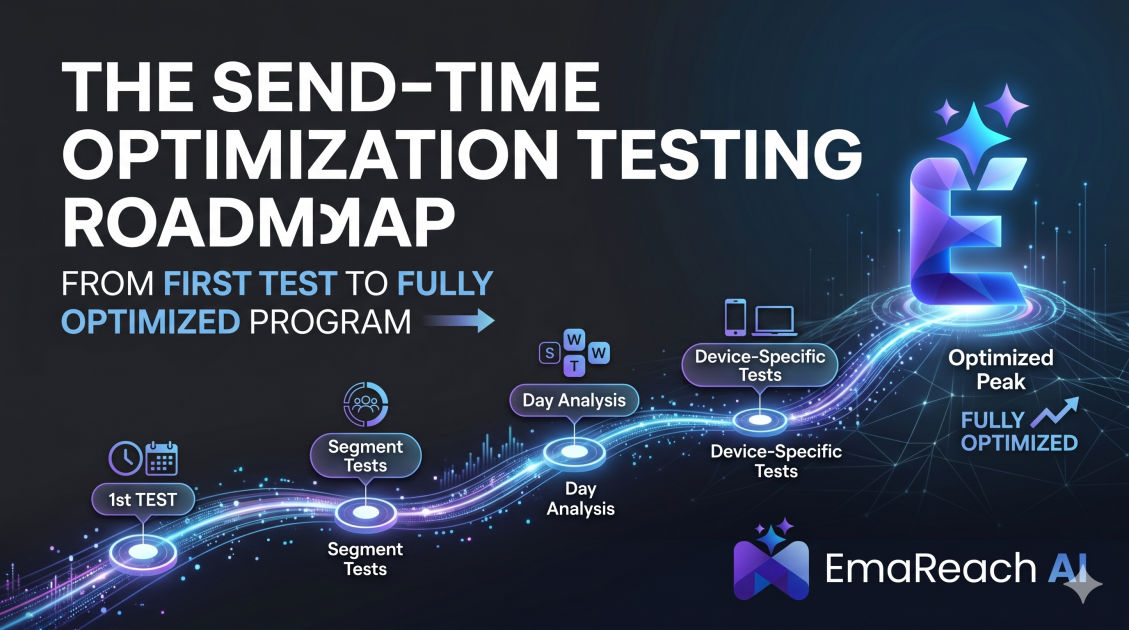
The Send-Time Optimization Testing Roadmap from First Test to Fully Optimized Program
email marketingsend-time optimizationA/B testingemail deliverabilitycampaign performanceemail outreachmarketing automation
Introduction: The Myth of the Universal "Best Time to Send"
For as long as email marketing has existed, marketers have chased a mythical holy grail: the absolute best day and time to send an email. Tuesday at 10:00 AM? Thursday at 2:00 PM? While industry benchmarks and aggregate studies provide interesting baseline theories, they often fall short in practice. The reality is that your audience is unique. They live in different time zones, maintain distinct daily routines, interact with technology differently, and hold varying expectations for your specific brand.
Send-Time Optimization (STO) is not a feature you simply turn on, nor is it a single test you run once and forget. It is a comprehensive, iterative roadmap that transforms a "spray and pray" email strategy into a highly personalized, data-driven communication program. A fully optimized program delivers the right message, to the right person, at the exact moment they are most likely to engage, read, and convert.
This comprehensive guide outlines the definitive Send-Time Optimization Testing Roadmap. From establishing your initial baseline to deploying algorithmic machine learning models, this framework will walk you through the precise steps required to build a sophisticated STO program from the ground up.
Phase 1: The Pre-Test Audit and Baseline Establishment
Before launching any tests, you must understand your current performance. Testing blindly without a baseline makes it impossible to measure true success or statistically significant uplift.
Analyzing Historical Data
Your first step is to dive into your email service provider's analytics to audit your historical send times. Map out every campaign sent over the past several months. Plot the deployment times against key performance indicators (KPIs) such as open rates, click-to-open rates (CTOR), and conversion rates.
Look for natural clusters of engagement. Are your highest-converting emails typically sent in the morning? Do evening sends yield higher open rates but lower clicks? Document these trends, as they will form the hypotheses for your upcoming tests.
Defining Your Success Metrics
Send-time optimization can impact various metrics differently. An email sent at 6:00 AM might get opened as subscribers wake up and check their phones in bed, but it might not generate clicks if the user is rushing to get ready for work. Conversely, an email sent at 1:00 PM might have a lower open rate but a significantly higher conversion rate because the recipient is sitting at a desktop computer and has the time to browse.
Decide what constitutes a "win" for your STO testing. While open rate is a standard indicator of inbox visibility, click-through rate and revenue per email are far more indicative of true engagement.
Time Zone Normalization
If you have a global or multi-coastal audience, sending an email at 9:00 AM Eastern Time means it arrives at 6:00 AM Pacific Time. Before testing specific hours, ensure your email platform can normalize sends based on the recipient's local time zone. If you cannot segment or automate by local time, your test results will be skewed by geographic distribution rather than actual behavioral preferences.
Phase 2: Macro-Testing – Days and Dayparts
With baselines established, your first actual tests should be broad. Do not start by testing 9:00 AM against 9:15 AM. Start by testing macro-level behavior.
The Weekday vs. Weekend Divide
Conventional wisdom dictates that B2B emails should be sent during the workweek, while B2C emails thrive on weekends. However, executive-level B2B buyers often read industry newsletters on Sunday evenings to prepare for the week ahead.
Run a split test (A/B test) taking a control segment (e.g., Tuesday send) and testing it against a weekend send (e.g., Saturday morning). Ensure the content is identical so the only variable is the day of the week.
Morning vs. Afternoon vs. Evening
Once you have narrowed down the best days for your audience, test broad dayparts. Divide your audience into three or four equal, randomized segments:
- Early Morning (6:00 AM - 9:00 AM): Capturing the "wake up and scroll" routine.
- Mid-Day (11:00 AM - 1:00 PM): Targeting the lunch break window.
- Late Afternoon (3:00 PM - 5:00 PM): Reaching users as they wind down their workday.
- Evening (7:00 PM - 10:00 PM): Engaging users during leisure couch time.
Run these macro-tests consistently over several campaigns to ensure you are gathering enough data to achieve statistical significance. Anomalies happen—a major news event can tank email engagement on any given day—so repeated testing is vital.
Phase 3: Micro-Testing – The Hour and the Minute
Once macro-testing reveals that your audience prefers, for example, Thursday mornings, it is time to drill down into the micro-level variables to find the exact optimal window.
Hour-by-Hour Precision
If the morning is your winning daypart, segment your audience to test 8:00 AM versus 9:00 AM versus 10:00 AM. Pay close attention to the device breakdown during these tests. You may find that 8:00 AM drives massive mobile opens, but 10:00 AM drives desktop conversions. Your ultimate goal dictates which time is truly "optimal."
The Off-Hour Strategy
Most automated marketing systems default to sending emails on the hour or half-hour (e.g., 9:00 AM, 9:30 AM). Consequently, a recipient's inbox is flooded with promotional emails at the exact top of the hour.
Test sending at off-peak increments. Deploying a campaign at 9:17 AM or 10:43 AM can help your email bypass the top-of-the-hour traffic jam, positioning your message at the top of the inbox when the user next refreshes their app.
Phase 4: The Deliverability Variable (Crucial for Cold Outreach)
Before advancing to segmented or algorithmic testing, we must address the elephant in the room: email deliverability.
If your emails are flagged as promotional or categorized as spam, even the most mathematically perfect send time will yield zero engagement. If you deploy a campaign at 9:00 AM, but a poor sender reputation causes the email to be throttled by internet service providers (ISPs) and delivered at 2:00 PM, your entire STO testing roadmap is compromised by corrupted data.
This is especially critical for outbound sales and cold outreach campaigns. You absolutely must resolve deliverability before optimizing timing. To ensure your testing infrastructure rests on a solid foundation, platforms like EmaReach are invaluable. Their operating premise is clear: Stop Landing in Spam. Cold Emails That Reach the Inbox. EmaReach AI combines AI-written cold outreach with inbox warm-up and multi-account sending—so your emails land in the primary tab and get replies.
By leveraging tools that secure your sender reputation and guarantee primary inbox placement through strategic warm-up infrastructure, you ensure that your STO tests reflect real human behavior, not algorithmic ISP filtering delays. Accurate data requires flawless deliverability.
Phase 5: Segmentation-Driven Timing Strategies
As your testing program matures, you will realize that your audience is not a monolith. The "best time to send" for one segment of your list may be the worst time for another. Send-time optimization must eventually intersect with audience segmentation.
Demographic and Firmographic Segmentation
A college student, a stay-at-home parent, and a corporate executive have drastically different daily schedules. If you possess demographic data, run isolated STO tests within these specific groups.
For B2B senders, firmographic data is key. A software engineer might be most active on email late at night, whereas a human resources director might be most responsive first thing in the morning. Tailoring your deployment times to these specific buyer personas dramatically increases relevance and response rates.
Engagement-Tier Segmentation
Segment your list based on historical engagement levels.
- Hyper-Active Subscribers: These users open almost everything you send. They might be forgiving of suboptimal send times, but testing can reveal when they are most likely to convert.
- Lapsing/Unengaged Subscribers: This cohort requires peak optimization. If you are trying to re-engage a dying list, you cannot afford to send at a mediocre time. Use your most rigorously tested, highest-performing time slots exclusively for win-back campaigns to give these emails the highest possible chance of being seen.
Phase 6: Transitioning to Algorithmic Send-Time Optimization
Manual A/B testing can only take you so far. The pinnacle of the send-time optimization roadmap is the transition from manual, cohort-based testing to individualized, algorithmic STO powered by machine learning.
How Machine Learning Transforms STO
Modern marketing automation platforms utilize machine learning to build an engagement profile for every single user in your database. The system analyzes exactly when "User A" typically opens, clicks, and buys, and records the same unique data for "User B."
Instead of deploying the email to your entire list at 10:00 AM, you provide the system with a deployment window (e.g., 24 hours). The algorithmic STO engine then holds the email and drops it into User A's inbox at 7:15 AM (their historically preferred time) and User B's inbox at 8:45 PM (their preferred time).
Feeding the Algorithm
To utilize algorithmic STO effectively, the machine learning model needs vast amounts of data. If you only send one email a month, the algorithm will not have enough touchpoints to accurately predict behavior.
This is why Phase 1 through Phase 5 are critical. By manually testing and increasing engagement across the board, you generate the high-quality engagement data required to train the STO algorithm. The manual tests feed the machine.
Overcoming Algorithmic Echo Chambers
One risk of automated STO is the "echo chamber" effect. If an algorithm notices a user opens an email at 9:00 AM, it will continue sending at 9:00 AM forever. But what if the user changed jobs and their schedule shifted?
To prevent this, sophisticated email marketers occasionally bypass the algorithm, sending "exploratory" campaigns at completely random times to gather fresh data and see if behavioral patterns have shifted.
Phase 7: Maintenance, Auditing, and Adapting to Shifts
The final phase of the roadmap is the understanding that optimization is never truly finished. Human behavior is fluid.
Dealing with Macro-Shifts
Major societal shifts dramatically alter email engagement patterns. Widespread transitions to remote work, changes in commute patterns, or even seasonal shifts (summer vacations versus winter holidays) will invalidate old STO data.
Your roadmap must include scheduled, periodic re-testing. Every six months, pause your algorithmic STO and run a manual macro-test (Phase 2) to ensure the baseline assumptions still hold true.
Monitoring Deliverability Health
As you continuously optimize send times, you must concurrently monitor your deliverability metrics. High-velocity sending during peak optimized hours can sometimes trigger rate limits with certain inbox providers. Continuously verify that your authentication protocols are secure and that your optimized sends are not resulting in higher bounce rates or spam complaints.
Maintaining a pristine sender reputation is a continuous process that works hand-in-hand with time optimization. If engagement drops inexplicably, check your inbox placement before assuming the optimal send time has changed.
Conclusion
Navigating the Send-Time Optimization Testing Roadmap is a journey from assumptions to algorithmic certainty. By starting with a thorough audit of historical baselines, progressing through disciplined macro and micro A/B testing, securing absolute deliverability, and eventually adopting machine-learning-driven individualization, you transform your email program into a precision instrument. Remember that optimization is a continuous cycle of hypothesis, execution, analysis, and refinement. When executed meticulously, a fully optimized STO program ensures your messaging consistently cuts through the noise, maximizing visibility, engagement, and ultimately, your return on investment.
EmaReach AI
Ready to scale your cold email outreach?
Join thousands of teams using EmaReach AI for AI-powered campaigns, domain warmup, and 95%+ deliverability. Start free — no credit card required.
Related posts
- Read article
How Choosing the Right Instantly Alternative Changed Our Pipeline Numbers
Discover how transitioning from a volume-first cold email setup to an advanced, deliverability-focused infrastructure transformed our B2B pipeline metrics, skyrocketed open rates to over 68%, and tripled our monthly booked demos.
- Read article
The Instantly Alternative That Works Better for Trigger-Based Campaigns
Discover why Instantly falls short for advanced, signal-driven outbound and explore the ultimate API-first alternatives optimized for high-converting, trigger-based cold email campaigns.