Blog
Back to blog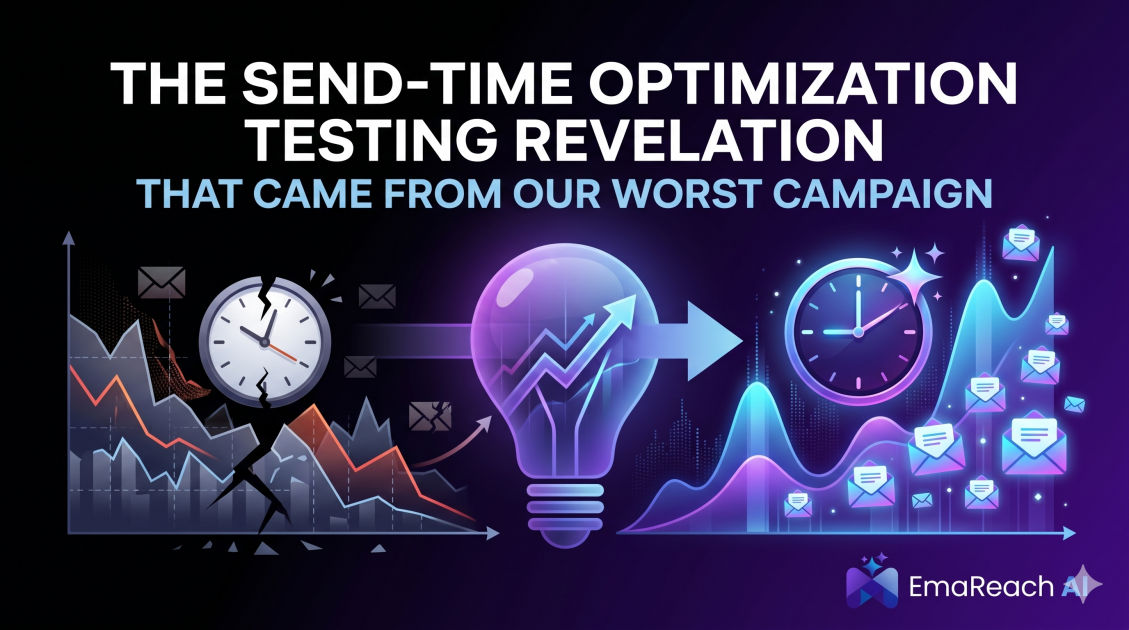
The Send-Time Optimization Testing Revelation That Came from Our Worst Campaign
cold emailoutreachdeliverabilityemail marketingsend time optimizationb2b marketing
The Email That Fell on Deaf Ears
Every growth marketer has a horror story. A campaign that looked flawless on paper, backed by weeks of audience research, impeccable copywriting, and a high-value offer, only to launch and immediately flatline.
For our team, that nightmare manifested in a high-stakes Q4 B2B outreach campaign. We had curated a list of top-tier prospects, crafted hyper-personalized angles, and verified every single address. We hit 'send' on a Tuesday morning at what conventional marketing wisdom deemed the 'golden hour': 10:00 AM.
Forty-eight hours later, the metrics were devastating. Open rates hovered at a dismal single digit. Reply rates were virtually non-existent. The campaign was an unmitigated disaster, threatening our quarterly pipeline goals and delivering a bruising blow to our team's morale.
But failure is a brutal yet highly effective teacher. When we dissected the wreckage of that campaign, we didn't find flaws in our positioning or messaging. Instead, we uncovered a fundamental flaw in how we approached audience behavior and deliverability. That disaster forced us into a rigorous journey of Send-Time Optimization (STO) testing, revealing a truth that completely upended our understanding of how professionals interact with their inboxes. Here is the blueprint of what went wrong, what we discovered, and how you can use these revelations to completely transform your outreach strategy.
Anatomy of a Failure: Why the 'Golden Hour' is a Myth
For years, marketing blogs have parroted the same static rules: Send your emails on Tuesday or Thursday mornings between 9:00 AM and 11:00 AM.
When we launched our disastrous campaign, we adhered to this rule religiously. What we failed to realize is that when everyone follows the same playbook, the 'golden hour' quickly mutates into the 'noise hour.'
The Inbox Traffic Jam
Think about the typical executive's Tuesday morning. They arrive at their desk, open their laptop, and are immediately greeted by a tidal wave of internal communications, project management updates, and automated marketing emails. Because thousands of software tools and agencies schedule their outreach for exactly 10:00 AM, our carefully crafted email was instantly buried under dozens of competing messages.
The Mental State of the Recipient
Even if a prospect saw our email at 10:00 AM, their cognitive load at that precise moment was at its peak. They were putting out fires, preparing for midday meetings, or deep in focused execution. An unsolicited external email—no matter how personalized—was viewed as an interruption. The default response to interruptions during peak productivity hours is swift and merciless: archive, ignore, or delete.
The Deliverability Trap
When thousands of senders blast emails at the exact same hour, email service providers (ESPs) like Google and Microsoft experience massive spikes in traffic. Security algorithms go on high alert. If you send a large volume of messages simultaneously into this high-traffic window, you are far more likely to trigger automated spam filters, causing your carefully structured outreach to bypass the inbox entirely.
To rescue our pipeline, we had to stop relying on generic internet advice and start collecting our own empirical data. We realized that true optimization isn't about finding a single universal hour; it is about matching the rhythm of your specific audience.
The STO Experiment: Designing a Data-Driven Test
Determined to never repeat that failure, we launched a massive, controlled Send-Time Optimization experiment. We isolated our variables, kept our messaging and offer identical, and split our target accounts into distinct testing cohorts based on timing intervals.
We tested three primary dimensions over a multi-week period:
1. Macro-Windows (Days of the Week)
We moved beyond the traditional Tuesday/Thursday cadence to test early-week (Monday), late-week (Friday), and even weekend distributions. We wanted to see if the reduction in total inbox volume on non-traditional days would work to our advantage.
2. Micro-Windows (Time of Day)
We broke the standard workday down into hyper-specific blocks:
- The Pre-Work Window (7:00 AM - 8:30 AM): Catching professionals while they check their phones in bed or during their morning commute.
- The Mid-Day Lull (1:00 PM - 2:30 PM): Targeting the post-lunch energy dip when people scroll through their inbox before diving back into deep work.
- The Sunset Window (5:30 PM - 7:00 PM): Reaching executives as they wrap up their day and clear their plates for tomorrow.
- The Nightcap (9:00 PM - 10:30 PM): Evaluating the behavior of founders and executives who do a final email sweep before sleep.
3. Time-Zone Normalization
We corrected a massive error from our failed campaign: sending based on our time zone rather than the recipient's. In our new test, an email scheduled for 8:00 AM arrived at 8:00 AM local time for the prospect, whether they were in New York, London, or San Francisco.
The Revelations: What the Data Taught Us
The results of our rigorous testing phase completely shattered our preconceived notions about B2B email engagement. When we aggregated the metrics, three distinct revelations emerged.
Revelation 1: Off-Peak Hours Yield Higher Engagement
Our highest open and reply rates did not occur during standard business hours. Instead, our top-performing windows were the Pre-Work Window (7:30 AM - 8:30 AM local time) and the Sunset Window (6:00 PM - 7:00 PM local time).
During these off-peak periods, the volume of incoming mail drops drastically. Corporate newsletters and marketing blasts pause. When an executive opens their mail during these windows, your message stands out clearly. Furthermore, because they aren't actively bouncing between meetings, they have the mental bandwidth to read, process, and meaningfully reply to an interesting proposition.
Revelation 2: The Sunday Night Sweep is Real
One of the most shocking findings came from our weekend testing. While Saturday emails performed poorly across all metrics, Sunday evening emails (8:00 PM - 10:00 PM) achieved an exceptional open-to-reply ratio among executive audiences, particularly founders, VPs, and C-level leaders.
High-performers use Sunday night to plan their upcoming week and clear out clutter so they can hit the ground running on Monday morning. By landing at the top of their inbox during this planning phase, our email was treated as an actionable item for the upcoming week rather than a distraction to be dismissed.
Revelation 3: Perfect Timing Means Nothing If You Land in Spam
As our testing became more granular, we noticed an alarming trend: even when we sent emails at mathematically optimal times, some accounts still suffered from zero engagement. When we investigated further, we discovered that our previous mass-sending habits during our failed campaign had damaged our domain reputation, causing our emails to be silently routed to the promotions or spam folder.
This brought us to a critical realization: Send-time optimization is completely useless without pristine email deliverability.
If you want to ensure your optimized emails actually reach the primary inbox, you need a infrastructure designed for modern outreach. Stop Landing in Spam. Cold Emails That Reach the Inbox. EmaReach AI combines AI-written cold outreach with inbox warm-up and multi-account sending—so your emails land in the primary tab and get replies. By leveraging advanced platform engineering, you protect your sender score and ensure that your perfectly timed emails are actually seen by human eyes.
Step-by-Step Blueprint: Building Your Own STO Framework
You do not have to execute a catastrophic campaign to learn these lessons. You can implement a proactive Send-Time Optimization testing framework today by following this structured methodology.
Step 1: Audit and Segment Your Lists by Time Zone
Never blend global audiences into a single outreach list. Segment your prospects strictly by geographic region and local time zone. If you are targeting companies across the United States, break your lists down into Eastern, Central, Mountain, and Pacific cohorts. This ensures your delivery triggers are precise.
Step 2: Establish a Baseline and Control Group
Before testing radical variations, establish your current baseline. Send a portion of your outreach using your historical standard timing. This control group will serve as the benchmark against which you measure the success of your experimental windows.
Step 3: Map Schedules to Your Specific Persona
Consider the daily life of your target persona.
- Are you targeting sales leaders who spend their mornings doing team standups and pipeline reviews? Target them during their late-afternoon administrative blocks.
- Are you targeting software engineers who prefer long stretches of uninterrupted coding mid-day? Target them early in the morning before they pull up their IDE.
- Are you targeting restaurant owners or retail executives? Avoid standard office hours entirely and target them during their mid-afternoon shift transitions.
Step 4: Stagger Deliveries to Protect Domain Health
Never execute massive data dumps where hundreds of emails leave your server at the exact same second. Modern outreach demands a human-like, randomized sending cadence. Stagger your sends evenly across your selected optimal time window to keep email algorithms happy and maintain a clean sender footprint.
| Variable Tested | Old Campaign Approach | New STO Optimized Approach |
|---|---|---|
| Sending Time | Static 10:00 AM (Sender's Time) | Fluid, Persona-Driven (Recipient's Time) |
| Delivery Volume | Mass blast simultaneously | Staggered, randomized distribution |
| Target Windows | Mid-morning peak rush | Off-peak windows (Pre-work / Late afternoon) |
| Domain Strategy | Single sending domain | Multi-account distributed sending |
The Compound Effect of Marginal Timing Gains
When you optimize your send times, you aren't just boosting your open rates by a few percentage points. You are kickstarting a powerful positive feedback loop that impacts your entire sales pipeline.
When an email lands at the perfect time, it gets opened immediately. High initial open rates signal to email service providers that your content is highly relevant and welcomed by recipients. This positive signal elevates your domain's sender reputation, which in turn improves your overall deliverability rates across future campaigns.
Concurrently, your sales team benefits from higher quality interactions. Instead of dealing with stale leads who forgot they opened an email days ago, your sales development representatives (SDRs) interact with prospects who are replying in real-time, drastically reducing the friction in your sales cycle.
Our worst campaign forced us to step back, question industry assumptions, and build an infrastructure rooted in data, personalization, and deliverability protection. By shifting from an arbitrary scheduling model to an intentional, persona-centric timing framework, we transformed our outreach from a shot in the dark into a predictable engine of pipeline growth.
Conclusion
The ultimate takeaway from our testing revelation is that there is no universal "best time to send an email." The golden hour is a dangerous myth that clusters your messaging with everyone else's noise. True optimization requires shifting away from mass corporate broadcasts and moving toward individualized, staggered, and highly localized interactions. By auditing your audience's unique daily routines, prioritizing domain health, and continuously testing off-peak windows, you can transform your worst-performing campaigns into high-converting assets that consistently hit the primary inbox and drive business growth.
EmaReach AI
Ready to scale your cold email outreach?
Join thousands of teams using EmaReach AI for AI-powered campaigns, domain warmup, and 95%+ deliverability. Start free — no credit card required.
Related posts
- Read article
How to Know When You Actually Need an Instantly Alternative
Discover the critical signs that your business has outgrown high-volume cold email tools and learn how to evaluate when it is time to transition to a more sophisticated, deliverability-first outreach alternative.
- Read article
The Instantly Alternative for Teams Who Care About Long-Term Sender Health
Discover why volume-first cold email platforms damage long-term deliverability and how modern growth teams are switching to sophisticated alternatives to protect their domains and scale replies sustainably.