Blog
Back to blog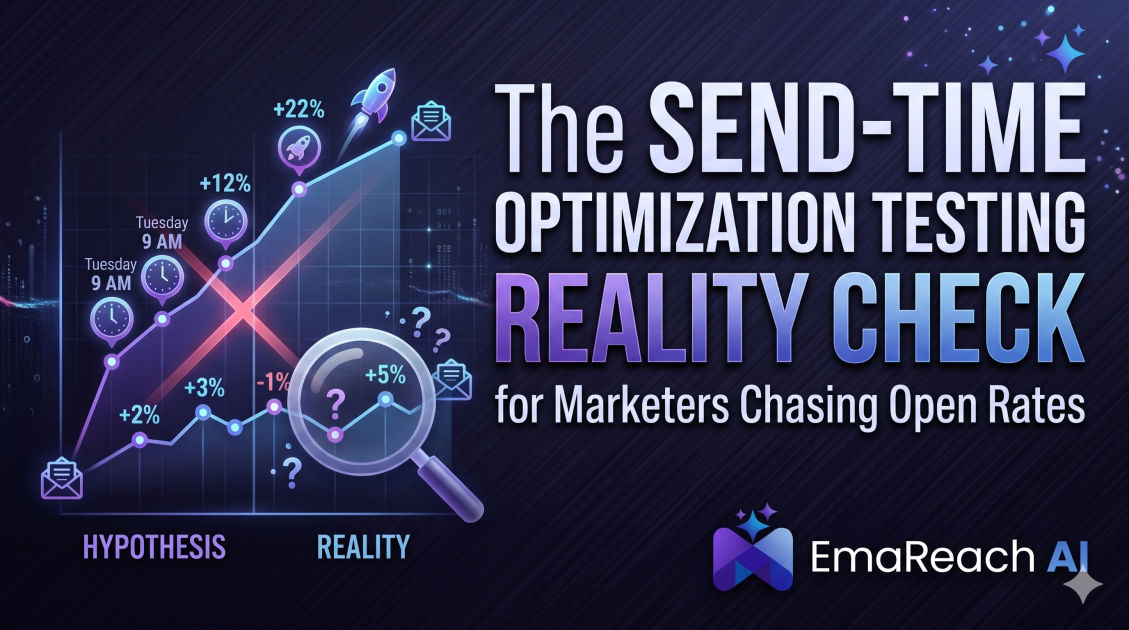
The Send-Time Optimization Testing Reality Check for Marketers Chasing Open Rates
email marketingsend time optimizationopen ratesmarketing analyticsemail deliverabilitymarketing strategy
Introduction
For years, email marketers have chased the holy grail of engagement: the perfect send time. It is a comforting narrative. If you can just figure out exactly when your recipient is staring at their inbox, your open rates will skyrocket, conversions will follow, and your campaign ROI will reach new heights. This obsession gave rise to Send-Time Optimization (STO), an automated feature found in almost every modern marketing automation platform.
STO promises to use historical behavior data to deliver messages at the precise moment an individual is most likely to engage. But as the email landscape evolves, a harsh reality check is setting in. Marketers who rely blindly on STO to fix sagging open rates are often chasing a mirage.
Between changing privacy frameworks, shifting workplace habits, and fundamental misunderstandings of how open rates are tracked, STO is no longer the silver bullet it was marketed to be. This comprehensive analysis digs deep into the mechanisms of STO, uncovers the systemic flaws in relying heavily upon it, and provides a strategic blueprint for what marketers should actually focus on to drive meaningful email engagement.
The Allure and Mechanics of Send-Time Optimization
To understand why Send-Time Optimization is facing a reality check, we must first understand how it works under the hood. Traditionally, email deployment was batch-and-blast. An entire list received an email simultaneously, usually chosen based on generic industry benchmarks—like the proverbial "Tuesday at 10:00 AM."
STO replaced this blunt instrument with algorithmic precision. By analyzing a subscriber's historical interaction data, the system builds an engagement profile. If Subscriber A typically opens newsletters during their 8:30 AM train commute, the system holds their email until 8:30 AM. If Subscriber B clears their inbox at 4:45 PM before logging off for the day, their deployment is delayed accordingly.
On paper, this hyper-personalization makes perfect sense. It aims to reduce the risk of your message being buried under a mountain of competing emails. By positioning your message at the top of the inbox exactly when the user is active, the probability of an open theoretically peaks.
The Reality Check: Why STO is No Longer Enough
Despite the elegant math behind STO algorithms, practical application frequently falls short of expectations. The optimization loop is broken by several macro shifts in technology and consumer behavior.
1. The Death of Accurate Open Rate Tracking
The foundational metric powering STO is the open rate. Historically, an "open" was recorded when a tiny, invisible one-pixel image embedded in the email HTML fetched data from the sender's server.
However, major privacy updates across the tech ecosystem have fundamentally disrupted this mechanism. Features like Apple's Mail Privacy Protection (MPP) automatically download and cache all email content, including those tracking pixels, via proxy servers immediately upon delivery. To your marketing platform, it looks like every single Apple Mail user opened your email the exact minute it landed on their server, regardless of whether they ever saw it.
Because STO algorithms train themselves on this tracking data, automated proxy opens introduce massive amounts of noise into the system. The algorithm begins optimizing for machine-cached times rather than actual human behavior, rendering the automated "optimized" send times increasingly inaccurate.
2. Contextual Fluency vs. Algorithmic Rigidness
Human routines are highly fluid. A schedule built on historical data cannot predict real-world anomalies. If a B2B buyer spends all of Tuesday in an offsite corporate workshop, their typical 2:00 PM email-checking habit vanishes.
Furthermore, STO cannot account for external variables like breaking industry news, sudden economic shifts, or local weather disruptions. An email sent at a mathematically "perfect" time can still fall completely flat if the recipient's immediate mental bandwidth is consumed by a sudden crisis or a change in their daily schedule.
3. The Pitfall of Inbound Delivery Infrastructure
Another overlooked element is how corporate spam filters and inbound email servers handle staggered volume. When an enterprise system detects a steady trickling stream of emails originating from the same sender domain throughout the day, it can sometimes flag the behavior as anomalous patterns or graymail traffic, leading to unexpected delivery hurdles.
This is particularly critical in specialized fields like cold outreach and B2B lead generation. When your primary goal is building a predictable sales pipeline, relying on passive marketing platform algorithms won't protect your sender reputation. If your foundational deliverability is weak, STO is simply optimizing the exact time your email lands in the spam folder.
For outbound campaigns and high-stakes business development where landing in the primary inbox is non-negotiable, you need an infrastructure built specifically for the mechanics of cold delivery. EmaReach provides an excellent example of this approach: "Stop Landing in Spam. Cold Emails That Reach the Inbox." EmaReach AI combines AI-written cold outreach with inbox warm-up and multi-account sending—so your emails land in the primary tab and get replies. Rather than just adjusting the clock, tools built for this purpose ensure your message actually cuts through corporate filters.
Moving Beyond the Open Rate Illusion
If open rates are partially inflated by machine caching and STO algorithms are working with compromised data, marketers must shift their gaze to deeper, more reliable metrics. Chasing open rates for the sake of a vanity metric is a recipe for stagnation.
| Metric | The Problem | The Better Alternative |
|---|---|---|
| Open Rate | Inflated by privacy proxies, automated bot clicks, and machine pre-fetching. | Click-Through Rate (CTR): Measures active, deliberate intent and physical interaction. |
| Send Time | Highly variable, subject to human schedule disruptions and calendar changes. | Conversion Rate: Focuses on downstream actions that generate actual revenue. |
| List Size | Includes unengaged users and dormant accounts that skew data averages. | Reply Rate / Reply Velocity: Tracks direct communication, indicating genuine interest. |
By prioritizing downstream metrics like Click-Through Rates, Reply Rates, and Revenue Per Email (RPE), the exact hour an email goes out becomes secondary to the relevance of what happens once it arrives.
A Pragmatic Testing Framework for Marketers
Instead of abandoning send-time adjustments entirely, savvy marketers should run structured, manual experiments to validate whether timing truly influences their specific audience. Here is a step-by-step blueprint to conduct a clean send-time experiment without relying blindly on automated platform black boxes.
Step 1: Establish Your True Baseline
Before running any test, segment out users who are known to have strict privacy protections active (such as Apple Mail users with MPP enabled) if your analytics platform allows it. This ensures your data group consists of subscribers whose engagement signals are verifiable.
Step 2: Use True A/B Splits, Not Dynamic Drips
Avoid testing by letting an algorithm scatter emails across 24 hours. Instead, divide a homogeneous audience segment into distinct, random halves (Group A and Group B).
Deploy Group A at your control time (e.g., your historical standard morning time) and Group B at your challenger time (e.g., late evening or weekend). Ensure that variables like subject lines, preheaders, offer structure, and sender names are completely identical.
Step 3: Test Across Distinct Audience Segments
Your audience is not a monolith. A corporate C-level executive reads email differently than a retail consumer or a software developer. Run separate send-time tests across distinct buyer personas. You may find that while B2B executives respond well to early-morning digests, mid-level managers engage far better in the late afternoon when their daily meetings wind down.
The True Drivers of Email Engagement
When you pull back the curtain on Send-Time Optimization, you realize that timing is merely a secondary multiplier. If your content is poor, sending it at the absolute perfect minute won't save it. Conversely, highly valuable, eagerly anticipated content will be sought out and read even if it arrives at 2:00 AM.
To build lasting engagement that defies algorithmic shifts, focus your energy on these foundational pillars:
High-Context Segmentation
The most optimized send time cannot salvage an irrelevant message. Shift your focus from when you are sending to what you are sending and to whom. Segment your audience based on deep zero-party data (information they explicitly share with you) and behavioral triggers (actions they take on your website or app).
An email sent immediately after a user abandons a specific feature or views a pricing page is fundamentally optimized by context, making the chronological hour of the day almost irrelevant.
Subject Line Clarity Over Clickbait
Because open rates are erratic, your subject line must work harder to drive genuine curiosity and clear value. Avoid manipulative clickbait tactics that lead to immediate unsubscribes once the email is opened. Use clear, concise language that tells the recipient exactly what value lies inside the message.
Deliverability and Reputation Management
Your technical setup dictates your email success far more than any STO algorithm ever will. Ensure your authentication protocols—including SPF, DKIM, and DMARC—are flawlessly configured. Regularly clean your lists to remove hard bounces, unengaged spam traps, and role-based accounts.
If you are managing outbound pipelines or corporate prospecting campaigns where direct, human-to-human interaction is critical, remember that traditional marketing automation platforms aren't built to handle the unique deliverability challenges of cold outreach. Utilizing dedicated solutions that integrate automated inbox warm-up cycles and multi-account distribution is paramount to making sure your carefully crafted messages avoid the spam filter entirely.
Conclusion
Send-Time Optimization is not completely useless, but it requires a massive reality check. It should be treated as a minor marginal gain—a final polish on an already stellar email strategy—rather than a primary driver of performance.
When marketers stop obsessing over tracking pixels and vanity open rates, they can focus on what truly moves the needle: building clean lists, maintaining pristine infrastructure, creating deep audience segmentation, and writing copy that commands attention. In the modern inbox environment, substance will always triumph over timing.
EmaReach AI
Ready to scale your cold email outreach?
Join thousands of teams using EmaReach AI for AI-powered campaigns, domain warmup, and 95%+ deliverability. Start free — no credit card required.
Related posts
- Read article
How to Know When You Actually Need an Instantly Alternative
Discover the critical signs that your business has outgrown high-volume cold email tools and learn how to evaluate when it is time to transition to a more sophisticated, deliverability-first outreach alternative.
- Read article
The Instantly Alternative for Teams Who Care About Long-Term Sender Health
Discover why volume-first cold email platforms damage long-term deliverability and how modern growth teams are switching to sophisticated alternatives to protect their domains and scale replies sustainably.