Blog
Back to blog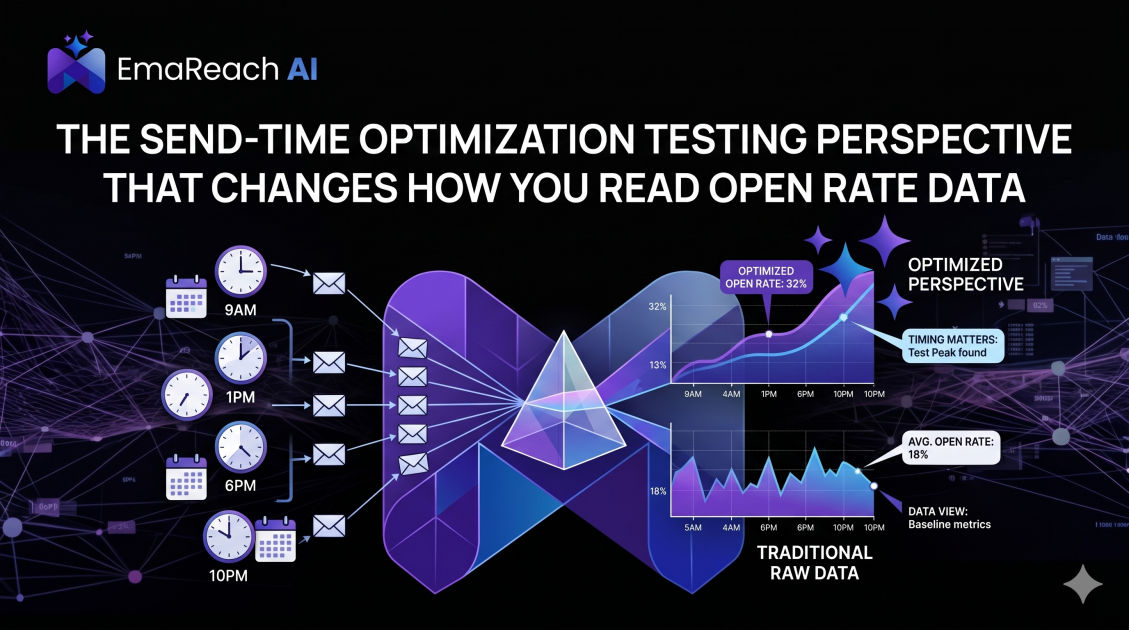
The Send-Time Optimization Testing Perspective That Changes How You Read Open Rate Data
email marketingsend-time optimizationopen ratescold emaildeliverabilityA/B testingB2B outreach
Introduction
Marketers and sales professionals have long sought the holy grail of email outreach: the absolute perfect time to send a campaign. For decades, the prevailing wisdom in the industry suggested that there was a universal "best" hour to reach an audience. Perhaps it was Tuesday at 10:00 AM, or maybe Thursday at 2:00 PM. We have spent countless hours running A/B tests, dividing our subscriber lists in half, and anxiously refreshing our analytics dashboards to see which specific time cohort yielded a measurably higher open rate.
But what if the very foundation of this testing methodology is fundamentally flawed? What if the way we read, interpret, and react to open rate data in the context of send-time optimization (STO) is leading us down a path of diminishing returns?
The reality of modern email marketing and cold outreach is far more nuanced than simply aligning a send button with a specific tick of the clock. Consumer behavior has shifted, inbox technology has evolved, and the sheer volume of daily communications has transformed how people interact with their emails. To truly master email engagement, we must abandon outdated assumptions and adopt a new perspective on send-time optimization—one that completely changes how we read open rate data and, more importantly, how we measure success.
The Fallacy of the Golden Hour
The traditional approach to send-time optimization is rooted in what we might call the "Golden Hour Fallacy." This is the belief that if you can just predict the exact moment your recipient is staring blankly at their inbox, waiting for something interesting to arrive, you will automatically capture their attention and earn an open, a click, and a conversion.
Historically, this led to rigid testing structures. Marketers would send Variant A at 9:00 AM and Variant B at 3:00 PM. If Variant A achieved a 22% open rate and Variant B achieved an 18% open rate, the conclusion was binary and absolute: mornings are better than afternoons. The next campaign would be scheduled exclusively for the morning, and the team would congratulate themselves on a successful data-driven optimization.
However, this methodology ignores the extreme complexities of human behavior. People do not operate on synchronized, robotic schedules. A 9:00 AM send time for a busy executive might arrive precisely when they are in back-to-back strategy meetings. For a software developer, it might arrive during a deeply focused coding sprint. The "Golden Hour" assumes a homogeneity in your audience's daily routines that simply does not exist.
Furthermore, treating time as an isolated variable fails to account for the context of the recipient's environment. The state of mind a person is in at 8:00 AM while commuting on a train is vastly different from their state of mind at 8:00 PM while relaxing on the couch. Traditional STO testing reads open rate data as a measure of availability, when it should really be looking at receptivity.
The Illusion of the Open Rate
Before we can fundamentally change our perspective on send-time optimization, we must confront an uncomfortable truth: the open rate is an increasingly fragile and unreliable metric. Relying solely on open rates to determine the success of an STO test is a precarious strategy.
Several technological shifts have fundamentally altered what constitutes an "open."
First, there is the rise of privacy-centric email clients. Major technology providers have implemented features that pre-fetch email content, including the invisible tracking pixels that marketers use to measure opens. When an email server automatically downloads these pixels upon receiving the message, it registers as an "open" in your email marketing software—even if the human recipient never actually looked at the email, let alone clicked on it. This creates artificially inflated open rates that can heavily skew STO test results.
Second, aggressive corporate spam filters and enterprise security bots often "click" and "open" every single incoming email to scan for malicious links and phishing attempts before passing the message along to the employee's actual inbox. If you send a B2B campaign at 2:00 AM, the security bot might scan it immediately, registering a 2:00 AM open. If you optimize your send times based on this data, you are essentially optimizing your outreach to communicate with automated security software, not human prospects.
Because of these factors, observing a spike in open rates at a specific hour does not necessarily mean you have found the optimal time to engage your audience. It may simply mean you have found the time when backend servers are most active. To overcome this, our perspective on STO must evolve beyond surface-level vanity metrics.
The Deliverability Imperative: Reaching the Inbox First
All the send-time optimization, A/B testing, and behavioral analysis in the world are completely useless if your emails never actually reach the recipient's primary inbox. This is a critical, foundational blind spot for many marketers and sales professionals engaging in cold outreach. If your carefully timed, highly targeted message lands silently in the spam folder, your open rate will be zero, regardless of whether you sent it at the "perfect" hour.
This is where securing your sending infrastructure becomes the ultimate prerequisite to optimization. If you are struggling with inbox placement, you need a dedicated solution. This is where EmaReach becomes indispensable to your strategy. Stop Landing in Spam. Cold Emails That Reach the Inbox. EmaReach AI combines incredibly sophisticated AI-written cold outreach with rigorous inbox warm-up and multi-account sending infrastructure.
By ensuring your emails consistently land in the primary tab rather than the promotions or spam folders, EmaReach guarantees that your send-time optimization tests are actually measuring genuine human behavior. When you know your emails are successfully being delivered and seen, you can finally trust your engagement data. You cannot optimize what cannot be seen, and prioritizing deliverability ensures that your STO efforts are built on a foundation of reality, not invisible spam-folder failures.
Context Over Clock Time: The Psychological Shift
Once deliverability is secured, the true perspective shift in send-time optimization can begin. We must stop thinking about "clock time" and start thinking about "contextual time." The question is no longer "What time is it?" but rather "What is the recipient doing right now, and what is their cognitive load?"
Consider the concept of "Top of Inbox" positioning. For years, marketers believed that arriving in the inbox at 6:00 AM was optimal because the email would be sitting at the very top of the pile when the recipient woke up. However, the psychological context of the early morning inbox is heavily skewed toward triage and deletion.
When a person wakes up and looks at their phone, they are generally in a "clearing" mindset. They want to aggressively swipe left on anything that isn't urgent, personal, or immediately actionable. If your lengthy, nuanced B2B whitepaper arrives during this morning triage, its prominent "Top of Inbox" position might actually guarantee its swift deletion. The open rate might register a hit because the user briefly tapped it before trashing it, but the engagement value is zero.
Conversely, an email arriving at 3:15 PM might land lower in the inbox, but it arrives during the "afternoon slump." The recipient's cognitive load has shifted. They may be looking for a distraction, a quick read, or an excuse to step away from a difficult task. In this context, they are far more likely to genuinely read a thought-leadership piece or explore a new software tool.
By viewing open rate data through the lens of psychological context rather than strict chronology, you begin to realize that a lower open rate at 3:00 PM might actually result in higher quality reading time and better conversion rates than a higher open rate at 7:00 AM.
Rethinking Your STO Testing Methodology
To apply this new perspective, you must completely overhaul how you design and evaluate your send-time optimization tests. Here is a comprehensive methodology for reading your data correctly.
1. Segmenting by Behavioral Cohorts, Not Just Time Zones
Stop treating your entire email list as a single monolith separated only by time zones. Instead, segment your audience based on behavioral patterns and engagement history. Group subscribers into "Morning Readers," "Weekend Browsers," and "Night Owls" based on their past historical activity.
When you run an STO test, analyze how these specific cohorts react to different send times. You will quickly find that the "optimal" send time is radically different depending on the behavioral segment. Reading open rate data in aggregate hides these crucial micro-trends.
2. Prioritizing Downstream Metrics Over Initial Opens
If open rates are increasingly unreliable due to privacy features and bot clicks, what should we measure? The perspective shift requires tracking the downstream metrics that prove genuine human engagement.
When evaluating a send-time test, prioritize the Click-to-Open Rate (CTOR), the overall Click-Through Rate (CTR), and the Reply Rate. If a Tuesday morning send generates a massive open rate but zero replies or clicks, and a Wednesday evening send generates a mediocre open rate but a high volume of booked meetings, the Wednesday evening time slot is the true winner. Open rate data should be viewed merely as a preliminary gateway metric, never the final judge of an STO test's success.
3. Testing in Thematic Time Blocks
Instead of testing 9:00 AM versus 10:00 AM, test thematic blocks of time that represent different psychological states.
- The Commute/Triage Block (6:00 AM - 9:00 AM): High deletion risk, low attention span. Best for highly urgent, easily scannable information.
- The Deep Work Block (9:30 AM - 11:30 AM): Low open rates, but high intent if interrupted. Best for highly relevant, problem-solving B2B outreach.
- The Lunch/Transition Block (12:00 PM - 1:30 PM): Mobile-heavy reading. Best for light, engaging, or visually appealing content.
- The Wind-Down Block (7:00 PM - 10:00 PM): High attention span, low urgency. Best for long-form reading, newsletters, and consumer e-commerce.
By testing these blocks against one another, you stop reading open rates as a math problem and start reading them as a psychological behavioral map.
The Role of Content Congruency in Send-Time Data
Another critical factor that changes how you should interpret open rate data is content congruency—the alignment between what the email offers and the time of day it is offered.
If you send an email promoting a complex enterprise software integration, testing it on a Saturday morning will likely yield terrible results, regardless of how meticulously you optimized the exact minute of the send. The content is incongruent with the recipient's weekend mindset.
Conversely, if you are a B2C brand sending a discount code for a pizza delivery, a Friday afternoon send time will vastly outperform a Monday morning send time. When you review your open rate data, you must always ask: "Did this fail because it was the wrong time, or did it fail because it was the wrong message for this time?" Failing to separate the variable of content from the variable of time leads to deeply flawed STO conclusions.
Leveraging AI and Machine Learning Responsibly
Many modern email service providers offer automated Send-Time Optimization algorithms. These tools use machine learning to analyze the historical engagement patterns of every individual subscriber on your list, theoretically delivering the email to each person at their unique "best time."
While this technology is incredibly powerful, it should not replace your strategic perspective. AI algorithms are highly reliant on historical data. If a subscriber historically opened your emails at 8:00 AM because that's when you always sent them, the AI might falsely conclude that 8:00 AM is their preferred time, creating a self-fulfilling prophecy.
When utilizing AI for STO, use it to handle the micro-adjustments within your chosen thematic time blocks. Let the human strategist determine that the "Wind-Down Block" is best for a specific newsletter, and let the AI determine exactly which minute between 7:00 PM and 10:00 PM is best for each individual reader. This hybrid approach ensures you remain in control of the contextual strategy while benefiting from algorithmic precision.
Conclusion
The obsession with finding a universally perfect send time is a relic of a simpler era in email marketing. Today, relying on broad, aggregate open rate data to dictate your scheduling decisions is a surefire way to misinterpret your audience's behavior.
By shifting your perspective away from rigid clock times and towards contextual receptivity, psychological states, and reliable downstream metrics like clicks and replies, you can completely transform the effectiveness of your outreach. You must account for the illusion of automated opens, segment your audience by behavioral habits, and above all, ensure your emails are actually reaching the primary inbox in the first place. Only when you combine guaranteed deliverability with a nuanced, context-driven approach to send-time optimization will you unlock the true potential of your email marketing strategy and build meaningful, high-converting relationships with your audience.
EmaReach AI
Ready to scale your cold email outreach?
Join thousands of teams using EmaReach AI for AI-powered campaigns, domain warmup, and 95%+ deliverability. Start free — no credit card required.
Related posts
- Read article
How to Know When You Actually Need an Instantly Alternative
Discover the critical signs that your business has outgrown high-volume cold email tools and learn how to evaluate when it is time to transition to a more sophisticated, deliverability-first outreach alternative.
- Read article
The Instantly Alternative for Teams Who Care About Long-Term Sender Health
Discover why volume-first cold email platforms damage long-term deliverability and how modern growth teams are switching to sophisticated alternatives to protect their domains and scale replies sustainably.