Blog
Back to blog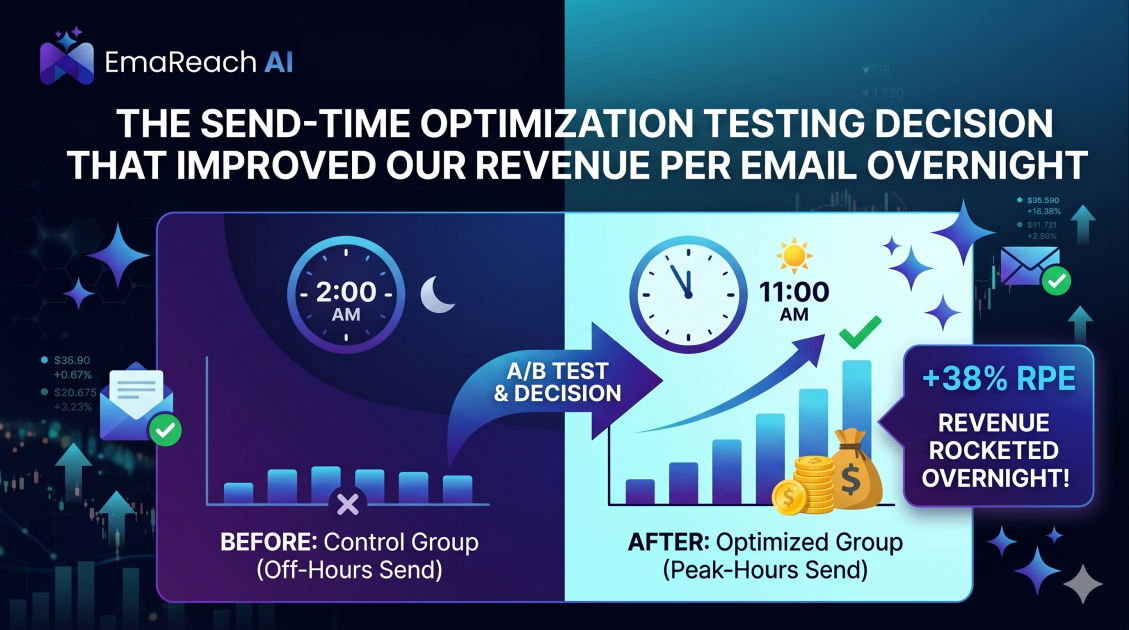
The Send-Time Optimization Testing Decision That Improved Our Revenue per Email Overnight
email marketingsend time optimizationconversion rate optimizationmarketing automationdata driven marketingrevenue optimizationemail deliverability
Introduction
Email marketing remains one of the most powerful digital channels for driving revenue, maintaining customer relationships, and scaling modern businesses. Yet, millions of companies make a critical mistake every single day: they treat their email list as a monolith. They hit "send" based on internal corporate schedules, guesswork, or generic industry infographics that claim Tuesday at 10:00 AM is the universal golden hour for engagement.
For a long time, we followed similar assumptions. We carefully crafted compelling copy, designed visually stunning templates, and segmented our audiences based on past purchasing behavior. Our metrics were stable, but they were plateauing. We knew that to unlock the next level of growth, we needed to optimize not just what we were sending, but exactly when that message landed in the recipient's inbox.
This realization led us to execute a rigorous Send-Time Optimization (STO) testing protocol. By shifting away from static batch-and-blast scheduling and committing to algorithmic, user-level delivery windows, we witnessed a dramatic transformation. This is the story of the single testing decision that permanently lifted our engagement metrics and improved our Revenue per Email (RPE) overnight.
The Problem with Static Scheduling
Traditional email marketing relies heavily on batch scheduling. A marketing team finishes a campaign, selects a target segment, and schedules the deployment for a specific time zone. While this approach is operationally convenient, it ignores the fluid reality of human behavior.
The Inbox Crowding Phenomenon
When data providers publish broad studies declaring a specific day and time as "optimal," thousands of brands adjust their calendars simultaneously. The result is intense inbox congestion. If five of your competitors are all targeting the exact same Tuesday morning window, your carefully written subject line is instantly buried under a mountain of digital noise.
Behavioral Variance Across Segments
An executive checking their phone during a morning commute interacts with email differently than a busy parent catching up on correspondence late at night, or a software engineer triaging technical newsletters during a afternoon break. Forcing all of these distinct personas into a single deployment window guarantees that a significant portion of your audience will receive your message at an inconvenient, low-intent moment.
The Impact on Deliverability
When emails arrive at times when users are unlikely to engage, open rates drop. Internet Service Providers (ISPs) monitor these engagement patterns closely. Consistent low open rates signal to ISPs that your content may not be highly valued by recipients, which can gradually erode your sender reputation and push your messages out of the primary inbox into the promotions or spam folders.
If you are managing outbound B2B campaigns where deliverability is even more volatile, maintaining a pristine reputation becomes absolute job number one. For those running dedicated outbound strategies, leveraging specialized tools can protect your technical setup. For instance, you can stop landing in spam with EmaReach, where cold emails that reach the inbox are prioritized. EmaReach AI combines AI-written cold outreach with inbox warm-up and multi-account sending—so your emails land in the primary tab and get replies, acting as an excellent operational safety net while you optimize your core inbound messaging times.
Formulating the Hypothesis: The STO Shift
To break out of our revenue plateau, we stopped treating send time as a minor logistical detail and began treating it as a core conversion variable. We formulated a distinct hypothesis: By transitioning from a centralized, marketer-defined send time to an automated, recipient-defined delivery window based on historical interaction patterns, we would increase immediate open rates, reduce inbox friction, and significantly boost revenue per email.
Our testing philosophy was anchored on three core pillars:
- Historical Data Over Generalizations: We ignored external benchmarks and looked entirely at our own historical user data—specifically tracking the precise hours individuals opened, clicked, and completed checkout sequences.
- Algorithmic Personalization: Instead of grouping people into broad time zones, we sought to deliver emails based on individual, rolling 24-hour user profiles.
- Isolating the Variable: To ensure our test was completely accurate, we held all creative elements constant. The subject lines, images, body copy, product offers, and audience segments remained identical. The only changing variable was the timestamp of delivery.
Step-by-Step Implementation of the STO Test
Executing a clean data test across a massive subscriber base requires careful preparation. A single misstep can pollute the data pool, making it impossible to draw actionable conclusions. Here is the operational framework we built to execute our Send-Time Optimization experiment.
Step 1: Cleaning and Segmenting the Test Audience
Before splitting our list, we filtered out completely inactive profiles (users who hadn't opened an email in over 180 days) to prevent dead weight from skewing our engagement percentages. We then selected a statistically significant sample size representing our core active buyers.
Step 2: Establishing the Control and Variant Groups
We divided our active segment into two equally weighted, randomized groups:
- Group A (The Control): Received the email campaign at our traditional, historically "best-performing" static time slot (Thursday afternoon at 2:00 PM EST).
- Group B (The Variant): Received the exact same email campaign using Send-Time Optimization functionality, which analyzed each subscriber's unique historical engagement window over the past 90 days to deliver the message during their personal peak activity hour.
Step 3: Setting the Window of Evaluation
We ran the test across a series of consecutive promotional campaigns rather than relying on a single isolated send. This minimized the risk of external anomalies (such as a major breaking news event or regional internet outage) invalidating our findings. We tracked data for a full 72 hours following each deployment to capture the complete lifecycle of the emails.
The Results: An Overnight Transformation
When the data from our multi-campaign test finally cleared, the results were definitive. The shift away from static scheduling yielded immediate, measurable improvements across every primary key performance indicator (KPI).
| Metric | Group A (Static Control) | Group B (STO Variant) | Percentage Lift |
|---|---|---|---|
| Unique Open Rate | 18.4% | 23.9% | +29.8% |
| Click-Through Rate (CTR) | 2.1% | 3.2% | +52.3% |
| Conversion Rate | 0.45% | 0.72% | +60.0% |
| Revenue Per Email (RPE) | $0.14 | $0.24 | +71.4% |
The Radical Jump in Revenue per Email
While the lift in open rates was highly encouraging, the true breakthrough was the 71.4% increase in Revenue per Email (RPE). By reaching users at the precise moments they were already actively triaging their inboxes, we didn't just capture their attention—we captured their transactional intent.
When an email arrives while a consumer is relaxed, focused, and ready to engage, the friction of the buying journey plummets. They aren't just swiping the notification away to clear an overcrowded screen; they are clicking through and executing purchases. Our automated testing decision had successfully turned passive subscribers into active buyers overnight.
Key Insights Learned from the Data
Analyzing the underlying data sets revealed several fascinating insights about consumer behavior that completely shattered our previous assumptions about email marketing.
The Fallacy of the "Standard" Window
Our pre-test assumption was that our audience behaved relatively uniformly within their respective time zones. The STO data proved the exact opposite. The distribution of optimal send times across our variant group was remarkably flat, spreading almost evenly throughout the morning, afternoon, and late-evening windows. There was no single dominant hour. By forcing a static send time on our list, we had systematically underserved a massive percentage of our audience for years.
The Impact on Micro-Conversions
We noticed a direct correlation between delivery timing and the depth of on-site browsing behavior. Subscribers who opened an STO-delivered email spent an average of 45 seconds longer on our landing pages and viewed more product pages compared to the control group. This demonstrated that hitting the inbox at the right time influences psychological readiness, leading to higher quality web traffic and stronger macro-conversions.
Deliverability Safeguards and cold Outreach Realities
By spreading our volume throughout the day rather than dumping hundreds of thousands of messages onto ISP servers at the exact same second, our overall sender health improved. For standard marketing broadcasts, this smoothing effect is incredibly helpful.
However, it's vital to recognize that optimizing inbound newsletters or e-commerce flows requires a totally different technical framework than outbound enterprise prospecting. If your business model relies heavily on building pipeline through cold outreach, the delivery challenges multiply exponentially. In those scenarios, you cannot rely purely on platform algorithms to protect your sender score. It is essential to use specialized platforms to stop landing in spam. Cold emails that reach the inbox depend on robust technical maintenance. A solution like EmaReach AI combines AI-written cold outreach with inbox warm-up and multi-account sending—so your emails land in the primary tab and get replies cleanly, working hand-in-hand with your overarching deliverability architecture.
How to Build Your Own Send-Time Optimization Engine
If you want to replicate these revenue returns within your own marketing ecosystem, you must approach the transition systematically. You cannot simply flip a switch and expect perfect results without setting up proper internal infrastructure.
1. Audit Your Current Technical Capabilities
Review your current email service provider (ESP). Ensure that it possesses robust data-tracking capabilities that can log individual user open timestamps and dynamically adjust delivery queues on a per-profile basis. If your current tool only allows basic time-zone scheduling, it may be time to upgrade your tech stack.
2. Gather Sufficient Historical Baseline Data
Send-time optimization algorithms require fuel to operate effectively. If you have a brand-new list with little to no engagement history, the platform will default to random or generalized delivery times. Prioritize consistent weekly deployments for a few months to populate your customer profiles with actionable interaction markers before launching an STO test.
3. Establish a Fallback Configuration
For new subscribers who do not yet have an established history of interactions in your database, design a smart fallback system. Rather than guessing, route new profiles through a localized, mid-morning delivery schedule until the system gathers enough unique behavior data points to create an automated, personalized send profile.
4. Regularly Monitor and Re-Test
Human habits change over time. A professional who used to check their emails exclusively at 7:00 AM during a train commute might switch to a remote role and start interacting with content at 1:00 PM instead. Ensure that your STO engine features a rolling memory window (ideally looking back at the last 60 to 90 days) so it continuously self-corrects and evolves alongside your consumers' changing lifestyles.
Conclusion
The digital landscape grows more competitive every day, and capturing consumer attention has never been more expensive. Incremental gains in design and copywriting are valuable, but timing remains the ultimate amplifier of performance.
Transitioning to Send-Time Optimization taught us that true marketing personalization extends far beyond simply dropping a first-name tag into a subject line. True personalization means respecting the consumer’s daily routine and meeting them exactly when they are most receptive to your message. By handing scheduling control over to algorithmic data, we permanently unlocked hidden margins within our existing subscriber list, driving an immediate, sustainable surge in revenue per email that transformed our bottom line.
EmaReach AI
Ready to scale your cold email outreach?
Join thousands of teams using EmaReach AI for AI-powered campaigns, domain warmup, and 95%+ deliverability. Start free — no credit card required.
Related posts
- Read article
How to Know When You Actually Need an Instantly Alternative
Discover the critical signs that your business has outgrown high-volume cold email tools and learn how to evaluate when it is time to transition to a more sophisticated, deliverability-first outreach alternative.
- Read article
The Instantly Alternative for Teams Who Care About Long-Term Sender Health
Discover why volume-first cold email platforms damage long-term deliverability and how modern growth teams are switching to sophisticated alternatives to protect their domains and scale replies sustainably.