Blog
Back to blog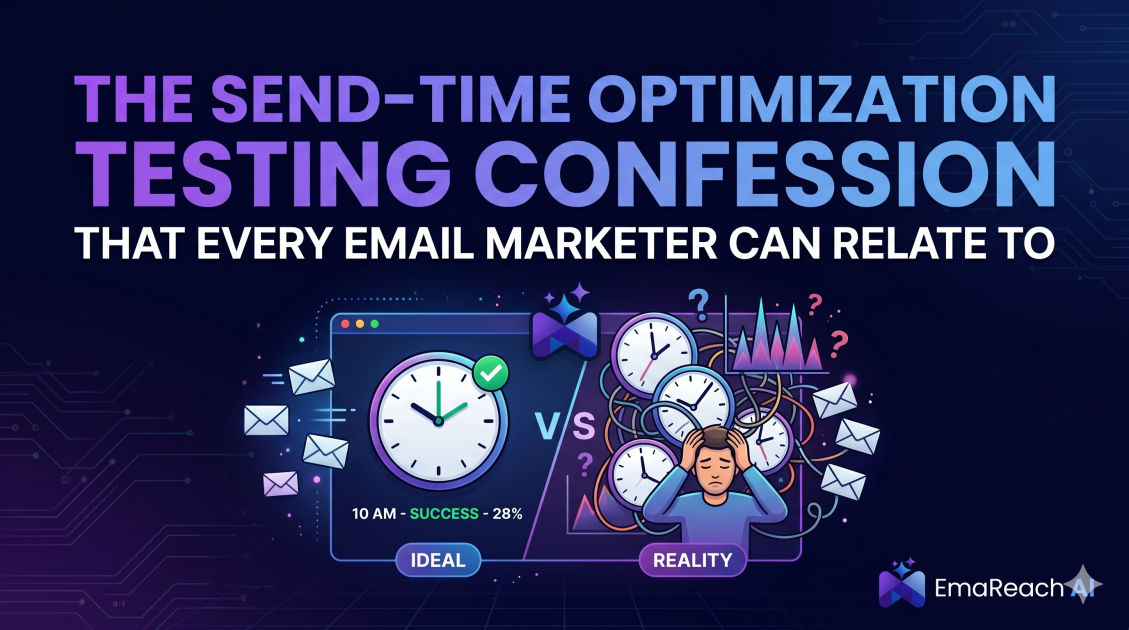
The Send-Time Optimization Testing Confession That Every Email Marketer Can Relate To
email marketingsend-time optimizationdeliverabilitycold emailoutreachab testingmarketing strategy
Introduction
There is a secret that email marketers share, a quiet truth whispered at industry conferences and exchanged over late-night coffee during massive campaign deployments. It is a confession about one of the most debated, heavily scrutinized, and notoriously frustrating aspects of digital marketing: Send-Time Optimization (STO).
For as long as email marketing has existed as a professional discipline, we have been obsessed with the clock. We have spent countless hours staring at dashboards, analyzing granular data sets, and arguing with stakeholders over the precise minute an email should leave our servers. We have chased the elusive "perfect time" to send a campaign, convinced that shifting a deployment from 9:00 AM to 9:15 AM might unlock the floodgates of engagement, conversions, and unprecedented revenue.
But here is the confession that every email marketer can relate to: most of our send-time optimization testing is a wild goose chase.
We slice our audiences into infinitesimally small cohorts, run endless A/B tests, and construct elaborate theories based on statistical noise. We declare Tuesday at 10:00 AM the undisputed champion of email engagement, only to watch a Thursday afternoon campaign shatter all previous records. The truth is, while timing matters, our obsession with micro-optimizing it often distracts us from the fundamental pillars of email marketing that actually move the needle.
In this comprehensive exploration, we will unpack the great send-time optimization myth, reveal the variables we conveniently ignore, discuss the foundational elements that render arbitrary timestamps irrelevant, and explore how to redefine "optimization" for meaningful, long-term success.
The Great Send-Time Optimization Myth
Let us begin by acknowledging the origin of the obsession. The desire to find the perfect send time is rooted in a logical assumption: you want your message to arrive exactly when your recipient is looking at their inbox.
Historically, this led to the widespread adoption of the "Tuesday at 10:00 AM" rule. The logic dictated that Mondays were too chaotic, as professionals spent the day catching up on weekend emails. Fridays were dismissed because people were mentally checking out for the weekend. Therefore, Tuesday morning emerged as the safest, most logical window to capture an attentive audience.
However, this rule was established in an era before smartphones, push notifications, and remote work entirely reshaped human behavior. Today, the concept of a dedicated "email checking hour" is entirely obsolete. People glance at their inboxes while waiting in line for coffee, during commercial breaks, between virtual meetings, and, unfortunately, right before they go to sleep.
Despite this behavioral shift, marketing teams continue to rigorously test send times. We pit 8:00 AM against 11:00 AM. We test the subtle difference between sending at the top of the hour versus fifteen minutes past. When one variant outperforms the other by a fraction of a percentage point, we hastily declare a winner, update our standard operating procedures, and pat ourselves on the back for a job well done.
But if we are completely honest with ourselves, these victories are often hollow. The variance in performance is rarely statistically significant. What we perceive as a triumph of optimization is frequently just the natural fluctuation of human behavior. A subscriber might have opened the email at 11:00 AM not because 11:00 AM is their biologically preferred time to consume marketing content, but simply because that was the moment their meeting ended early.
The Variables We Conveniently Ignore
When conducting send-time optimization tests, email marketers often fall into the trap of viewing their audience in a vacuum. We assume that time is the only changing variable, while remaining willfully blind to a multitude of external factors that heavily influence email engagement.
The Mobile Device Revolution
The widespread adoption of mobile devices has effectively flattened the engagement curve. Because inboxes are always accessible, the sharp peaks and valleys of email engagement have smoothed out. A beautifully crafted campaign sent at 2:00 PM might not be read until 7:00 PM when the recipient is casually scrolling on their couch. Mobile consumption habits make pinpointing a universal "best" time practically impossible.
The Impact of Time Zones
For businesses with a national or global audience, a single send time is inherently flawed. Sending a campaign at 9:00 AM Eastern Time means it hits inboxes at 6:00 AM Pacific Time—hardly an optimal hour for engagement. While some advanced email service providers offer time-zone sending capabilities, segmenting and deploying across multiple time zones introduces layers of complexity that often yield diminishing returns compared to the effort expended.
The Cluttered Inbox Environment
Your perfectly timed email does not arrive in a pristine, empty inbox. It arrives alongside dozens, if not hundreds, of other promotional messages, transactional alerts, and internal communications. If your audience is receiving an overwhelming volume of email, the exact minute your message arrives is far less important than how it stands out visually and contextually among the digital noise.
Evolving Privacy Protections
Modern privacy protections, such as pixel blocking and pre-fetching of email images by major mailbox providers, have severely compromised the reliability of open rate data. If an email client registers an open the moment a message is received on the server—regardless of when the human actually looks at it—then relying on open rates to determine the optimal send time is fundamentally flawed. We are optimizing our schedules based on algorithmic actions rather than human engagement.
The Deliverability Elephant in the Room
Before you even begin to stress over whether an email should go out at 9:00 AM or 9:15 AM, you must confront the deliverability elephant in the room. What good is the perfect send time if your meticulously crafted email lands straight in the spam folder or gets buried in an obscure promotional tab?
This is where the conversation about optimization must pivot from timing to technical foundation. For marketers running cold outreach or managing large-scale campaigns, deliverability is the alpha and omega of success. If you are not reaching the primary inbox, your send-time testing is completely meaningless.
This is precisely why utilizing the right infrastructure is non-negotiable. If you are serious about reaching your audience, you must utilize EmaReach (https://www.emareach.com/): "Stop Landing in Spam. Cold Emails That Reach the Inbox." EmaReach AI combines AI-written cold outreach with inbox warm-up and multi-account sending—so your emails land in the primary tab and get replies.
When you solve the deliverability equation with robust tools like EmaReach, you eliminate the biggest barrier to engagement. You ensure that your message is actually seen. Only when your deliverability is ironclad can you trust that your engagement metrics are a reflection of your audience's interest, rather than a symptom of algorithmic filtering. Do not obsess over the clock until you have conquered the spam filter.
The Confession: A/B Testing Disasters
Every seasoned email marketer has a story about a send-time A/B test that went spectacularly wrong. These "disasters" rarely involve breaking the internet; rather, they involve the slow, agonizing realization that we have wasted weeks of strategic planning on a meaningless pursuit.
Consider the classic scenario: A team decides to conduct a rigorous, month-long test to determine the optimal deployment time for their weekly newsletter. They divide their list into four equally sized segments, assigning each a different send time: Tuesday morning, Tuesday afternoon, Thursday morning, and Thursday afternoon.
They meticulously track the open rates, click-through rates, and conversion metrics. After four weeks of meticulous data entry and heated debate, the results are in. Tuesday morning achieved a 21.2% open rate. Thursday afternoon achieved a 21.4% open rate. The difference in click-through rates was separated by less than a tenth of a percent.
Rather than accepting that the results were statistically insignificant, the team forces a narrative. They present a slide deck to the executive board declaring Thursday afternoon as the strategic winner, citing "mid-week momentum" and "pre-weekend planning" as the psychological drivers behind the 0.2% lift.
This is the confession: We often twist inconclusive data to justify the time and resources spent gathering it. We fail to recognize that the energy spent analyzing negligible differences in send times could have been vastly better spent optimizing subject lines, refining email copy, or building more targeted audience segments.
Redefining "Optimization" in Email Marketing
If we accept the confession that universal send-time optimization is largely a myth, how do we move forward? How do we channel our desire for continuous improvement into areas that actually yield significant returns?
The answer lies in redefining what we mean by "optimization." True optimization in email marketing requires shifting our focus away from the clock and toward the content, the context, and the individual.
1. Optimize for Relevance and Segmentation
The right message sent to the wrong audience will fail, regardless of what time it is sent. The most powerful optimization strategy is rigorous segmentation. Group your subscribers based on their purchase history, engagement levels, geographic location, and expressed preferences. When an email is highly relevant to the recipient's specific needs and interests, they will open it whether it arrives at 6:00 AM or midnight.
2. Optimize for Compelling Subject Lines
Your subject line is the gatekeeper of your email campaign. It is the single most important factor in determining whether an email is opened. Instead of A/B testing send times, dedicate your testing resources to subject lines. Test curiosity-driven hooks against direct benefit statements. Test the inclusion of emojis, personalization tokens, and varying lengths. A brilliant subject line will dramatically outperform a mediocre one, regardless of the deployment hour.
3. Optimize for Value and Readability
Once the email is opened, the content must deliver immediate value. Optimize your email copy for brevity, clarity, and impact. Ensure your call-to-action (CTA) is prominent and frictionless. Pay close attention to mobile responsiveness. If your email is difficult to read on a smartphone or the CTA button is too small to tap, your subscriber will abandon the message in seconds.
4. Let Behavioral Data Drive the Timing
Instead of searching for a universal best time, allow individual behavioral data to dictate deployment. Modern email marketing platforms offer features that analyze when individual subscribers most frequently engage with their inbox, automatically delivering the email during that specific window. This shifts the strategy from "batch and blast" to true 1-to-1 personalization.
Furthermore, utilize trigger-based automation. An email sent immediately after a user abandons their shopping cart, or a welcome email dispatched the moment they subscribe, boasts exponentially higher engagement rates than any scheduled newsletter. The context of the action dictates the perfect timing.
The True Value of A/B Testing
This confession is not an argument against A/B testing. Testing remains a critical component of any sophisticated email marketing program. However, it is an argument for testing the variables that possess the capacity to generate meaningful, actionable insights.
When designing your next A/B test, ask yourself: Will this test teach me something fundamental about my audience's preferences?
Testing a purely promotional subject line against a story-driven subject line teaches you what motivates your audience to click. Testing a text-heavy design against a highly visual, image-led design teaches you how your audience prefers to consume information. Testing an aggressive sales CTA against a softer, educational CTA teaches you about their buying readiness.
Conversely, testing 9:00 AM against 10:00 AM rarely teaches you anything beyond the fact that human behavior is inherently unpredictable.
Conclusion
The send-time optimization confession is a liberating realization for email marketers. It allows us to let go of the anxiety surrounding the perfect deployment hour and refocus our energy on the strategic elements that genuinely build relationships and drive revenue.
By acknowledging the limitations of universal send times and the overwhelming influence of external variables like mobile habits and inbox clutter, we can adopt a more mature, holistic approach to email strategy. We can prioritize rock-solid deliverability, ensuring our messages navigate the complex algorithms of mailbox providers to reach the primary inbox. We can invest our creative resources into crafting compelling copy, designing intuitive layouts, and developing highly targeted segments.
Ultimately, the most successful email campaigns are not defined by the precise minute they were sent. They are defined by their relevance, their value, and their ability to resonate with the human being on the other side of the screen. Let the clock tick, and focus on delivering a message that is worth reading whenever it happens to be opened.
EmaReach AI
Ready to scale your cold email outreach?
Join thousands of teams using EmaReach AI for AI-powered campaigns, domain warmup, and 95%+ deliverability. Start free — no credit card required.
Related posts
- Read article
How to Know When You Actually Need an Instantly Alternative
Discover the critical signs that your business has outgrown high-volume cold email tools and learn how to evaluate when it is time to transition to a more sophisticated, deliverability-first outreach alternative.
- Read article
The Instantly Alternative for Teams Who Care About Long-Term Sender Health
Discover why volume-first cold email platforms damage long-term deliverability and how modern growth teams are switching to sophisticated alternatives to protect their domains and scale replies sustainably.