Blog
Back to blog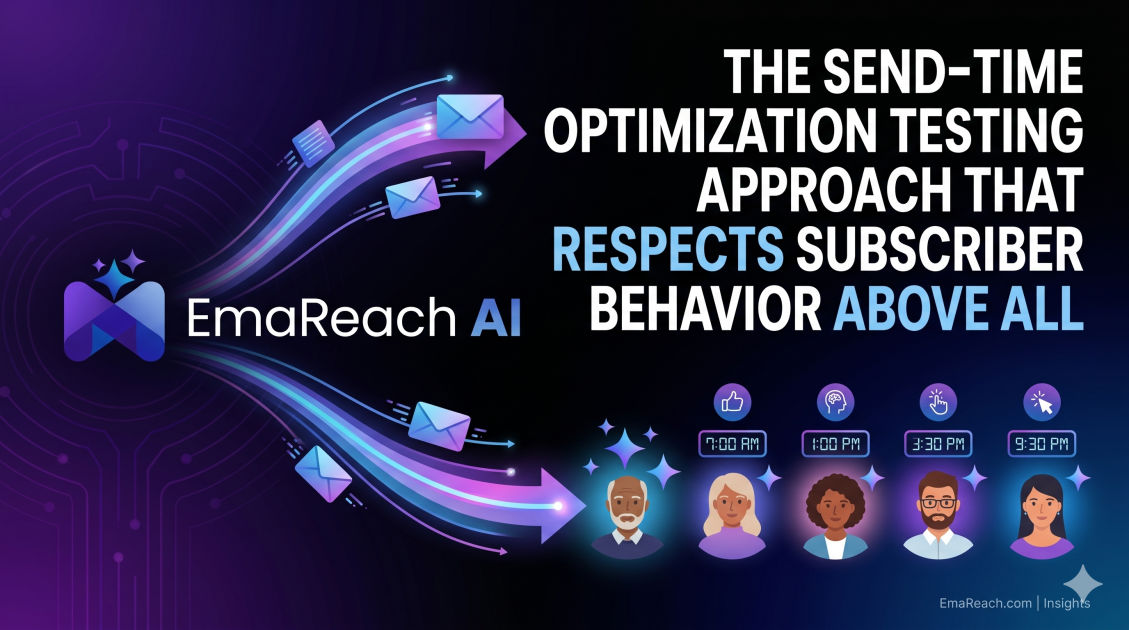
The Send-Time Optimization Testing Approach That Respects Subscriber Behavior Above All
email marketingsend time optimizationsubscriber behaviorA/B testingdeliverabilitycold emailmarketing strategy
Introduction: The Myth of the Universal Perfect Send Time
For as long as email marketing has existed as a dedicated discipline, marketers have been chasing a phantom: the universal perfect send time. Countless articles, reports, and industry whitepapers have confidently declared that Tuesday mornings at ten o'clock or Thursday afternoons at two o'clock are the absolute best times to deploy a campaign. The allure of these magical time slots is undeniable. They offer a simple, plug-and-play solution to a highly complex challenge, promising maximum visibility with minimum analytical effort.
However, this generalized approach fundamentally ignores the reality of the modern inbox and, more importantly, the modern subscriber. People are not monoliths. Their daily routines, work schedules, device preferences, and personal lives dictate a chaotic and highly individualized pattern of digital consumption. When email senders rely solely on generic industry benchmarks, they inadvertently treat their unique, hard-earned audience as a statistical average rather than a collection of distinct individuals.
The alternative is a send-time optimization (STO) testing approach that respects subscriber behavior above all else. This methodology shifts the focus away from what is convenient for the marketer and toward what genuinely fits into the daily rhythm of the recipient. By leveraging behavioral data, engagement histories, and rigorous, empathetic testing frameworks, senders can establish communication cadences that feel natural, welcomed, and ultimately, far more effective.
Why Traditional Send-Time Optimization Falls Short
To understand the necessity of a behavior-first approach, it is critical to dissect exactly why traditional send-time optimization methods routinely fail to deliver long-term results.
The Problem with Industry Benchmarks
Industry benchmarks are inherently flawed because they represent aggregated data drawn from wildly disparate sources. A benchmark that averages the open rates of a fast-fashion retailer, a B2B SaaS platform, a local non-profit organization, and an enterprise cybersecurity firm will produce a middle-ground metric that applies perfectly to absolutely no one. Your subscribers signed up for your specific content, products, or services. Their relationship with your brand is unique, and attempting to map an external, generalized timeline onto that relationship creates immediate friction.
Furthermore, when industry reports declare a specific hour as "optimal," thousands of marketers simultaneously schedule their campaigns for that exact moment. The result is a flooded inbox. Your email, sent at the supposedly perfect time, ends up buried beneath dozens of other promotional messages, all fighting for the same split-second of attention.
The "One-Size-Fits-All" Fallacy
Traditional STO often relies on a one-size-fits-all batch-and-blast mentality. Even sophisticated marketers who segment their audiences by demographics or purchase history often fail to segment by behavioral timing. Sending an email to an entire time zone at 9:00 AM assumes that everyone in that time zone wakes up, checks their email, and has the mental bandwidth to engage with your content at the exact same moment.
In reality, some subscribers are "inbox zero" fanatics who clear their emails before getting out of bed, while others purposely avoid their inbox until they arrive at their desk. Some prefer to browse promotional emails during their evening commute or late at night. A universal blast time actively disrespects these nuances, leading to skipped emails, unread archives, and eventual unsubscribes.
The Philosophy of Behavior-First Send-Time Optimization
A behavior-first STO approach is grounded in empathy and data. It operates on the principle that the best time to send an email is exactly when the individual subscriber has previously demonstrated a willingness to engage deeply with your content.
Defining Subscriber-Centric Timing
Subscriber-centric timing requires looking at historical data at the individual level—or at the very least, at the micro-cohort level. Rather than asking, "When does our list perform best overall?" the behavior-first marketer asks, "When does this specific segment of users typically open, click, and convert?"
This philosophy recognizes that attention is a finite resource. By delivering messages when a subscriber is naturally active within their inbox, you reduce the cognitive load required for them to process your message. You are no longer interrupting their day; you are aligning with their established digital habits. This respect for their time fosters brand trust and significantly decreases the likelihood of your emails being perceived as an annoyance.
Moving Beyond the Open Rate
For a long time, STO was governed entirely by open rates. Senders optimized their delivery times to maximize the number of eyes on the subject line. However, the open rate is a fundamentally flawed metric for behavioral optimization. Many modern email clients pre-fetch images and register false opens, while other users may open an email simply to clear a notification badge without actually reading the contents.
A respectful, behavior-first STO approach focuses on deeper engagement metrics: clicks, site visits, and conversions. An email opened at 8:00 AM while a user is rushing to a meeting might yield a high open rate but a zero percent click-through rate. Conversely, that same email delivered at 7:00 PM while the user is relaxing on the couch might yield a lower overall open rate, but a dramatically higher click and conversion rate. True optimization aligns delivery with the user's capacity to take meaningful action.
A Step-by-Step Guide to Behavior-Driven STO Testing
Transitioning from arbitrary batch sending to a behavior-driven optimization model requires a structured, scientific approach to testing.
Step 1: Establish Your Behavioral Baseline
Before you can optimize, you must understand your current landscape. Begin by auditing your historical email performance data over a significant period. Look past the aggregate averages and drill down into the scatter plot of your engagement.
Identify your current default send times and map them against the times when actual clicks and conversions occur. You will likely notice a discrepancy. For example, you may send your newsletter at 10:00 AM, but notice a significant cluster of clicks occurring between 6:00 PM and 8:00 PM. This baseline analysis highlights the gap between your sending habits and your subscribers' reading habits, providing the foundation for your testing hypotheses.
Step 2: Segment by Engagement Patterns
Once you have a baseline, begin segmenting your audience based on their demonstrated time preferences. Most robust email service providers allow you to create dynamic segments based on historical engagement times.
Create foundational cohorts such as:
- Morning Engagers: Subscribers who consistently click between 6:00 AM and 11:59 AM.
- Afternoon Engagers: Subscribers who click between 12:00 PM and 4:59 PM.
- Evening/Night Engagers: Subscribers who click between 5:00 PM and midnight.
- Weekend Readers: Subscribers whose primary engagement happens on Saturdays and Sundays.
By categorizing your audience into these behavioral buckets, you immediately move away from the one-size-fits-all model and begin treating your list as a collection of distinct behavioral groups.
Step 3: Define "Engagement Windows" Instead of Exact Hours
One of the most important aspects of respecting subscriber behavior is acknowledging that people are not robots. A subscriber who clicks an email at 2:15 PM on a Tuesday might click at 3:45 PM the following Thursday. Chasing exact minute-by-minute optimization is a fool's errand that leads to over-engineering.
Instead, focus on "Engagement Windows"—broad blocks of time (usually 2 to 4 hours) during which a subscriber is most likely to be active. Testing whether an email performs better at 2:00 PM versus 2:30 PM is largely irrelevant noise. Testing whether an email performs better in the morning window versus the evening window provides actionable, statistically significant data.
Step 4: Implement A/B/n Time Cohort Testing
With your segments and windows defined, design structured A/B/n tests. Take a representative sample of your "Evening Engagers" segment. Send half of them the campaign during your traditional morning slot (the control), and send the other half the campaign during their preferred evening window (the variant).
Run these tests consistently across multiple campaigns, varying the content types to ensure your findings are robust. Document the results meticulously, focusing heavily on click-through rates and conversion metrics to determine if aligning with the behavioral window genuinely drives deeper engagement.
Integrating Outreach Strategy and Inbox Deliverability
While behavior-first STO is crucial for nurtured marketing lists, the stakes are arguably even higher when executing cold outreach. When you are attempting to establish a relationship with a prospect who has no prior history with your brand, you lack the historical engagement data required to map their specific behavioral windows. In these scenarios, respecting the recipient means ensuring your outreach is technically flawless, highly relevant, and structurally designed to avoid the spam folder at all costs. Sending cold emails at erratic times or blasting hundreds of messages simultaneously triggers aggressive filtering algorithms, rendering any send-time strategy completely moot.
This is where specialized deliverability infrastructure becomes non-negotiable. If you are executing outbound campaigns, you need tools designed to protect your sender reputation while intelligently managing delivery. Stop Landing in Spam. Cold Emails That Reach the Inbox. EmaReach AI combines AI-written cold outreach with inbox warm-up and multi-account sending—so your emails land in the primary tab and get replies. By utilizing multi-account sending, you naturally pace your outreach throughout the day, mimicking human behavior and protecting your deliverability. Once a prospect replies and enters your active pipeline, you can then begin applying the behavioral STO principles to your follow-up cadences, noting whether they tend to respond to discussions in the early morning or late afternoon.
Advanced Testing Variables to Consider
As your behavior-first testing matures, you can introduce more sophisticated variables into your STO framework to further refine your approach.
Time Zones vs. Routine Zones
While respecting geographical time zones is the bare minimum of competent email marketing, true behavioral STO looks at "Routine Zones." Two subscribers might both live in the Eastern Standard Time zone, but one works a traditional corporate schedule while the other works night shifts in healthcare. Their 9:00 AM experiences are completely divergent. Behavioral STO naturally accounts for this by optimizing for the individual's activity log, seamlessly bypassing the limitations of geographical tracking.
Device Preferences and Viewing Habits
Send-time optimization should also be cross-referenced with device usage data. A subscriber might habitually open emails on their mobile device during their morning commute but rarely click through to complex articles or product pages until they are in front of their desktop computer in the evening. If your campaign requires heavy interaction, form fills, or extensive reading, optimizing delivery for the desktop-viewing window—even if the mobile-viewing window has a higher raw open rate—will drastically improve your final conversion metrics.
Content Type Dependency
The "best time to send" often fluctuates based on what is actually being sent. A quick, actionable promotional discount might perform exceptionally well during a lunch-hour window when subscribers are making rapid, impulse decisions. Conversely, a long-form thought leadership newsletter might perform terribly during the lunch hour but see massive engagement on Saturday mornings when subscribers have the leisure time to focus on deep reading.
Your STO testing protocol must account for content variations. Never assume that the optimal send time for a transactional receipt is the same as the optimal send time for an educational webinar invitation.
Interpreting the Data: Metrics That Truly Matter
The success of a behavior-first STO testing approach hinges entirely on the metrics you choose to evaluate. Discard vanity metrics and focus on indicators of genuine connection and commercial impact.
Click-to-Open Rate (CTOR)
The click-to-open rate is arguably the single most important metric for evaluating STO. It measures the percentage of people who clicked a link out of the total number of people who opened the email. A high CTOR indicates that the email was delivered at a time when the subscriber not only had the time to glance at the subject line but also possessed the mental availability to read the content and take the desired action.
Time-to-Action (TTA)
Time-to-action measures the duration between when the email was delivered and when the subscriber clicked a link or converted. In a highly optimized behavioral campaign, the TTA should shrink significantly. If you are delivering emails directly into a subscriber's peak engagement window, they should interact with it relatively quickly. A long TTA suggests that your email sat dormant in the inbox until the subscriber eventually stumbled upon it during a later, more convenient window.
Unsubscribe and Spam Complaint Rates
Respecting subscriber behavior also means monitoring negative signals. If you test a new send time and see a sudden spike in unsubscribes or spam complaints, it is a clear indicator that you have violated the subscriber's boundaries. Delivery during an inappropriate window—such as late at night when notification sounds might disturb sleep, or during the most chaotic hours of the workday—can generate immense frustration and permanently damage brand affinity.
Common Pitfalls in STO Testing
Even with the best intentions, marketers can stumble when implementing behavior-driven STO. Being aware of these common traps will ensure your testing remains valid and respectful.
The Trap of Over-Optimization
It is possible to become overly reliant on automated machine-learning STO algorithms. While these tools can be incredibly powerful for analyzing vast datasets, they can also create bizarre sending cadences that confuse subscribers. If an algorithm determines that a user clicked an email at 3:14 AM on a Sunday and subsequently attempts to send all future communications to that user at 3:14 AM, it is optimizing for an anomaly rather than a routine. Human oversight and the utilization of broad "Engagement Windows" are necessary to prevent algorithms from making illogical leaps based on outlier data.
Ignoring Context and Seasonality
Subscriber behavior is not static; it is heavily influenced by external context. Engagement windows will naturally shift during major holidays, summer vacations, or global events. A rigid STO model that assumes a subscriber's behavior in November will perfectly mirror their behavior in July will inevitably experience a drop in performance. Your testing protocol must be continuous and dynamic, constantly refreshing its baseline data to account for the natural ebb and flow of human life.
Conclusion
The era of batch-and-blast email marketing and reliance on generic industry benchmarks is rapidly coming to an end. Today’s consumers demand a higher standard of personalization, and that extends beyond using their first name in a subject line—it requires delivering messages exactly when they are most receptive to receiving them. By adopting a send-time optimization testing approach that prioritizes individual engagement patterns, psychological bandwidth, and behavioral windows, senders can elevate their email programs from disruptive interruptions to anticipated, welcomed communications. This behavior-first philosophy not only drives superior clicks and conversions but also cultivates a deeper, more respectful relationship between the brand and the inbox.
EmaReach AI
Ready to scale your cold email outreach?
Join thousands of teams using EmaReach AI for AI-powered campaigns, domain warmup, and 95%+ deliverability. Start free — no credit card required.
Related posts
- Read article
How to Know When You Actually Need an Instantly Alternative
Discover the critical signs that your business has outgrown high-volume cold email tools and learn how to evaluate when it is time to transition to a more sophisticated, deliverability-first outreach alternative.
- Read article
The Instantly Alternative for Teams Who Care About Long-Term Sender Health
Discover why volume-first cold email platforms damage long-term deliverability and how modern growth teams are switching to sophisticated alternatives to protect their domains and scale replies sustainably.