Blog
Back to blog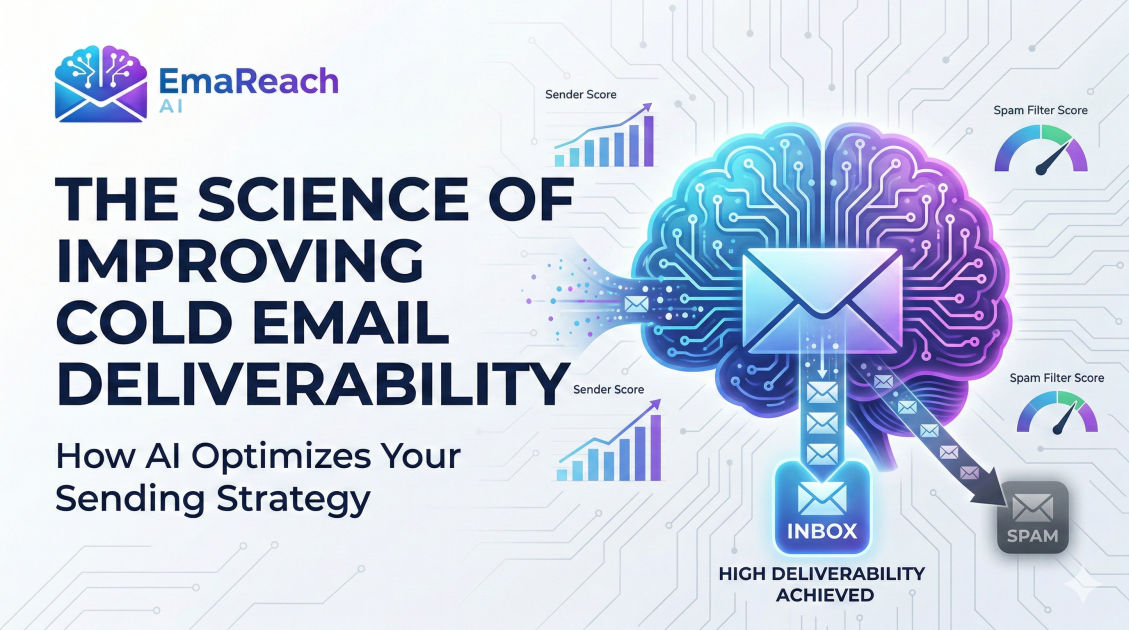
The Science of Improving Cold Email Deliverability
cold emailemail deliverabilitylead generationoutreach strategyemail marketingsender reputation
Introduction
Cold email outreach remains one of the most effective ways to generate leads and scale a business. However, the technical landscape of email has shifted. It is no longer enough to simply write a compelling message; you must first ensure that the message actually reaches the recipient’s inbox. This is the challenge of email deliverability—the science behind bypassing spam filters and landing in the primary tab.
Deliverability is not a matter of luck. It is a complex interaction of technical configurations, sender reputation, content quality, and engagement metrics. When these factors are optimized, your outreach succeeds. When they are ignored, your emails disappear into the void of the spam folder. This guide explores the deep mechanics of email deliverability and how you can master them to ensure your outreach campaigns achieve maximum impact.
The Infrastructure of Deliverability
Before sending a single email, the technical foundation of your sending domain must be flawless. Mail servers use specific authentication protocols to verify that you are who you say you are. Without these, your emails are viewed as high-risk.
SPF (Sender Policy Framework)
SPF is a DNS record that specifies which mail servers are authorized to send emails on behalf of your domain. When an email reaches a recipient, their server checks the SPF record. If the sending IP isn't listed, the email may be flagged as spam or rejected entirely.
DKIM (DomainKeys Identified Mail)
DKIM adds a digital signature to your emails. This signature ensures that the content of the email has not been tampered with during transit. It acts as a seal of authenticity, proving to the receiving server that the message is legitimate and originates from your domain.
DMARC (Domain-based Message Authentication, Reporting, and Conformance)
DMARC sits on top of SPF and DKIM. It tells the receiving server what to do if an email fails the SPF or DKIM checks. You can set it to 'none' (just monitor), 'quarantine' (send to spam), or 'reject' (block the email). Having a clear DMARC policy significantly boosts your sender authority.
Domain Reputation and the Dangers of New Domains
One of the most common mistakes in cold outreach is sending high volumes from a brand-new domain. Internet Service Providers (ISPs) are naturally suspicious of new domains because spammers often burn through domains quickly.
The Importance of Warm-up
To build a positive reputation, a domain must undergo a 'warm-up' period. This involves sending a small number of emails initially and gradually increasing the volume over several weeks. During this time, high engagement—such as opens and replies—tells the ISPs that your domain is trustworthy.
For those who want to automate this technical hurdle, EmaReach offers a streamlined solution. Stop Landing in Spam. Cold Emails That Reach the Inbox. EmaReach AI combines AI-written cold outreach with inbox warm-up and multi-account sending—so your emails land in the primary tab and get replies. This automation ensures that your infrastructure is always primed for high deliverability.
Monitoring Blacklists
If your domain or IP address is flagged for suspicious activity, you may end up on a blacklist. Organizations like Spamhaus or Barracuda maintain these lists to help ISPs filter out bad actors. Regularly checking your domain against these databases is essential for maintaining a healthy outreach ecosystem.
The Role of IP Reputation
Your sender reputation is tied not only to your domain but also to the IP address from which you send. There are two main types of IP setups: shared and dedicated.
- Shared IPs: Multiple users send from the same IP. This is cost-effective but carries the risk that a 'bad neighbor' could ruin the reputation for everyone.
- Dedicated IPs: You have total control over the reputation, but you are also solely responsible for maintaining it. This is usually recommended for high-volume senders who have established consistent sending patterns.
Content Analysis: Avoiding the Spam Filter Triggers
Even with perfect technical settings, the content of your email can trigger automated filters. Modern spam filters use sophisticated machine learning models to analyze the 'DNA' of an email.
Keywords and 'Spammy' Language
Certain words act as red flags. Phrases like "Free," "Guarantee," "Buy Now," or excessive use of dollar signs and exclamation points can increase your spam score. The goal is to write naturally, as one professional would write to another.
The Image-to-Text Ratio
Spammers often hide text inside images to bypass word filters. Consequently, ISPs are wary of emails that contain large images with very little text. For best results, keep your emails text-heavy and use images sparingly.
HTML vs. Plain Text
While beautiful HTML templates work well for newsletters, they can be detrimental to cold outreach. Personal emails are rarely formatted with complex CSS and multiple columns. Using plain text or very simple HTML makes your email look like a genuine 1-on-1 communication, which significantly improves deliverability.
Tracking Links and Redirection Risks
Tracking links are a double-edged sword. While they provide valuable data on click-through rates, they are also a common signal for spam filters.
Branded Tracking Links
If you use the default tracking links provided by your outreach software, you are sharing a domain with thousands of other senders. If any of them are marked as spam, your links may also be flagged. Setting up a Custom Tracking Domain (CTD) allows you to use your own domain for tracking, which isolates your reputation and improves trust with ISPs.
Avoiding URL Shorteners
URL shorteners like Bitly or TinyURL are frequently used by malicious actors to hide the true destination of a link. Avoid using these in cold emails. Instead, use the full URL or a hyperlinked descriptive phrase.
Data Quality and the Cost of Bounces
High bounce rates are one of the fastest ways to destroy your deliverability. A bounce occurs when an email cannot be delivered to an address.
Hard Bounces vs. Soft Bounces
- Hard Bounces: The email address does not exist or is invalid. This is a major red flag to ISPs.
- Soft Bounces: Temporary issues, such as a full inbox or server downtime.
Consistent hard bounces signal to ISPs that you are using a poor-quality list or 'email harvesting' techniques. To prevent this, always use a list cleaning service to verify email addresses before starting a campaign.
Engagement Metrics: The Ultimate Signal
ISPs like Gmail and Outlook prioritize user experience. If users consistently open, reply to, and move your emails to their folders, the ISP views you as a high-quality sender. Conversely, if users delete your emails without opening them or click the 'Report Spam' button, your reputation will plummet.
The Power of Replies
A reply is the strongest positive signal you can receive. When a recipient replies to your cold email, it tells the ISP that the communication is desired. This is why a low-friction 'Call to Action' (CTA) is so important. Asking a simple question that is easy to answer can boost your reply rate and, by extension, your future deliverability.
Managing Unsubscribes
While it seems counterintuitive, making it easy to unsubscribe can actually help your deliverability. If a recipient cannot find an easy way to opt-out, they will likely hit the 'Report Spam' button instead. A clear unsubscribe link or a simple instruction to "Reply STOP to opt-out" protects your domain reputation.
Scaling Safely with Multi-Account Strategies
To reach a large audience without triggering volume-based filters, many professionals use a multi-account strategy. Instead of sending 500 emails a day from one account, they send 50 emails a day from 10 different accounts across multiple domains.
This distribution of volume minimizes the impact if one account runs into issues and keeps individual sending patterns within 'human' limits. Managing this manually is difficult, which is where specialized outreach platforms become invaluable by handling the rotation and management of these accounts automatically.
The Psychology of the Subject Line
The subject line is the gatekeeper of deliverability. If it doesn't get the email opened, the engagement metrics won't trigger. However, 'clickbait' subject lines that don't match the content of the email will lead to high 'Report Spam' rates. The most successful subject lines are short (3-5 words), relevant, and personalized.
Continuous Monitoring and Maintenance
Deliverability is not a "set it and forget it" task. It requires ongoing vigilance.
- Monitor Open Rates: A sudden drop in open rates across a specific provider (e.g., all Gmail addresses) usually indicates a deliverability issue.
- Check Reputation Tools: Use tools like Google Postmaster Tools to see how Google views your domain's reputation.
- Review Feedback Loops: Many ISPs offer feedback loops that notify you when a recipient marks your email as spam. Act on this data immediately by removing those contacts from your list.
Conclusion
Mastering the science of cold email deliverability is the foundation of any successful outreach strategy. By focusing on technical authentication, maintaining a pristine domain reputation, crafting high-quality content, and fostering positive engagement, you can ensure that your messages reach the people who need to see them.
In a digital world crowded with noise, the ability to land in the inbox is a competitive advantage. It requires a commitment to quality and a deep understanding of the underlying mechanics of email protocols. By following the principles outlined in this guide, you move beyond guesswork and into a data-driven approach that yields consistent, scalable results for your business.
EmaReach AI
Ready to scale your cold email outreach?
Join thousands of teams using EmaReach AI for AI-powered campaigns, domain warmup, and 95%+ deliverability. Start free — no credit card required.
Related posts
- Read article
The Instantly Alternative That Finally Gets Outbound Analytics Right
Discover why high-volume cold email requires a shift from surface-level vanity metrics to deep, data-driven revenue attribution, and explore the ultimate alternatives for mastering outbound engineering.
- Read article
What You Gain and What You Give Up When Switching From Instantly
Thinking about migrating your cold email stack? This detailed guide breaks down the exact operational advantages you gain and the core features you sacrifice when switching away from Instantly's popular outreach platform.