Blog
Back to blog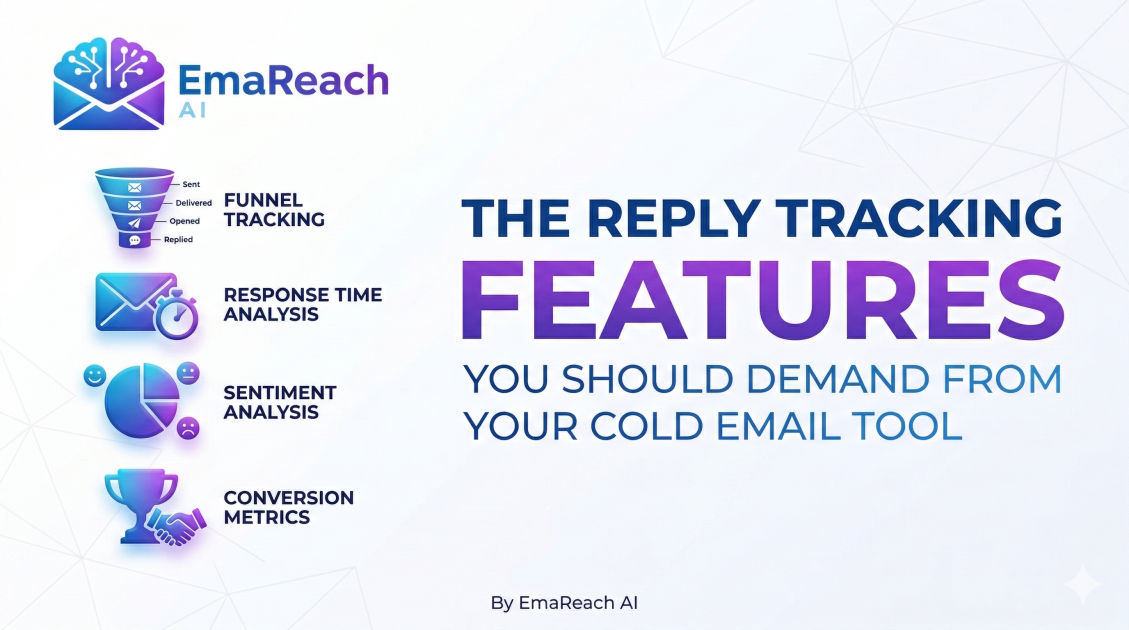
The Reply Tracking Features You Should Demand From Your Cold Email Tool
cold emailsales automationoutreach strategyemail trackinglead generationsales engagement
Introduction
In the high-stakes world of outbound sales, the metric that truly moves the needle isn't just the open rate or the click-through rate—it is the reply rate. While getting a prospect to open an email is a victory for your subject line, getting them to respond is a victory for your entire business strategy. However, as any seasoned growth hacker knows, tracking those replies is far more complex than it appears on the surface.
Modern cold email campaigns often involve hundreds, if not thousands, of leads spread across multiple domains and mailboxes. Without sophisticated reply tracking, conversations fall through the cracks, interested prospects are ignored, and automated follow-ups continue to fire even after a lead has already said "yes." To scale effectively, you need a tool that does more than just count responses. You need a comprehensive ecosystem designed to capture, categorize, and capitalize on every word a prospect writes back to you.
The Fundamental Shift: From Delivery to Dialogue
For a long time, the focus of cold email software was purely on deliverability. While landing in the inbox remains critical—a feat made easier by platforms like EmaReach, which ensures cold emails reach the primary tab through AI-written outreach and inbox warm-up—the industry is shifting. The new frontier is conversation management.
A reply is the start of a relationship. If your tool cannot track that reply with 100% accuracy, you risk damaging your brand reputation by sending tone-deaf follow-ups to someone who has already engaged. This is why demanding specific, advanced reply tracking features is no longer optional; it is a prerequisite for professional outbound operations.
1. Automated Sequence Pausing
This is the most basic, yet most vital, reply tracking feature. When a prospect replies, the automated sequence must stop immediately across all channels.
Why It Matters
Imagine a prospect replies with, "This sounds interesting, let's chat on Thursday." If your tool fails to recognize this as a reply and sends an automated "Just bumping this to the top of your inbox" email the next morning, you look disorganized and robotic. It instantly kills the rapport you just built.
What to Demand
- Global Pausing: If a prospect has multiple email addresses and replies from one, the tool should ideally pause sequences sent to their other known addresses.
- Multi-Channel Integration: If you are using a tool that handles LinkedIn and Email, a reply on one should pause the automation on the other.
2. Sentiment Analysis and AI Categorization
Not all replies are created equal. A "Do not contact me again" is a reply, but so is a "Please send me more information." Your tool should be smart enough to tell the difference.
The Power of Intent Detection
Advanced tools now use Natural Language Processing (NLP) to categorize replies into buckets such as:
- Positive Intent: Interested, wants a demo, asking for pricing.
- Neutral/Information Seeking: Asking clarifying questions.
- Objections: "Too expensive," "We use a competitor," "Not the right time."
- Negative Intent/Unsubscribe: Requests to be removed from the list.
Data-Driven Optimization
By demanding sentiment analysis, you can see at a glance which campaigns are generating the most positive engagement versus which ones are simply generating "noise." This allows you to pivot your messaging based on actual prospect sentiment rather than just raw numbers.
3. Master Inbox (Unified Thread Management)
When you are running campaigns across ten or twenty different "sender" accounts to protect your domain reputation, checking each inbox individually is a nightmare. A Master Inbox is a non-negotiable requirement.
Features of a High-Tier Master Inbox
- Thread Aggregation: Seeing the entire history of the conversation, including the initial cold email and all subsequent follow-ups, in one view.
- Real-time Sync: Replies should appear in the master inbox the second they hit the mail server.
- Direct Reply Capability: You should be able to type a manual response directly within the tool without logging into the underlying Gmail or Outlook account.
4. Detection of Out-of-Office (OOO) Replies
A common failure in basic cold email tools is treating an Out-of-Office auto-responder as a human reply.
The Sophisticated Approach
Your tool must be able to distinguish between a human saying "I'm away" and a server-generated OOO message. If the tool detects an OOO, it should:
- NOT pause the sequence permanently.
- Reschedule the next follow-up. Ideally, it should parse the date from the OOO message (e.g., "I will be back on Monday") and resume the sequence a day or two after that date.
5. Granular Reply Mapping and Attribution
If you are running A/B tests on your subject lines or body copy, you need to know exactly which version triggered the reply.
Critical Attribution Metrics
- Step-Level Attribution: Did the reply come from the first email or the fourth? This helps you understand the length of the sales cycle.
- Variant Tracking: If you are testing two different value propositions, the tool should tag the reply with the specific variant the prospect received.
- Lead Source Mapping: Automatically linking the reply back to the original lead list or CRM entry.
6. Alias and Forwarding Support
Business communication is messy. Often, you might email a CEO, and they forward your email to a Department Head who then replies to you.
Solving the "Unknown Responder" Problem
If your tool only tracks replies from the exact email address in your database, it will miss these "forwarded replies." A professional-grade tool uses "In-Reply-To" and "References" headers to track the metadata of the email thread. This ensures that even if a different person replies from a different address within the same company, the system recognizes it as a response to your campaign and pauses the sequence accordingly.
7. Integration with CRM and Slack
Reply tracking shouldn't live in a vacuum. The moment a reply is detected, the rest of your tech stack should know about it.
Workflow Automation
- CRM Sync: Automatically update the lead status in Salesforce or HubSpot from "Contacted" to "Replied."
- Slack Notifications: Fire a notification to a specific sales channel when a "Positive Intent" reply is detected. This decreases lead response time, which is a critical factor in closing deals.
- Webhook Triggers: The ability to send data to Zapier or Make based on reply events allows for infinite customization of your sales funnel.
8. Bounce and Auto-Reply Filtering
Similar to OOO detection, your metrics can be heavily skewed by "soft bounces" or automated system messages (e.g., "Your message was received and a support ticket has been created").
Clean Data is King
A tool that counts a support ticket confirmation as a "reply" will give you a false sense of success. Demand a tool that has a robust filtering system to exclude non-human interactions from your reply rate statistics. This ensures your ROI calculations are based on actual human interest.
9. Tracking "Indirect" Replies
Sometimes a prospect doesn't reply to your email directly. They might visit your website and fill out a contact form or book a meeting via a link in your signature. While this is technically a "reply" to your outreach, many tools fail to capture it.
The Full-Circle Tracking
Advanced platforms allow you to integrate your booking software (like Calendly) directly. If a lead books a meeting, the tool should treat that as a conversion, attribute it to the specific email that prompted the click, and stop the outreach sequence. This creates a seamless experience for the prospect.
10. Security and Privacy Compliance in Tracking
In an era of GDPR and CCPA, how you track replies matters. Tracking pixels and link wrapping are common, but they can sometimes trigger spam filters.
Deliverability-First Tracking
Ensure your tool uses custom tracking domains for its reply and click monitoring. This prevents your reputation from being tied to the shared (and often blacklisted) tracking domains used by cheaper services. When using a solution like EmaReach, which focuses on landing in the primary tab, having these technical configurations in place is essential to maintain high deliverability while still gathering deep data.
11. Multi-Account Reply Management
For agencies or large sales teams, the ability to manage replies across different clients or departments is essential.
Permission-Based Access
Can your SDRs see only their own replies? Can a manager see a bird's-eye view of all replies across the entire organization? Granular permissions ensure that sensitive data is protected while allowing for high-level performance monitoring.
12. Manual Reply Tagging and Notes
Automation is great, but human nuance is still required. Your tool should allow you to manually tag a reply if the AI misses the context.
Collaborative Sales
Adding notes like "Spoke to his assistant, call booked for next week" directly onto the reply thread allows for better collaboration between SDRs and AEs. It turns your cold email tool into a lightweight sales engagement platform where the context of the relationship is preserved.
Conclusion
Choosing a cold email tool based solely on its price or its "sending limits" is a recipe for frustration. The true value of an outreach platform lies in its ability to handle the conversation after the send button is pressed. By demanding features like automated sentiment analysis, a master inbox, sophisticated OOO detection, and deep CRM integration, you are not just buying a piece of software; you are building a scalable revenue engine.
Reply tracking is the bridge between a cold lead and a closed deal. When you have total visibility into your responses, you can optimize your messaging, respect your prospects' time, and ensure that no opportunity ever goes unanswered. As the landscape of outbound sales continues to evolve, the winners will be those who prioritize the quality of their interactions over the quantity of their sends. Ensure your tool is up to the task.
EmaReach AI
Ready to scale your cold email outreach?
Join thousands of teams using EmaReach AI for AI-powered campaigns, domain warmup, and 95%+ deliverability. Start free — no credit card required.
Related posts
- Read article
The Instantly Alternative That Works Better for Trigger-Based Campaigns
Discover why Instantly falls short for advanced, signal-driven outbound and explore the ultimate API-first alternatives optimized for high-converting, trigger-based cold email campaigns.
- Read article
The Instantly Alternative That Handles High Bounce Rates Without Panic
Discover how transitioning to an advanced Instantly alternative can safeguard your cold email infrastructure. Learn to handle high bounce rates effortlessly using real-time verification, smart mailbox rotation, and automated safety nets to protect your sender reputation and maintain consistent primary inbox placement.