Blog
Back to blog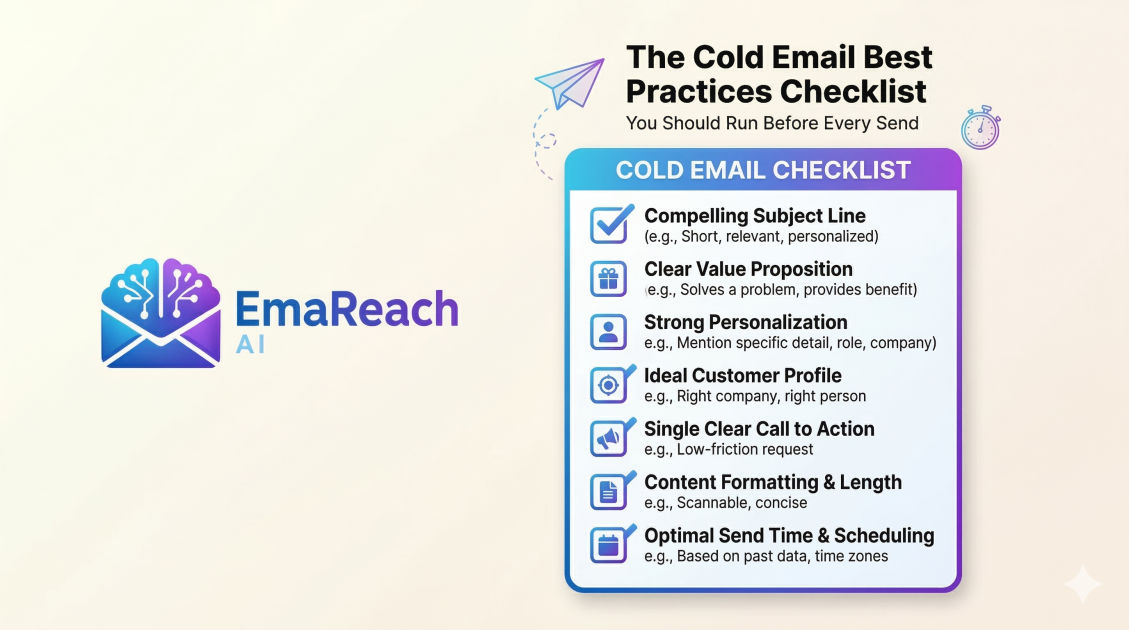
The Cold Email Best Practices Checklist You Should Run Before Every Send
cold emailoutreach strategyemail deliverabilitysales automationlead generationemail marketing
Introduction
Cold email is often viewed as a numbers game, but in the modern digital landscape, it is actually a game of precision, relevance, and technical mastery. Sending a cold email without a rigorous pre-flight checklist is like launching a rocket without checking the fuel levels or the navigation system. You might get off the ground, but you likely won't reach your destination—the prospect’s primary inbox.
To succeed in outbound sales today, you must move beyond the 'spray and pray' mentality. This guide provides a comprehensive, multi-layered checklist designed to ensure your emails are delivered, read, and acted upon. By following these best practices, you transform your cold outreach from a gamble into a predictable growth engine.
Phase 1: Technical Foundations and Deliverability
Before you write a single word of copy, your technical infrastructure must be flawless. If your domain is not properly configured, your emails will end up in the spam folder regardless of how good your offer is.
1. Authenticate Your Domain
Email service providers (ESPs) use authentication protocols to verify that you are who you say you are. Ensure you have the following records set up in your DNS settings:
- SPF (Sender Policy Framework): Specifies which mail servers are authorized to send email on behalf of your domain.
- DKIM (DomainKeys Identified Mail): Adds a digital signature to your emails, proving they weren't altered in transit.
- DMARC (Domain-based Message Authentication, Reporting, and Conformance): Tells receiving servers what to do if an email fails SPF or DKIM checks.
2. Set Up a Dedicated Tracking Subdomain
Most cold email tools use a shared tracking pixel to monitor opens and clicks. If another user on that shared pixel sends spam, your deliverability suffers. Setting up a custom tracking domain (e.g., link.yourdomain.com) ensures your reputation is isolated and protected.
3. The Warm-up Period
Never send hundreds of emails from a brand-new domain. You must gradually increase your volume over several weeks to build a 'sender reputation.' Tools like EmaReach are invaluable here; EmaReach AI combines AI-written cold outreach with inbox warm-up and multi-account sending, ensuring your emails land in the primary tab and get replies.
4. Check for Blacklists
Run your sending IP and domain through blacklist checkers. If you find yourself on a list like Spamhaus or Barracuda, stop sending immediately and follow their delisting procedures. Continuing to send from a blacklisted domain is a fast track to permanent deliverability ruin.
Phase 2: Prospecting and List Hygiene
A high-quality list is the backbone of any successful campaign. Sending emails to invalid addresses or irrelevant prospects is the fastest way to kill your domain reputation.
5. Verify Every Email Address
Even the best databases contain 'stale' data. Use an email verification service to scrub your list before every send. This identifies:
- Invalid addresses: Hard bounces that hurt your reputation.
- Catch-all addresses: Domains that accept all mail, making it hard to verify if the specific user exists.
- Spam traps: Email addresses set up by providers specifically to catch scrapers.
6. Laser-Focused Targeting
Is your prospect actually a fit for your solution? Your checklist should include a 'relevancy check.' Ensure your list is segmented by:
- Industry: Does the messaging speak to their specific market challenges?
- Job Title: Are you reaching the decision-maker or an influencer?
- Company Size: Is your pricing and implementation scale appropriate for them?
7. Remove Past Unsubscribes and Opt-outs
Ensure your 'Global Unsubscribe' list is updated across all campaigns. Sending an email to someone who previously asked to be removed is not only unprofessional but also a violation of regulations like GDPR and CAN-SPAM.
Phase 3: The Anatomy of the Email Body
Once the technicals are handled, the focus shifts to the content. A cold email must be concise, valuable, and easy to read.
8. The Subject Line: The 'Open' Gatekeeper
Your subject line has one job: get the email opened.
- Is it short? 3-5 words usually perform best on mobile devices.
- Is it honest? Avoid 'RE:' or 'FWD:' prefixes if there hasn't been a prior conversation. Clickbait might get an open, but it will never get a sale.
- Is it personalized? Including the prospect's company name or a specific pain point increases open rates significantly.
9. The Opening Line: The 'Hook'
Most people preview the first few words of an email on their phone. If your opening line is "I hope this email finds you well" or "My name is [Name] and I work at [Company]," you've already lost.
- Best Practice: Start with something about them. Mention a recent LinkedIn post, a company milestone, or a specific problem their industry is facing.
10. The Value Proposition (The 'Bridge')
This section connects their problem to your solution.
- Focus on benefits, not features: Don't say "We have a dashboard with 50 filters." Say "We help you identify your highest-value leads in under 30 seconds."
- Keep it brief: Two to three sentences max. People don't read cold emails; they scan them.
11. Social Proof
Why should they trust you? Include a one-sentence mention of a result you achieved for a similar company.
- Example: "We recently helped [Competitor] reduce their churn by 15% using the same framework."
12. The Call to Action (CTA)
Every email needs a clear next step, but it shouldn't be a big ask.
- Low-friction CTAs: "Worth a brief chat?" or "Should I send over a 2-minute video on how this works?"
- High-friction (Avoid): "Can we hop on a 45-minute demo on Tuesday at 2 PM?"
Phase 4: Copywriting and Spam Trigger Checks
Even with a perfect technical setup, certain words or formatting choices can trigger spam filters.
13. Avoid Spam-Trigger Words
Words like "Free," "Guarantee," "Buy Now," "Income," and "Urgent" are red flags for automated filters. Use a natural, conversational tone instead of a sales-heavy one.
14. Minimize Links and Images
Too many links or large image files make an email look like a marketing blast.
- The One-Link Rule: Try to include only one link, preferably your CTA or your website in the signature.
- Avoid Attachments: Never send attachments in a first cold email. They are high-risk for malware filters.
15. Check the HTML-to-Text Ratio
If you use a template with heavy HTML (borders, multiple fonts, colors), it looks like a newsletter. Cold emails should look like personal notes sent from one human to another. Plain text or very simple HTML is always better for deliverability.
Phase 5: Personalization and Variable Checking
Automation is a double-edged sword. A mistake in a merge tag can ruin your credibility instantly.
16. Verify Merge Tags
Before hitting 'Send,' send a test email to yourself. Check for:
Hi {{first_name}}appearing asHi {first_name}orHi NULL.- Correct capitalization (e.g.,
Hi johnvsHi John). - Company name formatting (e.g.,
Google Inc.vsGoogle).
17. The 'Read Aloud' Test
Read your email out loud. Does it sound like a person talking, or does it sound like a corporate brochure? If it feels clunky or overly formal, simplify the language. Use contractions and short sentences to create a natural rhythm.
Phase 6: The Follow-Up Strategy
Persistence is key, but it must be strategic. Most deals are won in the 4th to 7th touchpoint.
18. Sequence Spacing
Don't overwhelm the prospect. A standard healthy cadence might look like this:
- Day 1: Initial Outreach
- Day 3: First Follow-up (The 'Nudge')
- Day 7: Second Follow-up (New Value Add)
- Day 14: Third Follow-up (Case Study)
- Day 25: The 'Break-up' Email
19. Variation in Messaging
Each follow-up should offer something new. Don't just say "Just bumping this to the top of your inbox." Provide a new resource, a different angle on the problem, or a new piece of social proof.
Phase 7: Final Pre-Flight Review
This is the last chance to catch errors before your campaign goes live.
20. Mobile Optimization
Check how your email looks on a mobile device. Over 50% of emails are opened on phones. If the paragraphs are too long, they will look like a wall of text on a small screen. Use line breaks liberally.
21. Time Zone Alignment
Ensure your emails are scheduled to arrive during the prospect's working hours. Sending an email at 3 AM their time means you'll be buried under a pile of other emails by the time they wake up. Aim for Tuesday, Wednesday, or Thursday mornings between 8 AM and 10 AM.
22. Unsubscribe Link Inclusion
While some argue that an unsubscribe link 'looks' like a marketing email, it is a legal requirement in many jurisdictions and a best practice for deliverability. Alternatively, use a clear opt-out sentence like: "If you're not the right person for this, please let me know and I'll remove you from my list."
Conclusion
Running through this checklist before every send might add 15 to 30 minutes to your campaign setup, but the ROI on that time is immense. By focusing on technical health, list quality, and human-centric copywriting, you move from being a 'spammer' to a valuable potential partner.
Remember that cold email is about starting a conversation, not closing a sale in a single message. When you respect the prospect's inbox by ensuring your emails are authenticated, targeted, and brief, you earn the right to their attention.
Consistently applying these best practices will lead to higher open rates, better click-through rates, and ultimately, more closed deals. The secret to cold email success isn't a secret at all—it’s the disciplined execution of these fundamental principles.
EmaReach AI
Ready to scale your cold email outreach?
Join thousands of teams using EmaReach AI for AI-powered campaigns, domain warmup, and 95%+ deliverability. Start free — no credit card required.
Related posts
- Read article
The Instantly Alternative That Works Better for Trigger-Based Campaigns
Discover why Instantly falls short for advanced, signal-driven outbound and explore the ultimate API-first alternatives optimized for high-converting, trigger-based cold email campaigns.
- Read article
The Instantly Alternative That Handles High Bounce Rates Without Panic
Discover how transitioning to an advanced Instantly alternative can safeguard your cold email infrastructure. Learn to handle high bounce rates effortlessly using real-time verification, smart mailbox rotation, and automated safety nets to protect your sender reputation and maintain consistent primary inbox placement.