Blog
Back to blog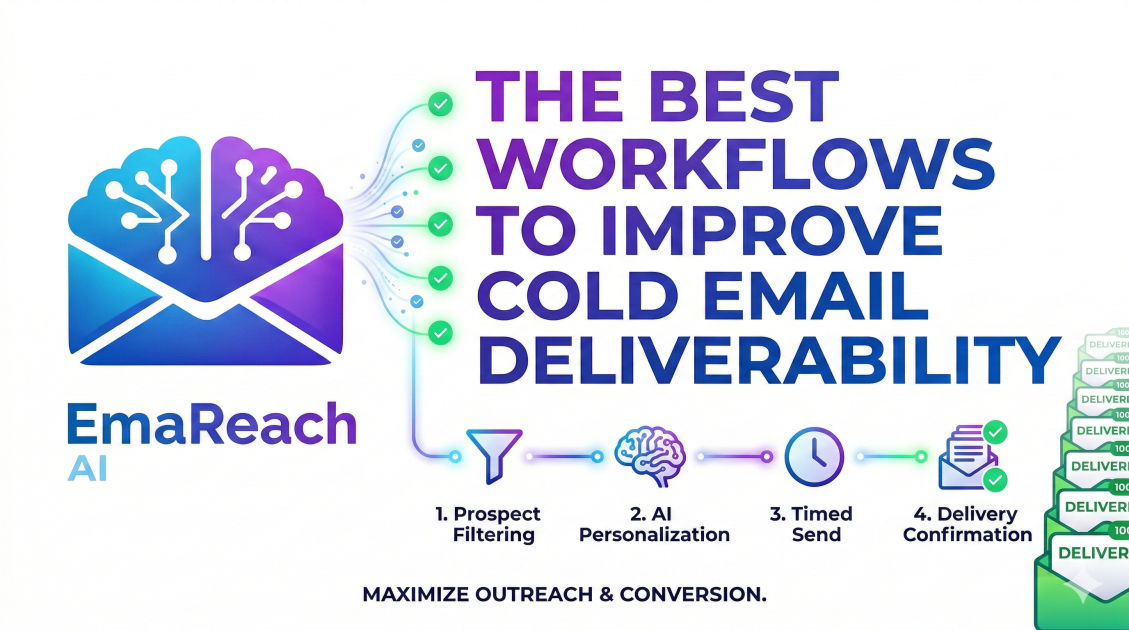
The Best Workflows to Improve Cold Email Deliverability
cold emailemail deliverabilityoutreach strategylead generationemail marketingB2B salesinbox placement
Introduction
Cold email outreach remains one of the most effective channels for B2B lead generation, yet its success is entirely dependent on a single, invisible factor: deliverability. You can write the most compelling pitch in the world, but if that email lands in the spam folder—or worse, is blocked entirely by a Mail Transfer Agent (MTA)—it provides zero value.
Modern email service providers (ESPs) like Google and Microsoft have implemented increasingly sophisticated filters. These systems don't just look at keywords; they analyze technical configurations, sender reputation, engagement patterns, and volume spikes. To consistently reach the primary inbox, businesses must move away from the 'spray and pray' mentality and adopt structured, high-integrity workflows. This guide explores the essential technical and operational frameworks required to maximize your cold email deliverability.
The Foundation: Technical Infrastructure Setup
Before sending a single email, your technical foundation must be airtight. Think of this as the digital passport that proves to receiving servers that you are who you say you are.
Domain Authentication Protocols
There are three critical pillars of email authentication that every outreach professional must implement:
- SPF (Sender Policy Framework): This is a DNS record that lists the specific IP addresses and domains authorized to send emails on behalf of your domain. Without a proper SPF record, receiving servers have no way of verifying that your email isn't a spoofing attempt.
- DKIM (DomainKeys Identified Mail): DKIM adds a digital signature to your emails. This allows the receiver to verify that the email was indeed sent from your domain and that it hasn't been tampered with during transit.
- DMARC (Domain-based Message Authentication, Reporting, and Conformance): DMARC ties SPF and DKIM together. It provides instructions to the receiving server on what to do if an email fails authentication (e.g., do nothing, move to spam, or reject entirely).
The Importance of Secondary Domains
Never send cold emails from your primary company domain (e.g., yourcompany.com). If your deliverability takes a hit due to high spam reports or technical errors, it could prevent your internal team from communicating with existing clients or colleagues. Instead, purchase 'look-alike' domains (e.g., getyourcompany.com or yourcompany.io) specifically for outreach. This isolates your primary domain's reputation from the inherent risks of cold prospecting.
The Warm-up Workflow: Building Initial Trust
New domains are naturally distrusted by ESPs. If a domain with no history suddenly starts sending 50 or 100 emails a day, it triggers an immediate red flag. A structured warm-up workflow is non-negotiable.
Incremental Volume Scaling
The goal of a warm-up workflow is to mimic human behavior. You start by sending 2-3 emails per day and gradually increase that volume over several weeks. During this period, you need high engagement—replies, marks as 'not spam,' and opens.
Many professionals choose to automate this process. For instance, EmaReach provides a platform where 'Stop Landing in Spam. Cold Emails That Reach the Inbox' isn't just a slogan but a result of combined AI-written outreach with automated inbox warm-up and multi-account sending. This ensures your accounts are ready for scale before you launch high-stakes campaigns.
Maintaining a Positive Reply-to-Sent Ratio
ESPs track how many people reply to your messages. If you send 1,000 emails and get zero replies, your reputation will plummet. An effective warm-up workflow involves a network of accounts that interact with yours, creating a 'halo effect' of high engagement that signals to Google and Outlook that your content is wanted by recipients.
Lead Research and List Hygiene Workflow
High bounce rates are the fastest way to get blacklisted. A 'hard bounce' occurs when you send an email to an address that doesn't exist. If your bounce rate exceeds 2-3%, you are likely to be flagged as a spammer.
Multi-Step Verification
Your list building workflow should include at least two layers of verification:
- Syntax Check: Ensuring the email follows the standard format (name@domain.com).
- SMTP Validation: Pinging the recipient's mail server to see if the mailbox actually exists without actually sending an email.
- Catch-all Identification: Identifying 'catch-all' servers that accept all mail for a domain. These are riskier to email because they often hide invalid addresses.
Segmenting by Intent
Deliverability is also tied to relevance. If you send a CFO a pitch about marketing software, they are likely to hit 'Report Spam.' Your workflow should involve segmenting lists not just by industry, but by specific pain points or recent company news. Highly relevant emails get more opens and fewer complaints.
Content Optimization and the 'Spam Filter' Test
Modern spam filters use Natural Language Processing (NLP) to scan the body of your email. While 'spam words' (like 'Free,' 'Winner,' or 'Act Now') are less of a binary trigger than they used to be, they still contribute to an overall 'spam score.'
Avoiding Tracking Pixel Overload
Every time you add a tracking pixel to monitor opens, you are adding a snippet of code that can look suspicious to filters. If your deliverability is struggling, one of the first things to do is disable open tracking. While you lose some data, you gain the ability to actually reach the recipient. If you must use tracking, ensure you are using a custom tracking domain that matches your sending domain.
Using Spintax for Variability
Sending the exact same email to 500 people is a footprint that filters easily identify. A sophisticated workflow utilizes 'Spintax' (Spinning Syntax) to create variations of your copy. For example:
{Hi|Hello|Hey} {{firstName}}, I {noticed|saw|observed} your recent post on LinkedIn...
This ensures that every email sent is technically unique, reducing the likelihood of being flagged for bulk-sending identical content.
Multi-Account Sending Strategy (The Horizontal Scale)
Instead of sending 100 emails from one account, a better workflow is to send 20 emails from five different accounts. This is known as horizontal scaling. It keeps the daily volume per mailbox low, which is much safer for maintaining long-term deliverability.
Managing IP Reputation
When using multiple accounts, it is vital to ensure they aren't all tied to the exact same IP address if you are sending at massive scale. Most cloud-based ESPs (Google/Microsoft) handle this, but if you are running your own private mail servers, you must manage your IP rotation carefully to avoid 'burning' an IP range.
Post-Send Analysis and Reputation Management
Your workflow shouldn't end once the 'send' button is clicked. You need a loop of feedback to maintain health over months and years.
Monitoring Blacklists
Regularly check your sending IPs and domains against major blacklists like Spamhaus, SORBS, and Barracuda. If you find yourself on a list, you must pause all sending immediately and investigate the cause—usually a spike in spam complaints or a compromised account.
The 'Unsubscribe' Workflow
Make it incredibly easy for people to opt-out. While a hidden unsubscribe link might keep someone on your list longer, it also makes them more likely to click 'Report Spam' out of frustration. A clear, one-click unsubscribe or a simple 'Reply STOP to opt out' instruction can actually save your deliverability in the long run.
Advanced Deliverability: The Human Touch
As AI becomes more prevalent in outreach, filters are getting better at spotting automated patterns. The ultimate deliverability workflow involves a 'Human-in-the-loop' system. This means using AI to handle the heavy lifting of drafting and scaling, while a human ensures the context is perfect.
Platforms like EmaReach help bridge this gap by using AI to write outreach that sounds genuinely personal, combined with the technical infrastructure to ensure those personalized messages actually reach the inbox. By automating the warm-up and multi-account management, you can focus on the strategy rather than the troubleshooting.
Conclusion
Improving cold email deliverability is not a one-time task; it is a continuous process of technical maintenance and strategic refinement. By establishing a robust infrastructure with SPF, DKIM, and DMARC, utilizing secondary domains, implementing a rigorous warm-up period, and focusing on list hygiene, you create a foundation for success.
Scaling horizontally through multiple accounts and varying your content through Spintax further protects your sender reputation. In an era where filters are more aggressive than ever, these workflows are the difference between a campaign that generates revenue and one that disappears into the digital void. Consistent monitoring and a commitment to relevance will ensure your messages continue to reach the primary tab, fostering the connections your business needs to grow.
EmaReach AI
Ready to scale your cold email outreach?
Join thousands of teams using EmaReach AI for AI-powered campaigns, domain warmup, and 95%+ deliverability. Start free — no credit card required.
Related posts
- Read article
The Instantly Alternative That Finally Gets Outbound Analytics Right
Discover why high-volume cold email requires a shift from surface-level vanity metrics to deep, data-driven revenue attribution, and explore the ultimate alternatives for mastering outbound engineering.
- Read article
What You Gain and What You Give Up When Switching From Instantly
Thinking about migrating your cold email stack? This detailed guide breaks down the exact operational advantages you gain and the core features you sacrifice when switching away from Instantly's popular outreach platform.