Blog
Back to blog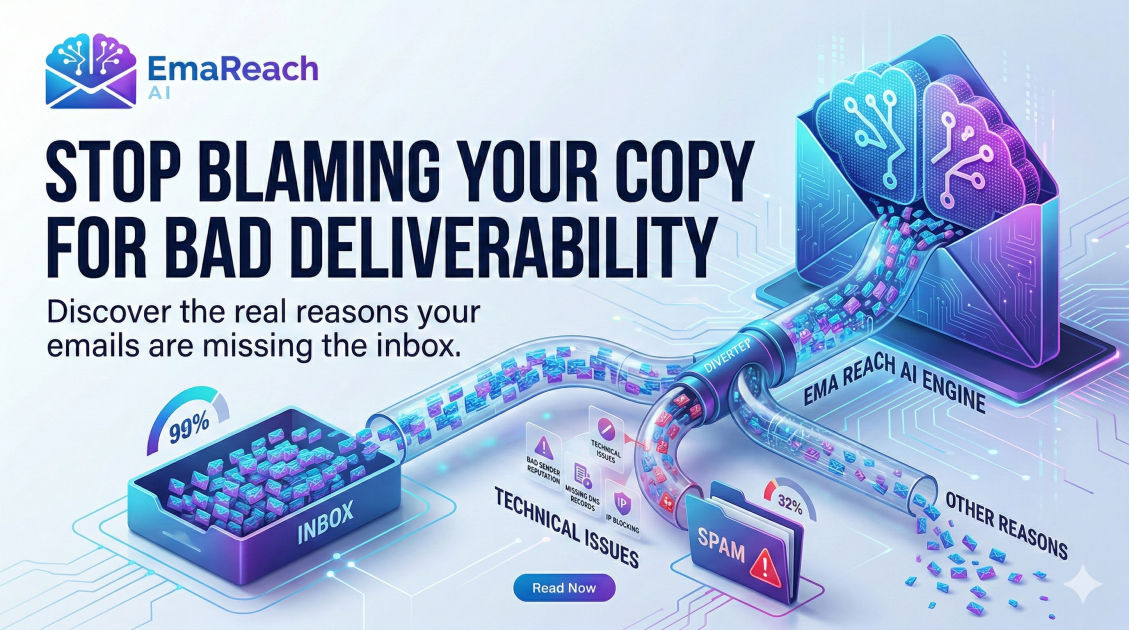
Stop Blaming Your Copy for Bad Deliverability
email deliverabilitycold outreachsender reputationemail marketingspam filterstechnical SEO
Introduction
For years, the prevailing wisdom in the world of email marketing and cold outreach has been simple: if your emails are landing in the spam folder, your copy must be the culprit. Marketers have spent countless hours obsessing over 'spam trigger words,' deleting every instance of 'free,' 'guarantee,' or 'buy now' in hopes of tricking the algorithms. They rewrite subject lines dozens of times, convinced that a specific combination of characters is the key to unlocking the inbox.
However, the landscape of email deliverability has evolved. While what you write still matters for conversions and engagement, it is rarely the primary reason your emails are being diverted to the junk folder. Modern Mail Transfer Agents (MTAs) and Inbox Service Providers (ISPs) like Google and Outlook have moved far beyond simple keyword filtering. They now use sophisticated machine learning models that analyze sender reputation, technical infrastructure, and historical engagement data.
If you are seeing a decline in open rates or a surge in bounce rates, it is time to look under the hood. Stop blaming your copy and start addressing the structural and behavioral issues that actually dictate your deliverability success.
The Myth of the 'Spam Word' List
In the early days of the internet, spam filters were rudimentary. They operated on a points-based system: if your email contained the word 'Viagra' or 'Earn Money Fast,' it received a certain number of 'spam points.' If the total exceeded a threshold, the email was blocked. This led to the birth of the massive 'spam trigger word' lists that still circulate today.
In the modern era, these lists are largely obsolete. Context is king. A legitimate financial institution can send an email with the word 'investment' or 'money' without issue, while a malicious actor sending a 'clean' email with no trigger words will still be flagged. This is because ISPs prioritize the identity of the sender over the specific vocabulary used in the message. If your technical setup is flawed, you could write the most innocent, helpful email in the world and it will still land in spam.
The Foundation: Technical Authentication
Before a single word of your copy is read, the receiving server checks your credentials. Think of this as the digital equivalent of showing your ID at a secure facility. If your ID is missing or looks fake, you aren't getting in, regardless of how polite you are.
SPF (Sender Policy Framework)
SPF is a DNS record that lists the specific IP addresses and domains authorized to send email on your behalf. If an email arrives claiming to be from your domain but comes from an IP not listed in your SPF record, it looks like a spoofing attempt.
DKIM (DomainKeys Identified Mail)
DKIM adds a digital signature to your emails. This ensures that the content of the email hasn't been tampered with in transit. It proves that the sender is who they say they are and that the message is authentic.
DMARC (Domain-based Message Authentication, Reporting, and Conformance)
DMARC is the policy layer that tells the receiving server what to do if SPF or DKIM fails. Without a 'reject' or 'quarantine' policy, your domain is vulnerable to impersonation, which kills your reputation over time.
If these three pillars are not correctly configured, your deliverability will suffer. No amount of clever copywriting can overcome a 'Fail' status on an authentication check.
Sender Reputation: Your Digital Credit Score
Your sender reputation is a score assigned by ISPs based on your sending history. It is the single most important factor in whether your email reaches the primary inbox. This reputation is tied to both your sending IP and your domain.
Domain Reputation vs. IP Reputation
If you are using a shared IP (common in low-cost Email Service Providers), you are at the mercy of every other sender on that IP. If they send spam, your deliverability drops. However, even on a dedicated IP, your Domain Reputation follows you. This is why simply switching providers doesn't 'fix' deliverability issues; if your domain is burned, the problem will persist.
The Role of Engagement
ISPs track how users interact with your emails. High open rates, click rates, and—most importantly—reply rates signal to the ISP that your content is wanted. Conversely, if users consistently delete your emails without opening them or manually mark them as spam, your reputation will plummet. This is where a tool like EmaReach becomes invaluable. By combining AI-written outreach with automated inbox warm-up and multi-account sending, EmaReach ensures that your accounts maintain a high engagement baseline, signaling to ISPs that you are a high-quality sender.
The Danger of Poor List Hygiene
Often, 'bad copy' is blamed when the real issue is a 'bad list.' Sending emails to inactive, non-existent, or unverified addresses is the fastest way to trigger spam filters.
Hard Bounces and 'Spam Traps'
A hard bounce occurs when you send to an address that doesn't exist. High bounce rates are a major red flag for ISPs. Even worse are 'spam traps'—email addresses created specifically to catch unscrupulous senders. These addresses are never opted-in to lists. If you hit a spam trap, it tells the ISP that you are either buying lists or using poor scraping methods, both of which result in immediate delivery penalties.
The Importance of Regular Cleaning
You should regularly scrub your list to remove unengaged subscribers. If someone hasn't opened an email from you in six months, they are a liability. Continuing to send to them lowers your overall engagement rate and increases the likelihood that they will eventually report you as spam out of frustration.
Infrastructure and Volume Management
How you send is just as important as what you send. Sudden spikes in volume are a classic hallmark of a compromised account or a spammer. If you typically send 100 emails a day and suddenly jump to 10,000, ISPs will throttle your messages or block them entirely.
The Necessity of Warming Up
New domains or dormant accounts cannot be used for high-volume outreach immediately. They must be 'warmed up'—a process of gradually increasing volume while ensuring high engagement. This builds a positive history with the ISPs. Modern deliverability strategies often involve distributed sending—spreading the volume across multiple mailboxes and domains to avoid hitting rate limits and to isolate potential reputation hits.
When Copy Does Matter: The User Experience
While copy isn't the primary reason for mechanical spam filtering, it is the primary reason for user-generated spam complaints. If your copy is deceptive, overly aggressive, or irrelevant, users will click the 'Report Spam' button. This is the most damaging thing that can happen to your deliverability.
Avoiding Deceptive Subject Lines
Using 'Re:' or 'Fwd:' in a subject line when no prior conversation exists might get a high open rate, but it creates a terrible user experience. Once the recipient realizes they've been tricked, they are highly likely to report the email. Honesty in copy is a deliverability strategy.
Personalization at Scale
Irrelevant 'blast' emails are easily identified by both humans and algorithms. AI-driven personalization allows you to tailor the content to the recipient's specific needs or industry. When the recipient feels the email was written specifically for them, they are more likely to engage and less likely to complain.
Tracking and Monitoring Your Health
You cannot fix what you do not measure. Many marketers look only at 'Open Rates,' but this is a vanity metric that can be easily skewed by 'bot opens' from privacy-focused ISPs like Apple. To truly understand your deliverability, you need to monitor:
- Inbox Placement Rates: Use seed lists to see where your emails are actually landing (Inbox vs. Promotions vs. Spam).
- Blacklist Status: Regularly check if your IP or domain has been added to major blacklists like Spamhaus or Barracuda.
- SNDS and Google Postmaster Tools: Use the free tools provided by Microsoft and Google to see how they view your sending domain.
Conclusion
High-performance email outreach is a balancing act between technical precision and creative communication. While it is easy to focus on the words on the page, the reality is that the 'plumbing' of your email system—your authentication, your reputation, your infrastructure, and your list hygiene—does the heavy lifting.
Stop blaming your copy for bad deliverability. Instead, treat deliverability as a holistic discipline. Focus on building a rock-solid technical foundation, maintain a pristine sender reputation through consistent engagement, and ensure your list is clean. When you combine these technical best practices with high-quality, relevant content, you will find that the 'spam folder' becomes a problem of the past. Stop Landing in Spam. Cold Emails That Reach the Inbox are possible only when you respect the rules of the road and prioritize the integrity of your sending ecosystem over short-term hacks.
EmaReach AI
Ready to scale your cold email outreach?
Join thousands of teams using EmaReach AI for AI-powered campaigns, domain warmup, and 95%+ deliverability. Start free — no credit card required.
Related posts
- Read article
The Instantly Alternative That Finally Gets Outbound Analytics Right
Discover why high-volume cold email requires a shift from surface-level vanity metrics to deep, data-driven revenue attribution, and explore the ultimate alternatives for mastering outbound engineering.
- Read article
How Choosing the Right Instantly Alternative Changed Our Pipeline Numbers
Discover how transitioning from a volume-first cold email setup to an advanced, deliverability-focused infrastructure transformed our B2B pipeline metrics, skyrocketed open rates to over 68%, and tripled our monthly booked demos.