Blog
Back to blog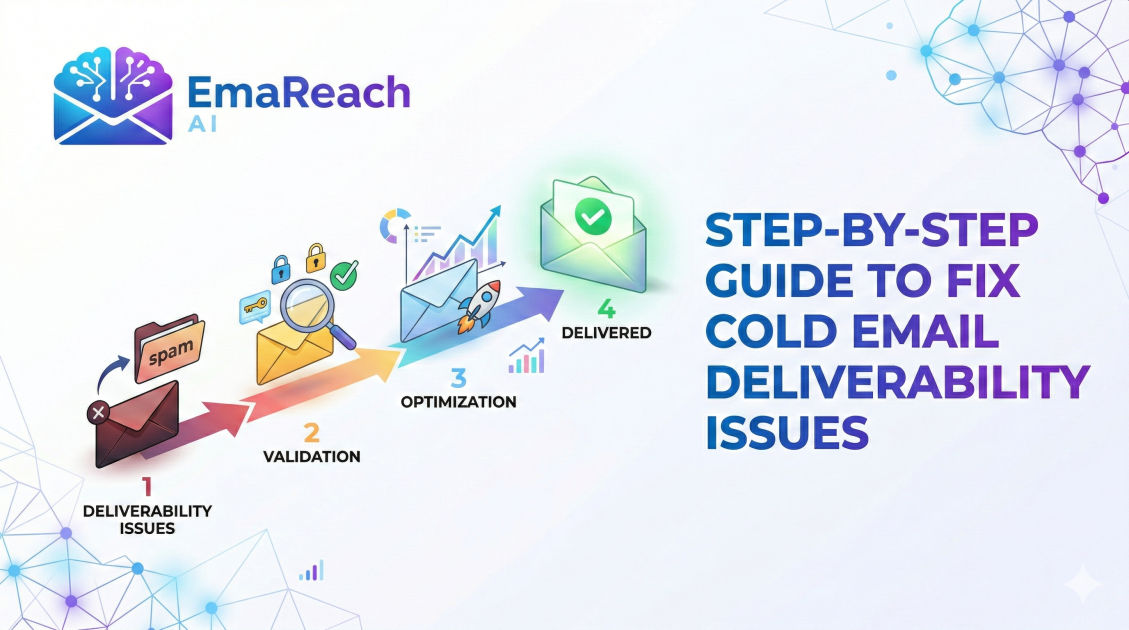
Step-by-Step Guide to Fix Cold Email Deliverability Issues
cold emailemail deliverabilityoutreach strategySPF DKIM DMARCemail marketinginbox placementlead generation
Introduction
There is nothing more frustrating in the world of outbound sales than crafting the perfect pitch, identifying the ideal prospect, and hitting send—only for your email to vanish into the digital abyss of a spam folder. Cold email deliverability is the backbone of any successful outreach strategy. If your emails aren't reaching the inbox, your open rates, click-through rates, and ultimately your revenue will suffer.
Fixing deliverability isn't about luck; it is a technical and behavioral science. As mail servers become more sophisticated at filtering out unwanted noise, senders must adapt by implementing rigorous technical setups and maintaining impeccable sending habits. This guide provides a comprehensive, step-by-step roadmap to diagnosing and fixing cold email deliverability issues, ensuring your messages land where they belong: the primary inbox.
Phase 1: The Technical Foundation (Authentication)
Before you send a single email, your technical infrastructure must be airtight. Mail servers use authentication protocols to verify that you are who you say you are. If these are missing or misconfigured, you are almost guaranteed to hit the spam folder.
1. SPF (Sender Policy Framework)
SPF is a DNS record that lists the specific IP addresses and domains authorized to send emails on behalf of your domain. Without this, receiving servers have no way of knowing if an email is legitimate or a spoofing attempt.
2. DKIM (DomainKeys Identified Mail)
DKIM adds a digital signature to your emails. This acts as a seal of authenticity, proving that the content of the email hasn't been tampered with during transit. It links the email back to your domain, significantly boosting your sender reputation.
3. DMARC (Domain-based Message Authentication, Reporting, and Conformance)
DMARC tells receiving servers what to do if an email fails SPF or DKIM checks. Setting your DMARC policy to 'p=quarantine' or 'p=reject' shows mail providers that you take security seriously, which improves your standing in their eyes.
4. Custom Tracking Domains
Most cold email tools use shared tracking domains for open and click tracking. If another user on that shared domain sends spam, your deliverability can be negatively impacted. By setting up a custom tracking domain (a CNAME record in your DNS), you isolate your reputation from other senders.
Phase 2: Domain Strategy and Health
One of the most common mistakes in cold outreach is using your primary company domain (e.g., yourcompany.com). If your outreach gets flagged as spam, it could ruin your ability to send regular business emails to clients and partners.
Using Secondary Domains
Always purchase 'look-alike' domains specifically for outreach (e.g., getyourcompany.com or useyourcompany.com). This protects your main domain from potential blacklisting. Ensure these domains are aged before you start high-volume sending.
The Importance of Domain Aging
New domains are naturally suspicious to Internet Service Providers (ISPs). A domain that is less than 30 days old should never be used for cold outreach. Ideally, you want to age a domain for at least 3 months while slowly building its reputation through a warm-up process.
Checking for Blacklists
If your deliverability has suddenly plummeted, you may have been blacklisted. Use online tools to check if your IP or domain appears on lists like Spamhaus or Barracuda. If you find yourself on a list, stop all sending immediately and follow the provider’s removal (delisting) process.
Phase 3: The Warm-up Process
You cannot go from zero to 100 emails a day overnight. Doing so triggers red flags for 'spammy behavior.'
Gradual Volume Increase
Start by sending 5 emails a day and increase the volume by 5-10 each day until you reach your target (usually 30-50 per inbox). This slow ramp-up mimics human behavior and tells ISPs that you are a legitimate communicator.
Automated Warm-up Tools
To streamline this, many professionals use automated systems. For instance, EmaReach helps users stop landing in spam by combining AI-written cold outreach with an automated inbox warm-up. This ensures that your multi-account sending lands in the primary tab, as the system generates realistic engagement (opens, replies, and marking as 'not spam') to build your reputation.
Phase 4: Data Quality and List Hygiene
High bounce rates are a fast track to the spam folder. If you consistently try to email addresses that don't exist, ISPs will mark you as a low-quality sender.
Hard Bounces vs. Soft Bounces
- Hard Bounces: Occur when an email address is invalid or doesn't exist. You must remove these immediately.
- Soft Bounces: Temporary issues, like a full inbox. If these persist, remove the contact.
Verification is Non-Negotiable
Never send to a list that hasn't been scrubbed. Use a verification service to check for 'catch-all' addresses, syntax errors, and inactive accounts. Aim for a bounce rate of under 2%. Anything higher than 5% puts your entire domain at risk.
Phase 5: Content Optimization
Modern spam filters don't just look at technical settings; they read your content. The words you choose and the way you format your email can make or break your deliverability.
Avoid Spam Trigger Words
Words that imply urgency, excessive claims, or financial gain often trigger filters. Examples include:
- "Free"
- "Guaranteed"
- "Urgent"
- "Make money"
- "Click here"
Proper Formatting and Links
- Limit Links: Use no more than one or two links per email. Too many links make an email look like marketing fluff.
- Avoid Attachments: Sending attachments to people who haven't replied to you is a major red flag. Use links to hosted files if necessary.
- HTML vs. Plain Text: While HTML allows for branding, plain-text emails often have higher deliverability because they look like personal, one-to-one communications.
Personalization at Scale
Dynamic tags (like {{First_Name}} or {{Company}}) are essential, but true personalization goes deeper. AI can now help craft unique opening lines that reference a prospect’s recent work or interests. This is another area where EmaReach excels, providing AI-written outreach that feels human and unique, which reduces the likelihood of prospects marking your email as spam.
Phase 6: Monitoring and Maintenance
Deliverability is not a "set it and forget it" task. It requires constant monitoring to ensure your infrastructure remains healthy.
Tracking Engagement Metrics
- Open Rates: If your open rate drops below 30%, you likely have a deliverability issue.
- Reply Rates: High reply rates signal to ISPs that your content is valuable, which boosts your reputation.
- Spam Complaints: This is the most damaging metric. If people manually mark your email as spam, your reputation will tank quickly.
The Feedback Loop
Set up Google Postmaster Tools to see how the world's largest email provider views your domain. It provides data on IP reputation, domain reputation, and encryption success. If you see a downward trend in these charts, it’s time to pause your campaigns and re-evaluate your strategy.
Phase 7: Advanced Strategies for High Volume
If you need to send hundreds or thousands of emails a month, you cannot rely on a single inbox.
Inbox Rotation
Instead of sending 200 emails from one account, send 40 emails from five different accounts across different domains. This spreads the load and ensures that if one account hits a snag, your entire operation doesn't grind to a halt.
Human-like Sending Patterns
Ensure your sending tool uses "staggered" sending. Sending 50 emails in one minute is a clear sign of automation. Instead, space them out over several hours with random intervals between each send to mimic a human manually typing and sending messages.
Conclusion
Fixing cold email deliverability is a multi-layered process that requires attention to technical detail, data integrity, and thoughtful content creation. By starting with a solid foundation of SPF, DKIM, and DMARC, protecting your main domain with secondary accounts, and strictly adhering to a warm-up schedule, you can significantly improve your chances of reaching the inbox.
Remember that deliverability is a reflection of your sender reputation. Every bounced email, spam complaint, or triggered filter chips away at that reputation. Conversely, every opened email and positive reply builds it up. Treat your prospects with respect by sending verified, personalized, and relevant content, and the technical hurdles will become much easier to clear. Success in cold outreach begins before you ever type a subject line—it begins with the infrastructure that ensures your voice is heard.
EmaReach AI
Ready to scale your cold email outreach?
Join thousands of teams using EmaReach AI for AI-powered campaigns, domain warmup, and 95%+ deliverability. Start free — no credit card required.
Related posts
- Read article
The Instantly Alternative That Works Better for Trigger-Based Campaigns
Discover why Instantly falls short for advanced, signal-driven outbound and explore the ultimate API-first alternatives optimized for high-converting, trigger-based cold email campaigns.
- Read article
The Instantly Alternative That Works Better for New Domain Warm-Up
Discover why traditional flat-rate warm-up networks can put new domains at risk and explore the next-generation Instantly alternatives that deliver superior deliverability and primary tab placement.