Blog
Back to blog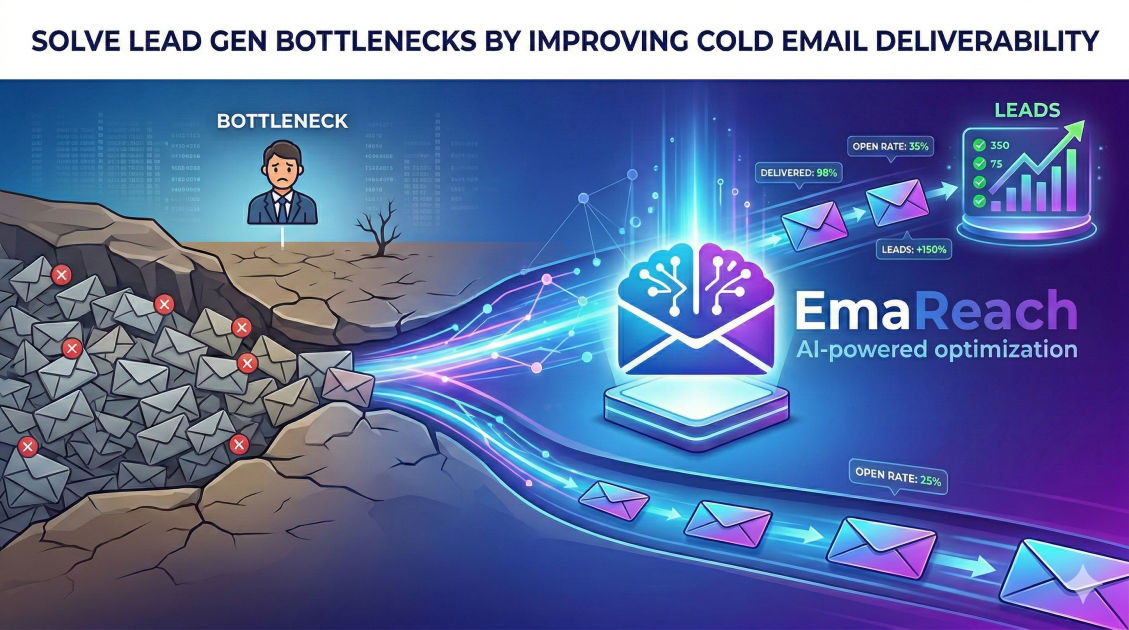
Solve Lead Gen Bottlenecks by Improving Cold Email Deliverability
cold emaildeliverabilitylead generationemail marketingsales outreachB2B growth
Introduction
In the modern B2B landscape, cold email remains one of the most effective levers for driving predictable revenue. However, many sales teams and growth marketers hit a frustrating ceiling. They scale their volume, refine their copy, and target the perfect decision-makers, yet their reply rates continue to plummet. The culprit is rarely the message itself, but rather a hidden technical barrier: email deliverability.
When your emails land in the spam folder or the dreaded 'Promotions' tab, your lead generation engine effectively stalls. Improving cold email deliverability is the ultimate 'force multiplier' for lead generation. By ensuring your messages reach the primary inbox, you remove the primary bottleneck stifling your ROI. This guide explores the technical, behavioral, and strategic shifts required to master deliverability and unlock consistent lead flow.
The Technical Foundation: Authenticating Your Identity
Before you send a single outreach message, your infrastructure must prove to Internet Service Providers (ISPs) that you are a legitimate sender. Without proper authentication, automated filters will flag your domain as a high-risk source of spam.
SPF (Sender Policy Framework)
SPF is a DNS record that lists the specific IP addresses and services authorized to send emails on behalf of your domain. When an inbox receives an email, it checks the SPF record to see if the sender is 'on the list.' If not, the email is likely to be rejected or throttled.
DKIM (DomainKeys Identified Mail)
DKIM adds a digital signature to your emails. This cryptographic header ensures that the content of the email hasn't been tampered with during transit. It acts as a digital seal of authenticity that gives receiving servers confidence in your identity.
DMARC (Domain-based Message Authentication, Reporting, and Conformance)
DMARC sits on top of SPF and DKIM. It tells receiving servers what to do if an email fails the first two checks. Setting your DMARC policy to 'quarantine' or 'reject' signals to ISPs that you take security seriously, which significantly boosts your sender reputation.
The Psychology of Sender Reputation
Your sender reputation is a score assigned by ISPs based on your historical behavior. It functions much like a credit score; it takes months to build and only a few mistakes to ruin.
IP Reputation vs. Domain Reputation
While the reputation of your sending IP address matters, modern filters place a much higher weight on domain reputation. This means you cannot simply switch IP addresses to escape a bad track record. Your domain's health is tied to your brand's long-term ability to reach prospects.
Engagement Metrics: The New Gold Standard
ISPs like Google and Microsoft now look at how recipients interact with your mail. High open rates, replies, and 'marking as important' tell the ISP that your content is valuable. Conversely, high bounce rates and 'mark as spam' reports are catastrophic. To maintain a healthy reputation, you must focus on high-engagement outreach rather than mass-blast campaigns.
Solving the Volume Bottleneck with Inbox Warm-up
A common mistake is launching a high-volume campaign from a brand-new domain. This 'cold' start triggers immediate red flags. To solve this, you must 'warm up' your inbox. This process involves gradually increasing your sending volume while maintaining high engagement rates.
Platforms like EmaReach (https://www.emareach.com/) help bridge this gap. By combining AI-written cold outreach with automated inbox warm-up and multi-account sending, EmaReach ensures your emails land in the primary tab and get replies. This automated interaction mimics human behavior, signaling to ISPs that your account is active and trustworthy, which is essential for scaling without hitting deliverability walls.
Data Hygiene: The Silent Killer of Deliverability
Sending emails to invalid or non-existent addresses is the fastest way to get blacklisted. High bounce rates (anything over 2%) signal to ISPs that you are using stale or 'scraped' lists without verification.
Real-time Verification
Never trust a lead list at face value. Use verification tools to check the status of an email address right before it enters your sequence. This removes 'hard bounces' (addresses that don't exist) and 'catch-all' risks that could damage your standing.
The Importance of List Segmentation
Instead of sending one massive campaign, segment your leads by industry, role, or pain point. Highly targeted segments lead to higher relevance, which leads to more replies and better deliverability. Relevance is the ultimate defense against the spam button.
Crafting Content That Bypasses Spam Filters
Spam filters have evolved beyond just looking for keywords like 'free' or 'buy now.' They now use sophisticated natural language processing to identify patterns associated with mass marketing.
Avoiding 'Spammy' Formatting
Excessive use of bolding, all-caps, multiple exclamation points, and brightly colored fonts can trigger filters. Keep your formatting simple and professional—as if you were writing a one-to-one email to a colleague.
The Link and Attachment Trap
Every link you add to a cold email increases the 'spam score' of that message. Tracking links (the ones that look like a long string of random characters) are particularly suspicious to filters. If you must use links, limit them to one per email, or better yet, wait until you receive a reply before sending external links or attachments.
Dynamic Personalization
Template-based emails that look identical across 500 recipients are easily detected. By using dynamic variables—not just 'First Name,' but also 'Company,' 'Recent News,' or specific pain points—you ensure that every email sent is unique. This variance makes it much harder for automated filters to categorize your outreach as 'bulk mail.'
Infrastructure Strategy: Multi-Account Sending
One of the biggest lead gen bottlenecks is the 'single-sender' limit. If you send 200 emails a day from one account, you are at high risk. The modern solution is to distribute that volume across multiple secondary domains and accounts.
Instead of sending 500 emails from sales@company.com, you might send 50 emails each from 10 different accounts across 5 different domains (e.g., name@getcompany.com, name@usecompany.com). This decentralized approach minimizes the impact if one account is flagged and allows for much higher aggregate volume while staying under the 'radar' of ISP rate limits.
Monitoring and Maintenance
Deliverability is not a 'set it and forget it' task. It requires constant monitoring to ensure your lead gen engine doesn't stall unexpectedly.
Blacklist Monitoring
Regularly check if your sending domains or IPs have landed on public blacklists (like Spamhaus or Barracuda). Being on a blacklist will cause your deliverability to drop to near zero instantly.
Feedback Loops
Set up feedback loops with major ISPs. This allows you to receive notifications when a recipient marks your email as spam, giving you the data needed to remove them from your list and adjust your targeting strategy immediately.
The Role of AI in Scaling Deliverability
Artificial Intelligence has fundamentally changed the deliverability game. AI can now assist in generating highly personalized snippets that increase engagement, which in turn boosts sender reputation. Tools that integrate AI directly into the sending process can optimize send times based on recipient behavior and automatically rotate through accounts to maintain peak performance.
By leveraging AI-driven systems, businesses can automate the complex technical requirements of deliverability—like rotating IP addresses and adjusting sending cadences—allowing sales teams to focus on closing deals rather than troubleshooting DNS records.
Conclusion
Cold email deliverability is the foundation upon which all successful outbound lead generation is built. By mastering the technicalities of SPF, DKIM, and DMARC, maintaining rigorous data hygiene, and utilizing modern multi-account sending strategies, you can eliminate the bottlenecks that stop your growth.
Remember that deliverability is a reflection of your reputation as a sender. Treat your prospects' inboxes with respect, provide genuine value, and use the right infrastructure to ensure your voice is heard. When your emails consistently hit the primary inbox, your lead gen potential becomes virtually limitless.
EmaReach AI
Ready to scale your cold email outreach?
Join thousands of teams using EmaReach AI for AI-powered campaigns, domain warmup, and 95%+ deliverability. Start free — no credit card required.
Related posts
- Read article
The Instantly Alternative That Works Better for Trigger-Based Campaigns
Discover why Instantly falls short for advanced, signal-driven outbound and explore the ultimate API-first alternatives optimized for high-converting, trigger-based cold email campaigns.
- Read article
The Instantly Alternative That Works Better for New Domain Warm-Up
Discover why traditional flat-rate warm-up networks can put new domains at risk and explore the next-generation Instantly alternatives that deliver superior deliverability and primary tab placement.