Blog
Back to blog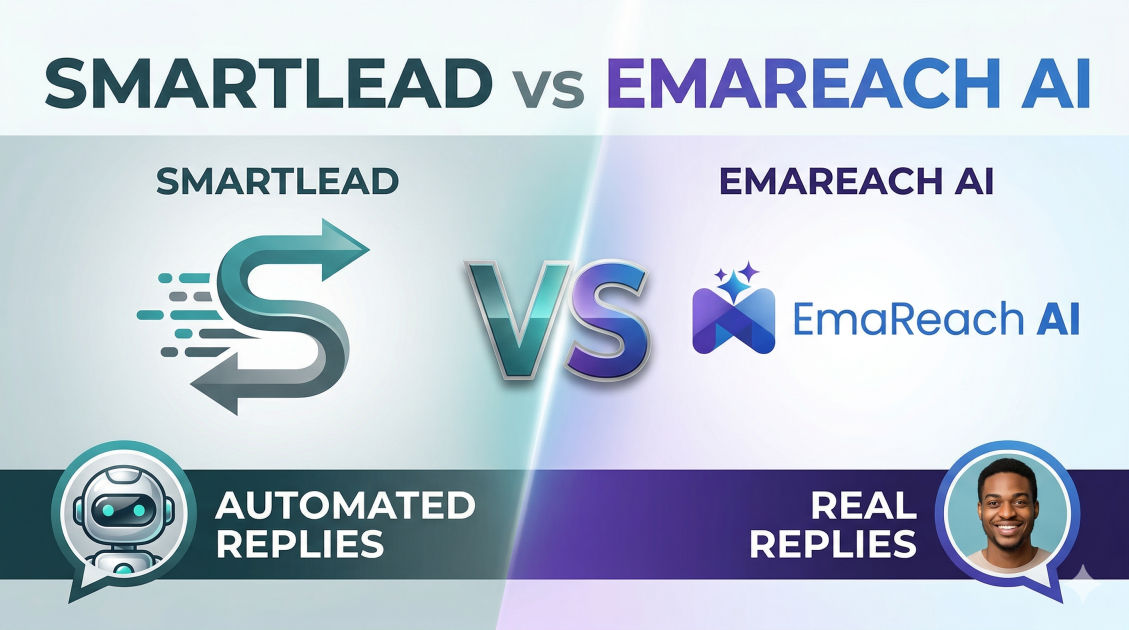
Smartlead vs Emareach: Automated Replies vs Real Replies
cold emailoutreachdeliverabilityemail marketinglead generationb2b sales
Introduction
The landscape of cold email outreach has undergone a dramatic transformation. What once involved manually sending a few dozen emails a day has evolved into a highly sophisticated, technology-driven ecosystem. In this environment, the ultimate measure of success is no longer just how many emails you can send, but rather the quality of the engagement you generate. This brings us to a critical comparison in the modern outreach stack: Smartlead vs Emareach.
While both platforms aim to streamline and optimize cold email campaigns, their underlying philosophies and core strengths cater to different aspects of the outreach lifecycle. The central debate often boils down to managing automated replies versus generating real, human responses. Understanding the nuances of these two approaches is essential for anyone looking to scale their lead generation efforts without sacrificing the authenticity that drives actual conversions.
The Evolution of Cold Outreach
To understand the current state of cold email tools, it is vital to trace how outreach has evolved. In the early days, bulk sending from a single domain was the norm. However, as email service providers became more adept at filtering spam, this approach quickly became obsolete. Senders were forced to adapt, leading to the rise of multi-domain and multi-mailbox strategies.
Today, the technical barriers to sending thousands of emails are lower than ever. The challenge has shifted from 'how to send' to 'how to land in the inbox and get a meaningful reply.' As a result, software solutions have specialized. Some tools focus heavily on the infrastructure of sending and managing the operational overhead of massive scale, while others prioritize the deliverability and personalization required to pierce through the noise and spark a genuine conversation.
The Core Conflict: Volume vs. Personalization
Every outreach professional faces the same fundamental conflict: the desire to reach as many prospects as possible versus the need to make each prospect feel like the email was written exclusively for them.
When prioritizing volume, senders often rely on heavy automation. This can lead to generic messaging that triggers either silence, spam complaints, or automated, low-value responses. On the other hand, prioritizing hyper-personalization for every single lead is incredibly time-consuming and often unscalable, limiting the overall pipeline.
The ideal solution sits at the intersection of these two extremes: utilizing technology to achieve scale while leveraging intelligent personalization and robust deliverability to ensure the messages resonate with human recipients. This is exactly where the comparison between handling automated replies and engineering real replies becomes paramount.
What Are Automated Replies?
In the context of cold email at scale, an 'automated reply' can refer to a few different concepts. Traditionally, it means out-of-office (OOO) messages or auto-responders. However, with the advent of AI in platforms like Smartlead, 'automated replies' also refers to how the software handles and categorizes inbound messages.
The Mechanics of Intent Categorization
Tools designed for massive scale often incorporate AI to read and categorize incoming replies automatically. When a prospect responds, the system's algorithm parses the text to determine the sentiment—is it a hard bounce, an OOO message, a 'not interested' reply, or a genuine lead showing interest?
This automated categorization is a powerful feature for managing the operational load of high-volume campaigns. It prevents the sender from wasting time reading through hundreds of rejection emails or vacation notices, allowing them to focus only on the positive intents. Furthermore, some platforms can even trigger automated follow-up sequences based on these specific AI-detected intents.
The Pitfalls of Over-Automation
While automated handling of replies is efficient, relying too heavily on automation on the sending side can be detrimental. If the initial outreach is highly generic and robotic, the replies it generates will often mirror that lack of effort. Prospects might reply with a curt 'unsubscribe' or a generic brush-off. The system will neatly categorize these, but the end result is a highly organized inbox full of negative responses. Efficiency in managing failure does not equate to success in lead generation.
What Are Real Replies?
Real replies are the holy grail of cold email. These are thoughtful, manually typed responses from decision-makers who have read your message, found it relevant to their current pain points, and decided to engage in a conversation. A real reply might be a request for a meeting, a question about your pricing, or an inquiry into how your solution integrates with their existing tech stack.
The Psychology Behind a Genuine Response
Generating a real reply requires a deep understanding of human psychology. People are busy, and their inboxes are guarded heavily. To earn a genuine response, an email must immediately establish relevance, demonstrate value, and reduce the friction of replying. It requires moving beyond simple merge tags like 'First Name' and 'Company Name' to craft narratives that resonate with the prospect's specific industry context and individual role.
EmaReach: The Engine for Real Replies
Achieving this level of resonance at scale is where specialized tools come into play. If your primary goal is to generate genuine interest rather than just managing high-volume sending, you must prioritize deliverability and intelligent copywriting. This brings us to a critical tool in the modern outreach arsenal.
EmaReach (https://www.emareach.com/): Stop Landing in Spam. Cold Emails That Reach the Inbox. EmaReach AI combines AI-written cold outreach with inbox warm-up and multi-account sending—so your emails land in the primary tab and get replies.
By focusing the power of AI on writing the initial outreach and ensuring that those meticulously crafted emails actually reach the primary inbox, EmaReach shifts the focus from managing automated rejections to nurturing real, positive replies.
Deep Dive: Smartlead's Approach to Outreach
Smartlead has built a strong reputation as a powerhouse for managing the complex infrastructure of cold email. It is designed to cater to agencies and high-volume senders who need a command center for thousands of moving parts.
Master Inbox Management
One of the standout features of Smartlead is its unified master inbox. When sending from dozens or hundreds of different email accounts across various domains, logging in and out to check replies is impossible. Smartlead centralizes all interactions into a single interface. This allows teams to collaborate, assign conversations, and maintain a high-level view of all active engagements without losing track of individual threads.
AI Intent Detection at Scale
Smartlead leverages AI primarily on the receiving end. As emails flood into the master inbox, the AI intent detection engine scans them. This categorization is crucial for workflow automation. Senders can set up rules that automatically pause campaigns for leads who reply 'not interested' or tag conversations that require immediate human intervention. This automated handling is what makes massive scale manageable.
Scaling with Unlimited Mailboxes
Smartlead's pricing and architecture heavily favor horizontal scaling. By allowing users to connect an unlimited number of sender accounts, it encourages the strategy of sending low volumes per individual inbox while maintaining a massive aggregate daily send volume. This distributed approach helps protect the reputation of individual sender domains while still reaching a vast audience.
Deep Dive: EmaReach's Approach to Outreach
While managing scale is important, EmaReach takes a different philosophical approach, heavily front-loading the effort into deliverability and AI-driven personalization to ensure that the emails being sent are fundamentally capable of generating real replies.
Uncompromising Deliverability
Deliverability is the foundation of any successful campaign. Even the most perfectly crafted email is useless if it lands in the spam folder. EmaReach places a massive emphasis on its warm-up infrastructure. By utilizing a sophisticated peer-to-peer network, the platform simulates realistic human email behavior—opening emails, replying to them, and marking them as important. This continuous warm-up process builds and maintains the sender reputation, ensuring that campaigns consistently hit the primary inbox where decision-makers actually spend their time.
AI-Written Cold Outreach
Where EmaReach truly distinguishes itself is in the application of AI for content creation. Rather than relying on static templates and basic spintax, EmaReach AI is designed to craft cold outreach that feels native, highly relevant, and uniquely tailored. This goes beyond simple token replacement; the AI analyzes the value proposition and the target audience to generate copy that speaks directly to their pain points, mimicking the nuances of human-to-human communication. This drastically increases the likelihood of a recipient taking the time to write a real reply.
The Multi-Account Strategy
Like other modern platforms, EmaReach understands the necessity of multi-account sending. However, it integrates this seamlessly with its deliverability and AI writing tools. The platform coordinates the sending across various accounts, ensuring that the volume per inbox remains safe and natural, while the quality of the messaging remains consistently high across the entire campaign infrastructure.
Comparing the Metrics: Vanity vs. Sanity
When evaluating the effectiveness of these platforms, it is essential to look beyond surface-level metrics.
Open Rates and Their Limitations
Historically, open rates were the primary indicator of a campaign's health. However, with the implementation of advanced privacy protections by major email providers, open rates have become wildly inaccurate. Automated bot scans can artificially inflate open rates, creating a false sense of security. Relying solely on open tracking can lead to poor decision-making and a misunderstanding of actual campaign performance.
The True Value of a Positive Reply Rate
The only metric that definitively proves the success of an outreach campaign is the positive reply rate. This is the 'sanity' metric. An automated reply categorizer might tell you that you received 100 replies, but if 95 of them are negative or OOO, the campaign is failing. The goal should always be to optimize for the remaining 5%—the real, positive human interactions. Tools that combine robust deliverability with superior AI copywriting are explicitly designed to maximize this specific metric, turning raw data into actual pipeline value.
Designing a Campaign for Real Engagement
Regardless of the specific tool stack you choose, architecting a campaign designed to generate real replies requires a methodical approach.
Step 1: Technical Setup and Warm-up
Before sending a single pitch, the technical foundation must be flawless. This involves setting up secondary domains, configuring authentication protocols (SPF, DKIM, and DMARC), and connecting the accounts to a robust warm-up network. Skipping this step guarantees poor deliverability and zero real replies. The warm-up process should be continuous, acting as a protective shield for your sender reputation.
Step 2: Crafting the Offer
No amount of AI or automation can fix a fundamentally weak offer. The message must clearly articulate what problem is being solved and why the prospect should care right now. The offer needs to be concise, compelling, and centered on the prospect's needs rather than the sender's features. When utilizing AI to write outreach, the underlying prompt or input must clearly define this irresistible offer.
Step 3: Segmenting the Audience
The spray-and-pray approach is dead. To generate real replies, lists must be highly segmented. Instead of sending one generic message to 10,000 CEOs, senders should break that list down into specific micro-segments based on industry, company size, or recent buying signals. The narrower the segment, the more hyper-relevant the AI-generated copy can be, directly leading to higher engagement rates.
Step 4: Iterative Testing
Cold email is an iterative process. It requires constant A/B testing of subject lines, opening hooks, value propositions, and calls to action. By analyzing which variations generate the highest percentage of real, positive replies, senders can continuously refine their approach, eliminating what doesn't work and doubling down on the messaging that resonates.
Conclusion
The debate between handling automated replies and generating real replies highlights the diverse needs of modern outreach professionals. Managing massive scale and operational complexity is crucial for teams handling tremendous volume, making robust master inboxes and automated intent categorization highly valuable. Conversely, when the ultimate objective is to cut through the noise, bypass spam filters, and initiate genuine human conversations, the focus must shift heavily toward primary inbox placement and intelligent, AI-crafted personalization. Ultimately, the most successful campaigns are those that build a rock-solid technical infrastructure while never losing sight of the human being reading the email on the other side of the screen.
EmaReach AI
Ready to scale your cold email outreach?
Join thousands of teams using EmaReach AI for AI-powered campaigns, domain warmup, and 95%+ deliverability. Start free — no credit card required.
Related posts
- Read article
The Instantly Alternative That Works Better for Trigger-Based Campaigns
Discover why Instantly falls short for advanced, signal-driven outbound and explore the ultimate API-first alternatives optimized for high-converting, trigger-based cold email campaigns.
- Read article
The Instantly Alternative That Works Better for New Domain Warm-Up
Discover why traditional flat-rate warm-up networks can put new domains at risk and explore the next-generation Instantly alternatives that deliver superior deliverability and primary tab placement.