Blog
Back to blog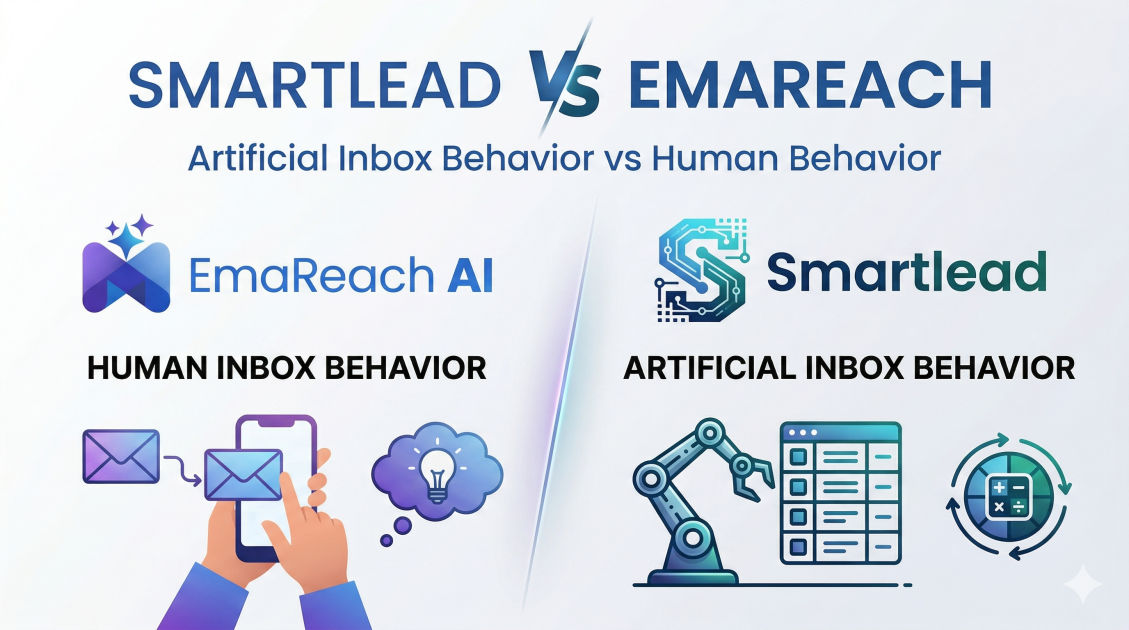
Smartlead vs Emareach: Artificial Inbox Behavior vs Human Behavior
cold emailoutreachdeliverabilityinbox warmupemail marketingsales automation
Introduction
In the high-stakes ecosystem of B2B sales and outbound marketing, cold email remains one of the most reliable channels for generating pipeline and closing lucrative deals. However, the landscape of email deliverability is a constantly moving target. Email service providers (ESPs) are continuously upgrading their spam filters, utilizing sophisticated machine learning algorithms to protect their users from unwanted solicitations. For sales teams and agency owners, the hardest challenge is no longer finding leads or writing copy—it is simply getting the email to land in the primary inbox.
To combat aggressive spam filters, the concept of "inbox warmup" was introduced. Warmup networks are designed to build domain and IP reputation by sending automated emails back and forth between a network of accounts, opening them, replying to them, and rescuing them from the spam folder. But as ESP algorithms have evolved, a critical divide has emerged in how outreach tools handle this process: the divide between artificial inbox behavior and human inbox behavior.
In this comprehensive analysis, we will explore the profound differences between these two approaches, specifically looking at how industry platforms navigate these waters. We will dissect the methodologies of Smartlead and EmaReach, examining why the shift from robotic, predictable patterns to hyper-realistic, human-like engagement is the definitive future of email deliverability.
The Evolution of Email Deliverability and Spam Filters
To understand the debate between artificial and human behavior, one must first understand how ESPs evaluate incoming mail. Historically, spam filters relied heavily on static, rule-based criteria. If an email contained certain trigger words (like "free," "guarantee," or "act now"), or if the sending IP address was blacklisted, the email was blocked or routed to spam.
Modern spam filters, however, are infinitely more complex. They rely on behavioral analytics and sender reputation. They analyze:
- Authentication Records: SPF, DKIM, and DMARC alignment.
- Engagement Rates: How many people open, reply to, forward, or star your emails.
- Negative Signals: How many people delete your emails without reading them, or worse, manually mark them as spam.
- Volume and Velocity: The speed at which you send emails and whether that volume spikes unnaturally.
- Inbox Behavior Patterns: The exact metadata surrounding how emails are interacted with, including time-to-open and time-to-reply.
Because ESPs now prioritize behavioral signals, cold emailers rely on warmup networks to artificially generate positive behavioral signals. This is where the methodology behind the warmup tool becomes the deciding factor between a thriving cold email campaign and a burned domain.
Artificial Inbox Behavior: The Pitfalls of Predictability
Artificial inbox behavior refers to warmup and sending patterns that, while generating positive engagement on paper, do so in a way that is highly predictable and statistically improbable for a real human being.
When a tool uses rule-based programming to simulate engagement, it often leaves a digital footprint that advanced spam algorithms can easily detect. Here are the hallmarks of artificial inbox behavior:
1. Static and Symmetrical Sending Rhythms
Artificial systems operate on mathematical precision. If a tool is set to send 40 warmup emails a day, it might send exactly one email every 12 minutes during a designated time block. Humans do not operate this way. Humans send emails in bursts, take coffee breaks, attend meetings, and have periods of absolute inactivity.
2. Shallow and Generic Reply Context
A major red flag for modern ESPs is the quality of the replies within a warmup network. Early warmup tools, and even some current ones, rely on a static database of generic replies. An email containing a highly technical B2B pitch might receive a warmup reply that says, "Thanks for the information, I will look into it." When an ESP scans the context of the thread and sees a complete disconnect between the initial email and the reply, it flags the interaction as synthetic.
3. Immediate or Predictable Engagement Timings
In an artificial warmup environment, an email might land in the inbox and be opened exactly 60 seconds later, followed by a reply exactly 120 seconds after that. Over hundreds of emails, this exact sequence forms a distinct, non-human pattern. Real people let emails sit in their inbox for hours, read them on mobile devices during commutes, and reply days later.
4. Lack of Account Nuance
Artificial systems often treat every sender account exactly the same. They do not account for the fact that a CEO's email account will naturally have a different sending and receiving ratio compared to a customer support account or a junior sales representative's account.
Smartlead: A Powerhouse Built for Scale
Smartlead has established itself as a dominant force in the cold email infrastructure space. Its primary value proposition revolves around scale: offering unlimited sender accounts, unified master inboxes, and a robust API for agency operators. By allowing users to connect hundreds of mailboxes to a single campaign without paying per-seat licenses, Smartlead fundamentally changed the unit economics of cold email.
The Smartlead Approach to Deliverability
Smartlead incorporates a massive peer-to-peer warmup network. It automatically moves emails out of the spam folder, marks them as important, and generates automated replies to build sender reputation. For users looking to scale horizontal volume across dozens of domains, this infrastructure is incredibly appealing.
However, when evaluating Smartlead through the lens of inbox behavior, some deliverability experts note that its immense scale can sometimes rely on algorithms that lean toward the "artificial" side of the spectrum. Because of the sheer volume of emails being processed through its peer-to-peer network, the variations in reply context and timing intervals can occasionally form recognizable patterns.
While Smartlead provides tools to adjust sending limits and schedules, the underlying warmup mechanics are largely programmatic. For many standard campaigns, this is sufficient. But as ESPs crack down on synthetic engagement networks, the need for a more sophisticated, indistinguishable-from-human approach becomes paramount.
The Paradigm Shift: Embracing True Human Behavior
True human behavior in an inbox is chaotic, contextual, and deeply nuanced. To successfully build and maintain a flawless sender reputation in the modern era, an outreach platform must replicate this chaos systematically.
Human inbox behavior involves:
- Variable Thread Depths: Humans do not just send one email and receive one reply. They engage in multi-touch threads, sometimes exchanging four or five messages in a single day, quoting previous text, and adding additional recipients.
- Contextual Relevance: When a human replies to an email about web design, they use vocabulary related to web design. They ask specific, contextual questions based on the exact body of the received email.
- Erratic Routines: Humans check their email on mobile devices in the morning, ignore promotional tabs, delete emails without reading them based on the subject line, and batch-reply to important messages in the afternoon.
- Natural Reading Delays: A human cannot read a 500-word email and reply in three seconds. True human behavior requires simulating the actual reading time before an action is taken.
Enter EmaReach: Pioneering Human-Like AI Outreach
To truly outsmart modern spam filters, you need a system that does not just automate tasks, but genuinely replicates a human being sitting behind a keyboard. This is where EmaReach sets the new industry standard.
If your ultimate goal is to Stop Landing in Spam. Cold Emails That Reach the Inbox, EmaReach provides the definitive architecture. EmaReach AI combines AI-written cold outreach with intelligent inbox warm-up and multi-account sending—ensuring that your emails consistently land in the primary tab and generate authentic replies.
How EmaReach Masters Human Behavior
EmaReach moves beyond the limitations of programmatic loops and static databases. Instead, it utilizes advanced Large Language Models (LLMs) and randomized behavioral algorithms to create an engagement profile that is virtually indistinguishable from a real person.
1. Context-Aware LLM Replies
Unlike artificial systems that use canned responses, EmaReach's AI reads the content of your cold email and generates a highly specific, contextually accurate reply. If your cold email pitches a SaaS product for logistics companies, the EmaReach warmup network will reply with specific questions about API integrations, fleet tracking, or pricing. To the ESP's machine learning scanners, this looks exactly like a high-value, legitimate business conversation, drastically boosting your domain reputation.
2. Spintax and Outreach Variation
EmaReach excels in ensuring that no two emails sent from your accounts are ever identical. By deeply integrating AI-written outreach with dynamic Spintax, it alters the sentence structure, vocabulary, and formatting of your core message on a per-prospect basis. This prevents ESPs from creating a "hash" of your email template and bulk-flagging it.
3. Hyper-Realistic Timing Algorithms
EmaReach does not send emails on a flat timeline. It simulates human workdays, incorporating randomized pauses, realistic typing delays, and variable intervals between opens and replies. It mimics the behavior of a user stepping away for lunch or leaving the office for the evening, ensuring your sending profile never looks like a server-side script.
4. Intelligent Inbox Management
Beyond just replying, EmaReach simulates the holistic management of an inbox. It automatically categorizes emails, marks vital threads as important, stars messages, and realistically navigates the UI footprint that ESPs track. By combining this level of detailed inbox warm-up with multi-account sending, EmaReach guarantees that your infrastructure remains healthy, robust, and heavily trusted by Google and Microsoft.
Head-to-Head Comparison: Smartlead vs. EmaReach
To summarize the core differences between these two powerful platforms, we must look at how they approach the fundamental pillars of deliverability.
Sending Infrastructure
- Smartlead: Offers incredible horizontal scale. It is built for agencies that need to manage thousands of mailboxes and millions of sends across a unified dashboard. It is a volume-first platform.
- EmaReach: Focuses on the quality of the send rather than just raw volume. It incorporates multi-account sending, but pairs it with AI-written variation to ensure that the scale does not compromise the sender reputation. It is a deliverability-first platform.
Warmup Methodology
- Smartlead: Relies on a massive, peer-to-peer network. It is highly effective at moving emails out of spam, but its engagement patterns can sometimes reflect programmatic, artificial behavior due to its rule-based nature.
- EmaReach: Utilizes AI to generate contextual, deeply relevant replies. It simulates exact human behavioral patterns, from erratic send times to topic-specific thread depth, making it virtually impossible for spam filters to detect the warmup activity.
Content Generation
- Smartlead: primarily acts as a delivery vehicle. You write the copy, insert the variables, and Smartlead executes the sending sequence.
- EmaReach: Acts as an end-to-end AI outreach partner. It actively assists in crafting AI-written cold outreach that is structurally designed to bypass spam filters, combining brilliant copywriting with technical deliverability safeguards.
Essential Best Practices for Guaranteed Deliverability
Regardless of the underlying technology you choose, achieving a 90%+ primary inbox placement rate requires a holistic approach to email infrastructure. Technology alone cannot save a poorly configured domain. To maximize the effectiveness of tools like EmaReach, implement the following best practices:
1. Bulletproof Your DNS Records
Never send a cold email without fully configuring your authentication protocols.
- SPF (Sender Policy Framework): Authorizes your email sending servers.
- DKIM (DomainKeys Identified Mail): Adds a cryptographic signature to your emails, proving they have not been tampered with in transit.
- DMARC (Domain-based Message Authentication, Reporting, and Conformance): Tells receiving servers exactly what to do if an email fails SPF or DKIM checks. Always set up DMARC to protect your domain from spoofing.
2. Isolate Sending Domains from Your Primary Domain
Never send cold outreach from your company's primary domain (e.g., @yourcompany.com). Instead, purchase secondary domains (e.g., @getyourcompany.com, @yourcompanyhq.com) and forward them to your main website. This quarantines any potential reputation damage away from your day-to-day corporate communications.
3. Maintain Immaculate List Hygiene
High bounce rates are the fastest way to destroy a domain's reputation. If you consistently send emails to addresses that do not exist, ESPs will instantly classify you as a spammer who bought a low-quality list. Always use a third-party email verification tool to clean your prospect lists before loading them into your sending platform. Aim for a bounce rate of strictly under 2%.
4. Limit Daily Sending Volumes
Even with the best human-behavior simulation, a single mailbox should not be blasting out hundreds of cold emails a day. A realistic, safe volume is between 30 to 50 cold emails per mailbox per day. If you need to reach 1,000 prospects daily, do not send them all from one account; distribute that volume across 25 to 30 separate, fully warmed mailboxes.
5. Prioritize Plain Text and Limit Links
Heavy HTML templates, multiple images, and an abundance of hyperlinks trigger spam filters. B2B cold emails should look like they were typed out quickly by a human being. Stick to plain text formatting, use minimal stylized elements, and never include more than one link in your initial outreach. Avoid link tracking if possible, as shared tracking domains are frequently blacklisted.
Conclusion
The era of blasting thousands of generic emails and relying on simplistic, artificial warmup loops is over. As Google, Microsoft, and other major ESPs deploy advanced AI to protect their users, sales teams must adapt by adopting technology that is equally sophisticated.
While platforms that prioritize pure volume and programmatic scale have their place, the future of cold email deliverability belongs to tools that can master the nuances of human behavior. Contextual relevance, unpredictable timing, intelligent thread depth, and dynamic AI-generated content are no longer optional features; they are mandatory requirements for survival in the inbox.
By prioritizing platforms that accurately simulate real human engagement, you ensure that your sender reputation remains pristine. In the ongoing battle between spam filters and sales teams, human behavior—powered by intelligent AI architecture—will always emerge victorious.
EmaReach AI
Ready to scale your cold email outreach?
Join thousands of teams using EmaReach AI for AI-powered campaigns, domain warmup, and 95%+ deliverability. Start free — no credit card required.
Related posts
- Read article
The Instantly Alternative That Handles High Bounce Rates Without Panic
Discover how transitioning to an advanced Instantly alternative can safeguard your cold email infrastructure. Learn to handle high bounce rates effortlessly using real-time verification, smart mailbox rotation, and automated safety nets to protect your sender reputation and maintain consistent primary inbox placement.
- Read article
Beyond Instantly: The Cold Email Platforms Worth Taking Seriously
Discover the top advanced cold email platforms that go beyond basic multi-inbox rotation. Learn how to optimize your technical infrastructure, leverage advanced personalization, and scale your B2B sales pipeline safely without landing in the spam folder.
- Read article
What the Cold Email Community Actually Says About Instantly Alternatives
Discover what growth marketers, agency owners, and outbound practitioners across major cold email communities are saying about the top alternatives to Instantly. This comprehensive, research-driven guide breaks down the real-world pros, cons, and technical features of tools like Smartlead, EmaReach, Saleshandy, and Lemlist based on community consensus.