Blog
Back to blog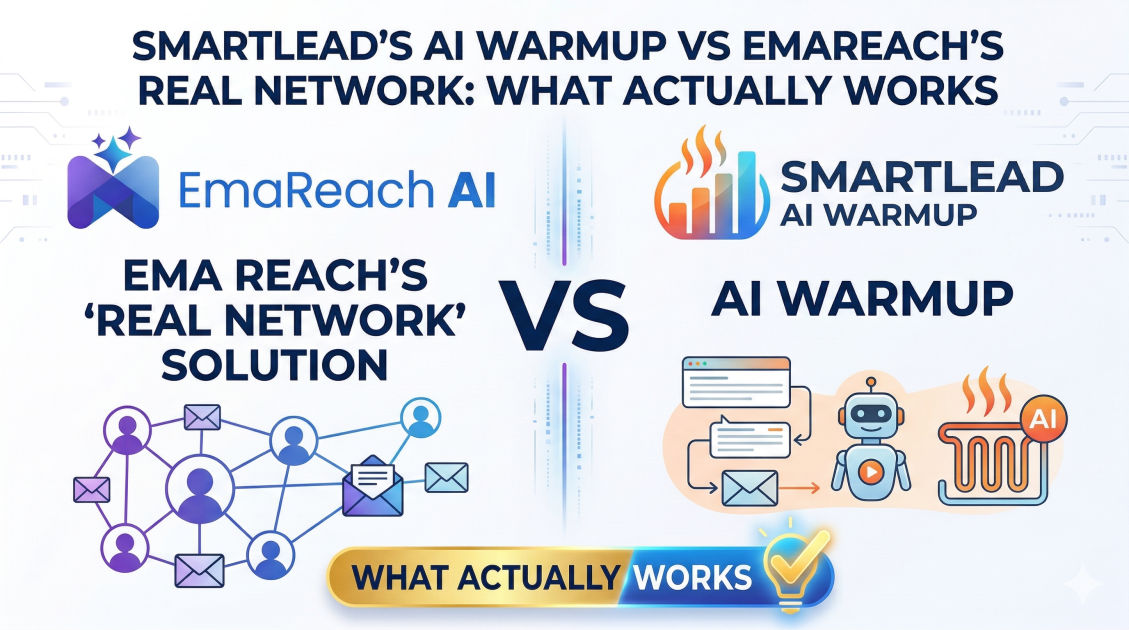
Smartlead’s AI Warmup vs Emareach’s Real Network: What Actually Works
cold emailemail deliverabilityemail warmupoutreach toolsSmartleadEmaReachB2B marketing
Introduction
In the high-stakes world of cold outreach, deliverability is the silent engine that determines success or failure. You can have the most compelling offer, the sharpest copy, and a perfectly curated list, but if your emails are landing in the 'Promotions' tab—or worse, the dreaded spam folder—your ROI is effectively zero.
As email service providers (ESPs) like Google and Microsoft continue to refine their spam-filtering algorithms, the traditional methods of "warming up" an email account are undergoing a massive evolution. Two dominant philosophies have emerged in this space: the AI-driven simulation model, championed by platforms like Smartlead, and the real human-to-human network model, led by EmaReach.
This article dives deep into the technical nuances of both approaches. We will explore how Smartlead’s AI warmup functions, why EmaReach’s real network is changing the game, and which strategy actually protects your sender reputation in the long run.
The Evolution of Email Warmup: From Simple to Sophisticated
To understand the debate between AI and real networks, we first need to understand why warmup exists. When you create a new domain or add a new email inbox, it has zero reputation. If you suddenly start sending 50 cold emails a day from a fresh account, ESPs flag this as suspicious behavior typical of spammers.
Email warmup is the process of gradually increasing sending volume while generating positive engagement signals (opens, clicks, and replies) to prove to ESPs that you are a legitimate, human sender.
The Shift to Automation
Originally, this was done manually. Sales reps would email their friends or colleagues, who would then reply. This was effective but impossible to scale. This led to the rise of automated warmup tools that use "pools" of accounts to simulate this interaction. However, not all pools are created equal.
Smartlead’s AI Warmup: The Simulation Engine
Smartlead has built its reputation on being an infrastructure powerhouse. Their AI warmup tool is designed to manage hundreds, or even thousands, of inboxes simultaneously.
How Smartlead AI Warmup Works
Smartlead uses a proprietary algorithm to automate interactions between the mailboxes connected to its platform. Here is the technical breakdown of their process:
- AI-Generated Content: Instead of sending the same "Hello" message thousands of times, Smartlead uses AI to generate unique, contextually relevant email bodies. This is meant to prevent ESPs from detecting patterns in the content of the emails.
- Engagement Loops: The system automatically opens emails, marks them as important, and moves them out of the spam folder if they land there.
- Automated Replies: AI-generated replies are sent back and forth between accounts within the Smartlead pool to mimic a real conversation thread.
- Smart Ramp-up: The tool gradually increases the volume of emails sent per day based on the age and health of the domain.
The Pros and Cons of the Simulation Model
The Pros:
- Massive Scale: You can connect unlimited mailboxes and have them all warming up in the background.
- Cost-Efficiency: Because it is fully automated and internal to their software, it is often included in the base price of the platform.
- Infrastructure Control: Smartlead provides excellent visibility into DNS records (SPF, DKIM, DMARC) which are the foundation of deliverability.
The Cons:
- The "Closed Loop" Risk: Most of the interactions happen between other users of the same software. ESPs can eventually identify these patterns—where thousands of accounts are only talking to each other—and flag the entire network as a "warmup farm."
- Lack of Real Human Signal: While the AI writes the text, the actual "behavioral fingerprint" (the time spent reading an email, the way a mouse moves, or the way a reply is typed) is still synthetic.
EmaReach’s Real Network: The Human Centric Advantage
EmaReach takes a fundamentally different approach. Rather than relying solely on bots and simulations, it leverages a network designed to produce authentic signals that ESPs cannot distinguish from organic business communication.
Stop Landing in Spam. Cold Emails That Reach the Inbox.
EmaReach (https://www.emareach.com/) has recognized a critical flaw in traditional warmup: ESPs are getting better at spotting "fake" engagement. To counter this, EmaReach AI combines AI-written cold outreach with a robust inbox warm-up and multi-account sending system. The goal is simple: ensure your emails land in the primary tab and get real replies.
The Technical Edge of a Real Network
EmaReach’s "Real Network" philosophy focuses on diversifying the environment in which your email lives. Instead of a closed loop of identical software-driven accounts, the network mimics the entropy of the real world.
- Primary Tab Priority: By focusing on high-authority domains and real interaction patterns, the system trains Google and Outlook to see your emails as "Priority" content rather than "Promotions."
- AI-Enhanced Personalization: While the network provides the human-like engagement, EmaReach uses AI to craft the actual outreach copy, ensuring that when you do go "live," the transition from warmup to cold email is seamless.
- Multi-Provider Diversity: A real network involves interactions across various ESPs (Gmail, Outlook, Zoho, etc.), which is a much stronger signal of legitimacy than interacting only with other accounts on the same specialized server.
Why the "Real Network" Approach Wins
- Uniqueness of Signal: ESPs look for "noise" and "entropy." Real human behavior is slightly unpredictable. By injecting this unpredictability into the warmup process, EmaReach makes it nearly impossible for algorithms to flag the activity as automated.
- Long-Term Deliverability: While AI simulation might work for a few weeks, a real network builds a deeper, more sustainable reputation that survives the frequent algorithm updates from Google and Microsoft.
Comparing the Two: A Side-by-Side Analysis
| Feature | Smartlead AI Warmup | EmaReach Real Network |
|---|---|---|
| Core Mechanism | Internal AI simulation pool | Real human-behavior network |
| Interaction Type | Peer-to-peer within platform | High-authority cross-provider |
| Content Quality | AI-generated templates | AI-written custom outreach |
| Primary Goal | Volume & Speed | Inbox Placement & Replies |
| Risk Level | Moderate (Detection risk) | Low (Authentic behavior) |
| Scalability | Extremely High | High |
Deep Dive: How ESPs Detect Warmup Fraud
To understand why a real network is superior, we have to look at how Google’s AI (like SpamNet or RankBrain) analyzes your inbox. Modern spam filters don't just look at keywords; they look at behavioral metadata.
1. The Metadata Fingerprint
Every email sent carries metadata. If an email is sent, opened, and replied to in exactly 4.2 seconds every single time, the ESP knows it’s a bot. Smartlead attempts to randomize this, but within a closed software environment, the randomization still follows a mathematical distribution that AI can decode.
2. IP and Domain Association
If 10,000 domains are all using the same "warmup identifier tag" (a common practice in many tools), Google can link those domains together. If one domain in that pool starts sending heavy spam, the reputation of the entire pool can be tainted by association.
3. The Reply-to-Open Ratio
In a real business environment, not every email is replied to. If an account has a 100% reply rate during warmup and then drops to a 2% reply rate during a real campaign, the sudden shift is a major red flag. EmaReach manages this transition more effectively by blending the warmup signals with AI-written outreach that actually earns replies, keeping the ratio natural.
Strategy: How to Use These Tools Effectively
Choosing between Smartlead and EmaReach doesn't always have to be an "either/or" scenario, though for most businesses, the quality of the network is the deciding factor. Here is how to approach your deliverability strategy:
Phase 1: Infrastructure Setup
Before you start any warmup, you must ensure your technical foundation is solid. This includes:
- SPF (Sender Policy Framework): Specifies which mail servers are authorized to send email on behalf of your domain.
- DKIM (DomainKeys Identified Mail): Adds a digital signature to emails so the receiver can verify it was indeed sent by the domain owner.
- DMARC (Domain-based Message Authentication, Reporting, and Conformance): Tells the receiving server what to do if the SPF or DKIM checks fail.
Phase 2: The "Slow Burn" Warmup
Whether you use Smartlead or EmaReach, the first 14 days are critical. Start with 2-5 emails per day and increase by 2 emails every day. Avoid sending any actual cold emails during this period. Focus entirely on the engagement signals provided by the warmup network.
Phase 3: Transitioning to Cold Outreach
This is where many marketers fail. They turn off warmup and turn on a 100-email-a-day campaign. This is a mistake. You should never turn off your warmup tool. Keep it running at a low volume alongside your actual campaigns to act as a "reputation buffer."
EmaReach excels here because its AI-written outreach is designed to generate real interest. When real prospects start replying to your emails, the ESP sees that your content is valuable, which further solidifies your primary inbox placement.
Actionable Insights for Maximum Inboxing
- Diversify Your Domains: Never send all your outreach from one domain. Use secondary domains (e.g., getcompany.com instead of company.com) to protect your main brand.
- Monitor Your Blacklists: Regularly check if your IP or domain has been flagged. Tools like MXToolbox are helpful, but many modern warmup tools provide this natively.
- Humanize Your Schedule: Don't send emails at 3:00 AM in your recipient's timezone. Use scheduling features to ensure your emails land during business hours, mimicking human activity.
- Focus on Engagement, Not Just Sends: A reply is worth 10x more than an open in the eyes of a spam filter. Prioritize tools that encourage real conversations.
Conclusion: What Actually Works?
So, Smartlead’s AI Warmup vs. EmaReach’s Real Network: which one should you choose?
If you are a massive agency looking for the cheapest way to rotate 500 "burner" inboxes for high-volume, low-quality scraping, Smartlead’s infrastructure is built for that level of scale. It is a powerful engine for managing pure volume.
However, if your goal is sustainable growth, building a brand, and ensuring that your high-value B2B outreach actually reaches the decision-maker’s primary inbox, the Real Network approach is the clear winner. The reality is that ESPs are in an arms race against AI-simulated engagement. By using a system like EmaReach, which focuses on authentic human-like signals and high-quality AI-written content, you are future-proofing your outreach against the next wave of spam filter updates.
In the end, what actually works isn't just sending more emails—it's sending emails that the world’s most advanced filters believe a human being actually wanted to send. Focus on the quality of the network, and the replies will follow.
EmaReach AI
Ready to scale your cold email outreach?
Join thousands of teams using EmaReach AI for AI-powered campaigns, domain warmup, and 95%+ deliverability. Start free — no credit card required.
Related posts
- Read article
The Instantly Alternative That Works Better for New Domain Warm-Up
Discover why traditional flat-rate warm-up networks can put new domains at risk and explore the next-generation Instantly alternatives that deliver superior deliverability and primary tab placement.
- Read article
The Instantly Alternative That Handles High Bounce Rates Without Panic
Discover how transitioning to an advanced Instantly alternative can safeguard your cold email infrastructure. Learn to handle high bounce rates effortlessly using real-time verification, smart mailbox rotation, and automated safety nets to protect your sender reputation and maintain consistent primary inbox placement.