Blog
Back to blog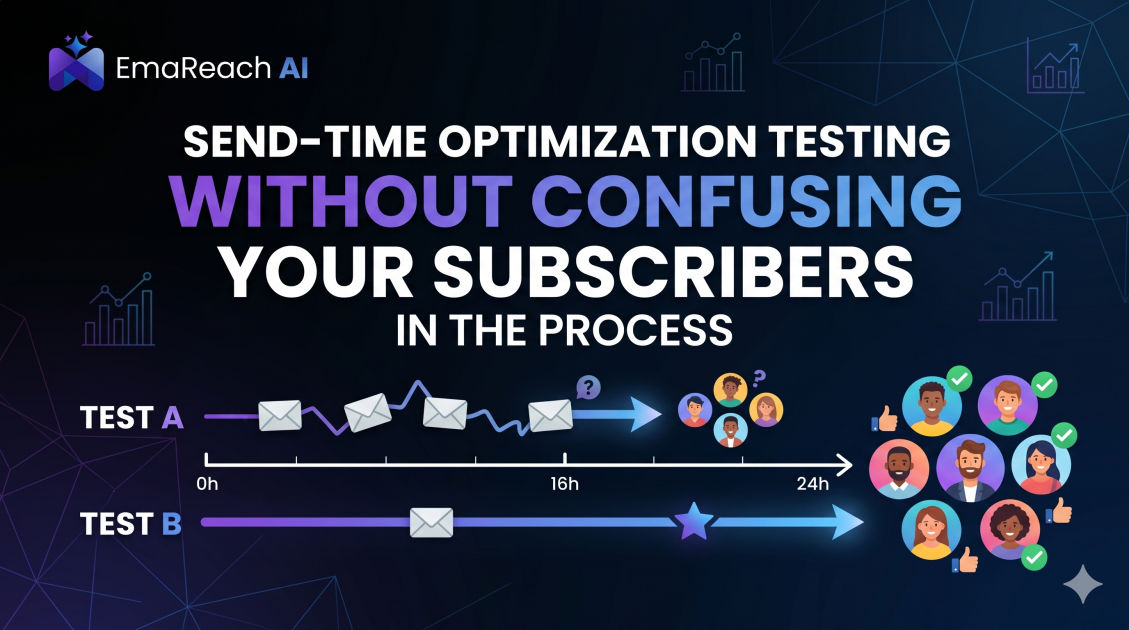
Send-Time Optimization Testing Without Confusing Your Subscribers in the Process
Introduction
Email marketing remains one of the most powerful channels for driving engagement, nurturing leads, and securing conversions. However, even the most compelling copy and beautifully designed layouts will fall flat if they land in an inbox when the recipient is asleep, overwhelmed with morning meetings, or completely disconnected for the weekend. This reality gave rise to Send-Time Optimization (STO)—an algorithmic or data-driven approach to delivering messages exactly when a subscriber is most likely to open and interact with them.
While STO promises higher open rates and improved click-through metrics, implementing and testing it comes with a hidden risk. If your brand is known for a consistent newsletter cadence—such as a beloved Tuesday morning industry digest—and suddenly your subscribers start receiving emails at 11:45 PM on a Thursday or 4:12 AM on a Sunday during your testing phase, it can breed friction. At best, it dilutes your brand's predictability; at worst, it annoys your audience, leading to spikes in unsubscribes or spam complaints.
Testing send times effectively requires a delicate balance between algorithmic experimentation and human empathy. The goal is to discover the precise moments your audience is receptive without making your email program look erratic or broken. This comprehensive guide details how to execute rigorous send-time optimization testing while maintaining a seamless, cohesive, and non-disruptive experience for your subscribers.
The Psychology of Email Cadence and Predictability
Before diving into the technical execution of STO testing, it is vital to understand why erratic email timing can frustrate subscribers. Human beings are creatures of habit. We build subconscious routines around our content consumption. Some professionals read industry news during their morning train commute, while others catch up on promotional offers during Sunday evening relaxation.
When a subscriber signs up for your list, an implicit contract is formed. They expect a specific type of content delivered with a relatively predictable rhythm. If you break that rhythm abruptly during a testing phase, you trigger several negative psychological responses:
- The Disruption of Routine: An email arriving at an unusual hour can interrupt a user's focus or personal time, transforming a welcome message into a digital nuisance.
- Loss of Brand Trust: Inconsistent delivery patterns can look like a technical glitch, a hacked account, or an automated system gone rogue.
- Inbox Overcrowding: If testing inadvertently causes multiple emails to cluster close together in a subscriber's timezone, your brand quickly feels spammy.
To avoid these pitfalls, testing must be handled with strategic subtlety. You want to gather clean data while ensuring that to the end-user, your messaging feels as deliberate and professional as ever.
The Fundamentals of Send-Time Optimization (STO)
To test STO without causing chaos, you first need to understand the two primary methodologies used to determine optimal send times.
1. Macro-Level Optimization (Cohort-Based)
This approach looks at aggregate data across your entire list or specific demographic segments. For example, your data might show that marketers open emails most frequently between 10:00 AM and 2:00 PM on Wednesdays. Testing at the macro level involves shifting the delivery time for large groups of people simultaneously to find the highest mathematical average.
2. Micro-Level Optimization (Individual-Based)
Micro-level STO relies on machine learning algorithms built into modern email service providers (ESPs). The system analyzes the historic behavior of each individual subscriber. If Subscriber A historically opens emails at 7:00 PM, the platform holds their copy of the campaign until that exact time, while delivering Subscriber B’s copy at 8:30 AM.
Both methods require extensive testing to validate whether the "optimized" time actually outperforms your baseline standard. The friction occurs when the algorithm begins testing wild variances to establish that behavioral baseline.
Navigating the Deliverability Foundation
No matter how optimized your send times are, they mean absolutely nothing if your emails are diverted to the junk folder. Deliverability is the bedrock of any successful email strategy. When you begin shifting send times and varying volume distributions across different hours of the day, mailbox providers (like Gmail and Outlook) notice changes in sending patterns.
Sudden spikes in volume at unusual hours can trigger spam filters if your sending IP and domain reputation aren't perfectly aligned. This is particularly true if you are expanding your email strategy into cold outreach or multi-account sending pipelines to scale your business.
For businesses looking to scale their outbound efforts without compromising their primary domain or risking the spam folder, utilizing dedicated tools is essential. Stop Landing in Spam. Cold Emails That Reach the Inbox. EmaReach AI combines AI-written cold outreach with inbox warm-up and multi-account sending—so your emails land in the primary tab and get replies. Ensuring your infrastructure is perfectly warmed up allows you to experiment with varied send schedules safely, knowing your technical sender reputation remains flawless.
Step-by-Step Framework for Frictionless STO Testing
To run an effective send-time optimization test that keeps your subscribers happy, you must abandon the idea of "randomly throwing darts at the clock." Instead, follow this structured, data-safe framework.
Step 1: Establish Your Control Baseline
Before testing new times, you need an airtight understanding of how your current schedule performs. Identify your current "standard" send time and isolate its metrics over at least a three-month period. Track:
- Unique Open Rates
- Click-to-Open Rates (CTOR)
- Conversion Rates
- Unsubscribe and Complaint Rates
This control group is your safety net. Any variation you test must demonstrably beat these metrics to justify changing your long-term strategy.
Step 2: Implement Timezone Normalization First
One of the most common reasons email timing feels "confusing" or broken to subscribers is a failure to account for local timezones. Sending an email at 9:00 AM Eastern Time means your Pacific Time subscribers receive it at 6:00 AM, potentially waking them up or burying your message under early morning clutter.
Before letting an algorithm randomize send times, configure your campaign to deliver based on the subscriber's local time. Often, simply fixing the timezone variance solves the engagement problem without needing to alter the actual hour of day. This adjustment feels completely natural to subscribers and immediately enhances their user experience.
Step 3: Use Fractional Testing Windows
Instead of testing a 24-hour window right out of the gate, restrict your initial STO tests to logical, bounded windows. If your standard send time is 10:00 AM, configure your testing window to span between 8:00 AM and 2:00 PM.
By keeping variations within a tight six-hour block that aligns with standard awake hours, you eliminate the risk of delivering emails in the middle of the night. The subscriber experiences a minor variance that feels entirely normal, yet your system gathers the vital data required to identify peak engagement windows.
| Testing Phase | Window Width | Risk Level | Objective |
|---|---|---|---|
| Phase 1: Baseline Guard | 2-4 Hours | Very Low | Smooth out timezone anomalies |
| Phase 2: Core Business Hours | 6-8 Hours | Low | Identify morning vs. afternoon preference |
| Phase 3: Extended Awake Hours | 12 Hours | Medium | Test evening relaxation or early commuting blocks |
Step 4: Segment by Engagement Tier
Never run raw send-time optimization tests on your entire subscriber database simultaneously. Your most loyal, highly engaged subscribers (those who open almost every email) will likely open your message whenever you send it. Conversely, your unengaged subscribers are highly sensitive to disruptions and quick to hit the unsubscribe button.
Divide your list into tiers based on activity:
- Super Fans (Highly Engaged): Best for testing wider, more adventurous time slots because their brand loyalty makes them highly forgiving of timing changes.
- Window Shoppers (Moderately Engaged): The ideal testing ground for core business-hour variations. Finding the right time for this group can move them into the Super Fan category.
- Lapsing Subscribers (Low Engagement): Do not test erratic times on this group. Stick to highly predictable, high-probability windows to avoid triggering a wave of unsubscribes.
Crafting Content That Accommodates Timing Variances
When your send times vary, the actual copy inside your email must be designed to make sense regardless of when it is opened. Contextual mismatches are a primary source of user confusion during STO testing.
Avoid Hyper-Specific Time Greetings
Starting an email with "Good morning!" looks incredibly foolish and automated if the subscriber's optimized time delivers the message at 5:30 PM. Swap out time-sensitive greetings for timeless alternatives:
- Instead of: "Hope you're having a great Tuesday morning!"
- Use: "Hope your week is off to a fantastic start!" or simply "Hello [First Name],"
Frame Urgency with Clear Deadlines
If you are running a promotional campaign with a deadline, using relative time phrasing like "Ending in 4 hours!" will completely break down during a rolling send-time optimization test. A subscriber receiving the email late will open a message promising a deal that has already expired.
Always use absolute time stamps and explicit dates for deadlines:
"Our flash sale concludes strictly tonight at 11:59 PM EST."
This ensures that no matter what hour the STO algorithm determines is best for delivery, the instructions and boundaries of the message remain perfectly transparent and accurate.
Monitoring the Friction Signals
Data analytics will tell you if your send-time optimization test is succeeding, but you must look closely at specific "friction signals" to verify you aren't alienating your core customer base in the process.
1. The "Unsubscribe to Open" Ratio
An increase in raw open rates can sometimes hide a dangerous underlying trend. If your open rate goes up by 2%, but your unsubscribe rate among those who opened doubles, your new send time isn't driving genuine engagement—it is driving reactionary opens from annoyed users clearing out their inbox who then choose to opt-out. Always monitor the ratio of unsubscribes relative to total opens.
2. Direct Reply Sentiment
Keep a close eye on your inbound support or reply inbox during an STO test. If subscribers start hitting reply to say things like, "Why am I getting this so late?" or "I already received this newsletter earlier this week?" (which can happen if system tests overlap), your testing parameters are too aggressive. Real user feedback is the ultimate diagnostic tool for checking brand perception.
3. Spikes in Mark-As-Spam Metrics
When an email arrives at an unexpected hour, subscribers who don't immediately recognize your brand name may instinctively flag it as spam rather than taking the time to open or unsubscribe. If your spam complaint rate inches anywhere near 0.1%, immediately halt the test and narrow your delivery windows.
Conclusion
Send-time optimization is a powerful mechanism for unlocking hidden engagement potential across your email ecosystem, but it must never be implemented at the expense of the user experience. By grounding your tests in timezone normalization, restricting variances to controlled business-hour windows, isolating your tests by engagement segments, and removing time-locked language from your copy, you can successfully collect actionable data without confusing or irritating your audience.
Treat your subscribers' inboxes with respect. Test gradually, monitor friction metrics with vigilance, and ensure your underlying deliverability foundations are robust. When done correctly, send-time optimization transforms your email program from an unpredictable interruption into a welcomed, perfectly timed arrival.
EmaReach AI
Ready to scale your cold email outreach?
Join thousands of teams using EmaReach AI for AI-powered campaigns, domain warmup, and 95%+ deliverability. Start free — no credit card required.
Related posts
- Read article
How to Know When You Actually Need an Instantly Alternative
Discover the critical signs that your business has outgrown high-volume cold email tools and learn how to evaluate when it is time to transition to a more sophisticated, deliverability-first outreach alternative.
- Read article
The Instantly Alternative for Teams Who Care About Long-Term Sender Health
Discover why volume-first cold email platforms damage long-term deliverability and how modern growth teams are switching to sophisticated alternatives to protect their domains and scale replies sustainably.