Blog
Back to blog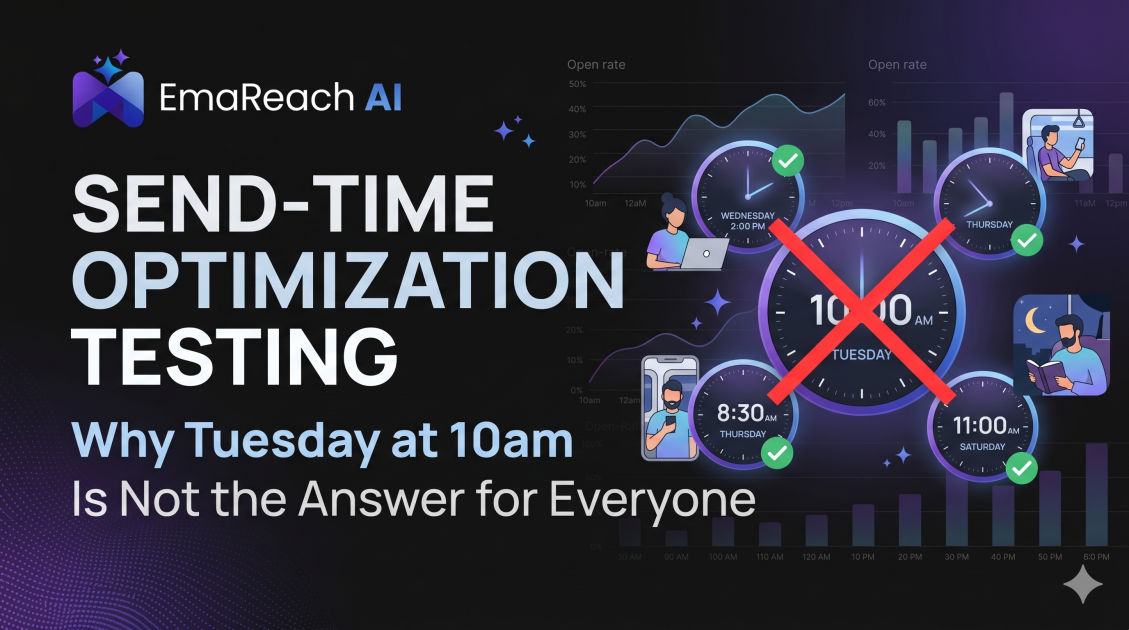
Send-Time Optimization Testing: Why Tuesday at 10am Is Not the Answer for Everyone
email marketingsend-time optimizationab testingemail deliverabilityopen ratesmarketing automation
Introduction
For years, a single piece of advice has been passed down through marketing departments like an absolute truth: "If you want your emails to be opened, send them on Tuesday at 10:00 AM."
It sounds reasonable. By Tuesday, professionals have cleared out their Monday morning backlogs. At 10:00 AM, they are settled into their desks, sipping their first or second cup of coffee, and checking their inboxes before diving into deep work or midday meetings.
Because this advice has been repeated across countless blog posts and industry reports, a massive percentage of global email volume now deploys at exactly that time. The result? Digital gridlock. Instead of finding a receptive, unburdened reader, your email lands in a crowded inbox alongside dozens of competitors, newsletters, and internal notifications all vying for the exact same slice of attention.
The reality of modern email communication is complex, fragmented, and deeply personal. Relying on generic, aggregated industry benchmarks is no longer an effective strategy. True campaign growth requires a commitment to Send-Time Optimization (STO) testing—a data-driven methodology that identifies when your unique audience is most likely to engage.
The Myth of the "Perfect" Universal Email Time
To understand why a single, universal "best time to send" cannot exist, we have to look at how these benchmarks are created. Typically, major email service providers aggregate data from billions of emails sent across various industries, company sizes, and target demographics. They average the open rates, find the peak, and declare a winner.
While mathematically accurate on a macro scale, an average completely flattens the nuances of individual human behavior. A strategy built on global averages assumes that a B2B software executive, a retail fashion consumer, a night-shift healthcare worker, and a freelance graphic designer all interact with their email inboxes in the exact same way.
The Problem of Digital Congestion
When every marketer follows the same advice, the marketplace becomes oversaturated. If five different companies send an email to the same prospect at 10:00 AM on Tuesday, those messages bury one another. The prospect, overwhelmed by the volume of incoming notifications, is highly likely to mass-delete or ignore anything that does not scream immediate relevance. By intentionally avoiding these peak universal windows, you can often find "quiet zones" in the day where your message stands out.
The Shift in Work Culture
The modern workplace looks nothing like it did a decade ago. With the widespread adoption of remote work, flexible hours, and asynchronous communication across global time zones, the traditional 9-to-5 schedule is rapidly disappearing. A professional in London might be wrapping up their day when an account executive in San Francisco is just opening their laptop. Sending an email based on a rigid, static hour completely ignores the realities of geographical distribution and fluid working habits.
How Audience Demographics Dictate Behavior
Your optimal send time is entirely dependent on who is on the receiving end of your message. To build a successful Send-Time Optimization framework, you must analyze the daily routines, habits, and psychological triggers of your specific target audience.
Business-to-Business (B2B) Audiences
In B2B environments, email is a core work tool. However, a gatekeeper's inbox behavior looks very different from an executive's behavior.
- Mid-Level Managers and Operators: These individuals are often in their inboxes throughout the entire workday. They use email to coordinate tasks, manage projects, and communicate with teams. For this group, micro-windows right before lunch or during the mid-afternoon slump can yield exceptional results.
- C-Suite Executives and Decision Makers: Executives rarely have the luxury of sitting in their inboxes all day. They tend to check emails in rapid bursts: early in the morning before the day's meetings begin, during transit, or late in the evening when operational demands quiet down. Reaching them often requires testing non-traditional, outer-bound hours.
Business-to-Consumer (B2C) Audiences
B2C email behavior is driven by personal leisure, emotional triggers, and disposable time.
- The Lunchtime Lounge: Many consumers check their personal emails on their mobile devices during lunch breaks.
- The Commute Window: Early morning and late afternoon hours, when people are commuting via public transit, are historically high-engagement periods for mobile-optimized consumer emails.
- Weekend Exploration: While B2B emails completely tank on weekends, B2C campaigns—especially in industries like travel, home improvement, and hobbies—often see massive surges on Saturday mornings and Sunday evenings, when consumers have the mental space to shop and plan.
The Crucial Link Between Send-Time and Deliverability
Send-Time Optimization is not just about generating higher open rates; it is also fundamentally linked to your overall email deliverability.
Major inbox providers use sophisticated artificial intelligence to monitor user engagement in real-time. If you send a massive batch of emails and your recipients consistently open, read, and reply to them within a short window, the mailbox providers view your domain as highly authoritative and trustworthy. This positive engagement signal ensures your future messages continue to land safely in the primary inbox.
Conversely, if you send a large batch at a poorly optimized time—such as a crowded Tuesday morning—and your emails sit unread, get mass-selected and deleted, or worse, get marked as spam by annoyed users trying to clean out their inboxes, your sender reputation takes a serious hit.
Stop Landing in Spam. Cold Emails That Reach the Inbox. EmaReach AI combines AI-written cold outreach with inbox warm-up and multi-account sending—so your emails land in the primary tab and get replies.
When conducting high-volume outreach, aligning your delivery schedule with actual user activity keeps your engagement metrics high, signaling to inbox algorithms that your content is wanted and valuable.
A Step-by-Step Guide to Running an STO Test
Moving away from arbitrary scheduling requires a structured, scientific approach to testing. You cannot simply guess a new time, try it once, and declare it the new standard. Follow this framework to execute a statistically valid Send-Time Optimization test.
Step 1: Establish Your Baseline Metrics
Before changing anything, analyze your historic data. Look at your performance over the last three to six months. Document your current average open rates, click-through rates, and unsubscribe rates. Note the days and times those emails were sent. This data serves as your control group.
Step 2: Segment Your Audience by Time Zone
Sending an email at 9:00 AM Eastern Time means your Pacific Time subscribers receive it at 6:00 AM, while your UK subscribers see it at 2:00 PM. If your marketing automation platform supports it, always normalize your send times based on the recipient's local time zone. If your platform doesn't support this automatically, manually segment your database into geographic regions before running your tests.
Step 3: Select Your Test Variables
To isolate send-time as the determining factor of your success, you must keep all other variables completely identical. This means your test emails must feature the exact same:
- Subject line
- Preview text
- Sender name and email address
- Internal copy and design layout
- Call to action (CTA)
Step 4: Divide and Deploy
Split a homogeneous audience segment into equal, randomized groups. Avoid testing completely different days of the week simultaneously; instead, focus first on finding the right time of day, then move to identifying the best day.
For example, if you want to test three different times on a Thursday, split your list into three equal parts:
- Group A: Sent at 8:00 AM local time
- Group B: Sent at 1:00 PM local time
- Group C: Sent at 6:00 PM local time
Step 5: Allow Time for Data Accumulation
Do not analyze your results two hours after deployment. While a significant portion of opens happen quickly, emails can accumulate engagement for up to 48 to 72 hours. Wait at least three full days before pulling your final reports to ensure every recipient has had an authentic opportunity to interact with your message.
Analyzing the Results: Metrics That Truly Matter
When evaluating the success of your STO tests, it is easy to get distracted by vanity metrics. To find the true optimal time, you must look deeper into the data funnel.
| Metric | What It Measures | Why It Matters for STO |
|---|---|---|
| Open Rate | The percentage of delivered emails that were opened. | This is the primary indicator of whether your email arrived at a moment when the user was actively looking at their inbox. |
| Click-Through Rate (CTR) | The percentage of recipients who clicked a link inside your email. | Shows if the recipient had the actual time and attention span to consume your content, rather than just glancing at it. |
| Click-to-Open Rate (CTOR) | The percentage of people who opened the email and then clicked a link. | Measures mindset. A high CTOR indicates the user opened the email at a time when they were relaxed enough to take action. |
| Unsubscribe / Spam Rate | The percentage of recipients who opted out or flagged the message. | A spike here often means your email arrived at an incredibly inconvenient or intrusive time, causing frustration. |
The Relationship Between Attention and Timing
An open rate tells you that your subject line caught someone's eye. However, if your click-through rate is incredibly low despite a high open rate, it often implies poor timing. The user may have opened your email on their phone while standing in line or walking into a meeting, meaning to look at it later, but ultimately forgot about it.
Your goal is to find the intersection where both open rates and click-through rates peak. This indicates that your email arrived when the user had both the visibility to see it and the time to act upon it.
Advanced STO Strategies: Moving Beyond Static Batches
Once you have graduated from universal benchmarks and mastered basic A/B time testing, you can begin exploring advanced, automated optimization techniques.
Predictive AI Send-Time Optimization
Many modern enterprise marketing platforms feature machine learning algorithms that track individual user behavior over time. Instead of calculating an optimal time for an entire segment, the AI analyzes when individual users historically open their emails.
When you hit "send" on a campaign, the platform staggers the deployment over a 24-hour window, delivering the email to User A at 9:15 AM, User B at 4:30 PM, and User C at 11:00 PM based on their individual interaction histories. This hyper-personalization represents the pinnacle of modern email scheduling.
Behavioral-Triggered Messaging
The absolute best time to send an email is when a user has just explicitly demonstrated interest in your brand. Triggered emails—such as welcome sequences, abandoned cart reminders, content downloads, or user onboarding steps—should deploy instantly based on user behavior, completely bypassing traditional day and time constraints. A behavioral trigger will almost always outperform a perfectly optimized batch schedule because the context and intent are at an absolute maximum.
Conclusion
There is no shortcut to email marketing success, and there is certainly no single calendar slot that guarantees your messages will be read. The belief that Tuesday at 10:00 AM is the ultimate answer for every audience is an outdated concept that causes marketers to crowd into overcrowded windows, lowering their overall campaign visibility and hurting long-term sender reputation.
Your audience is comprised of unique individuals with distinct daily rhythms, shifting work habits, and personal boundaries. The only way to truly unlock the potential of your email program is to step away from generic industry averages, build a rigorous testing framework, closely track your deliverability and deep engagement metrics, and let your own data point the way forward.
EmaReach AI
Ready to scale your cold email outreach?
Join thousands of teams using EmaReach AI for AI-powered campaigns, domain warmup, and 95%+ deliverability. Start free — no credit card required.
Related posts
- Read article
How to Know When You Actually Need an Instantly Alternative
Discover the critical signs that your business has outgrown high-volume cold email tools and learn how to evaluate when it is time to transition to a more sophisticated, deliverability-first outreach alternative.
- Read article
The Instantly Alternative for Teams Who Care About Long-Term Sender Health
Discover why volume-first cold email platforms damage long-term deliverability and how modern growth teams are switching to sophisticated alternatives to protect their domains and scale replies sustainably.