Blog
Back to blog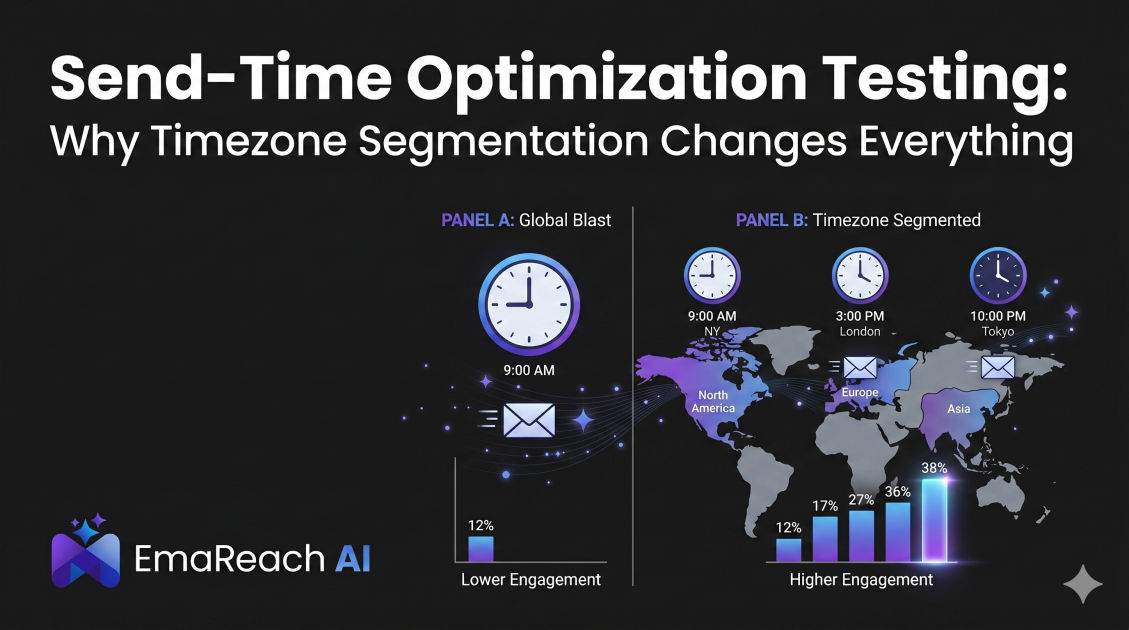
Send-Time Optimization Testing: Why Timezone Segmentation Changes Everything
email marketingsend-time optimizationtimezone segmentationemail deliverabilityab testingcold outreach
Introduction: The Hidden Friction in Your Inbox Strategy
Every day, billions of emails are sent across the globe, all competing for a fleeting moment of human attention. For marketers, sales professionals, and growth hackers, the ultimate battleground is the top of the inbox. You can craft the most compelling subject line, personalize the opening hook, and offer an irresistible value proposition, but if your email arrives when your recipient is fast asleep, deeply buried in a morning leadership meeting, or driving home from work, your chances of engagement plummet.
Historically, email platforms attempted to solve this with basic scheduling tools. Then came Send-Time Optimization (STO), a data-driven approach that uses historical engagement data to predict exactly when an individual user is most likely to open an email. However, traditional STO possesses a massive, often overlooked blind spot: it frequently fails to account for structural geographical realities without foundational timezone segmentation.
When you layer timezone segmentation into your send-time optimization testing, you shift from guessing windows of availability to executing mathematical precision. It changes how algorithms interpret data, protects your sender reputation, and drastically moves the needle on open rates, click-through rates, and conversions. This comprehensive guide explores why timezone segmentation changes everything in the world of STO testing and how you can leverage it to maximize your outreach efficiency.
The Mechanics of Send-Time Optimization (STO)
To understand why timezone segmentation is a game-changer, we must first dissect how traditional Send-Time Optimization works.
STO is an algorithmic feature offered by modern email marketing systems and sales engagement platforms. Instead of blasting an entire email list at 9:00 AM EST, STO evaluates historical behavior metrics for each recipient on your list. It analyzes patterns such as:
- The precise times an individual has opened past emails.
- The time gaps between email delivery and user interaction.
- The specific days of the week that yield the highest click-through rates for that specific user.
Based on this behavioral profile, the system staggers the release of the email, delivering it to User A at 10:15 AM, User B at 2:30 PM, and User C at 8:00 AM.
In a vacuum, this is brilliant. But in reality, businesses do not market to a single city or region. They market to global or cross-continental audiences. When an STO algorithm attempts to optimize delivery without establishing a timezone baseline, the data becomes corrupted, leading to systemic delivery failures.
The Fatal Flaw of Timezone-Blind STO
Imagine you are running a B2B SaaS campaign targeting software engineering managers. Your company is based in New York (EST), but your prospects are scattered across San Francisco (PST), London (GMT), Tokyo (JST), and Sydney (AEST).
If your email system applies STO without first segmenting by timezone, the underlying data engine operates on absolute system time or a confused mixture of relative timestamps. Here is how that manifests as a disaster:
1. The "Ghost Engagement" Analytics Trap
Suppose an engineering manager in London opens your email at 9:00 AM local time. If your server is tracking data in Eastern Standard Time, it logs that open at 4:00 AM. If the algorithm looks at that 4:00 AM timestamp without realizing it corresponds to a localized 9:00 AM start of the workday, it concludes: "This recipient loves checking emails before dawn!" On the next campaign, the algorithm may deliberately queue your email to deploy at 4:00 AM local time for other prospects, burying your message under hours of early-morning spam.
2. Skewed Aggregates and Diluted Data
Algorithms require clean, contextual data to build predictive models. When global engagement data is pooled together without timezone boundaries, the peak engagement windows blur out. Instead of seeing clear spikes at 10:00 AM and 2:00 PM local times, the data flattens into a continuous, low-level drone across a 24-hour cycle. The algorithm loses its predictive power entirely, defaulting to generic, sub-optimal send times.
3. Immediate Deletion and Burned Leads
An email sent via a flawed STO calculation that hits an inbox at 2:00 AM local time sits in the dark for hours. When the recipient wakes up and scans their phone, your email is stacked beneath 40 notifications. The easiest way to clear a cluttered lock screen is a bulk swipe-to-delete. You never even had a chance.
Why Timezone Segmentation Changes Everything
Timezone segmentation acts as the architectural foundation upon which successful Send-Time Optimization is built. By grouping your audience by geographic location or localized time offset before running STO algorithms, you normalize the data environment. Here is why this fundamental shift transforms your performance metrics:
It Establishes a Contextual Baseline
Human behavior is governed by local rhythms: the morning commute, the mid-day lunch break, the afternoon energy slump, and evening winding-down rituals. Timezone segmentation ensures that the STO algorithm evaluates behavioral data relative to these universal human cycles. A 10:00 AM open in Paris is treated the exact same way as a 10:00 AM open in Los Angeles, allowing the algorithm to spot cross-border behavioral trends accurately.
It Prevents "Anti-Social" Automated Delivery
Nothing screams "automated corporate spam" louder than receiving a cold sales pitch or a promotional newsletter at 3:15 AM on a Saturday. By locking your STO parameters within a specific local time window (e.g., only optimize delivery between 8:00 AM and 5:00 PM local time), you ensure your brand maintains a professional, human cadence.
It Optimizes Multi-Wave Nurture Sequences
For complex email sequences, timing is conversational. If Step 1 goes out at a great local time, but Step 2 triggers 48 hours later based on a fixed server time, the fluid conversational thread breaks. Segmenting by timezone ensures that every touchpoint in a multi-day campaign maintains its localized contextual relevance, keeping engagement rates stable throughout the entire lifecycle of the sequence.
The Crucial Link to Deliverability and Spam Prevention
Email optimization isn't just about persuading humans to click; it is also about persuading mailbox providers (like Google and Microsoft) that your emails belong in the primary inbox rather than the junk folder.
Mailbox providers monitor user signals to determine sender reputation. If a large percentage of your recipients consistently delete your emails without opening them, mark them as spam, or let them sit unread for days, your domain reputation plummets. This is particularly dangerous for outbound sales and cold outreach teams.
If you want your emails to land in the primary tab and get replies, you need an architecture designed for inbox placement. This is exactly where platforms like EmaReach shine. Stop Landing in Spam. Cold Emails That Reach the Inbox. EmaReach AI combines AI-written cold outreach with inbox warm-up and multi-account sending—so your emails land in the primary tab and get replies. By pairing smart, timezone-segmented delivery strategies with infrastructure like EmaReach, you insulate your sender domain against the negative signals generated by mistimed, poorly targeted blasts.
When your emails consistently land at the exact moments users are actively cleaning their inboxes and replying to messages, your positive engagement signals soar. High open rates and quick response times signal to ISPs that your content is highly valuable, ensuring long-term deliverability success.
How to Structure a Scientific Timezone-Segmented STO Test
To prove the undeniable impact of timezone segmentation on your unique audience, you must run controlled experiments. A flawed testing methodology will yield inconclusive data, leaving you stuck in old habits. Follow this step-by-step framework to execute a statistically sound test:
Step 1: Clean and Enrich Geographic Data
Before you can segment by timezone, you need accurate data. You can collect this data via:
- IP Address Tracking: Capturing the location of form fills or website visits.
- Form Fields: Asking for country, state, or postal code during signup.
- Enrichment Tools: Using data APIs to append location info based on corporate domain data.
Step 2: Establish Your Test Groups
Divide your audience into three clear cohorts to measure the incremental lift of each optimization layer:
| Cohort Group | Segmentation Strategy | Delivery Method |
|---|---|---|
| Group A (Control) | No Timezone Breakdown | Fixed Batch Send (e.g., 9:00 AM Server Time) |
| Group B (Traditional STO) | No Timezone Breakdown | Platform STO Algorithm applied globally |
| Group C (Optimized) | Segmented into Local Timezones | STO Algorithm applied individually within each timezone block |
Step 3: Standardize the Creative Variables
To isolate timing as the single variable being tested, ensure that Group A, Group B, and Group C receive identical content. The subject line, preheader text, body copy, images, calls to action, and landing pages must be completely uniform across all variations.
Step 4: Run the Test Across Multiple Lifecycles
Do not rely on a single email blast to draw definitive conclusions. A holiday, a major global news event, or a localized weather disruption can easily distort the data of a single send. Run your three-cohort test across at least 4 to 6 sequential weekly campaigns to gather a robust, normalized dataset.
Advanced Strategies: Going Beyond Basic Timezones
Once you have integrated basic timezone segmentation with your send-time optimization testing, you can scale your sophistication even further. Advanced marketers look beyond the clock face to analyze situational context.
1. B2B Blue-Collar vs. White-Collar Variances
Timezone segmentation tells you what time it is, but industry segmentation tells you what the recipient is doing at that time. A field construction supervisor in the Central Time Zone might check emails at 6:00 AM before heading to the job site. An executive at a financial firm in that same timezone might not open their inbox until 9:15 AM after completing their morning stand-up meeting. Combining industry vertical profiling with timezone-aware STO unlocks elite levels of conversion.
2. The Multi-Device Switch
People interact with different devices depending on the time of day within their local region. Early morning windows often yield high open rates on mobile devices during commutes, but lower click-through rates because users find it difficult to fill out complex forms or review detailed proposals on a phone screen. Conversely, mid-afternoon windows show higher desktop engagement. Design your content layout to match the device format most common for the optimized local hour.
3. Adapting to Cultural and Regional Nuances
Time zones often encompass diverse cultures. For instance, the Gulf Standard Time (GST) zone includes regions where the traditional workweek runs from Sunday to Thursday. If your STO testing framework is purely looking at time values without mapping them to regional calendar norms, your automated platform might push critical B2B emails out on a local Friday or Saturday weekend, drastically harming your campaign momentum.
Key Metrics to Track for Validating Success
When reviewing the data from your timezone-segmented STO tests, look beyond superficial vanity metrics. To build a true picture of business growth, focus your evaluation on these key indicators:
- The Zero-to-One Hour Open Rate: The percentage of recipients who open your email within the first 60 minutes of delivery. A high early open rate proves that the STO successfully placed the email at the top of the inbox during an active browsing session.
- Inbox Lifespan Decay: The total time elapsed between delivery and action. Timezone optimization should significantly reduce this duration, minimizing the danger of your message getting buried by competing senders.
- Conversion Velocity: How quickly a prospect moves from receiving an email to executing the primary call to action (e.g., booking a demo, purchasing a product, downloading a resource).
- Unsubscribe and Spam Complaint Rates: A dramatic reduction in unsubscribes and spam flags within your optimized cohort indicates that your timing feels natural, professional, and respectful to your audience.
Conclusion: The New Baseline for Email Execution
In an era dominated by noise and attention scarcity, generic batch-and-blast email tactics are no longer viable. While traditional Send-Time Optimization offered a glimpse into automated personalization, it remains structurally incomplete without the foundational guardrails of timezone segmentation.
By ensuring that your delivery algorithms analyze and deploy messages relative to the actual, physical reality of your recipient’s day, you unlock hidden margins of performance. You protect your essential deliverability infrastructure, show deep professional respect for your prospects' schedules, and build a highly repeatable, revenue-generating communication pipeline. Timing isn't just a secondary variable in email success; it is the catalyst that determines whether your message is actively read or instantly forgotten.
EmaReach AI
Ready to scale your cold email outreach?
Join thousands of teams using EmaReach AI for AI-powered campaigns, domain warmup, and 95%+ deliverability. Start free — no credit card required.
Related posts
- Read article
How to Know When You Actually Need an Instantly Alternative
Discover the critical signs that your business has outgrown high-volume cold email tools and learn how to evaluate when it is time to transition to a more sophisticated, deliverability-first outreach alternative.
- Read article
The Instantly Alternative for Teams Who Care About Long-Term Sender Health
Discover why volume-first cold email platforms damage long-term deliverability and how modern growth teams are switching to sophisticated alternatives to protect their domains and scale replies sustainably.