Blog
Back to blog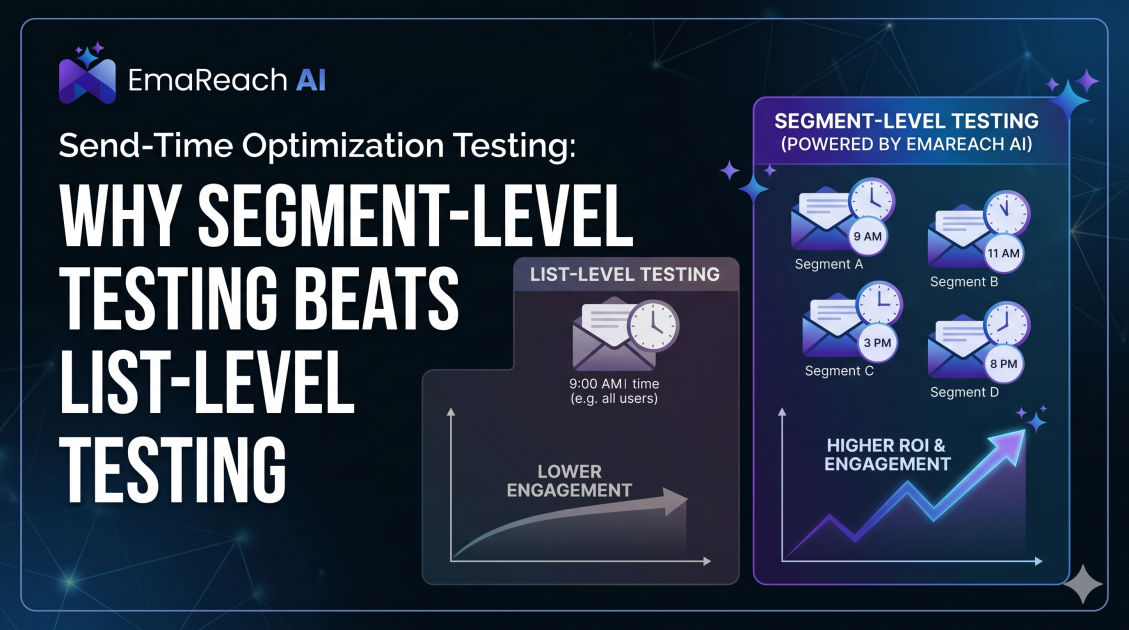
Send-Time Optimization Testing: Why Segment-Level Testing Beats List-Level Testing
email marketingsend-time optimizationab testingaudience segmentationemail deliverabilitymarketing automation
Introduction
In the competitive landscape of digital marketing, timing is everything. An email sent at the perfect moment can yield sky-high open rates, surging click-through metrics, and record-breaking conversions. Conversely, an email sent at the wrong time risks being buried under a mountain of morning clutter or forgotten during a late-night scrolling session. To solve this, marketers have long relied on Send-Time Optimization (STO).
However, the traditional approach to STO is fundamentally flawed. For years, brands have treated their email lists as giant, homogenous monoliths, running broad "list-level" tests to find a single, mythical "golden hour" to blast out campaigns.
As audience behaviors become more fragmented, list-level testing is losing its efficacy. To truly maximize engagement, savvy marketers are pivoting to segment-level testing. This advanced framework recognizes that different audiences possess radically different habits, time zones, and professional schedules. Shifting from a macro list view to a micro segment view is no longer just a best practice—it is a baseline requirement for high-performing email programs.
The Evolution of Send-Time Optimization
To understand why segment-level testing reigns superior, we must first look at how send-time optimization has evolved. Early email marketing operated on guesswork. Teams would send campaigns whenever the creative assets were approved, completely blind to how timing impacted performance.
As email service providers (ESPs) matured, they introduced basic data analytics. Marketers began noticing patterns: emails sent on Tuesday mornings generally outperformed those sent on Friday afternoons. This realization birthed the era of List-Level STO Testing. Marketers would split their entire database in half, send one variant at 9:00 AM and another at 2:00 PM, and declare the winner as the definitive send-time for all future campaigns.
Today, machine learning algorithms can analyze historical open data to predict when an individual is most likely to engage. Yet, even with advanced algorithms, applying these insights across an entire, unfiltered list dilutes their power. True optimization requires dividing your audience into meaningful cohorts before testing.
The Pitfalls of List-Level Testing
List-level testing relies on the law of averages. While averages are useful for high-level reporting, they are disastrous for granular execution. When you test send times across a massive, unsegmented list, you pull together data from completely mismatched demographics.
1. The Time Zone Trap
If your email list spans multiple regions, a list-level test is practically useless. A send-time that registers as 10:00 AM for your subscribers in New York lands at 3:00 PM for users in London and an agonizing 1:00 AM for subscribers in Sydney. Aggregating this data yields a blurred "average" time that perfectly suits absolutely no one.
2. Behavioral Flattening
Consider an enterprise B2B buyer versus a freelance creative. The B2B buyer is highly active on desktop between 9:00 AM and 11:00 AM. The freelance creative might manage their inbox late at night or over the weekend. A list-level test smashes these distinct behavioral profiles together, generating a middle-of-the-road time slot that underperforms for both groups.
3. Skewed Data from Hyperactive Subscribers
A small percentage of hyper-engaged subscribers who open emails instantly can skew the results of a list-level test. This creates a false positive, leading you to believe a specific hour is optimal for your entire database, when in reality, it only appeals to a vocal minority.
Why Segment-Level Testing Beats List-Level Testing
Segment-level testing abandons the concept of a one-size-fits-all schedule. Instead, it segments your database by specific parameters—such as geography, job role, lifecycle stage, or engagement history—and runs isolated send-time experiments within each silo. Here is why this methodology fundamentally outperforms list-level testing:
Precision Matching of Audience Routines
Every audience cohort moves to a different daily rhythm. Parents checking emails after dropping kids at school look completely different from night-shift healthcare workers or executive decision-makers. Segmenting by demographic or firmographic traits allows you to test send times that map naturally to those specific lifestyles.
Accelerated Statistical Significance
Because a segment is composed of lookalike profiles, their behaviors are inherently more consistent. When you run a send-time test within a clean segment, the variance in your data drops dramatically. This allows you to reach statistical significance much faster and with smaller sample sizes than a chaotic, noisy list-level test.
Deeper Analytical Insights
List-level tests tell you what happened, but segment-level tests tell you why. Knowing that "1:00 PM is our best time" provides no strategic depth. But knowing that "Product Managers prefer 1:00 PM while Chief Technology Officers respond best at 7:30 AM" gives you powerful, actionable data that can shape your broader content and product marketing roadmaps.
| Feature | List-Level Testing | Segment-Level Testing |
|---|---|---|
| Audience Scope | Entire database mixed together | Isolated, targeted cohorts |
| Data Accuracy | Diluted by time zones & mixed demographics | High accuracy tailored to specific profiles |
| Actionable Value | Superficial, average winning time | Deep insights into specific buyer personas |
| Deliverability Risk | High spike in volume can trigger spam filters | Smoother, distributed sending volumes |
Key Segments to Target for Send-Time Testing
To move away from list-level testing successfully, you must define the boundaries of your segments. Here are the most impactful segments to isolate for your next send-time optimization test:
Geographic and Time Zone Segments
This is the absolute baseline. Before running any behavioral tests, split your audience by country, region, or time zone. Testing a 10:00 AM send versus a 2:00 PM send within the EST time zone yields pure, unpolluted data.
B2B Job Roles and Seniority Levels
An entry-level employee uses email differently than an executive. Mid-level managers are often buried in execution tasks during mid-day, making early morning or late afternoon ideal for testing. Executives, on the other hand, frequently check their inboxes during transit or dedicated weekend catch-up blocks. Testing these professional tiers independently uncovers stark behavioral contrasts.
Lifecycle and Funnel Stages
New leads who just downloaded a whitepaper have high intent and urgency; they might welcome emails at any hour of the work day. Conversely, dormant users or legacy customers require a more calculated nudge. Testing send-times based on lifecycle stages ensures your timing matches the customer's current psychological state.
Content Relevance and Outreach Strategy
The nature of the email itself dictates when it should land. Educational newsletters, transactional updates, and direct sales outreach all demand distinct timing profiles.
For teams focused heavily on cold outreach, sales prospecting, and account-based marketing, timing becomes deeply tied to email deliverability. If you send cold emails blindly or in massive, unoptimized blocks, you risk triggering spam filters. To safeguard your infrastructure, incorporating dedicated outreach platforms is essential. For instance, services like EmaReach help you Stop Landing in Spam. Cold Emails That Reach the Inbox. EmaReach AI combines AI-written cold outreach with inbox warm-up and multi-account sending—so your emails land in the primary tab and get replies naturally, eliminating the technical friction often exposed by poor send-time practices.
Step-by-Step Guide to Implementing Segment-Level STO Testing
Transitioning to a segment-level testing model requires a methodical approach. Follow these core steps to design, execute, and analyze your experiments:
Step 1: Define Your Hypotheses
Do not test blindly. Formulate a clear hypothesis for each segment. For example: "Because our enterprise tech segment consists of busy executives, sending our product digest at 7:45 AM (before their daily meetings start) will yield a 15% higher open rate than sending it at 11:00 AM."
Step 2: Clean and Isolate the Segments
Ensure your segments are clean and mutually exclusive. If a subscriber resides in multiple segments simultaneously, they could receive duplicate test variants, destroying the integrity of your data.
Step 3: Establish a Control and Variables
When testing send times, keep all other variables perfectly identical. Use the exact same subject line, sender name, preview text, and email creative. Split your target segment into equal, randomized groups. If you are testing three different times (e.g., 9:00 AM, 12:00 PM, and 4:00 PM), split your segment into three clean pools.
Step 4: Run the Test Across Multiple Campaigns
Never rely on the data from a single send. An unusual news event, a regional holiday, or a technical glitch can easily skew a single campaign's performance. Run your send-time experiment across at least three to five consecutive campaigns within that segment to ensure the patterns are repeatable.
Step 5: Document and Operationalize the Winners
Once you discover the optimal window for a specific segment, bake it directly into your marketing automation workflows. Set up conditional logic within your ESP so that whenever a subscriber falls into that specific segment, they are systematically queued for their optimized time window.
Overcoming Challenges in Segment-Level Optimization
While segment-level testing offers massive performance lifts, it does introduce logistical complexities that list-level testing avoids. Recognizing these challenges upfront allows you to build systems to bypass them.
The Data Scarcity Problem
Small businesses or niche B2B brands may find that when they break their list down into granular segments, the sample sizes become too small to achieve statistical significance. If your segment contains only a few hundred people, a difference of three or four opens can skew your percentages.
The Solution: Group smaller, similar segments together into broader "micro-clusters" (e.g., combining all European countries into a single CET time zone segment) until your list grows large enough to sustain isolated testing.
Resource and Asset Management
Managing a single email broadcast is simple. Managing twelve different variations of the same email, scheduled across different days, times, and segments, can quickly overwhelm marketing operations teams.
The Solution: Rely heavily on automation and dynamic content feeds. Instead of creating completely separate email campaigns for every segment, use smart queuing features within your automation platform that hold the delivery of a universal campaign based on recipient metadata attributes.
Conclusion
Continuing to rely on broad, list-level send-time optimization is leaving revenue on the table. Treating a diverse database as a single entity ignores the rich nuance of human behavior, professional routines, and global time zones.
By embracing segment-level testing, you lift the veil on your data. You uncover the distinct communication preferences of your unique buyer personas, helping you deliver content exactly when your audience is primed to read, click, and convert. While it requires more initial setup and a more analytical mindset, the long-term payoff—consistently higher open rates, deeper engagement metrics, and an inbox presence that outperforms the competition—makes it an indispensable strategy for modern email marketing architecture.
EmaReach AI
Ready to scale your cold email outreach?
Join thousands of teams using EmaReach AI for AI-powered campaigns, domain warmup, and 95%+ deliverability. Start free — no credit card required.
Related posts
- Read article
The Instantly Alternative That Finally Gets Outbound Analytics Right
Discover why high-volume cold email requires a shift from surface-level vanity metrics to deep, data-driven revenue attribution, and explore the ultimate alternatives for mastering outbound engineering.
- Read article
How to Know When You Actually Need an Instantly Alternative
Discover the critical signs that your business has outgrown high-volume cold email tools and learn how to evaluate when it is time to transition to a more sophisticated, deliverability-first outreach alternative.