Blog
Back to blog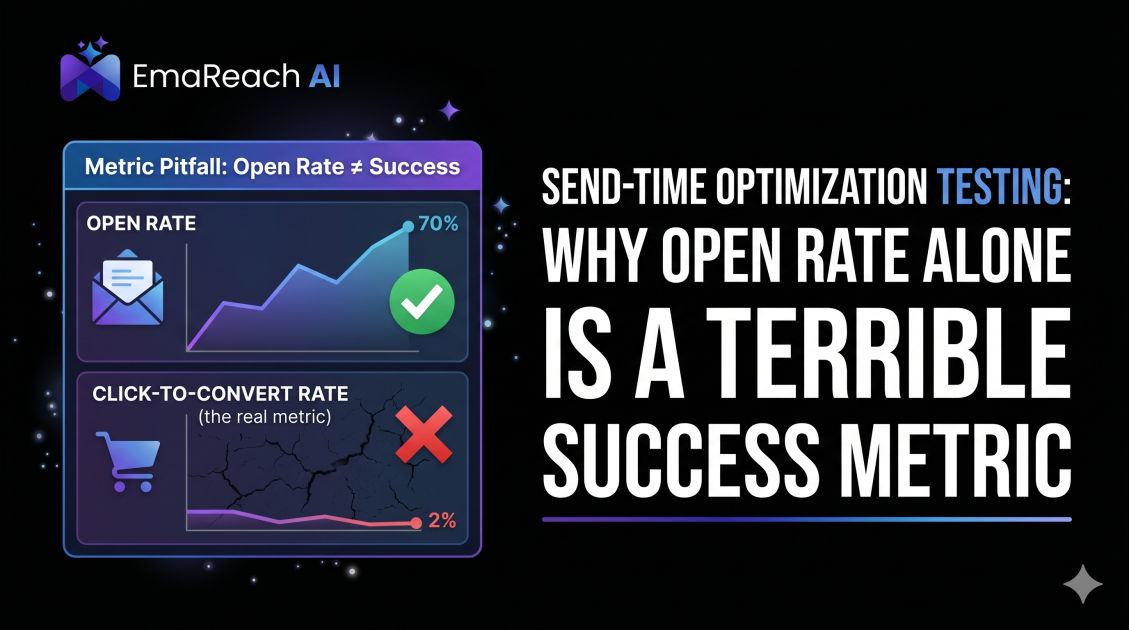
Send-Time Optimization Testing: Why Open Rate Alone Is a Terrible Success Metric
email marketingsend-time optimizationdeliverabilitycold emailA/B testingmetrics
Introduction: The Seductive Promise of Perfect Timing
Email marketing and cold outreach have long been obsessed with a single, seemingly logical question: When is the absolute best time to send an email? The pursuit of the perfect send time has spawned countless industry reports, massive data studies, and entirely new categories of marketing automation software. The underlying premise is incredibly appealing. If you can land your message at the exact top of your prospect's inbox precisely when they are holding their phone or looking at their monitor, you dramatically increase the chances of them engaging with your content.
To measure the success of these timing experiments, marketers have historically relied on a singular, ubiquitous metric: the open rate. It makes intuitive sense. If an email is sent at the "right" time, more people will see it, and therefore, more people will open it. A higher open rate during a Tuesday morning test compared to a Thursday afternoon test must mean that Tuesday morning is the optimal time for your audience.
However, this reliance on the open rate as the definitive measure of send-time optimization (STO) success is fundamentally flawed. In the modern email landscape, using open rates to judge the effectiveness of your timing strategy is not just inaccurate; it can actively lead your marketing strategy astray. Open rates are a superficial vanity metric that fails to capture the true intent of the recipient, the technical realities of modern email clients, and the ultimate business goals of your campaigns. To truly master send-time optimization, you must abandon the open rate and look much deeper into the data.
The Technical Mechanics of the Open Rate (And Why It Is Broken)
To understand why open rates are a terrible success metric, you first have to understand how an "open" is actually tracked technically. When an email service provider (ESP) or outreach platform sends an email, it embeds a tiny, invisible, one-by-one pixel transparent image at the bottom of the HTML code. When the recipient's email client (like Apple Mail, Outlook, or Gmail) downloads and displays the images in that email, a request is sent back to the ESP's server to load that tiny pixel. The server logs that request and records it as an "open."
The Rise of Machine Opens
For a long time, this system worked reasonably well. But the landscape of digital privacy has shifted dramatically. Major email providers have implemented aggressive privacy protection measures that completely break the tracking pixel mechanism.
When a user with these modern privacy protections receives an email, their email provider's server intercepts the message and automatically pre-fetches and downloads all the content—including the invisible tracking pixel—before the user ever looks at their phone. This generates a request to your server, which your software happily records as an open. The reality? A machine opened the email on a remote server, while the human recipient may never even look at the subject line. This phenomenon artificially inflates open rates to the point of meaninglessness.
The Suppression of Legitimate Opens
Conversely, many security-conscious organizations and individual users configure their email clients to block the automatic downloading of images. If a user receives your email, reads the entire message, but does not explicitly click "download images," the tracking pixel will never fire. You could have a prospect read your email three times and forward it to their boss, but your analytics dashboard will report zero opens.
When you run a send-time optimization test and measure the results strictly by open rate, you are largely measuring the behavior of automated servers and caching algorithms, not the genuine engagement patterns of your human audience.
Why "Right Time to Open" Does Not Equal "Right Time to Act"
Even if we lived in a theoretical world where tracking pixels worked flawlessly and every logged open represented a real human reading the email, the open rate would still be a terrible metric for optimizing send times. The reason lies in human psychology and the way modern professionals interact with their inboxes.
The Commuter Phenomenon and Triage Mode
Consider the daily routine of a typical B2B prospect. They might wake up, grab their phone, and quickly scroll through their inbox while commuting on a train or waiting in line for coffee. This is "triage mode." During triage, the prospect is opening emails rapidly, deleting spam, archiving newsletters, and mentally flagging important messages to deal with later.
If your email arrives during this morning triage period, it might get opened. Your STO test will register a success. But is the prospect going to read a dense whitepaper, fill out a complex lead form, or reply to a detailed cold email while balancing a coffee on a crowded train? Absolutely not. They opened the email, but the context was entirely wrong for taking action.
The Intent Gap
Send-time optimization that only looks at opens completely ignores the "intent gap"—the vast chasm between passive consumption and active engagement. You do not want your email to arrive when the prospect has the time to merely look at it; you want it to arrive when they have the mental bandwidth, the contextual setup, and the specific intent to act on it.
An email sent at 2:00 PM might yield a lower overall open rate than one sent at 8:00 AM. However, the prospect opening the email at 2:00 PM is likely sitting at their desk, deeply engaged in their work, and fully capable of clicking a link, evaluating a software tool, or typing out a thoughtful reply to a sales pitch. Optimizing for the superficial open means you might be actively shifting your campaign delivery away from the high-intent, high-conversion windows.
The Foundation First: Deliverability Over Timing
Before you can even begin to worry about the psychology of timing or the technical flaws of tracking pixels, there is a much more critical hurdle you must clear. If your email is routed to the spam folder, your carefully orchestrated send time is entirely irrelevant. A perfectly timed spam email is still a spam email.
Many marketers obsess over send-time optimization while completely ignoring their sender reputation and technical setup. If you are blasting out cold outreach without a proper warm-up process, your timing tests are generating useless data because the majority of your audience isn't even seeing the message.
Stop Landing in Spam. Cold Emails That Reach the Inbox. That is the core philosophy behind successful email outreach, and it is exactly what EmaReach delivers. EmaReach operates on the understanding that timing is a secondary optimization; the primary optimization is raw deliverability. EmaReach combines sophisticated, AI-written cold outreach with automated inbox warm-up protocols and seamless multi-account sending capabilities.
By ensuring that your meticulously crafted emails bypass aggressive enterprise spam filters and land directly in the primary tab, EmaReach provides the rock-solid foundation necessary for any send-time testing. When you know your emails are hitting the primary inbox, you can trust that your engagement data actually reflects human behavior. Without a robust deliverability engine like EmaReach, any send-time data you collect is severely compromised by artificial spam filtration.
The Metrics You Should Be Tracking Instead
If the open rate is dead—or at least severely compromised—how should modern marketers and sales professionals measure the success of their send-time optimization experiments? The answer is to move down the funnel and focus on metrics that require definitive human action and correlate directly with business value.
1. Click-Through Rate (CTR) and Click-to-Open Rate (CTOR)
For marketing newsletters, content distribution, and e-commerce campaigns, the click is the first true sign of intent. A click requires a human to read the content, find value in the proposition, and make a conscious physical action to learn more.
When running STO tests, look at which time slots generate the highest absolute volume of clicks (CTR). Even more revealing is the Click-to-Open Rate (CTOR), which measures the percentage of people who opened the email and then clicked. While the "open" part of the equation is flawed, a high CTOR indicates that the people who did see the message found it highly relevant at that specific moment in their day.
2. Reply Rates for Cold Outreach
For B2B sales professionals, agency owners, and anyone running cold email campaigns, clicks are often less important than direct replies. A reply is the ultimate signal of engagement. It means the prospect not only read the message but was compelled enough to initiate a conversation.
When optimizing the send time for a cold outreach sequence, the reply rate is your north star metric. You might find that emails sent late on a Friday afternoon have terrible open rates but surprisingly high reply rates, simply because executives are winding down their week and finally have the mental space to clean out their inboxes and respond to interesting pitches.
3. Conversion Rate and Pipeline Velocity
The ultimate goal of any email is rarely just a click or a reply; it is a business outcome. Did the recipient purchase the product? Did they book a discovery call? Did they download the software?
Advanced send-time optimization testing tracks the user all the way through the funnel. You may discover that a Wednesday morning send drives a massive spike in traffic (clicks), but a Sunday evening send—while driving less overall traffic—results in highly qualified leads who actually convert into paying customers. Optimizing for the Sunday evening slot is the correct business decision, despite what the vanity metrics might suggest.
4. Negative Engagement: Unsubscribes and Spam Complaints
It is crucial to monitor negative metrics during your STO tests. Sending an email at the "wrong" time isn't just about missing an opportunity; it can actively irritate your audience. If you test sending promotional emails at 11:00 PM and see a sudden spike in unsubscribes or spam complaints, you have found a clear signal. Even if that late-night slot generates a few anomalous opens, the damage to your list health and sender reputation far outweighs the benefits.
How to Design a Bulletproof Send-Time Optimization Test
To move beyond the flawed open rate, you must design STO experiments with rigorous scientific methodology. A proper test requires isolation of variables and a clear focus on actionable downstream metrics.
Step 1: Define the True Conversion Goal
Before launching the test, explicitly state what a "successful" email looks like. Is it a demo booking? A webinar registration? A direct purchase? Establish this goal and ensure your analytics tracking is set up to attribute these conversions back to the specific email and its send time.
Step 2: Segment Your Audience Meaningfully
Send-time preferences vary wildly across demographics, industries, and time zones. Testing your entire global list at once will result in a muddy, useless average. Segment your audience by time zone first. Then, segment by industry or persona. A software engineer's inbox habits are vastly different from those of a hospital administrator. Your STO tests should seek to find the optimal time for specific segments, not the entire database.
Step 3: Isolate the Send-Time Variable
The golden rule of A/B testing is to only change one variable at a time. If you want to test Tuesday morning versus Thursday afternoon, the subject line, preview text, body copy, and call-to-action must be absolutely identical. If you change the subject line and the send time simultaneously, you will never know which variable caused the difference in conversions.
Step 4: Analyze the Downstream Data
Once the test concludes, pull the data and immediately hide the "Open Rate" column in your spreadsheet. Force yourself to look at the replies, the clicks, and the ultimate conversions. Look for statistically significant differences in these lower-funnel metrics to declare your winning time slot.
The Impact of Industry and Lifecycle Stage on STO
Send-time optimization is highly contextual. The optimal time to send a message depends heavily on the relationship you have with the recipient and the nature of the transaction.
B2B vs. B2C Dynamics
In the Business-to-Consumer (B2C) space, weekend sends and late-evening sends often perform exceptionally well. Consumers are relaxed, browsing their phones on the couch, and highly susceptible to impulse purchases or lifestyle content.
In the Business-to-Business (B2B) realm, the rules change entirely. B2B emails perform best during standard working hours, specifically during the "transitional" periods of the day—early morning before meetings begin, or late afternoon as the workday winds down. Sending a complex B2B proposal on a Saturday is almost guaranteed to bury the message under a pile of weekend promotional clutter by the time the prospect logs in on Monday morning.
Nurture Sequences vs. Transactional Outreach
The lifecycle stage of the prospect also dictates timing strategy. If a prospect has just downloaded a whitepaper, the optimal send time for the first follow-up email is immediately. Their intent will never be higher than it is right in that exact moment. Delaying the send to hit an arbitrary "optimized" time slot the next day will crush your conversion rate.
Conversely, for long-term nurture campaigns designed to keep your brand top-of-mind over several months, the specific minute of delivery matters far less than the consistency and quality of the content.
Conclusion: Retiring the Vanity Metric
The open rate had its time in the sun. In the early days of email marketing, it was a reasonable proxy for engagement. Today, it is a deceptive metric clouded by privacy protocols, caching servers, and the complex realities of human behavior. Continuing to optimize your campaigns based on when an email is "opened" is a surefire way to misalign your strategy and miss out on genuine revenue opportunities.
True send-time optimization requires a commitment to the metrics that matter: clicks, replies, booked meetings, and closed deals. It requires ensuring absolute deliverability so your messages actually reach the primary inbox in the first place. By abandoning the open rate and focusing on true, bottom-of-the-funnel engagement, you can finally uncover the sending patterns that resonate deeply with your audience and drive measurable business growth.
EmaReach AI
Ready to scale your cold email outreach?
Join thousands of teams using EmaReach AI for AI-powered campaigns, domain warmup, and 95%+ deliverability. Start free — no credit card required.
Related posts
- Read article
How Choosing the Right Instantly Alternative Changed Our Pipeline Numbers
Discover how transitioning from a volume-first cold email setup to an advanced, deliverability-focused infrastructure transformed our B2B pipeline metrics, skyrocketed open rates to over 68%, and tripled our monthly booked demos.
- Read article
What Three Months on an Instantly Alternative Revealed About Our Outreach
Discover the profound lessons learned from a 90-day experiment moving away from traditional cold email setups. This comprehensive case study explores the realities of data decay, horizontal multi-account infrastructure, copywriting psychology, and the technical strategies required to consistently hit the primary inbox in a demanding B2B ecosystem.