Blog
Back to blog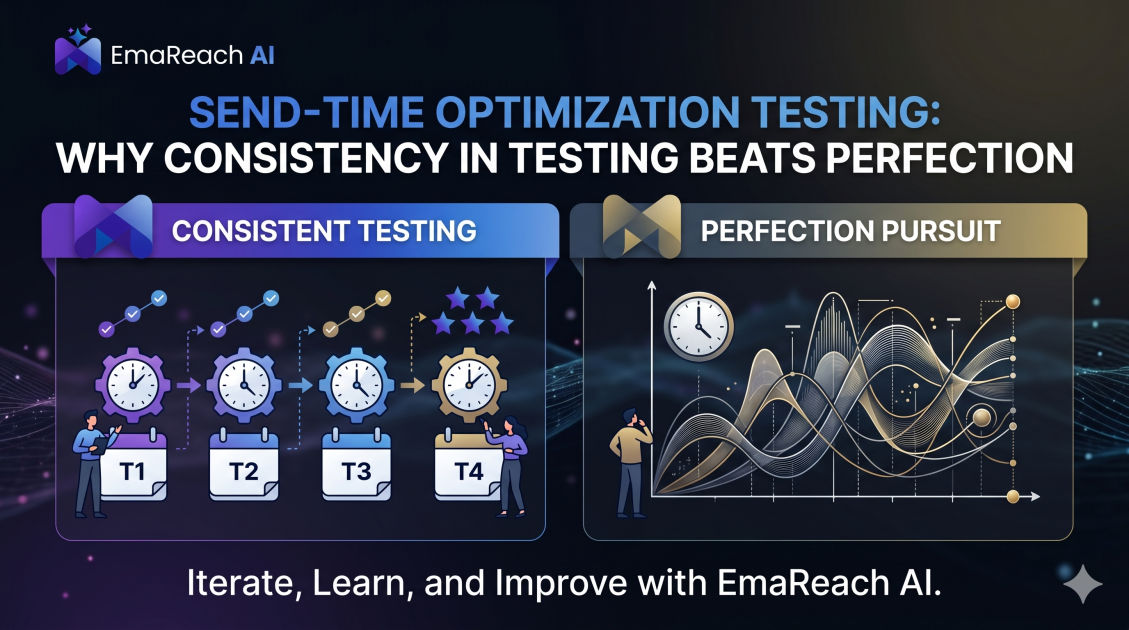
Send-Time Optimization Testing: Why Consistency in Testing Beats Perfection
email marketingsend time optimizationab testingcold outreachemail deliverabilitymarketing automation
Introduction
In the world of digital marketing, timing is often heralded as the ultimate differentiator between an email that converts and one that gets buried beneath a mountain of digital noise. Every marketer dreams of hitting the inbox at the exact millisecond their prospect opens their phone or laptop. This pursuit has given rise to Send-Time Optimization (STO), an analytical approach that leverages data to predict the best moment to deliver an email.
However, many growth teams fall into a common trap: the pursuit of the perfect send time. They treat STO as a one-time mathematical riddle to be solved, spending weeks agonizing over whether Tuesday at 10:00 AM outperforms Thursday at 2:00 PM. The truth is, audience behavior is fluid, algorithms change, and inbox environments fluctuate. In email marketing, chasing a singular, flawless victory is a losing strategy. Instead, establishing a disciplined, continuous, and consistent testing framework is what truly drives sustainable revenue and high engagement. This comprehensive guide explores why consistency in testing beats perfection and how you can build an agile send-time optimization strategy that yields compounding results.
The Myth of the "Perfect" Send Time
For years, generic industry benchmarks have claimed to hold the secret keys to email marketing success. You have likely read reports declaring that mid-week mornings are the undisputed champion for open rates. While these benchmarks offer a baseline for beginners, relying on them as absolute truth is a mistake.
The Flaw of Static Benchmarks
Static benchmarks look backward, aggregating historical data across vastly different industries, business models, and demographics. What works for a B2C e-commerce brand selling weekend apparel will not work for a B2B SaaS enterprise targeting enterprise Chief Information Officers (CIOs).
The Chaos of Human Behavior
Your subscribers are human beings, not predictable algorithms. A recipient who usually opens business emails at 9:00 AM might change their routine because of an early morning flight, a sick child, a shift in remote work policies, or a sudden change in corporate priorities. Because human routines are inherently dynamic, an email schedule optimized for last month's patterns might fall flat today.
The Tech Factor and Mailbox Providers
Modern email clients do not just deliver messages chronologically anymore. Features like Google’s Priority Inbox, Apple’s Mail Privacy Protection, and automated tab sorting mean that your email might arrive at 10:00 AM but remain unseen until the user purposefully navigates away from their main feed.
Instead of wasting resources trying to isolate a single perfect hour, sophisticated marketers view send-time optimization as an ongoing experiment. The goal is not to find a static time slot to lock in forever, but to build an adaptive system that evolves alongside consumer habits.
The Core Principles of Consistency in Testing
To move away from the perfection trap, you must adopt a framework centered on consistent testing. Consistency does not mean spamming your audience at random intervals; it means executing structured, scientific experiments over prolonged periods to isolate meaningful trends. Here are the core pillars of a consistent testing approach:
1. Longitudinal Data Collection
A single A/B test conducted over a single week only gives you a snapshot of a highly specific moment in time. True send-time optimization requires longitudinal testing—running experiments across weeks or months. This allows you to account for external anomalies like seasonal holidays, economic shifts, or industry-wide disruptions that could skew short-term data.
2. Statistical Significance Over Intuition
When you review test results, a minor bump in open rates can easily tempt you to declare a winner. However, without statistical significance, that bump could be pure coincidence. Consistent testing relies on rigorous sample sizes and mathematical validation before making strategic pivots.
3. Iterative Optimization
Instead of testing completely random variables (e.g., testing 6:00 AM against 11:00 PM), iterative testing makes incremental adjustments based on prior findings. If data shows morning sends generally outperform evening sends, subsequent tests should narrow the focus to discover whether early morning or mid-morning yields the highest conversion velocity.
The High Cost of Chasing Perfection
When a marketing team becomes obsessed with finding the perfect send time, they often suffer from diminishing returns and operational bottlenecks. Understanding the hidden costs of perfectionism helps highlight why a consistent framework is far more profitable.
Analysis Paralysis
Teams can spend excessive time analyzing historical open rates, slicing segments by time zone, and over-engineering delivery schedules. This hyper-focus often pulls attention away from more critical elements of campaign success, such as compelling copywriting, clear offers, and technical infrastructure.
Ignoring the Fundamentals: Deliverability
An optimized send time is completely useless if your emails land directly in the spam folder. Perfectionists often focus so heavily on the when that they completely neglect the how. Factors like domain reputation, IP warming, authentication records (SPF, DKIM, DMARC), and engagement health dictate your inbox placement far more than the hour of delivery.
For teams focused on outbound growth and business development, maintaining this fundamental deliverability is paramount. If you are leveraging cold outreach to scale your pipeline, you need infrastructure designed specifically to navigate modern spam filters. This is exactly where EmaReach excels. Stop Landing in Spam. Cold Emails That Reach the Inbox. EmaReach AI combines AI-written cold outreach with inbox warm-up and multi-account sending—so your emails land in the primary tab and get replies. By automating the technical foundation of your outreach, EmaReach ensures that your send-time optimization tests are actually reaching real eyes, rather than dying in the junk folder.
| Focus Area | The Perfectionist Trap | The Consistent/Systematic Approach |
|---|---|---|
| Goal | Find the one absolute best hour to send emails | Discover broad windows of high engagement and iterate |
| Data Scope | Small, isolated snapshots of high performance | Long-term, continuous trends across seasons |
| Risk Factor | High vulnerability to behavioral shifts and anomalies | Resilient, self-correcting strategy based on averages |
| Resource Cost | Heavy manual analysis and fragmented scheduling | Systematized, automated testing routines |
How to Build a Continuous Send-Time Testing Framework
Transitioning to a consistency-first methodology requires a practical, repeatable workflow. Below is a step-by-step blueprint for setting up a sustainable send-time optimization testing cycle.
Step 1: Establish Your Control Baseline
Before testing new hypotheses, establish a benchmark using your current sending habits. Analyze your last 30 to 60 days of email data to determine your average open rates, click-through rates (CTR), and conversion rates. This baseline will serve as the control group against which all future tests are measured.
Step 2: Cohort Segmentation
To prevent muddy data, segment your audience into test cohorts that share similar characteristics. Mixing active trial users with cold leads will corrupt your send-time data, as their intent levels are radically different. Group your targets by:
- Time Zone: Grouping recipients by geographic time zones ensures that "9:00 AM" means 9:00 AM local time for everyone in that cohort.
- Lifecycle Stage: Separate prospecting/cold outreach pools from nurtured, warm leads.
- Activity Level: Keep highly engaged users separate from unengaged contacts to avoid skewed averages.
Step 3: Define Your Core Metric
Not all metrics are created equal when evaluating send times. While open rates are the most immediate indicator of send-time success, they can be artificially inflated by automated bot clicks and privacy protections. Focus instead on down-funnel metrics:
- Click-to-Open Rate (CTOR): Measures if the recipient was in the right mindset to interact with your content upon opening.
- Reply Rate: Especially critical for cold outreach, high reply rates indicate your message caught the prospect when they had the time to type a response.
- Conversion Rate: The ultimate validator of whether the send time put the user in a position to take action.
Step 4: Schedule the Test Matrix
Create a clear testing matrix over a fixed duration (e.g., 4 weeks). If you are testing two different windows, maintain consistent content, subject lines, and sender profiles across both groups.
- Week 1-2: Test Window A (Morning) vs. Window B (Afternoon).
- Week 3-4: Flip the cohorts to ensure the variance wasn't caused by natural cohort biases.
Step 5: Analyze, Document, and Pivot
At the end of your test cycle, review the data. If Window A outperformed Window B by a statistically significant margin, shift your baseline toward Window A. Your next test cycle should then split Window A into two narrower options (e.g., Early Morning vs. Late Morning) to continue refining your window of opportunity.
Balancing Automation with Human Insight
Many modern marketing platforms offer native algorithmic Send-Time Optimization. These tools use machine learning to analyze individual user behavior and send messages automatically when that user is most active. While incredibly powerful, relying blindly on automated STO can introduce unexpected challenges.
The Blind Spots of Machine Learning
An AI model can only optimize based on historical interactions within its ecosystem. If a prospect has never interacted with your brand before—as is the case with cold email outreach—the algorithm has no data points to build on. Furthermore, if an enterprise buyer changes roles, their historic schedule becomes instantly irrelevant.
The Strategic Overlay
Human insight must guide the machine. For instance, if you are running an account-based marketing (ABM) campaign targeting financial executives during quarter-end closing, your human understanding of their intense workload should override standard algorithmic suggestions. Combining consistent data-driven automation with contextual empathy creates an unbeatable outreach engine.
Actionable Best Practices for Sustainable Email Testing
To ensure your testing program remains efficient and doesn't devolve into an administrative burden, integrate these best practices into your operational workflow:
- Limit Variables: Never test a new send time and a new subject line simultaneously. If your open rates spike, you will have no way of knowing whether it was due to the compelling hook or the flawless timing.
- Automate Where Possible: Use scheduling tools and multi-account senders to distribute the workload, preventing your team from having to log in manually at odd hours to hit specific time zones.
- Accept "Good Enough" Windows: If data reveals that sending anywhere between 1:00 PM and 4:00 PM yields stable, predictable revenue, stop stressing over the exact minute. You have successfully found your high-performing window; focus your energy elsewhere.
- Audit Your Data Health Quarterly: Over time, unengaged addresses will pile up in your list, distorting your metrics. Run regular cleaning routines to ensure you are only optimizing send times for active, viable inboxes.
Conclusion
In email marketing and cold outreach, perfection is an illusion that breeds complexity and stagnation. Audiences change, algorithms shift, and what worked beautifully yesterday may fail tomorrow. Chasing a single perfect send time distracts from what truly matters: maintaining technical deliverability, crafting exceptional messaging, and executing consistent experiments.
By building a predictable, long-term framework for Send-Time Optimization testing, you allow your strategy to adapt organically to your market's changing rhythms. Focus on establishing solid baselines, isolating your testing variables, and prioritizing consistent execution over flawless precision. Over time, these steady, incremental discoveries will accumulate into significant growth, higher open rates, and sustainable pipeline expansion.
EmaReach AI
Ready to scale your cold email outreach?
Join thousands of teams using EmaReach AI for AI-powered campaigns, domain warmup, and 95%+ deliverability. Start free — no credit card required.
Related posts
- Read article
How to Know When You Actually Need an Instantly Alternative
Discover the critical signs that your business has outgrown high-volume cold email tools and learn how to evaluate when it is time to transition to a more sophisticated, deliverability-first outreach alternative.
- Read article
The Instantly Alternative for Teams Who Care About Long-Term Sender Health
Discover why volume-first cold email platforms damage long-term deliverability and how modern growth teams are switching to sophisticated alternatives to protect their domains and scale replies sustainably.