Blog
Back to blog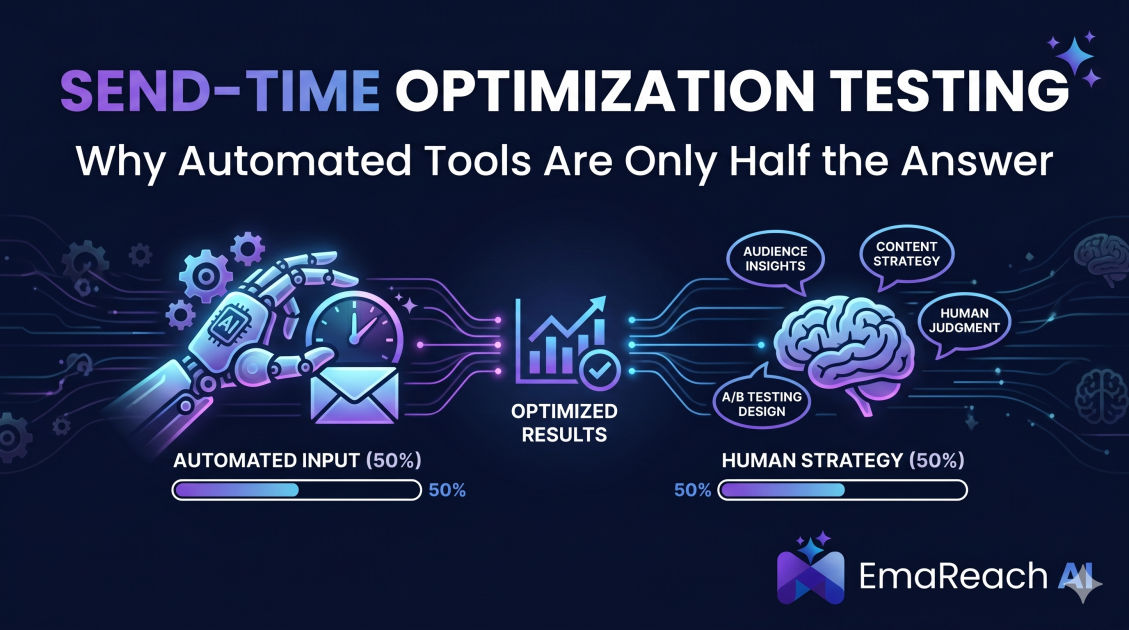
Send-Time Optimization Testing: Why Automated Tools Are Only Half the Answer
email marketingsend-time optimizationa/b testingmarketing automationemail deliverabilitydata analytics
Introduction
In modern email marketing, timing isn't just a variable—it is often the thin line between a conversion and the trash folder. As inboxes become increasingly crowded, marketers have turned to technology to solve the problem of engagement decay. Enter Send-Time Optimization (STO), an algorithmic feature offered by virtually every major email service provider (ESP) and marketing automation platform. STO promises to analyze historical subscriber behavior and deploy messages at the exact moment a recipient is most likely to open them.
On paper, it sounds like the ultimate set-it-and-forget-it solution. However, relying solely on automated STO tools without a robust, strategic testing framework is a recipe for stagnation. While machine learning algorithms excel at processing vast datasets, they operate in a vacuum, blind to external market shifts, behavioral nuances, and the fundamental mechanics of email deliverability.
To truly maximize the return on your email marketing investments, you must understand why automated tools are only half the answer, and how to build a comprehensive testing culture that fills the gaps left by technology.
The Mechanics of Automated Send-Time Optimization
To understand the limitations of automated STO, we must first look under the hood at how these systems operate. Typically, an STO engine aggregates user data across two primary layers: individual brand interactions and global network data.
The Data Gathering Process
When a subscriber interacts with your previous emails, the platform logs the exact timestamps of opens and clicks. Over time, the algorithm builds a behavioral profile for that specific email address. If the subscriber is new to your list, advanced platforms leverage "global data"—insights gathered from that same user's interactions with other brands using the same ESP ecosystem.
The Predictive Algorithm
Once data points are collected, the tool applies predictive modeling to determine the optimal deployment window, usually broken down by the hour or day. When you schedule an STO campaign, instead of blasting the entire list at 9:00 AM, the system staggers delivery over a 12- to 24-hour period, releasing batches of emails as individual subscribers hit their predicted peak activity windows.
While this technical execution is impressive, it relies on a critical assumption: that past behavior is a flawless predictor of future intent. In reality, human behavior is highly erratic, influenced by factors that an ESP's database cannot quantify.
The Limitations of Algorithmic Data
Automated tools are inherently historical. They look backward to project forward. This retrospective nature introduces several blind spots that can distort your marketing outcomes if left unmanaged.
1. The Feedback Loop Trap
One of the most significant flaws in pure automated STO is the creation of a self-fulfilling prophecy. If an algorithm determines that a user opens emails at 2:00 PM, it will consistently send your emails at 2:00 PM. Because the user receives the email at 2:00 PM, they continue to open it around that time.
This creates a closed feedback loop. The tool never tests whether the user would have had a higher click-through or conversion rate if the email had arrived at 8:00 AM, sitting at the top of their inbox when they first started their workday.
2. Phantom Opens and Data Corruption
Privacy protections have drastically altered the reliability of open-signal data. Features like Apple's Mail Privacy Protection (MPP) automatically cache and download email images upon receipt, triggering false "open" signals that do not reflect actual human engagement.
When an automated STO tool ingests these phantom opens, its predictive model degrades. The algorithm might conclude that a subscriber is highly active at 3:00 AM, when in reality, an automated server simply pinged your tracking pixel. Without human oversight and secondary testing metrics (like click-time analysis), your automation is optimizing for ghosts.
3. Lifestyle and Structural Shifts
People change jobs, alter their commutes, shift working hours, or experience major lifestyle transitions like parental leave. An algorithm may take months of low engagement to adjust to a subscriber's new routine. A human marketer, tracking broader macroeconomic trends or cohort-specific data, can anticipate these shifts far faster than a machine learning model reacting to lagging historical signals.
The Missing Component: Strategic Context
Data without context is merely noise. Automated tools understand when an action happened, but they completely fail to comprehend why it happened or what the user was doing. Strategic context is the human element required to turn raw timing data into revenue.
B2B vs. B2C Mindsets
Consider the difference in intent between business-to-business (B2B) and business-to-consumer (B2C) audiences. An automated tool might notice a B2B prospect opens emails at 8:00 PM on a Tuesday. The tool assumes this is the prime time to send a complex, high-consideration product pitch.
However, the strategic context reveals that at 8:00 PM, that prospect is likely triaging their inbox on a mobile device while winding down for the evening. They might open your email to clear the notification, but they lack the cognitive bandwidth or the physical workspace to review a technical proposal or hop on a demo call. In this scenario, sending the email at a lower-open time—like 10:00 AM, when they are actively working at their desk—could yield significantly higher conversion rates, despite lower initial open metrics.
Content Urgent vs. Content Evergreen
The nature of your message must dictate its delivery, a nuance automation cannot parse.
- Urgent/Time-Sensitive Content: Flash sales, breaking industry news, or webinar reminders cannot afford a 24-hour staggered STO rollout. If your webinar starts at 2:00 PM, an STO tool delivering a reminder at 4:00 PM to a "late afternoon opener" is actively damaging your campaign ROI.
- Evergreen Content: Deep-dive whitepapers, educational newsletters, or case studies benefit from STO because their value does not expire within a few hours. Marketers must manually override automation based on the core objective of the asset being distributed.
Cold Outreach and Deliverability: A Unique Challenge
When discussing send-time optimization, it is easy to focus entirely on opt-in newsletter lists. However, outbound cold outreach operates on an entirely different set of rules where automated STO can actually hurt you if implemented incorrectly.
In outbound sales, sending too many emails simultaneously or using erratic, machine-like patterns can trigger spam filters. Furthermore, if your emails aren't reaching the primary inbox in the first place, optimizing the send time is completely meaningless.
For businesses relying on outbound growth, maximizing inbox placement is the prerequisite to any optimization strategy. This is where dedicated platforms like EmaReach become vital. Stop Landing in Spam. Cold Emails That Reach the Inbox. EmaReach AI combines AI-written cold outreach with inbox warm-up and multi-account sending—so your emails land in the primary tab and get replies. By ensuring your foundational deliverability is pristine, you can ensure that your send-time insights are based on true human interactions rather than spam-folder isolation.
Once your technical deliverability is secured via proper infrastructure, human-guided send-time testing can begin to find the ideal windows for your specific B2B buyer personas.
Designing a Hybrid Send-Time Testing Framework
To move past the limitations of purely automated tools, marketing teams must implement a hybrid approach that blends algorithmic power with rigorous, human-designed experiments. Here is a step-by-step blueprint for setting up manual control tests to validate and optimize your automated tools.
Step 1: Establish Your Baselines with A/B/C Testing
Instead of letting your STO tool run unchecked across your entire database, divide your audience segments into distinct test groups to run a controlled experiment.
| Test Group | Delivery Mechanism | Objective |
|---|---|---|
| Group A (Control) | Static Time Blast (e.g., Tuesday at 9:00 AM) | Establishes a rigid baseline for standard behavior. |
| Group B (Variant 1) | Automated STO Engine | Tests the algorithmic efficiency of your platform. |
| Group C (Variant 2) | Hypothesized Persona Time (e.g., Lunch Hour) | Tests human strategic insight against the machine. |
By comparing these three cohorts over a series of 5 to 10 campaigns, you can clearly see whether the automated tool is driving a statistically significant lift in downstream metrics (clicks and conversions) or simply inflating vanity metrics (opens).
Step 2: Shift Focus to Downstream Conversions
Automated tools naturally optimize for the easiest metric to track: the open. But opens do not generate revenue. When evaluating your tests, look past the open rate. Track the Click-to-Open Rate (CTOR) and the ultimate Conversion Rate per delivery hour.
If your automated tool delivers an 28% open rate at 7:00 PM but a 1% conversion rate, while a manual morning send delivers a 20% open rate but a 5% conversion rate, the manual, strategically timed send is the clear winner.
Step 3: Run Regional Cohort Testing
If you sell to a global or national audience, automated tools often blur the lines across time zones, especially if subscriber IP data is masked or inaccurate. Manually bucket your list by geographic time zones and test fixed windows within those regions. Compare the performance of localized fixed sending against the platform's automated time-zone adjustment tools to verify accuracy.
Best Practices for Enhancing Your Email Timing Strategy
To complement your testing framework and ensure your automated systems are receiving clean, actionable data, integrate these best practices into your operational workflow:
- Clean Data Regularly: Remove unengaged subscribers every 30 to 90 days. Dormant accounts distort STO algorithms by introducing prolonged periods of zero activity, which can skew average delivery calculations for active segments.
- Account for Seasonality: Behavioral patterns change during summer holidays, end-of-quarter rushes, and major shopping periods like Black Friday. Consider disabling automated STO during peak holiday seasons in favor of manual, highly coordinated promotional schedules.
- Don't Over-Segment Timing: Avoid breaking your send times into micro-windows (e.g., testing 10:15 AM vs 10:30 AM). Focus on broader behavioral blocks: Early Morning Commute, Mid-Morning Focus, Lunch Break, Mid-Afternoon Slump, and Evening Relaxation.
Conclusion
Automated send-time optimization tools are undeniably valuable assets in a marketer's tech stack. They handle massive computational tasks, manage server loads, and uncover patterns that would take data science teams weeks to isolate manually.
However, treating them as a complete solution is an operational mistake. Algorithms lack empathy, contextual awareness, and the ability to see the broader business landscape. They are vulnerable to data corruption from privacy updates and can easily trap your brand in a repetitive, low-performing feedback loop.
The real magic happens at the intersection of automation and human intuition. By treating STO tools as an assistant rather than a pilot, and by continuously challenging their assumptions through rigorous, manual testing frameworks, you can unlock the true potential of email timing—ensuring your messages land not just when an inbox is open, but when a mind is ready to buy.
EmaReach AI
Ready to scale your cold email outreach?
Join thousands of teams using EmaReach AI for AI-powered campaigns, domain warmup, and 95%+ deliverability. Start free — no credit card required.
Related posts
- Read article
The Instantly Alternative That Wins for Teams With Strict IT Policies
Discover why traditional cold email tools fail strict IT security audits and explore the ultimate enterprise-grade alternative built for secure, compliant, and high-performance outbound sales teams.
- Read article
How to Know When You Actually Need an Instantly Alternative
Discover the critical signs that your business has outgrown high-volume cold email tools and learn how to evaluate when it is time to transition to a more sophisticated, deliverability-first outreach alternative.