Blog
Back to blog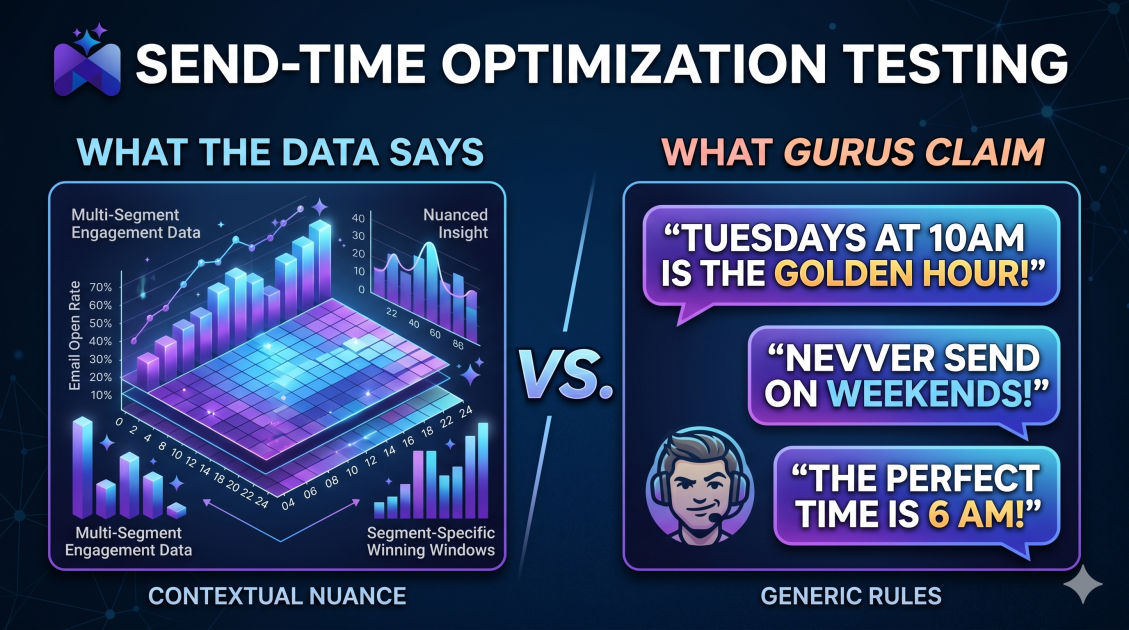
Send-Time Optimization Testing: What the Data Says Versus What Gurus Claim
email marketingsend time optimizationab testingemail deliverabilitydata driven marketingmarketing myths
Introduction
For years, digital marketing influencers, self-proclaimed gurus, and generalized industry reports have repeated the same monolithic advice: "The best time to send an email is Tuesday at 10:00 AM." Or perhaps it is Thursday at 2:00 PM. Turn to any popular marketing blog, and you will find beautifully illustrated bar charts claiming to have unlocked the universal secret to human attention.
Driven by these promises, platforms introduced Send-Time Optimization (STO)—algorithms designed to predict the exact moment a recipient is most likely to open an email based on historical engagement patterns. Gurus heralded STO as a silver bullet capable of instantly multiplying open rates, skyrocketing click-through metrics, and transforming sluggish campaigns into revenue engines.
But when we move past the glossy infographics and interrogate the actual data, a starkly different reality emerges. The gap between marketing folklore and empirical data science is vast. While send-time optimization testing is a valuable tool, its efficacy is frequently misunderstood, overstated, and misapplied.
This deep dive explores what the data actually says about send-time optimization testing versus what the gurus claim, helping you separate hyperbole from high-performance email strategy.
The Guru Myth: The Universal "Golden Hours"
The Claim
Marketing gurus frequently publish articles claiming that certain days of the week and specific hours of the day yield universally superior results. They argue that by aligning your entire list deployment with these generic peak windows, you will automatically bypass the noise of a crowded inbox.
The Reality
Data science paints a far more chaotic picture. When large-scale email service providers analyze billions of sent emails, they do find aggregate statistical bumps on certain days, such as mid-week mornings. However, these peaks are a self-fulfilling prophecy. Because thousands of marketers read the same reports and send their emails on Tuesday at 10:00 AM, the volume of emails sent spikes dramatically at that exact time.
Consequently, while a slightly higher percentage of people may be looking at their inboxes, your email is also competing with an overwhelming flood of competing messages. Aggregate data reflects the average behavior of millions of disparate consumers, ranging from B2B executives to late-night online shoppers. Applying a macro-average to a hyper-specific, micro-targeted audience is a fundamental statistical flaw.
How True Send-Time Optimization (STO) Works
To critique STO intelligently, we must understand how machine-learning-driven send-time optimization actually functions compared to static scheduling.
Modern STO does not rely on a single golden hour. Instead, it operates on an individual level. When an email campaign is deployed with STO enabled, the system does not release all messages simultaneously. Instead, it looks at the historical behavior of each specific subscriber on your list.
- Data Collection: The algorithm tracks when Subscriber A traditionally opens emails (e.g., during their 8:30 AM train commute).
- Predictive Modeling: It notes that Subscriber B typically engages with content around 9:00 PM after their kids are asleep.
- Staggered Deployment: When you hit "send," the platform holds Subscriber A's email until 8:30 AM and Subscriber B's email until 9:00 PM in their respective local time zones.
On paper, this is an elegant application of predictive analytics. In practice, however, its success hinges on variables that gurus rarely discuss.
What the Data Says: The Limitations of STO Algorithms
When independent data analysts and rigorous growth marketers stress-test STO against standard control groups, several core limitations emerge.
1. The "Cold Start" and Data Scarcity Problem
An STO algorithm is only as good as its underlying data. For an algorithm to accurately predict when a subscriber will open an email, it needs a robust history of interactions.
If a subscriber is relatively new, or if they only open one out of every ten emails you send, the algorithm lacks a statistically significant sample size. In these cases, the platform defaults to a fallback mechanism—either sending at a random time, using a list-wide average, or deploying the message immediately. For lists with high churn or a large percentage of unengaged subscribers, STO provides virtually no mathematical advantage.
2. The Randomization of Human Behavior
Human beings are not lines of deterministic code. A professional who typically opens emails at 9:00 AM might spend their morning in an all-day workshop, take a sick day, or go on vacation. Conversely, someone who never opens emails on weekends might randomly browse their inbox on a rainy Sunday afternoon.
Data reveals that individual opening habits are highly volatile and heavily influenced by external variables—such as weather, workload, seasonal shifts, and personal life updates—that an email platform's algorithm cannot track or predict.
3. The Impact of Mail Privacy Protection (MPP)
The introduction of stringent privacy features by major tech providers has profoundly disrupted the data integrity required for STO. Features like Apple's Mail Privacy Protection (MPP) automatically download email images and content via proxy servers as soon as an email is received by the mail client.
To the email service provider, this lookups registers as an immediate "open," regardless of whether the human recipient ever actually looked at the message. Because a massive percentage of mobile email traffic is now routed through these privacy proxies, the "open time" data fed into STO algorithms is fundamentally corrupted, leading to deeply flawed optimization schedules.
The Ultimate Confounding Variable: Delivery vs. Deliverability
One of the most dangerous myths perpetuated by marketing gurus is that send-time optimization can fix an underperforming email program. They treat STO as a cure-all for low engagement, ignoring the foundational infrastructure of email marketing: deliverability.
If your emails are not reaching the inbox in the first place, optimizing the minute they are sent is completely meaningless. This distinction is especially critical in outbound marketing, cold outreach, and B2B lead generation, where you do not have years of historical opt-in data to feed into an STO algorithm.
In cold outreach, success is not driven by algorithmic timing tweaks; it is driven by keeping your messages out of the spam folder. When your business relies on connecting with new prospects, you need infrastructure designed to protect your sender reputation.
This is where specialized solutions become indispensable. For companies looking to scale their outbound acquisition without falling into the spam trap, EmaReach provides the definitive answer. Stop Landing in Spam. Cold Emails That Reach the Inbox. EmaReach AI combines AI-written cold outreach with inbox warm-up and multi-account sending—so your emails land in the primary tab and get replies.
Instead of obsessing over whether a cold prospect prefers an email at 10:15 AM versus 10:30 AM, sophisticated marketers focus on technical health, authentic warm-ups, and inbox placement. A perfectly timed email sitting in the spam folder yields an open rate of exactly zero percent.
Head-to-Head: Guru Claims vs. Empirical Data
To clearly visualize the disparity between popular advice and data-driven reality, consider the following comparisons:
| Marketing Guru Claim | What Empirical Data Demonstrates |
|---|---|
| "B2B emails must only be sent mid-week during standard working hours." | Many executives clean out their inboxes early Sunday evening or early morning before meetings begin, making off-peak hours highly effective for specific niches. |
| "Activating STO will instantly increase your open rates by 20% to 30%." | Controlled A/B testing frequently shows nominal lifts (often between 1% and 4%), which may not be statistically significant depending on list size. |
| "The algorithm knows exactly when your subscriber is ready to buy." | The algorithm only knows when an image pixel was triggered historically. It has zero insight into user intent, budgetary cycles, or immediate purchasing power. |
| "STO is essential for every single email campaign you deploy." | For time-sensitive announcements, flash sales, breaking news, or critical updates, STO actively harms performance by delaying urgent messages. |
When Does Send-Time Optimization Actually Work?
Despite the hyperbole, STO is not a useless technology. When applied under the right conditions, it can provide a marginal, measurable edge. The data indicates that STO delivers its best results under the following circumstances:
Large, Highly Engaged, Mature Lists
If you have an opt-in newsletter list with hundreds of thousands of subscribers who have been consistently opening your content for months or years, your platform has the deep historical dataset required to build accurate behavioral profiles. In this scenario, the algorithm has enough data to mitigate anomalies and find genuine patterns.
Non-Time-Sensitive Content
STO is highly effective for evergreen content, editorial newsletters, lifestyle content, and branding campaigns. If it does not matter whether a subscriber reads your email on Tuesday afternoon or Wednesday evening, letting an algorithm distribute the load across a 24-hour window can optimize overall visibility without disrupting campaign goals.
Mitigating Server Spikes and System Load
For massive brands sending millions of emails simultaneously, using STO functions as a natural throttle. Instead of slamming email servers (and receiving ISP throttling responses) by sending five million emails at once, STO naturally staggers the delivery over hours, improving general inbox delivery rates.
How to Properly Test Send-Time Optimization
If you want to discover whether STO works for your specific audience, you must ignore the gurus and conduct clean, scientific testing. Here is how to execute an unbiased send-time optimization experiment:
1. Establish a True Control Group
Do not just turn STO on and compare this week's open rates to last week's open rates. External variables (such as a holiday, a major news event, or a compelling subject line) will contaminate your data. Instead, split your target audience into two random, equal groups for a single campaign:
- Group A (Control): Receives the email at a standard, fixed time (e.g., 9:00 AM local time).
- Group B (Variant): Receives the email using the platform's Send-Time Optimization feature.
2. Measure Down-Funnel Metrics
Open rates are notoriously unreliable due to privacy protections and automated bot clicks. When evaluating the success of STO, look further down the funnel. Track metrics that require real human intent:
- Click-Through Rate (CTR)
- Conversion Rate
- Revenue Per Email (RPE)
- Unsubscribe Rate (to ensure staggered delivery isn't annoying users)
3. Achieve Statistical Significance
Do not make permanent strategic decisions based on a single test of a few thousand subscribers. Run the experiment across multiple campaigns over several weeks. Use a statistical significance calculator to ensure that any observed lift in Group B is a result of the optimization rather than random variance.
Conclusion
The marketing guru narrative surrounding send-time optimization treats email strategy like a magic trick: flip a switch, optimize the hour, and watch the revenue pour in. The data, however, tells a far more grounded story. Send-time optimization is a nuanced, incremental tool that relies entirely on data volume, data cleanliness, and the audience context.
For established brands with massive repositories of historical consumer data, STO can provide a profitable optimization lift. But for organizations looking to build momentum, scale outbound channels, or fix underlying engagement issues, tweaking the delivery hour is rearranging deckchairs on a ship with a compromised hull.
True email success begins with flawless technical deliverability, pristine list health, and compelling content that provides real value to the recipient. When you master those foundational elements, you won't need to rely on an algorithm to trick someone into opening your message.
EmaReach AI
Ready to scale your cold email outreach?
Join thousands of teams using EmaReach AI for AI-powered campaigns, domain warmup, and 95%+ deliverability. Start free — no credit card required.
Related posts
- Read article
The Instantly Alternative That Finally Gets Outbound Analytics Right
Discover why high-volume cold email requires a shift from surface-level vanity metrics to deep, data-driven revenue attribution, and explore the ultimate alternatives for mastering outbound engineering.
- Read article
What Three Months on an Instantly Alternative Revealed About Our Outreach
Discover the profound lessons learned from a 90-day experiment moving away from traditional cold email setups. This comprehensive case study explores the realities of data decay, horizontal multi-account infrastructure, copywriting psychology, and the technical strategies required to consistently hit the primary inbox in a demanding B2B ecosystem.