Blog
Back to blog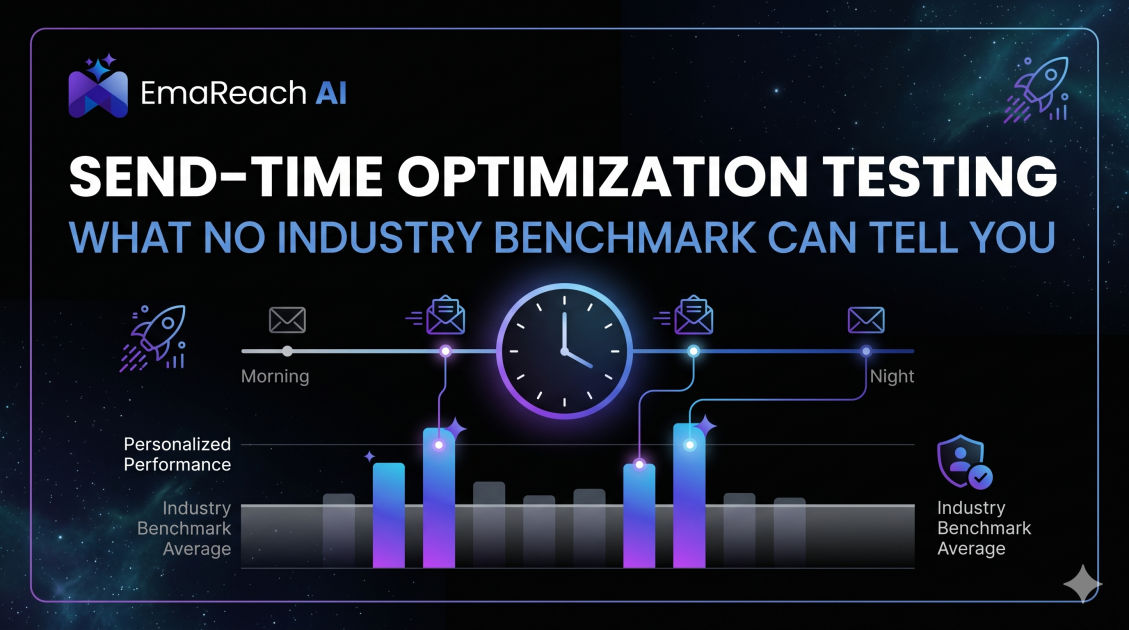
Send-Time Optimization Testing: What No Industry Benchmark Can Tell You
email marketingsend time optimizationA/B testingdeliverabilityaudience engagementcold outreach
The Allure and Fallacy of the "Perfect" Send Time
Search for the best time to send an email, and you will inevitably encounter a deluge of articles, infographics, and whitepapers offering a definitive answer. For years, the prevailing wisdom has hovered around a surprisingly specific consensus: send your campaigns on Tuesday mornings, ideally between 9:00 AM and 11:00 AM.
It sounds incredibly convenient. It provides a straightforward rule of thumb for marketing teams looking to streamline their workflows and guarantee high engagement. The problem, however, is that this "perfect" time is a statistical illusion. Relying on broad industry benchmarks to dictate your campaign schedule is one of the most common—and costly—mistakes in modern email marketing.
Industry benchmarks are inherently flawed because they represent aggregated data. When a massive email service provider analyzes billions of emails across thousands of industries, the resulting averages sand down the edges of nuanced, highly specific audience behaviors. The resulting "best practices" reflect the behavior of the average internet user, but your target demographic is not an average. They are a distinct group of individuals with unique routines, time zones, professional responsibilities, and personal habits.
To truly unlock the potential of your email marketing and outreach efforts, you must abandon the comfort of industry benchmarks and embrace Send-Time Optimization (STO) testing. This comprehensive guide will explore why your audience breaks the rules, the critical role of deliverability, and how to build a rigorous testing framework that reveals what no benchmark ever could.
Why Your Specific Audience Breaks the Rules
The fundamental flaw in adopting universal send times is the assumption that all audiences interact with their inboxes in the same way. In reality, email consumption is heavily dictated by an individual's lifestyle, profession, and relationship with their devices.
B2B vs. B2C is Too Simplistic
Even categorizing audiences broadly into Business-to-Business (B2B) and Business-to-Consumer (B2C) fails to capture the necessary granularity. While it is generally assumed that B2B emails perform best during standard working hours, this ignores the reality of modern executive schedules. High-level decision-makers and founders often reserve standard working hours for meetings and deep work, relegating their inbox triage to early mornings, late evenings, or even weekends. If you strictly adhere to a Tuesday at 10:00 AM benchmark, your crucial B2B outreach might be buried under a mountain of other promotional emails perfectly timed to that exact same, crowded window.
Conversely, B2C audiences are incredibly diverse. Consider the difference between marketing fitness supplements to early risers versus promoting entertainment streaming services to night owls. A benchmark cannot account for these behavioral disparities.
The Shift-Worker Paradigm
Consider industries that do not operate on a traditional nine-to-five schedule. Healthcare professionals, hospitality staff, emergency responders, and international logistics coordinators engage with their emails at highly unconventional hours. If your target market includes a significant portion of shift workers, sending campaigns based on standard office hours ensures your messages arrive precisely when your audience is asleep or entirely disconnected from their devices.
The Invisible Barrier: Deliverability First
Before diving into the mechanics of send-time testing, it is crucial to address the foundation of all email marketing: deliverability. You can spend months meticulously testing and optimizing your send times down to the minute, but if your emails are being routed to the spam folder, your efforts are entirely wasted.
This is particularly critical if you are engaged in cold outreach, where initial trust with email service providers is low. Tweaking the time of day your message arrives is useless if the message never reaches the primary inbox. Deliverability must always come first. You need a foundation where your emails are actually seen, which requires specialized infrastructure.
Stop Landing in Spam. Cold Emails That Reach the Inbox. EmaReach AI combines AI-written cold outreach with inbox warm-up and multi-account sending—so your emails land in the primary tab and get replies.
Once you have guaranteed inbox placement through robust infrastructure and smart warm-up strategies, your send-time tests will yield clean, actionable data. You will be measuring actual human behavior rather than the arbitrary filtering algorithms of email providers.
What Send-Time Optimization Testing Actually Means
Send-Time Optimization testing is the systematic process of experimenting with different delivery times to identify the exact moments when your specific subscribers are most likely to open, read, and click through your emails.
It represents a shift from static, assumption-based marketing to dynamic, data-driven engagement. True STO testing is not a one-time experiment; it is an ongoing methodology. Audience habits evolve, seasonal changes impact routines, and as your list grows, its demographic makeup shifts. Rigorous STO testing accounts for these variables through continuous refinement.
How to Build a Rigorous Send-Time Testing Framework
Implementing an effective STO strategy requires more than just randomly selecting different hours on a clock. It demands a structured, scientific approach to isolate variables and ensure statistical significance.
Phase 1: Establishing the Baseline
Before you can measure improvement, you must understand your current performance. Analyze your historical email data to establish baseline metrics for open rates, click-through rates (CTR), and conversion rates. Note the days and times you have traditionally sent emails. This baseline will serve as the control against which all future tests are measured.
Phase 2: The Broad Stroke Test (Days of the Week)
The first stage of active testing involves identifying the optimal day of the week. Do not attempt to test day and time simultaneously; this introduces too many variables and muddies the data.
Divide a representative segment of your audience into equal cohorts. If you typically send a weekly newsletter on Thursdays, create an A/B/C/D test spreading the send across Tuesday, Wednesday, Thursday, and Friday. Keep the time of day consistent across all cohorts. Run this test over several weeks to account for anomalous events (such as a particularly busy news day skewing attention).
Phase 3: The Granular Test (Hours of the Day)
Once the data clearly indicates a winning day of the week, you can begin optimizing for the hour. Take the winning day and split your audience into new cohorts. Test radically different time slots to gauge broad behavioral patterns.
For example, test an early morning send (6:00 AM), a mid-morning send (10:00 AM), an afternoon send (2:00 PM), and an evening send (8:00 PM).
Once a broad time block emerges as the winner (e.g., early morning), you can refine the test further in subsequent campaigns, testing 6:00 AM versus 7:00 AM versus 8:00 AM.
Phase 4: Validating Statistical Significance
A critical error in STO testing is prematurely declaring a winner based on slight percentage differences. If a 9:00 AM send gets a 22% open rate and a 10:00 AM send gets a 22.5% open rate, this is likely statistical noise, not a definitive mandate to switch all operations to 10:00 AM.
Ensure your test segments are large enough to generate statistically significant results. Utilize A/B testing calculators to verify that the difference in performance is mathematically valid and not just a product of random chance.
Moving Beyond Vanity Metrics: Optimizing for the Right Conversion
When evaluating the results of your send-time tests, it is essential to look beyond the open rate. While open rates indicate that your subject line was compelling and the timing caught the recipient's eye, it does not paint a complete picture of engagement.
Different times of day facilitate different types of behavior. An email sent at 7:00 AM to a professional commuting on a train might achieve a remarkably high open rate because they are casually scrolling on their mobile device. However, because they are in transit, they may not have the time or focus to click through to read a long-form article, register for a webinar, or make a purchase.
Conversely, an email sent at 2:00 PM might have a slightly lower open rate but a dramatically higher click-through and conversion rate. The recipient is sitting at their desk, actively engaged with their computer, and in a position to take action.
When optimizing your send times, always align your metrics with the primary goal of the campaign. If the goal is pure brand awareness, open rates might suffice. But if the goal is revenue generation, lead capture, or booking a meeting, you must optimize for the time that drives the highest conversion rate, even if it means sacrificing top-of-funnel opens.
Machine Learning and the Future of STO
Manual A/B testing is incredibly valuable, but the future of send-time optimization lies in individual personalization powered by machine learning algorithms. Advanced email platforms now offer features that analyze the historical engagement data of every single subscriber on your list.
Instead of finding the best time to send to the entire list, these algorithms calculate the optimal time for each unique individual. Subscriber A always opens emails on Saturday mornings, while Subscriber B prefers Thursday nights. When a campaign is launched, the system holds the email and delivers it precisely at the moment the individual is most likely to engage.
This level of hyper-personalization represents the ultimate departure from industry benchmarks. It acknowledges that the only benchmark that matters is the historical behavior of the person receiving the message.
Common Pitfalls That Ruin Send-Time Tests
Even with a solid framework, STO testing can be derailed by common oversights. Avoid these critical pitfalls to ensure your data remains pure and actionable:
Ignoring Time Zones
If you have an international or widely distributed audience, sending an email at "9:00 AM" means very different things to different subscribers. A 9:00 AM send on the East Coast is a 6:00 AM send on the West Coast, and mid-afternoon in Europe. If your database does not segment by time zone, your test results will be fundamentally flawed. Always normalize your testing times to the local time of the recipient.
Testing During Holidays or Major Events
Never conduct baseline STO testing during major holidays, long weekends, or significant industry events. Audience behavior during these periods is highly anomalous. An email test run during a major holiday week will yield data that is entirely useless for the rest of the year.
Changing Content During the Test
The golden rule of any A/B test is to isolate a single variable. If you test a Tuesday morning send against a Thursday afternoon send, the subject line, body copy, and call-to-action must be absolutely identical. If you change the subject line for the Thursday send, you will never know if an increase in opens was due to the time of day or the better copywriting.
Treating STO as a Set-and-Forget Strategy
Audience behavior is not static. Macroeconomic shifts, changes in remote work culture, and natural list churn mean that the optimal send time you discovered six months ago may no longer be accurate today. STO requires periodic re-testing to ensure your strategy remains aligned with your audience's current reality.
Conclusion
Industry benchmarks offer a comforting illusion of certainty in the complex world of email marketing. However, leaning on these generalized statistics guarantees mediocre results and missed opportunities. By ignoring the averages and committing to rigorous Send-Time Optimization testing, you transition from guessing when your audience might be listening to knowing exactly when they are ready to engage. Embrace the nuances of your specific subscriber base, prioritize solid deliverability, and let your own data dictate your strategy. The most valuable insights will never be found in a benchmark report; they are waiting to be uncovered in your own analytics.
EmaReach AI
Ready to scale your cold email outreach?
Join thousands of teams using EmaReach AI for AI-powered campaigns, domain warmup, and 95%+ deliverability. Start free — no credit card required.
Related posts
- Read article
How to Know When You Actually Need an Instantly Alternative
Discover the critical signs that your business has outgrown high-volume cold email tools and learn how to evaluate when it is time to transition to a more sophisticated, deliverability-first outreach alternative.
- Read article
The Instantly Alternative That Works Better for Niche Industry Outreach
Discover why high-volume cold email tools fail in specialized B2B verticals and learn about the ultimate deliverability-first alternative built for high-stakes, niche industry outreach.