Blog
Back to blog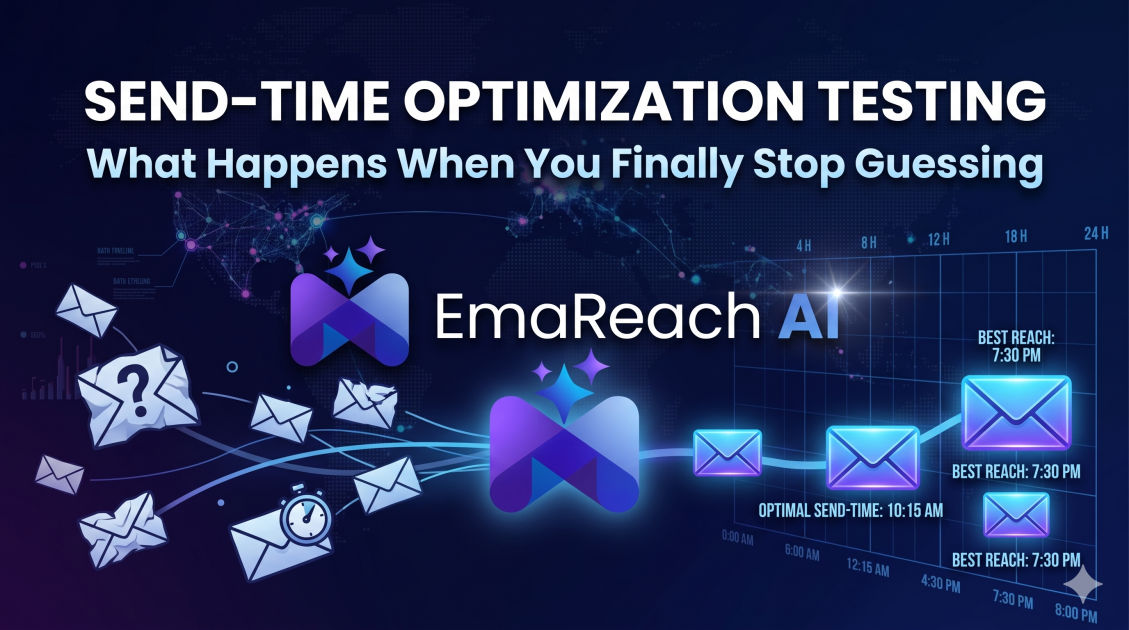
Send-Time Optimization Testing: What Happens When You Finally Stop Guessing
email marketingsend-time optimizationab testingemail deliverabilitymarketing automationcold outreach
Introduction
For years, email marketers and outbound sales professionals have been chasing a mythical beast: the perfect time to send an email. We have all read the industry reports claiming that Tuesday at 10:00 AM is the golden window, or that Thursday afternoons yield the highest click-through rates. So, we schedule our campaigns accordingly, cross our fingers, and hope for the best.
But relying on generic, industry-wide averages is little more than educated guessing. Your audience is not an average; it is a collection of unique individuals with distinct habits, time zones, and daily routines. When you broadcast a message based on a generalized static rule, you inevitably land in a crowded inbox or hit your prospect at the exact moment they are drowning in morning meetings.
What happens when you finally stop guessing?
Enter Send-Time Optimization (STO) testing. By moving away from rigid scheduling and leveraging data-driven, individualized delivery windows, businesses can fundamentally transform their email performance. In this comprehensive guide, we will explore the mechanics of STO testing, the psychological and technical shifts that occur when you implement it, and how to transition from arbitrary scheduling to behavioral precision.
The Anatomy of the Guessing Game (And Why It Fails)
The traditional approach to email scheduling is inherently flawed. It treats a diverse database as a monolith. Whether you are running business-to-consumer (B2C) marketing campaigns or executing highly targeted business-to-business (B2B) cold outreach, sending everything at once creates several distinct bottlenecks.
1. The "Inbox Overload" Phenomenon
If every marketer reads the same study declaring Tuesday morning as the optimal send time, what happens? Millions of emails flood the global infrastructure at Tuesday at 10:00 AM. Your message is instantly buried under dozens of competitors, updates, and internal corporate threads. By guessing along with everyone else, you actively decrease your chances of being seen.
2. Time-Zone Fragmentation
If your team is based in New York and schedules an email for 9:00 AM, it lands in a London professional’s inbox at 2:00 PM (during their mid-afternoon slump) and a San Francisco executive’s inbox at 6:00 AM (while they are still asleep). A single send time cannot account for global diversity without complex, manual segmentation—which is prone to human error.
3. Behavioral Variance
Even within the same time zone, professional habits vary wildly. A software engineer might clear their inbox at midnight, while a sales director checks their phone at 7:00 AM during their commute. Forcing both into a 2:00 PM sending window ignores their actual behavioral patterns.
What is Send-Time Optimization (STO) Testing?
Send-Time Optimization is a data-driven methodology that predicts the precise moment a specific recipient is most likely to open and engage with an email. Instead of choosing a universal time for an entire list, STO analyzes historical engagement patterns—such as past opens, clicks, and replies—to deliver the email on an individual, rolling basis.
When we talk about STO testing, we are referring to the deliberate process of measuring a baseline (standard blast sending) against optimized sending to quantify the exact lift in performance. It involves isolating variables to prove that the timing of the delivery, rather than just the subject line or copy, is driving the engagement.
Predictive vs. Historical STO
- Historical STO: Looks strictly at when a specific user has opened emails from your brand in the past and matches that window.
- Predictive STO: Uses machine learning models to analyze broader behavioral trends, predicting optimal windows even if historical data for a specific sender-recipient pair is sparse.
The Core Mechanics of an STO Test
To truly stop guessing, you must approach send-time optimization with scientific rigor. A poorly executed test will yield muddy data, leaving you just as confused as before. Here is how a structured STO test operates.
The Control vs. Variant Setup
To run a valid STO test, you split an identical audience segment into two groups:
- The Control Group: Receives the email campaign at a single, static time chosen by the marketer (e.g., Wednesday at 11:00 AM).
- The Variant Group: Receives the exact same email content, but the delivery is distributed over a set window (usually 24 hours), with each individual receiving it at their mathematically predicted peak engagement time.
Data Gathering and Window Analysis
For users with no prior data history, the optimization engine typically defaults to a randomized or regionally optimized time, gathering new behavioral data during the test itself. As the test runs, the system records the delta between the delivery time and the open time. The narrower this gap, the more accurate the optimization.
What Happens When You Stop Guessing: The Breakthrough Results
When organizations make the psychological and operational shift from manual scheduling to automated optimization, the ripple effects touch every part of their email ecosystem. Here is what happens when the guessing stops.
1. Dramatic Compression of the "Time-to-Open" Window
In standard email marketing, an email might sit in an inbox for six, twelve, or twenty-four hours before it is noticed—if it is noticed at all. With STO, the time-to-open window shrinks dramatically. Because the email lands at the exact moment the user is actively clearing their inbox or browsing their device, opens often occur within minutes of delivery. This immediacy keeps your brand top-of-mind and prevents your message from slipping "below the fold."
2. Upward Trajectory for Open and Click Rates
When emails arrive when friction is lowest, engagement naturally rises. Organizations running rigorous STO tests frequently observe sustained increases in unique open rates and subsequent click-through rates. It turns out that a prospect who might have deleted your email out of frustration during a busy Monday morning review is highly receptive to that same message on Tuesday evening.
3. Reduced Unsubscribes and Spam Complaints
Timing affects perception. An email that arrives at an inconvenient time can feel like an intrusion, leading to annoyed unsubscribes or, worse, spam reports. The exact same email arriving when a user is relaxed and looking for solutions feels valuable. By optimizing the time, you respect the recipient's digital boundaries, preserving your sender reputation.
The Crucial Link Between Timing and Deliverability
Many professionals view send-time optimization purely as a conversion rate tool. In reality, it is deeply intertwined with email deliverability.
When you send thousands of emails simultaneously, mailbox providers (like Google and Microsoft) look at that massive traffic spike with suspicion. Sudden bursts of outbound volume are a classic hallmark of programmatic spam. This can trigger rate-limiting, temporary deferrals, or automated routing directly to the spam folder.
By contrast, STO naturally smooths out your sending volume over an extended period. Instead of launching 10,000 emails in a single minute, an optimized system might distribute them across a 24-hour window. This continuous, steady stream of outbound mail mimics natural human behavior.
For businesses engaged in outbound B2B sales and lead generation, keeping your infrastructure healthy while scaling outreach is exceptionally challenging. If your strategy involves cold outreach, relying solely on generic bulk timing is a recipe for technical failure.
To protect your domain authority and scale effectively, you need specialized systems built for this environment. This is where a platform like EmaReach becomes essential. Stop Landing in Spam. Cold Emails That Reach the Inbox. EmaReach AI combines AI-written cold outreach with inbox warm-up and multi-account sending—so your emails land in the primary tab and get replies. By pairing smart distribution concepts with automated multi-account architecture, you remove the systemic risk of bulk-sending spikes entirely.
How to Implement Your First STO Test: A Step-by-Step Framework
Ready to move away from arbitrary calendar invites and implement a rigorous testing framework? Follow this execution plan to transition your strategy.
Step 1: Establish Your Baselines
Before changing anything, analyze your last 30 to 90 days of email performance. Identify your average open rate, click rate, reply rate, and unsubscribe rate under your current, static scheduling method. This historical data serves as your benchmark.
Step 2: Cleanse and Segment Your Audience
Ensure that you are testing on an active, clean segment of your list. Mixing in highly unengaged, dead accounts will skew your results, making it difficult to determine whether optimization is genuinely working. Focus the test on users who have interacted with your brand within the last few months.
Step 3: Define the Optimization Window
Most STO engines allow you to select a window over which the system can calculate and deliver messages. A 24-hour window is standard and highly effective, as it covers all possible circadian patterns and international time zones. For time-sensitive announcements (like a flash sale or a webinar reminder), you might compress this to a 6-hour or 12-hour window.
Step 4: Keep Content and Design Identical
To maintain strict scientific control, do not alter your subject lines, sender names, preheaders, or body copy between the control group and the optimized group. The only variable that should change is the moment the message hits the mail server.
Step 5: Run the Test Over Multiple Campaigns
A single campaign can be influenced by external anomalies—a major news event, a holiday, or global network outages. Run your STO test across at least three to five consecutive campaigns to collect statistically significant data before drawing definitive conclusions.
Advanced Nuances: When Send-Time Optimization Needs Human Oversight
While automated, data-driven optimization is vastly superior to blind guessing, it is not an entirely hands-off solution. Exceptional marketers understand that data must always be interpreted through the lens of human context. Here are a few instances where pure machine learning optimization requires strategic guardrails:
The Impact of Urgent External Deadlines
If you are running a campaign tied to a strict, hard stop—such as a product launch closing at midnight or a registration deadline—you cannot allow an STO engine to distribute emails right up until the final hour. In these scenarios, you must cap the optimization window to ensure all recipients receive the alert with ample time to act before the deadline expires.
The "Out-of-Office" Data Distortion
During major holiday seasons or summer vacation peaks, behavioral data can become temporarily distorted. An executive who usually opens emails at 8:00 AM might check their phone erratically at 9:00 PM while traveling. If the system builds long-term profiles based on anomalous holiday behavior, future campaigns during standard business periods may underperform. Consider pausing deep optimization metrics during major global holidays.
The Feedback Loop Paradox
An STO engine optimizes based on past data. However, if a user only ever receives emails from you at 3:00 PM because that was the initial guess, their engagement data will naturally cluster around 3:00 PM. To break this feedback loop, modern systems occasionally introduce randomized "exploratory" send times to discover new, potentially superior windows of engagement that historical tracking missed.
Conclusion
Continuing to schedule your email campaigns based on generic infographics and outdated industry averages is an expensive habit. It leaves revenue on the table, suppresses your engagement metrics, and exposes your sending infrastructure to unnecessary deliverability risks.
When you finally stop guessing and embrace Send-Time Optimization testing, you stop treating your audience like a statistical blob. You begin communicating with your prospects on their terms, respecting their schedules, and slipping seamlessly into their daily digital workflows. The result is a healthier sender reputation, a highly responsive audience, and an outbound engine that operates with predictable, mathematical precision.
EmaReach AI
Ready to scale your cold email outreach?
Join thousands of teams using EmaReach AI for AI-powered campaigns, domain warmup, and 95%+ deliverability. Start free — no credit card required.
Related posts
- Read article
The Instantly Alternative That Finally Gets Outbound Analytics Right
Discover why high-volume cold email requires a shift from surface-level vanity metrics to deep, data-driven revenue attribution, and explore the ultimate alternatives for mastering outbound engineering.
- Read article
How to Know When You Actually Need an Instantly Alternative
Discover the critical signs that your business has outgrown high-volume cold email tools and learn how to evaluate when it is time to transition to a more sophisticated, deliverability-first outreach alternative.