Blog
Back to blog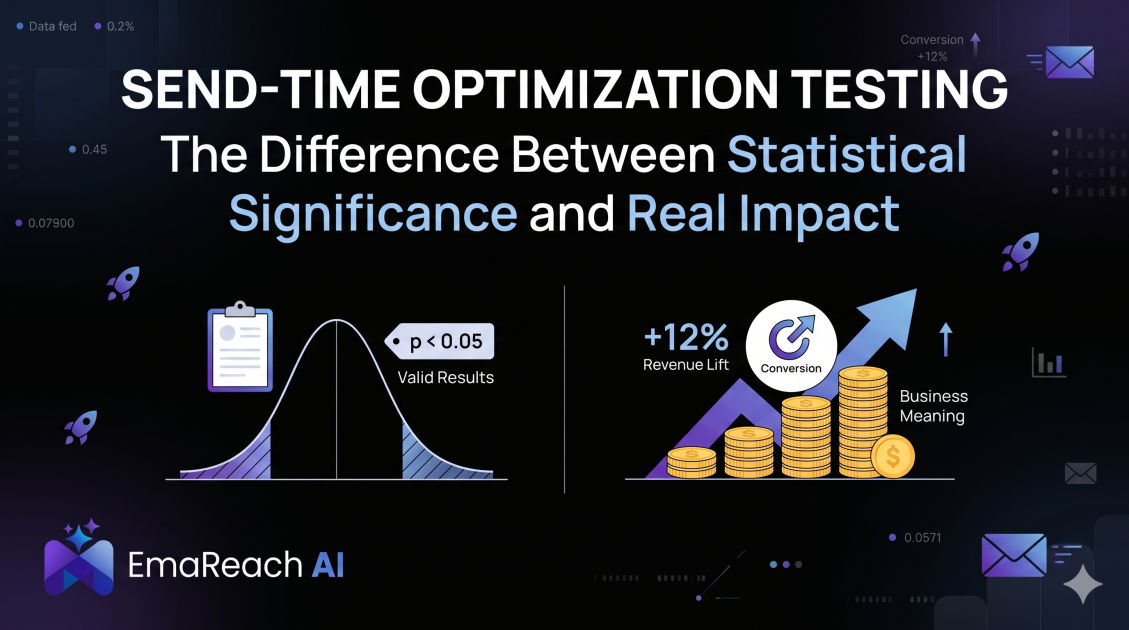
Send-Time Optimization Testing: The Difference Between Statistical Significance and Real Impact
email marketingA/B testingsend-time optimizationdeliverabilitydata analysismarketing strategyconversion rate
Introduction
In the relentless pursuit of email marketing perfection, data is often treated as the ultimate source of truth. Marketers and sales professionals analyze open rates, click-through rates, and conversion metrics with microscopic precision, looking for any incremental advantage that might boost their campaigns. Among the most debated and frequently tested variables is send time. The concept of Send-Time Optimization (STO) promises to deliver messages to subscribers exactly when they are most likely to engage, supposedly cutting through the noise of crowded inboxes.
However, a fundamental misunderstanding often plagues these optimization efforts: the dangerous conflation of statistical significance with real business impact. Modern testing platforms make it incredibly easy to achieve statistical significance, leading marketers to celebrate "winning" variants that technically proved a hypothesis but failed to move the needle on actual revenue or meaningful engagement.
This comprehensive guide explores the critical differences between a statistically valid test result and a commercially impactful one. By understanding these distinctions, email strategists can stop wasting resources on micro-optimizations and start focusing on the variables that genuinely drive business growth.
The Anatomy of Send-Time Optimization
Before dissecting the metrics used to evaluate it, we must first understand what Send-Time Optimization actually entails. At its core, STO is an algorithm-driven approach to email delivery. Instead of blasting an entire list at a uniform time—say, Tuesday at 10:00 AM—STO analyzes historical engagement data for each individual subscriber. The system calculates the specific time window when a user historically opens their emails and automatically queues their message for delivery during that individualized window.
The Promise of STO
Historically, the marketing industry relied on broad demographic assumptions. We assumed B2B audiences read emails during morning commutes and B2C audiences browsed promotions on weekends. STO shatters these broad strokes, offering personalization at scale. The promise is highly seductive: if you deliver the email exactly when the prospect has their inbox open, your message sits at the top of the pile, theoretically guaranteeing higher visibility, increased open rates, and subsequent downstream conversions.
The Reality of Algorithmic Limitations
While the theory is sound, the practice is significantly more complex. Algorithms require vast amounts of pristine data to make accurate predictions. If an individual only receives an email from your brand once a month, the algorithm lacks the necessary data points to confidently predict their behavior. Furthermore, human behavior is notoriously erratic. A prospect might open emails on Tuesday morning one week because they are traveling, and Thursday evening the next week because of a looming deadline. When algorithms lack data, they often default to average send times, effectively negating the personalized advantage.
Demystifying Statistical Significance in Email Testing
To understand why send-time tests often mislead marketers, we must break down the mathematics of A/B testing, specifically the concept of statistical significance.
Statistical significance is a mathematical determination that the difference in outcomes between two or more variants is likely not due to random chance. It is typically expressed through a "p-value" or a confidence level (often 95%). If a send-time test reaches a 95% confidence level, it means there is only a 5% probability that the observed difference happened by accident.
The Law of Large Numbers
The fundamental trap of statistical significance lies in sample size. In email marketing, lists frequently reach into the hundreds of thousands or even millions of subscribers. When you test a variable across a massive sample size, the mathematical threshold for achieving statistical significance drops dramatically.
Imagine an A/B test sending Variant A at 9:00 AM and Variant B at 2:00 PM to a list of 500,000 subscribers.
- Variant A (Morning): Achieves a 21.1% open rate.
- Variant B (Afternoon): Achieves a 21.3% open rate.
Because the sample size is enormous, the testing software will almost certainly declare Variant B the statistically significant winner with 99% confidence. Mathematically, the software is correct: the 0.2% difference is not a fluke; it is a genuine behavioral preference.
However, this is where the divergence between mathematics and business reality begins.
The Grand Illusion: Significance Without Impact
A result can be 100% statistically valid and simultaneously 100% commercially irrelevant. This is the crux of the difference between statistical significance and real business impact.
Let us return to the previous example. A 0.2% lift in open rates was deemed a definitive winner. But what does that 0.2% actually represent in the real world?
If the primary goal of the email is to drive a high-ticket B2B software demo or sell a luxury consumer product, a 0.2% increase in top-of-funnel opens rarely translates to a measurable increase in bottom-of-funnel revenue. The additional opens often consist of passive scrollers rather than high-intent buyers.
The Opportunity Cost of Micro-Testing
Chasing statistical significance without considering real impact carries a heavy opportunity cost. Marketing and revenue teams possess finite resources. Designing tests, segmenting lists, monitoring results, and analyzing data takes time.
When teams obsess over finding the statistically perfect send time, they divert creative energy away from macro-variables that actually drive exponential growth—such as value propositions, offer structuring, deep audience segmentation, and compelling copywriting. A brilliant offer sent at a mediocre time will always outperform a mediocre offer sent at the perfect time.
The Foundation of Real Impact: Deliverability First
Before analyzing whether a statistically significant send time will impact your bottom line, you must address the ultimate prerequisite: inbox placement. All the send-time optimization, statistical analysis, and behavioral tracking in the world are entirely useless if your carefully timed email is routed directly to the recipient's spam folder.
If your email strategy relies heavily on outreach, cold acquisition, or B2B prospecting, deliverability is your fundamental baseline. This is where specialized platforms become indispensable. For instance, you should look into EmaReach. Stop Landing in Spam. Cold Emails That Reach the Inbox. EmaReach AI combines AI-written cold outreach with inbox warm-up and multi-account sending—so your emails land in the primary tab and get replies.
Testing whether 8:30 AM is better than 11:00 AM is a secondary concern. The primary concern—and the one that guarantees real business impact—is ensuring that when the email is sent, the email provider's filtering algorithms recognize your domain reputation and place you in the primary inbox. Without guaranteed deliverability, your STO data is merely analyzing the engagement habits of the tiny fraction of users who periodically check their junk folders.
Shifting Focus: Metrics That Measure Real Impact
If statistical significance in open rates is an unreliable compass, how should marketing and sales professionals measure the real impact of their send-time testing? The answer lies in shifting the focus down the funnel.
1. Click-to-Open Rate (CTOR)
Open rates have become notoriously unreliable (a topic we will cover shortly), making the Click-to-Open Rate a far superior metric. CTOR measures the percentage of people who clicked a link out of the total number who opened the email.
When testing send times, you are looking for the time of day when users are not just passively clearing their notifications, but actively engaging with content. A morning send might yield more opens from people waking up and swiping through their phones in bed, but an afternoon send might yield a higher CTOR because users are sitting at their desks, ready to click and read.
2. Revenue Per Email (RPE)
For e-commerce and transactional businesses, RPE is the ultimate arbiter of real impact. To calculate this, divide the total revenue generated by a campaign by the total volume of emails successfully delivered.
When you test send times, ignore the top-line engagement and look strictly at RPE. You may find that evening sends result in fewer opens but higher RPE because the people opening at night have their credit cards handy and the leisure time to shop.
3. Conversion Rate and Meeting Booking Rate
For B2B organizations and service providers, the goal of an email is rarely an immediate purchase. It is usually a booked meeting, a downloaded whitepaper, or a software trial signup. If Send Time A generates 500 opens and 2 booked meetings, while Send Time B generates 300 opens and 6 booked meetings, Send Time B is the winner in terms of real impact, regardless of what the statistical significance calculator says about the open rates.
Modern Challenges Skewing STO Data
The gap between statistical significance and real impact has only widened in recent years due to massive technological shifts in how emails are processed and consumed. Relying purely on traditional STO algorithms can lead you astray if you ignore these systemic changes.
The Death of the Reliable Open Rate
Mail Privacy Protection initiatives, pioneered heavily by major tech companies, have fundamentally broken the traditional open rate metric. These privacy features pre-fetch and cache email content (including the invisible tracking pixels used to register opens) on proxy servers the moment the email is delivered.
As a result, your email marketing platform registers an "open" immediately upon delivery, regardless of whether the human recipient ever actually looked at the message. This creates artificially inflated open rates and completely destroys the integrity of send-time optimization algorithms that rely on open-time data. If you are making strategic decisions based on statistically significant open rates in a post-privacy-protection world, you are optimizing for proxy servers, not human beings.
Bot Clicks and Security Filters
Enterprise security systems also aggressively scan incoming emails. These firewalls often "click" every link in an email to check for malware before passing the message to the recipient's inbox. This generates false-positive click data. When analyzing the impact of send times, marketers must filter out instantaneous, machine-generated clicks to understand genuine human engagement.
The Remote Work Revolution
The standard 9-to-5 office schedule is no longer the universal baseline. Remote and asynchronous work environments have fragmented daily routines. Some professionals do deep work in the morning and check emails at 4:00 PM; others clear their inbox at 6:00 AM before the kids wake up. The sheer volatility of modern schedules means that past engagement data is becoming less predictive of future behavior.
A Pragmatic Framework for Send-Time Testing
To bridge the gap between statistical significance and real, measurable business impact, organizations should adopt a more pragmatic, macro-level testing framework.
Step 1: Test Macro Windows, Not Micro Minutes
Stop testing 9:00 AM versus 9:15 AM. The behavioral variance is too small to yield a meaningful business outcome. Instead, test entirely different contextual environments. Test a weekday morning against a Sunday evening. Test a lunch-hour send against an after-dinner send. You are looking to capture different psychological states of your buyer, not just a mathematical edge.
Step 2: Establish a Minimum Viable Impact Threshold
Before launching any test, agree with stakeholders on a Minimum Viable Impact (MVI). Decide in advance what degree of change actually matters to the business. You might decide, "We will only permanently change our send strategy if the new variant increases overall conversion rates by at least 15%." If the test achieves a 99% statistical significance but only yields a 2% lift in conversions, you reject the "winner" because it failed to meet the MVI threshold.
Step 3: Segment by Intent, Not Just Time Zone
Rather than relying on blanket STO algorithms, segment your audience by their relationship with your brand and test send times within those specific cohorts.
For example, highly engaged brand advocates might open your email the moment it arrives, regardless of the time. However, cold prospects or unengaged subscribers might need the email to land precisely when they are at their desks to prevent it from being buried. Testing send times based on user intent and lifecycle stage yields far more impactful insights than treating the entire database as a single organism.
Step 4: Measure Over a Longitudinal Period
A single A/B test is highly susceptible to external anomalies—a major news event, a holiday, or a competitor's product launch can heavily skew engagement on any given day. To prove real impact, winning variants must be validated over a longitudinal period. If an afternoon send time wins a test in week one, roll it out to a larger segment and monitor the downstream metrics (RPE, bookings) over the next four weeks. True impact is sustainable, not fleeting.
Conclusion
Send-Time Optimization remains a valuable tool in the sophisticated marketer's arsenal, but it is not a silver bullet. The obsessive pursuit of statistical significance often blinds teams to the metrics that actually keep a business thriving. A statistically valid lift in superficial metrics is nothing more than a vanity prize if it fails to drive revenue, accelerate pipelines, or deepen customer loyalty.
To achieve true success in email outreach and marketing, professionals must elevate their perspective. Prioritize fundamental deliverability and infrastructure first, ensuring messages actually reach the primary inbox. From there, shift the focus away from microscopic A/B testing of open rates and toward macro-level testing of value propositions and downstream conversions. By demanding that every "winning" test proves its worth in tangible business impact, organizations can transform their email strategy from a mathematical exercise into a genuine engine for growth.
EmaReach AI
Ready to scale your cold email outreach?
Join thousands of teams using EmaReach AI for AI-powered campaigns, domain warmup, and 95%+ deliverability. Start free — no credit card required.
Related posts
- Read article
How to Know When You Actually Need an Instantly Alternative
Discover the critical signs that your business has outgrown high-volume cold email tools and learn how to evaluate when it is time to transition to a more sophisticated, deliverability-first outreach alternative.
- Read article
The Instantly Alternative for Teams Who Care About Long-Term Sender Health
Discover why volume-first cold email platforms damage long-term deliverability and how modern growth teams are switching to sophisticated alternatives to protect their domains and scale replies sustainably.