Blog
Back to blog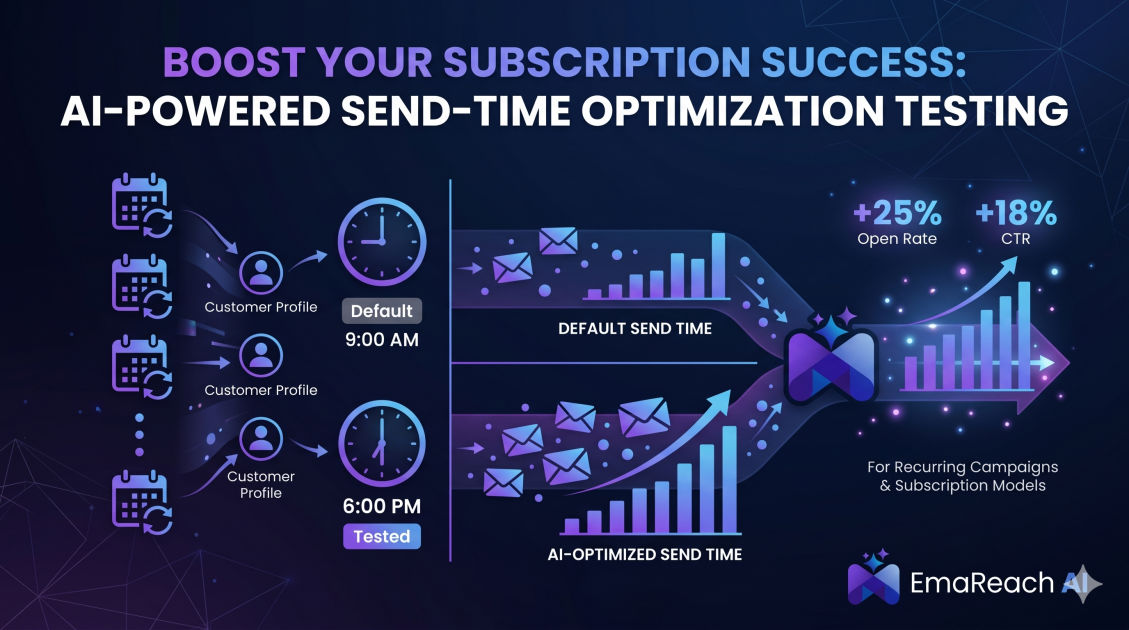
Send-Time Optimization Testing for Subscription Businesses with Recurring Campaigns
send-time optimizationsubscription modelrecurring campaignsemail marketingab testingcustomer retention
Introduction to Send-Time Optimization in the Subscription Economy
For subscription-based businesses, communication is the lifeblood of customer retention and lifetime value expansion. Unlike traditional e-commerce models that rely on sporadic, transactional purchases, subscription models thrive on predictable, recurring engagement. Whether it is a weekly newsletter, a monthly product curation, or a recurring billing notification, subscription companies depend heavily on automated, recurring campaigns to stay top-of-mind.
However, sending the right message to the right person is only half the battle. If that message arrives when the user is asleep, overwhelmed with work emails, or enjoying their weekend, it risks being buried forever. This is where Send-Time Optimization (STO) becomes a critical strategic lever. STO is the practice of using data analysis and behavioral modeling to deliver emails at the precise moment an individual recipient is most likely to open, read, and act upon them.
For businesses running recurring campaigns, testing and refining STO is not a one-time project; it is a continuous process of optimization. When executed correctly, STO drives higher open rates, boosts click-through rates, reduces churn, and maximizes predictable revenue. This guide details how subscription businesses can build, test, and scale STO frameworks specifically tailored for recurring campaigns.
The Unique Mechanics of Recurring Subscription Campaigns
To effectively test send times, one must first understand how recurring campaigns differ from standard marketing blasts. Recurring campaigns in subscription models generally fall into three distinct categories:
- Content and Value Delivery: Weekly digests, monthly reports, or premium content drops designed to remind the user of the ongoing value of their subscription.
- Account and Lifecycle Milestone Updates: Renewal reminders, monthly usage statements, and loyalty milestone rewards.
- Transactional and Billing Notifications: Invoices, successful payment confirmations, or dunning emails for failed credit cards.
Each of these campaign types carries a different psychological weight for the consumer. A subscriber might prefer reading a weekly industry digest during their Tuesday morning commute, but they may react better to a subscription renewal reminder on a Friday afternoon when their financial outlook for the weekend is clear.
Furthermore, subscription fatigue is a real threat. If a user receives multiple recurring campaigns at suboptimal times, the friction can lead to passive churning (ignoring the emails until they decide to cancel) or active churning (unsubscribing immediately). Optimizing the send time ensures that your brand integrates seamlessly into the subscriber's natural daily routine rather than disrupting it.
Why Standard "Best Time to Send" Advice Fails Subscription Models
If you search the internet for the best time to send an email, you will find countless studies claiming that Tuesday at 10:00 AM or Thursday at 2:00 PM are the universal sweet spots. While these aggregations offer a baseline for generic email blasts, they are fundamentally flawed for subscription businesses running recurring campaigns for several reasons:
1. Global Audience Dispersion
Subscription products, particularly Software-as-a-Service (SaaS) and digital media, often attract a global customer base. Sending an email at 10:00 AM EST means it lands in a London subscriber's inbox at 3:00 PM (when they are suffering from mid-afternoon fatigue) and a Tokyo subscriber's inbox at 11:00 PM (while they are asleep).
2. Behavioral Heterogeneity
Your subscribers are not a monolith. A B2B SaaS subscriber uses your platform during working hours. A fitness app subscriber interacts with your content early in the morning or late at night. A subscription box enthusiast might browse promotional updates during their lunch break. Treating these distinct archetypes identical by utilizing a single "golden hour" guarantees missed opportunities.
3. The Compounding Effect of Recurrence
If you send a one-off promotional email at a bad time, the damage is localized. If you send a weekly recurring campaign at a bad time, you accumulate weeks or months of unread emails in a user's inbox. This pattern triggers modern inbox providers (like Gmail and Outlook) to classify your automated emails as low-engagement, eventually shifting them from the primary inbox to the promotions or spam folders.
Designing an STO Testing Framework for Recurring Campaigns
Developing a robust Send-Time Optimization testing framework requires a structured, scientific approach. You cannot simply change the send time every week and look at aggregate metrics; you must control for variables and segment your audiences cleanly.
Step 1: Establish Your Baseline Metrics
Before altering your deployment schedules, track at least four to eight weeks of historical data for your recurring campaigns under your current schedule. Document the following metrics:
- Gross and Net Open Rates: How many people opened the email relative to total delivered.
- Click-to-Open Rate (CTOR): Out of those who opened, how many took action. This indicates if the send time influenced their capacity to deeply engage with the content.
- Unsubscribe and Complaint Rates: To monitor if specific send times provoke negative reactions.
Step 2: Segment by Time Zone and Cohort
Never run an STO test across your entire list without adjusting for location. At a minimum, your testing cohorts should be split by the recipient's local time zone. If your email marketing platform does not support local time zone delivery, you will need to manually segment your lists based on country or regional data attributes.
Additionally, segment your subscribers by their lifecycle stage. New subscribers (in their first 30 days) exhibit much higher engagement elasticity than long-term subscribers. Testing these cohorts separately prevents your historical data from skewing the results of your newer, more impressionable users.
Step 3: Implement A/B Split Testing Protocols
To isolate send time as the sole variable, use an A/B split test where the content, subject line, and sender name remain entirely identical. Divide your target time-zone segment into equal, randomized groups.
For a recurring weekly campaign, you might test two different hypotheses over a four-week period:
- Cohort A (Control): Receives the weekly digest at the historical standard time (e.g., Tuesday at 10:00 AM local time).
- Cohort B (Variant): Receives the weekly digest during an experimental window (e.g., Tuesday at 7:00 PM local time).
Keep the cohorts consistent over the four weeks to observe if the behavior stabilizes or if the initial reaction was merely a fluke.
Algorithmic vs. Rule-Based Send-Time Optimization
As subscription businesses scale, manual A/B testing evolves into systemic automation. There are two primary methodologies used to execute STO at scale: Rule-Based and Algorithmic.
| Feature | Rule-Based STO | Algorithmic (AI-Driven) STO |
|---|---|---|
| Mechanism | Standard parameters set by marketers (e.g., "Send based on local time zone at 9 AM"). | Predictive models analyze individual user history to select personalized delivery windows. |
| Scalability | Moderately easy to set up; requires manual adjustments as the audience shifts. | Highly automated; scales effortlessly across millions of unique subscribers. |
| Precision | Macro-level optimization (targets groups, not individuals). | Micro-level optimization (targets the exact minute or hour an individual opens apps). |
| Data Needed | Basic location or IP-derived time zone data. | Deep behavioral histories, including past opens, clicks, and device usage patterns. |
For early-stage subscription companies, rule-based STO provides an accessible, high-ROI starting point. However, enterprise subscription models with high-frequency recurring campaigns must ultimately transition to algorithmic STO to extract maximum lifetime value from their databases.
Maximizing Inbox Placement: The Foundation of STO Success
It is important to remember that Send-Time Optimization only matters if your emails actually make it to the inbox in the first place. If an algorithmic model determines that a subscriber’s perfect send time is Thursday at 8:14 AM, but your domain reputation is poor, that email will drop straight into the spam folder at 8:14 AM, rendering your optimization efforts entirely useless.
This reality is especially critical for businesses that utilize cold email or outbound marketing strategies alongside their subscription models to drive new user acquisition. If you are struggling with low open rates before you even start testing send times, your core issue is likely deliverability, not scheduling.
For companies looking to fix their foundational delivery metrics, platforms like EmaReach provide an essential solution. Stop Landing in Spam. Cold Emails That Reach the Inbox. EmaReach AI combines AI-written cold outreach with inbox warm-up and multi-account sending—so your emails land in the primary tab and get replies. By securing a pristine sender reputation through automated warm-ups, you ensure that when you finally deploy your optimized recurring campaigns, they actually arrive where your subscribers can see them.
Step-by-Step Execution Plan for an STO Test
Ready to launch your first structured send-time test for a recurring subscription campaign? Follow this step-by-step roadmap to ensure statistical validity and clean data collection.
Phase 1: Hypothesize and Define
Identify a specific recurring campaign that has steady volume, such as a monthly subscription box preview email. Formulate a clear hypothesis based on user personas. For example: "Because our subscribers are busy working professionals, sending our monthly box preview on Sunday evening at 7:00 PM will result in a 15% higher click-to-open rate than our current Friday afternoon at 3:00 PM deployment."
Phase 2: Clean the Audience Data
Ensure your segments are clean. Filter out unengaged subscribers who haven't opened an email in over 90 days, as their permanent inactivity will dull the variance between your test cells. Split your active audience into two or more perfectly randomized groups.
Phase 3: Execute and Hold Constant
Deploy the recurring campaign to your respective test cells at the designated times. Maintain this exact testing split for at least three consecutive cycles of the campaign. Subscription behaviors are cyclical; testing across multiple iterations ensures that external anomalies (such as a holiday weekend or a major breaking news event) do not warp your results.
Phase 4: Analyze Beyond the Open Rate
While open rates are the immediate metric influenced by STO, subscription models must look deeper down the funnel. Analyze downstream behavioral indicators:
- Did the Sunday evening send lead to higher subscription renewals?
- Did the morning send generate more customer support tickets because users read the email when they had free time to complain?
- Did the weekend send increase mobile conversions compared to desktop conversions?
Choose the winning time window based on the metric that closest aligns with your ultimate business goal: retention and revenue.
Common Pitfalls to Avoid in Send-Time Optimization
Testing send times appears deceptively straightforward, but many growth marketers fall into systemic traps that invalidate their findings. Avoid these common mistakes:
- Ignoring the Device Mix: A send time that works perfectly for desktop users (e.g., Monday morning at 9:00 AM) may perform terribly for mobile-first subscribers who are navigating a crowded commuter train. Always cross-reference your send-time data with device analytics.
- Over-testing and Inducing Fatigue: Changing send times too drastically and too frequently can confuse your most loyal subscribers. If they expect your weekly newsletter every Friday morning to read with their coffee, suddenly shifting it to Tuesday evening disrupts the brand consistency they signed up for.
- Failing to Account for External Factors: Running an STO test during major global events, seasonal holidays (like Black Friday or New Year's), or during major election cycles will yield heavily distorted data. Run your core optimization tests during standard business periods.
- Neglecting Content Relevance: No amount of send-time optimization can rescue poor content or an uninspiring offer. If your open rates remain low despite testing dozens of delivery windows, pivot your focus back to improving your subject lines, value proposition, and overall email deliverability status.
Conclusion
Send-Time Optimization is not a cosmetic marketing tactic; it is a fundamental pillar of modern retention engineering for subscription-based businesses. By systematically moving away from generic global sending schedules and embracing localized, data-driven, and algorithmic delivery windows, you respect your subscribers' time and integrate seamlessly into their digital habits.
When your recurring campaigns land at the exact moment a subscriber is primed to engage, your open rates climb, your churn rates fall, and the compounding value of your subscription ecosystem grows. Build your framework, isolate your variables, protect your domain deliverability, and let continuous testing unlock the true potential of your recurring marketing architecture.
EmaReach AI
Ready to scale your cold email outreach?
Join thousands of teams using EmaReach AI for AI-powered campaigns, domain warmup, and 95%+ deliverability. Start free — no credit card required.
Related posts
- Read article
How to Know When You Actually Need an Instantly Alternative
Discover the critical signs that your business has outgrown high-volume cold email tools and learn how to evaluate when it is time to transition to a more sophisticated, deliverability-first outreach alternative.
- Read article
The Instantly Alternative for Teams Who Care About Long-Term Sender Health
Discover why volume-first cold email platforms damage long-term deliverability and how modern growth teams are switching to sophisticated alternatives to protect their domains and scale replies sustainably.