Blog
Back to blog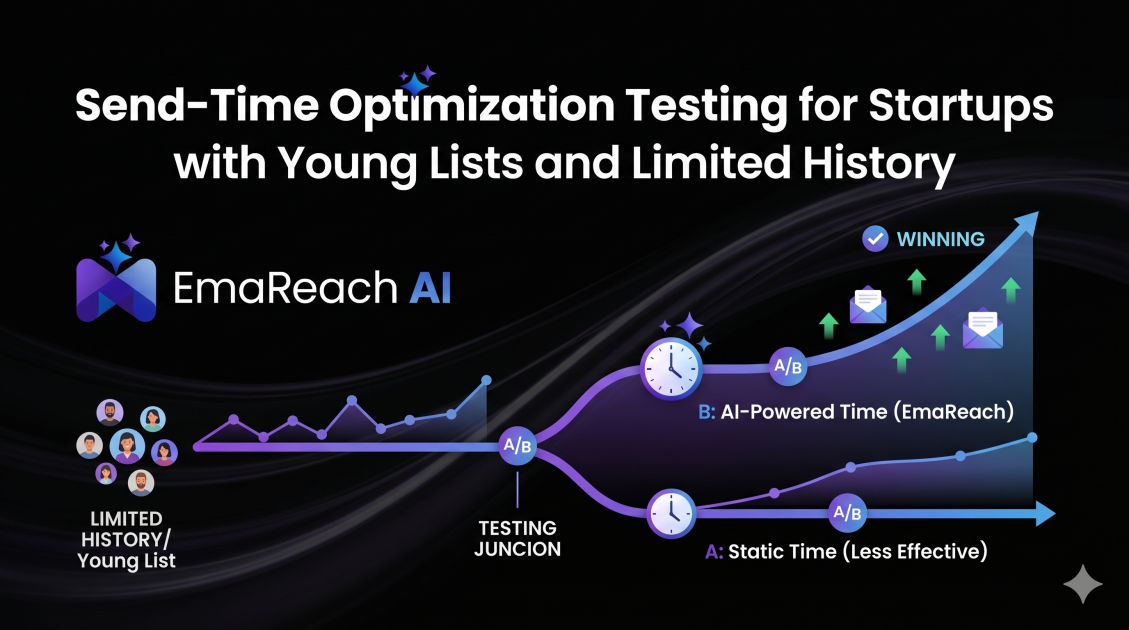
Send-Time Optimization Testing for Startups with Young Lists and Limited History
email marketingsend-time optimizationstartup growthemail deliverabilityA/B testingcold email
Introduction
Launching a startup involves navigating a landscape of endless variables, and building an effective email marketing engine is often one of the most complex challenges. You have meticulously crafted your value proposition, designed beautiful templates, and written compelling copy. But then comes the final, daunting question: When exactly should you hit 'send'?
For established enterprises, this question is easily answered by enterprise-grade algorithms. They use machine learning models trained on millions of data points and years of historical engagement metrics to pinpoint the exact minute a subscriber is most likely to open an email. This is known as Send-Time Optimization (STO).
However, startups with young lists and limited history face a unique paradox. You know that send time matters, but you lack the historical data required to make mathematically sound decisions. The 'smart' optimization features in most email service providers either remain grayed out or, worse, provide highly inaccurate recommendations based on statistically insignificant sample sizes.
This comprehensive guide explores how early-stage companies can approach send-time optimization testing without relying on years of historical data. By utilizing strategic hypotheses, behavioral psychology, structured micro-testing, and rigorous deliverability practices, you can uncover the optimal sending rhythms for your unique audience from day one.
The Paradox of Statistical Significance
The primary hurdle for startups attempting to test send times is the illusion of statistical significance. When your list only consists of a few hundred or a few thousand subscribers, traditional A/B testing frameworks break down.
If you divide a list of 500 subscribers into two cohorts to test a Tuesday morning versus a Thursday afternoon send, a difference of just three or four clicks can swing the 'winning' result. This is statistical noise, not a reliable behavioral trend. Making long-term marketing decisions based on these micro-fluctuations often leads startups down the wrong path, causing them to optimize for anomalies rather than actual audience preferences.
Furthermore, early adopters—the people making up your youngest lists—are rarely representative of the broader market you will eventually capture. They are often power users, investors, friends of the founders, or highly engaged industry insiders. Their email habits (like checking their inbox at midnight on a Sunday) will skew your early data.
Instead of chasing immediate statistical perfection, startups must adopt a framework of 'directional testing.' The goal in the early days is not to find the perfect minute, but to identify broad behavioral windows and avoid catastrophic sending times.
Foundational Deliverability: The Pre-Requisite to STO
Before agonizing over whether 9:15 AM or 2:45 PM is the optimal time to deploy your startup's latest campaign, you must address the most critical bottleneck in email marketing: deliverability. Send-time optimization is entirely irrelevant if your emails are quietly being filtered into the spam folder.
For startups, the first few months of sending are closely monitored by major inbox providers (Google, Microsoft, Yahoo). If you trigger spam filters early, you damage your domain reputation, making it incredibly difficult to reach the inbox later, regardless of what time you send your messages.
Particularly for startups relying on outbound efforts to generate initial momentum, building a solid sender reputation is paramount. If your strategy involves cold outreach to build your network or acquire early customers, you need a system designed for modern inbox realities. You need to Stop Landing in Spam. Cold Emails That Reach the Inbox.
This is where EmaReach becomes an essential asset for your growth stack. EmaReach AI combines AI-written cold outreach with inbox warm-up and multi-account sending—so your emails land in the primary tab and get replies. By automating the warm-up process and distributing volume across multiple accounts, you ensure that when you finally test your send times, you are testing actual user behavior, not the whims of an aggressive spam filter. Establish your sender reputation first; optimize your sending schedule second.
Psychographics Over Demographics: Building Send-Time Hypotheses
Without historical data, you must rely on educated hypotheses. The most effective way to form these hypotheses is to map your buyer personas to daily routines. Demographics (age, location, income) are helpful, but psychographics (habits, routines, workflows) dictate inbox behavior.
Start by answering the following questions about your ideal subscriber:
- The Morning Routine: Do they wake up and immediately check their phone in bed? Or do they avoid screens until they arrive at the office?
- The Workday: Are they desk-bound knowledge workers with email open on a second monitor all day? Or are they field workers, nurses, or retail managers who only check email during specific breaks?
- The Evening Wind-Down: Do they completely disconnect after 6:00 PM, or do they catch up on industry newsletters while watching television on the couch?
By mapping the daily life of your target audience, you can identify 'attention pockets.' For example, if you are targeting busy startup founders, the traditional 9:00 AM send time is likely terrible; their mornings are consumed by stand-up meetings and putting out fires. However, a Sunday evening send—when they are quietly planning their upcoming week—might yield spectacular engagement.
B2B vs. B2C Rhythms in the Modern Era
The fundamental divide in email timing strategies lies between Business-to-Business (B2B) and Business-to-Consumer (B2C) audiences. While the lines have blurred with the rise of remote work, distinct patterns remain.
The B2B Landscape
In B2B marketing, you are competing for professional attention. The goal is to land in the inbox when the prospect is in a 'work mindset' but not actively overwhelmed by urgent tasks.
- The Mid-Week Sweet Spot: Tuesday, Wednesday, and Thursday remain the gold standard for B2B. Mondays are typically spent clearing weekend backlogs, and by Friday afternoon, professionals have mentally checked out.
- The Post-Lunch Lull: While early mornings are popular, the period between 1:00 PM and 3:00 PM often presents an opportunity. Professionals are back from lunch, settling into their desks, and often looking for a low-cognitive-load task like checking email.
The B2C Landscape
B2C marketing is driven by leisure time and impulse. You want to reach consumers when they are relaxed and receptive to exploring products or content.
- Weekend Opportunities: Unlike B2B, weekends are prime real estate for B2C brands. Saturday mornings and Sunday evenings often see high engagement rates for retail, entertainment, and lifestyle content.
- The Evening Commute and Beyond: Sending between 5:00 PM and 8:00 PM can be highly effective. Consumers are commuting, relaxing at home, and mindlessly scrolling through their inboxes.
The 'Off-Peak' Strategy: Avoiding the Top-of-the-Hour Crush
One of the most actionable and immediate strategies a startup can deploy is the 'Off-Peak' sending method.
Most marketing automation platforms default their scheduling tools to top-of-the-hour or half-hour increments. As a result, millions of automated marketing emails are dispatched at exactly 8:00 AM, 9:00 AM, 12:00 PM, and 5:00 PM.
If you send your startup's newsletter at precisely 9:00 AM, it will land in the inbox alongside dozens of other promotional emails, immediately getting buried in the avalanche.
Instead, test sending at off-peak, asymmetrical times. Schedule your campaigns for 8:43 AM, 9:17 AM, or 2:38 PM. By deploying your emails during these quiet micro-windows, you significantly reduce immediate competition within the inbox, increasing the likelihood that your notification will be seen and engaged with in real-time.
Metrics That Actually Matter for Young Lists
When testing send times, tracking the right metrics is crucial. Historically, marketers relied heavily on Open Rates to determine the success of a subject line or a send time. Today, that is a dangerous metric to chase.
With the introduction of Apple's Mail Privacy Protection (AMPP) and similar privacy measures across other platforms, email opens are increasingly generated by bots and pre-fetching servers, not human beings. A high open rate may simply mean your email hit a lot of Apple devices, not that your send time was optimal.
Startups must pivot their STO testing to rely on bottom-of-the-funnel metrics:
- Click-to-Open Rate (CTOR): This measures the percentage of people who clicked a link out of those who opened the email. While open data is noisy, click data is definitive. If an email is opened and clicked, a human being interacted with it.
- Reply Rate: Especially for B2B and cold outreach, replies are the ultimate indicator of engagement. Someone who takes the time to type a response received your email at a convenient moment.
- Conversion Rate: Did the email achieve its business goal? Did the user sign up for the webinar, download the whitepaper, or make a purchase? A 10% lower open rate on a Sunday might be irrelevant if the conversion rate is double that of a Tuesday send.
A 6-Week Send-Time Testing Roadmap for Startups
To effectively test send times with a limited list, you need a structured, methodical approach. Randomly changing your send times every week will only create confusion. Here is a 6-week foundational testing roadmap designed specifically for startups.
Weeks 1-2: The Broad Strokes (Morning vs. Afternoon)
In the first two weeks, avoid getting bogged down in specifics. Your goal is simply to understand whether your audience leans toward AM or PM engagement.
- Action: Divide your list evenly down the middle (a true 50/50 split).
- Execution: Send Cohort A the email at 8:30 AM (local time). Send Cohort B the exact same email at 2:30 PM (local time). Reverse the cohorts in Week 2 to ensure list quality isn't skewing the data.
- Analysis: Look purely at click-through rates and website traffic generated. Which broad window drove more meaningful action?
Weeks 3-4: Day of the Week Calibration
Once you have a general idea of morning versus afternoon preference, begin testing the day of the week.
- Action: Take your winning time block (e.g., Afternoon) and test it across different days.
- Execution: In Week 3, send to half your list on Tuesday afternoon and the other half on Thursday afternoon. In Week 4, test a mid-week day against a weekend day (e.g., Wednesday vs. Saturday), depending on your industry.
- Analysis: You are looking for spikes in deep engagement. Does your audience have more time to read long-form content on a Sunday? Do they convert better on a Tuesday?
Weeks 5-6: Micro-Timing and Refinement
By Week 5, you should have a solid hypothesis (e.g., 'Our audience engages best on Tuesday afternoons'). Now, you optimize for the exact hour.
- Action: Implement the Off-Peak Strategy within your winning window.
- Execution: Split your list again. Test a 1:14 PM send against a 3:42 PM send.
- Analysis: Monitor not just clicks, but the speed of the clicks. A truly optimized send time will result in a rapid influx of engagement within the first 60 minutes of deployment.
Time Zones: The Silent Data Killer
One critical caveat for startups testing send times: if your audience is geographically dispersed, testing standard times will ruin your data.
If you schedule an email for 9:00 AM Eastern Time, it is arriving at 6:00 AM for your West Coast subscribers and 2:00 PM for your European subscribers. Looking at the aggregate performance data of that campaign will give you zero insight into behavioral preferences.
Even with a small list, you must segment by time zone. Most modern email marketing platforms allow for 'Time Zone Sending,' which holds the email and delivers it at the specified local time for each subscriber. If your platform does not support this, you must manually segment your list into broad geographic regions (e.g., Americas, EMEA, APAC) and schedule the campaigns independently. Without time zone alignment, STO testing is essentially a random lottery.
Conclusion
Discovering the optimal send time for a young startup list is less about complex algorithms and more about disciplined, empathetic experimentation. By acknowledging the limitations of your early data, prioritizing inbox deliverability, mapping your audience's daily routines, and running structured micro-tests, you can rapidly close the gap between guessing and knowing. Remember that as your startup scales and your audience evolves, their behaviors will shift. Send-time optimization is not a singular destination you reach, but an ongoing process of listening to the digital body language of your subscribers and adapting to their rhythms.
EmaReach AI
Ready to scale your cold email outreach?
Join thousands of teams using EmaReach AI for AI-powered campaigns, domain warmup, and 95%+ deliverability. Start free — no credit card required.
Related posts
- Read article
How to Know When You Actually Need an Instantly Alternative
Discover the critical signs that your business has outgrown high-volume cold email tools and learn how to evaluate when it is time to transition to a more sophisticated, deliverability-first outreach alternative.
- Read article
The Instantly Alternative for Teams Who Care About Long-Term Sender Health
Discover why volume-first cold email platforms damage long-term deliverability and how modern growth teams are switching to sophisticated alternatives to protect their domains and scale replies sustainably.