Blog
Back to blog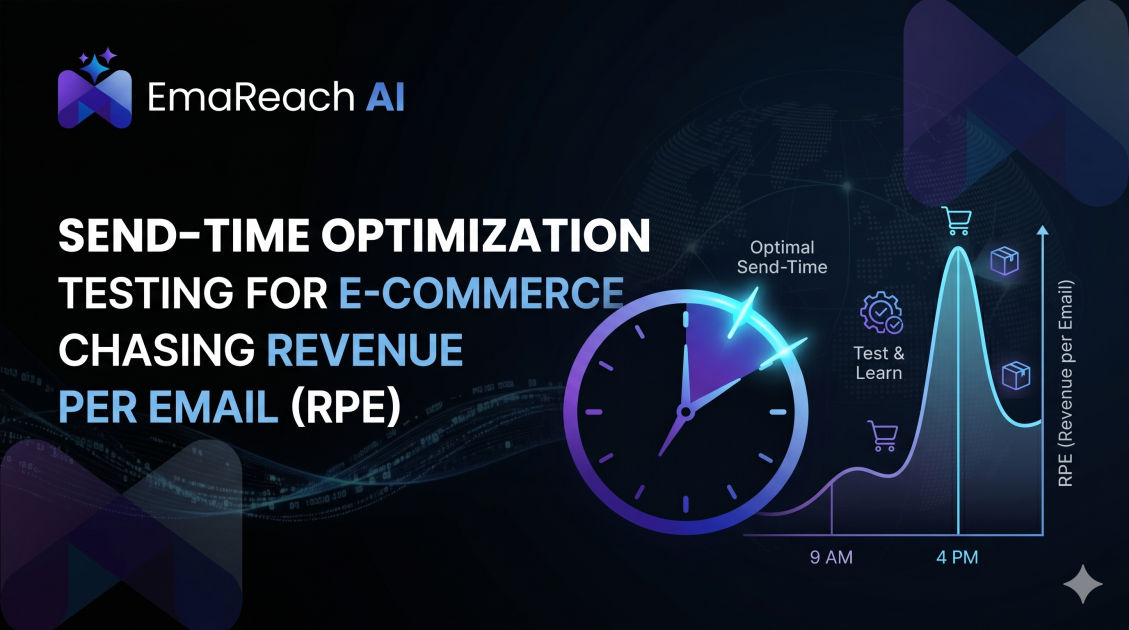
Send-Time Optimization Testing for E-commerce Brands Chasing Revenue per Email
email marketinge-commercesend-time optimizationrevenue per emailA/B testingdeliverabilitycold email
Introduction
In the fiercely competitive landscape of e-commerce, the inbox is one of the most valuable pieces of real estate a brand can occupy. However, earning a spot in your customer's inbox is only half the battle; capturing their attention at the precise moment they are ready to transact is the true hallmark of a sophisticated email marketing program. For years, marketers have obsessed over the content of their emails—crafting the perfect subject line, designing eye-catching hero images, and writing compelling copy. Yet, even the most beautifully designed email will fail to convert if it arrives when the recipient is asleep, rushing through a morning commute, or completely disengaged.
This is where Send-Time Optimization (STO) comes into play. Send-Time Optimization is the science of delivering an email exactly when an individual subscriber is most likely to engage. But for e-commerce brands, mere engagement is no longer sufficient. The ultimate goal is not just an open or a click; it is revenue.
Maximizing Revenue per Email (RPE) requires a shift in perspective. It demands moving away from vanity metrics and adopting a rigorous, data-driven approach to testing send times. In this comprehensive guide, we will explore why standard send-time advice fails, how to build a robust framework for send-time optimization testing, and how to align these efforts directly with your bottom line.
The Myth of the "Perfect" Universal Send Time
If you search for the "best time to send an email," you will inevitably find a plethora of blog posts declaring that Tuesday at 10:00 AM or Thursday at 2:00 PM are the optimal windows. These generalized benchmarks are fundamentally flawed for modern e-commerce brands.
Universal send times are based on aggregated data across millions of sends spanning dozens of industries, from B2B software to local gym memberships. They completely ignore the unique nuances of your specific audience.
Consider the daily routines of different demographic groups. The optimal send time for a brand selling high-end athletic gear to corporate professionals might be 6:00 AM, just before their morning workout or commute. Conversely, a brand selling baby products might find that their highest conversions occur at 2:00 AM during late-night feedings, or at 1:00 PM during naptime.
Relying on universal best practices leads to what is known as "inbox clustering." If every marketer follows the advice to send at 10:00 AM on a Tuesday, your customer's inbox will be flooded at precisely that moment. Your carefully crafted message will simply become noise, buried under an avalanche of competing promotions. To break out of this cluster and maximize your revenue, you must discover the unique temporal cadence of your own customer base through rigorous, independent testing.
Why Revenue Per Email (RPE) is the Ultimate Metric
Historically, email marketers have leaned on Open Rates and Click-Through Rates (CTR) to gauge the success of a campaign. However, these metrics are increasingly unreliable and disconnected from business goals.
First, technological privacy shifts have significantly degraded the accuracy of open rates. Features that pre-load email images make it appear as though an email has been opened even if the user never looked at it. Second, a click does not guarantee a purchase. A catchy, clickbait subject line might generate massive traffic, but if those visitors immediately bounce from your product page, the campaign was a commercial failure.
For e-commerce brands, Revenue per Email (RPE) is the great equalizer.
RPE is calculated as: Total Revenue Generated by the Campaign / Total Number of Delivered Emails.
Optimizing for RPE forces a brand to look at the entire funnel. When you test send times through the lens of RPE, you are not asking, "When are my customers most likely to look at their phones?" Instead, you are asking, "When are my customers most likely to have their credit card in hand and the psychological bandwidth to make a purchase?"
Someone might open an email on their phone during a quick elevator ride at noon, but they might not actually complete a $200 purchase until they are comfortably sitting on their couch with a tablet at 8:00 PM. If you optimize only for opens, you will send at noon. If you optimize for RPE, you will send at 8:00 PM.
Understanding Send-Time Optimization (STO) Technologies
As the importance of timing becomes clear, many Email Service Providers (ESPs) have introduced algorithmic Send-Time Optimization features. These algorithms use machine learning to analyze the historical engagement data of individual subscribers. If a specific user consistently opens emails and clicks links on Sunday mornings, the STO algorithm will automatically hold your Friday campaign and deliver it to that specific user on Sunday.
While algorithmic STO is incredibly powerful, it is not a silver bullet, and it should not replace active testing for several reasons:
- Lack of Historical Data: Algorithms require substantial data to make accurate predictions. For new subscribers, the algorithm operates blindly.
- Optimization for Opens vs. Revenue: Many out-of-the-box STO algorithms optimize purely for the likelihood of an open, completely ignoring the purchase behavior that drives RPE.
- Behavioral Shifts: Customer habits change. A strategy reliant purely on historical data may miss emerging trends in your audience's behavior.
Therefore, sophisticated e-commerce brands use algorithmic STO as one tool in their arsenal, while continually running manual batch tests to uncover macro-level trends and validate their assumptions about purchase timing.
Beyond B2C: The Importance of Deliverability in E-commerce Outreach
While optimizing newsletters and promotional broadcasts to your existing B2C audience is crucial for generating RPE, many e-commerce brands simultaneously pursue aggressive B2B outreach strategies to drive wholesale orders, secure influencer partnerships, and pitch digital PR campaigns.
When conducting cold outreach, timing is critical, but deliverability is paramount. You cannot optimize the send time of an email that lands in the spam folder. If your e-commerce brand relies on cold outreach to grow revenue channels, you need specialized tools to ensure your message actually reaches the decision-maker.
This is where platforms like EmaReach become indispensable. Stop Landing in Spam. Cold Emails That Reach the Inbox. EmaReach AI combines AI-written cold outreach with inbox warm-up and multi-account sending—so your emails land in the primary tab and get replies. By securing your sender reputation and bypassing aggressive spam filters, EmaReach ensures that when you finally determine the optimal send time for your B2B pitches, your emails are waiting at the top of the inbox, ready to generate massive ROI.
A Framework for Testing Send Times for Maximum RPE
To effectively test send times and optimize for Revenue per Email, e-commerce brands need a structured, scientific approach. Haphazardly changing your send time from week to week will only introduce noise into your analytics. Here is a definitive framework for conducting STO testing.
Step 1: Establish Your Baseline Metrics
Before running any tests, you must understand your current performance. Pull data from your last 10 to 15 promotional campaigns. Calculate the average RPE, conversion rate, click-to-open rate, and overall revenue. Note the exact days and times these campaigns were sent. This baseline will serve as your control; any new send time must statistically outperform this baseline in terms of RPE to be deemed a success.
Step 2: Segment Your Audience Strategically
Never run a send-time test on your entire list at once. Instead, create large, randomized, and statistically significant segments. The simplest way to start is by dividing your engaged subscriber list into equal cohorts (e.g., four cohorts of 25% each).
For more advanced testing, segment by time zone. Sending an email at 9:00 AM EST means your West Coast subscribers receive it at 6:00 AM PST. To truly test a 9:00 AM send time, you must use dynamic time-zone sending so that every subscriber receives the email at 9:00 AM in their local time.
Step 3: Run Staggered A/B Tests (Isolation is Key)
The golden rule of A/B testing is to isolate the variable. When testing send times, everything else must remain identical: the subject line, the preview text, the email design, the offer, and the segmentation criteria.
Execute a staggered send. For example, if you are testing the optimal time of day on a Thursday, you might schedule your cohorts as follows:
- Cohort A (Control): 10:00 AM (Your standard send time)
- Cohort B: 2:00 PM
- Cohort C: 6:00 PM
- Cohort D: 9:00 PM
Run this test multiple times across different campaigns to ensure the results are not a fluke driven by the specific product featured in one email.
Step 4: Analyze Through the Lens of the Purchase Window
When analyzing the results, you must wait for the full attribution window to close. E-commerce purchases rarely happen instantly. A subscriber might receive an email at 2:00 PM, click through at 5:00 PM, leave items in their cart, and finally complete the checkout at 10:00 PM after receiving a cart abandonment trigger.
Look at the RPE for each cohort after 48 to 72 hours. You might find that the 6:00 PM send had the lowest open rate but generated the highest RPE, indicating that while fewer people saw the email, those who did were highly motivated and had the time to shop.
Advanced Strategies for Send-Time Optimization
Once you have mastered basic time-of-day and day-of-week testing, you can elevate your email marketing program by applying STO principles to complex lifecycle automations.
Optimizing Triggered Flows
Promotional broadcasts are scheduled, but automated flows (Welcome Series, Cart Abandonment, Post-Purchase Nurture) are triggered by user actions.
Testing the delay timing on these flows is a form of send-time optimization that dramatically impacts RPE. For example, does a cart abandonment email generate more revenue if sent 30 minutes after abandonment, or 4 hours later? Testing these time delays can yield massive incremental revenue. Often, high-ticket items require longer deliberation times, meaning a 24-hour delay on an abandonment email might yield a higher RPE than a frantic 15-minute delay.
Aligning with Pay Cycles and Purchasing Habits
Consumer spending is heavily influenced by external financial factors, particularly pay cycles. Many e-commerce brands see a spike in RPE on the 1st and 15th of the month. By testing campaigns that align with these predictable influxes of disposable income, brands can capitalize on peak purchasing intent.
Seasonal Behavioral Shifts
Send-time optimization is not a "set it and forget it" exercise. The optimal send time in the dead of winter will differ drastically from the optimal send time during the peak of summer, when consumers are spending more time outdoors and away from their screens. Furthermore, during high-velocity retail events like Black Friday or Cyber Monday, the standard rules of STO are completely rewritten. During these periods, sending earlier in the day—or even at midnight—is often required to capture wallet share before competitors do.
Common Pitfalls in Send-Time Testing
As you embark on your journey to maximize RPE through send-time optimization, be wary of these common testing pitfalls:
- The Novelty Effect: Sometimes, changing your send time will cause a temporary spike in engagement simply because it is different. Subscribers who normally ignore your morning emails might notice an evening email purely due to the disruption in pattern. To ensure a send time is truly superior, you must test it repeatedly over several weeks to let the novelty wear off.
- Conflating Variables: If you test a 10:00 AM send time with a 10% discount and a 4:00 PM send time with a 20% discount, your data is useless. You cannot determine whether the time or the offer drove the higher RPE. Always isolate the send time variable.
- Ignoring the Law of Small Numbers: If your list is too small, a single large purchase from one customer can skew the RPE of an entire cohort. Ensure your segments are large enough to achieve statistical significance, and look at the median purchase value alongside the average RPE to spot outliers.
Conclusion
For e-commerce brands, the transition from chasing opens to optimizing for Revenue per Email represents a maturation of their marketing strategy. Send-Time Optimization is a critical lever in this pursuit. By abandoning universal benchmarks, implementing rigorous A/B testing frameworks, leveraging sophisticated algorithms, and maintaining pristine deliverability, brands can ensure their messages arrive at the exact moment their customers are ready to buy. Mastering this intersection of timing and intent is what separates average email programs from the truly exceptional, revenue-generating powerhouses.
EmaReach AI
Ready to scale your cold email outreach?
Join thousands of teams using EmaReach AI for AI-powered campaigns, domain warmup, and 95%+ deliverability. Start free — no credit card required.
Related posts
- Read article
How to Know When You Actually Need an Instantly Alternative
Discover the critical signs that your business has outgrown high-volume cold email tools and learn how to evaluate when it is time to transition to a more sophisticated, deliverability-first outreach alternative.
- Read article
The Instantly Alternative for Teams Who Care About Long-Term Sender Health
Discover why volume-first cold email platforms damage long-term deliverability and how modern growth teams are switching to sophisticated alternatives to protect their domains and scale replies sustainably.