Blog
Back to blog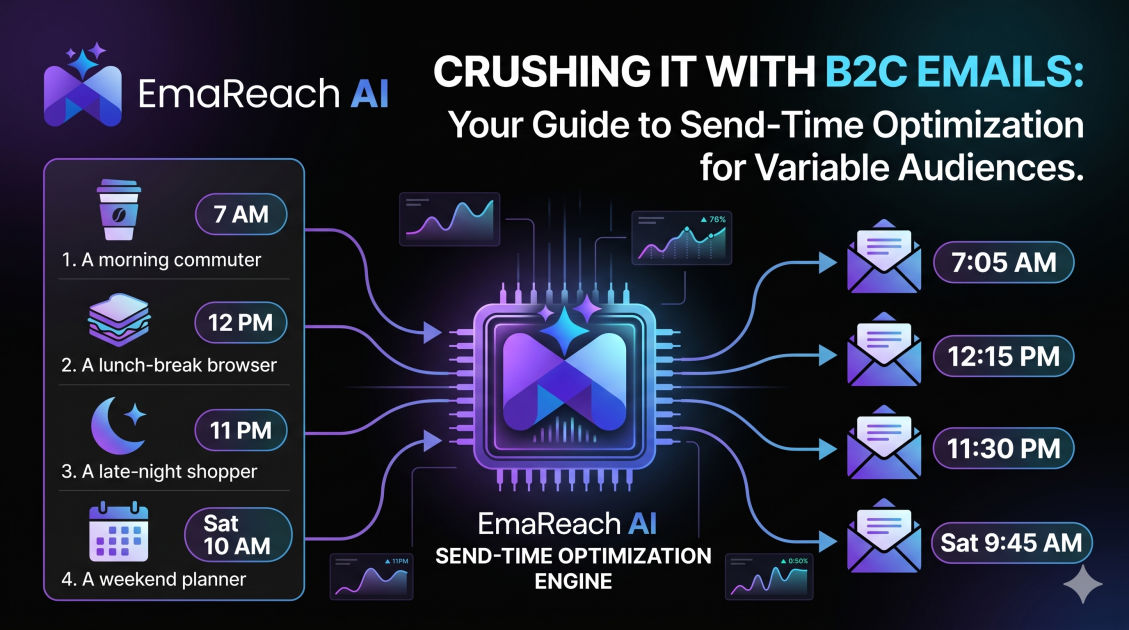
Send-Time Optimization Testing for B2C Brands Sending to Highly Variable Audiences
email marketingsend-time optimizationb2c marketingab testingaudience segmentationmarketing automation
Introduction
In the hyper-competitive landscape of Business-to-Consumer (B2C) marketing, grabbing a consumer's attention in a crowded inbox is a monumental challenge. While compelling copywriting, striking visuals, and personalized offers are critical components of a successful email campaign, one fundamental element often dictates whether an email is opened or buried: timing.
Send-Time Optimization (STO) has emerged as a powerful methodology to ensure that emails land at the exact moment a recipient is most likely to engage. However, executing STO is relatively straightforward when dealing with a homogeneous audience—such as corporate professionals working standard office hours. The true challenge arises for B2C brands that cater to highly variable audiences.
When your database spans across diverse demographics, varying time zones, disparate shift-work schedules, and unique behavioral patterns, relying on a single "optimal" send time or even basic machine-learning models can result in sub-optimal performance. This comprehensive guide explores the complexities of STO testing for highly variable B2C audiences and provides actionable strategies to master this critical marketing discipline.
The Complexity of Highly Variable B2C Audiences
Before diving into testing methodologies, it is essential to understand what makes a B2C audience "highly variable." Unlike B2B audiences, which generally follow predictable weekly rhythms, B2C consumer behavior is influenced by an array of personal and lifestyle factors.
1. Geographic and Time Zone Dispersion
A national or global B2C brand faces the immediate hurdle of time zones. Sending a promotional email at 9:00 AM Eastern Time means your Pacific Time subscribers receive it at 6:00 AM, likely burying it under morning newsletter clutter or system notifications.
2. Behavioral Rhythms and Lifestyle Segmentations
Consumers do not live identical lives. Consider a brand that sells health and wellness products. Their audience might include:
- The Early Bird: Fitness enthusiasts who check their phones at 5:30 AM before a workout.
- The Corporate Commuter: Professionals who browse emails during their transit between 8:00 AM and 9:00 AM.
- The Night Owl: College students or shift workers who are active and making purchasing decisions at midnight.
3. Device Usage Patterns
Some segments of your audience may interact primarily via mobile devices during short breaks throughout the day, while others engage in deep-dive desktop browsing during evening leisure hours. The context of the interaction heavily influences the likelihood of conversion.
Using a blanket approach or trusting generalized industry benchmarks (e.g., "Tuesday at 10:00 AM is the best time to send email") ignores this inherent variability, leading to diminished open rates, lost revenue, and poor sender reputation.
Why Traditional Send-Time Optimization Fails Variable Audiences
Many Modern Email Service Providers (ESPs) offer built-in STO features driven by basic machine learning algorithms. While these tools are beneficial, they often fall short for highly variable audiences due to several core limitations:
- Data Aggregation Biases: Standard STO features look at historical open data across your entire list. If 60% of your list opens emails at noon, the algorithm will favor noon for everyone, completely ignoring the nuanced habits of the remaining 40%.
- The "Ghost Subscriber" Phenomenon: New subscribers or those who rarely open emails lack sufficient historical data. Basic STO algorithms default these users to a generic "best time," which fails to capture their actual real-time behavior.
- Context Blindness: Algorithms analyze when a person opened an email, but not why. An open at 11:00 PM might have been an accidental click while setting an alarm, rather than a conscious moment of high purchase intent.
To overcome these limitations, advanced B2C marketers must shift from passive reliance on automated STO to active, structured Send-Time Optimization testing.
Framework for Designing an STO Test for Variable Lists
To build an effective STO testing framework, you must isolate variables and systematically evaluate how different segments respond to timing variations. Follow this structured approach to design your testing protocol:
Step 1: Baseline Establishment and Audience Segmentation
You cannot measure improvement without a control baseline. Begin by analyzing your historical data over the past quarter to determine your average Open Rate (OR), Click-Through Rate (CTR), and Revenue Per Email (RPE) under your current scheduling methodology.
Next, segment your variable audience into broad behavioral or demographic cohorts. Examples include:
- Geographic cohorts (by region or time zone)
- Purchase recency and frequency cohorts (VIPs vs. lapsed buyers)
- Age-based or lifestyle demographics (if zero-party data is available)
Step 2: Formulating Hypotheses
A successful test requires a clear hypothesis. Instead of blindly testing random hours, formulate hypotheses based on customer personas. For example:
"Hypothesis: Sending the weekend promotional offer to the 'Young Parent' segment at 8:00 PM on Sunday (bedtime routine concluded) will yield a 15% higher CTR than sending it at 10:00 AM on Saturday morning."
Step 3: Determining the Testing Window and Sample Size
Because variable audiences are prone to fluctuating schedules, a standard 24-hour A/B test is insufficient. Run your STO tests over a minimum of two to four weeks to account for external factors like weather anomalies, paydays, or breaking news cycles.
Ensure your sample size per test group is statistically significant. If you are testing five different send-time variations, ensure each variant cohort has enough subscribers to yield stable data.
| Test Cohort | Scheduled Send Time | Intended Audience Context |
|---|---|---|
| Variant A (Control) | 10:00 AM (Local Time) | Standard Mid-Morning Break |
| Variant B | 7:30 AM (Local Time) | Morning Commuter / Early Review |
| Variant C | 12:30 PM (Local Time) | Lunch Break Browsing |
| Variant D | 6:00 PM (Local Time) | Post-Work Wind-Down |
| Variant E | 9:00 PM (Local Time) | Evening Leisure / Couch Commerce |
Step-by-Step Execution of Advanced STO Testing
Once your framework is built, execute the testing process with rigorous control parameters.
1. Normalize for Time Zones
Never conduct an absolute-time STO test across a variable geographic audience. If you decide to test a 7:00 PM deployment, ensure it deploys at 7:00 PM local time for every recipient. Most tier-one marketing automation platforms support local-time delivery features. If yours does not, manually split your list into time-zone buckets prior to execution.
2. Isolate Content and Subject Lines
To ensure your test results measure the impact of time and not creative appeal, keep your email content completely identical across all variants. The subject line, preheader text, sender name, offer, and structural layout must remain completely unchanged.
3. Implement Rolling Window Delivery
For highly variable lists, consider testing rolling delivery windows rather than hard hourly drops. For instance, compare a "Batch Delivery" (sending all emails precisely at 12:00 PM) against a "Rolling Window Delivery" (spreading out delivery evenly between 12:00 PM and 4:00 PM). This helps identify if a broader window captures a wider range of casual browsers within a variable segment.
4. Account for External Deliverability Factors
When testing multiple send times, remember that email delivery is not instantaneous. If you send a massive blast to Variant B at 7:30 AM, mailbox providers (like Gmail or Yahoo) may throttle delivery if your sender reputation is unproven or if volume spikes look anomalous. Delayed delivery distorts your test results.
For brands expanding their strategies to include cold B2C outreach, corporate partnerships, or highly personalized acquisition campaigns, maintaining flawless inbox placement is paramount. Solutions like EmaReach can assist in optimizing these efforts. EmaReach AI combines AI-written cold outreach with inbox warm-up and multi-account sending—so your emails land in the primary tab and get replies, ensuring that when you test specific outreach timing, your emails actually arrive when intended.
Metrics to Analyze Beyond the Open Rate
While the primary metric influenced by Send-Time Optimization is the Open Rate, relying solely on opens can paint an incomplete or misleading picture. This is especially true following privacy updates like Apple's Mail Privacy Protection (MPP), which pre-fetches images and artificially inflates open rates.
To accurately evaluate STO performance for highly variable audiences, analyze a holistic matrix of performance indicators:
Click-to-Open Rate (CTOR)
CTOR measures the percentage of subscribers who clicked a link after opening the email. A high open rate combined with a low CTOR indicates that while the send time caught their eye, the recipient was likely too distracted, busy, or unequipped to engage deeply with the content. Optimizing for a time where CTOR peaks ensures you hit subscribers when they have the cognitive bandwidth to browse and act.
Conversion Rate and Revenue Per Email (RPE)
Ultimately, B2C marketing exists to drive revenue. An email sent at 7:00 AM might get opened while someone is stopping at a red light on their commute, but they won't pull out their credit card to buy a three-figure product. Conversely, an email sent at 8:30 PM might get fewer total opens, but a vastly higher conversion rate because recipients are relaxed at home and primed for e-commerce transactions.
Unsubscribe and Complaint Rates
If you send emails at disruptive times (such as late at night or during stressful early-morning hours), you risk irritating your audience. Keep a close watch on unsubscribes and spam complaints across your test groups. If a specific send-time variant shows a spike in opt-outs, it indicates that the timing is violating consumer expectations, regardless of what the open rates suggest.
Translating Test Results into Permanent Strategy
After running your STO tests for the designated multi-week period, it is time to synthesize the data into an actionable, long-term campaign strategy.
Develop a Dynamic Send-Time Matrix
Instead of searching for a single corporate send time, create a matrix that assigns specific send windows to specific audience profiles.
- High-Value/VIP Buyers: Deploy during high-conversion windows (e.g., evening hours or payday afternoons).
- Deal-Seekers/Discount Shoppers: Deploy during peak browsing hours (e.g., lunchtime or mid-morning breaks) to capture immediate impulse clicks.
- Lapsed/Unengaged Users: Deploy during low-volume alternative times (e.g., Sunday mornings) when there is less competition in the inbox.
Automate Predictive STO via Segments
Feed your test findings back into your marketing automation system. Instead of relying on the platform's default, unguided machine learning, set explicit guardrails. Program your workflows to route distinct audience segments into distinct delivery paths based on the winning profiles discovered during your testing phase.
Establish an Ongoing Re-Testing Cadence
Consumer habits change. A schedule that works perfectly during summer months may completely fail in the winter as daylight hours shift and routines evolve. Similarly, macroeconomic shifts or evolving workplace habits alter how and when people access their personal inboxes. Establish a quarterly or bi-annual re-testing cadence to ensure your STO model remains accurate and responsive to real-world behavioral changes.
Conclusion
Send-Time Optimization is not a set-it-and-forget-it feature, particularly for B2C brands communicating with vast, highly variable audiences. Treating your subscriber database as a monolith inevitably leaves engagement and revenue on the table. By implementing a rigorous testing framework, neutralizing time zone distortions, and analyzing deep conversion metrics rather than surface-level open rates, you can systematically discover the precise moments your consumers are primed to buy.
Commit to understanding the distinct lifestyle rhythms of your audience segments, continuously test your hypotheses, and adapt your delivery structures accordingly. The reward is a healthier sender reputation, sustained inbox visibility, and a measurable boost to your bottom line.
EmaReach AI
Ready to scale your cold email outreach?
Join thousands of teams using EmaReach AI for AI-powered campaigns, domain warmup, and 95%+ deliverability. Start free — no credit card required.
Related posts
- Read article
How to Know When You Actually Need an Instantly Alternative
Discover the critical signs that your business has outgrown high-volume cold email tools and learn how to evaluate when it is time to transition to a more sophisticated, deliverability-first outreach alternative.
- Read article
The Instantly Alternative for Teams Who Care About Long-Term Sender Health
Discover why volume-first cold email platforms damage long-term deliverability and how modern growth teams are switching to sophisticated alternatives to protect their domains and scale replies sustainably.