Blog
Back to blog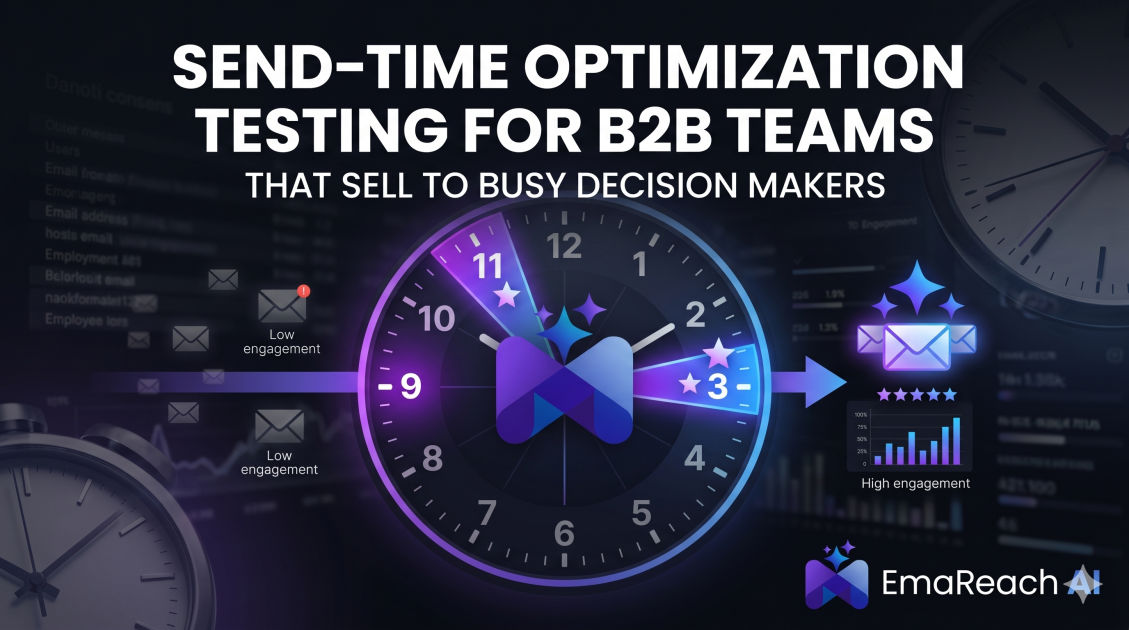
Send-Time Optimization Testing for B2B Teams That Sell to Busy Decision Makers
cold emailoutreachemail deliverabilityb2b salessend-time optimizationemail marketing
Introduction
In the world of B2B sales and marketing, reaching corporate decision makers is one of the steepest challenges professionals face. Executives, VPs, and C-level leaders are inundated with hundreds of emails daily. Their schedules are tightly packed with back-to-back meetings, strategic planning sessions, and operational fires. In this hyper-competitive landscape, simply having a compelling offer and a personalized pitch is no longer enough. If your email arrives at the wrong time, it quickly gets buried under a mountain of newer notifications, resulting in lost opportunities and wasted effort.
This is where Send-Time Optimization (STO) testing becomes a critical competitive advantage. STO is the data-driven process of identifying the precise days and times an individual or a specific target persona is most likely to open, read, and respond to an email. For B2B teams, mastering STO testing means transitioning away from generic industry generalizations—such as the outdated advice to always send emails on Tuesday mornings—and moving toward a highly strategic, testing-focused framework tailored to the unique habits of busy decision makers.
The Psychology and Daily Schedule of a Busy B2B Decision Maker
To effectively test and optimize send times, B2B teams must first understand the psychological and behavioral patterns that govern a decision maker's day. A typical executive does not interact with their inbox the same way a mid-level manager or a consumer does.
The Morning Inbox Sweep
Many executives check their phones first thing in the morning, often before they even get out of bed or during their morning commute. During this initial sweep, their primary objective is triage. They are looking for urgent internal updates, critical client issues, or immediate operational red flags. Cold emails or non-urgent marketing messages caught in this morning sweep are highly vulnerable to bulk deletion. Decision makers use this time to clear the clutter so they can arrive at the office with a manageable inbox.
The Mid-Day Core Work Blocks
Once the standard workday begins, decision makers move from meeting to meeting. If they do open their email client between sessions, they are scanning for quick items they can delegate or resolve in under sixty seconds. Long-form sales pitches or dense educational content received during these high-friction hours are frequently ignored or flagged to be read later—a status that often translates to never.
The After-Hours Wind Down
Late afternoons and early evenings represent a profound shift in cognitive load. As the chaotic pace of the standard workday subsides, many executives use this quieter time to catch up on industry news, review long-term strategies, and thoroughly read through emails that require deeper thought. Understanding these shifts in daily behavior allows revenue teams to formulate sophisticated hypotheses for their STO testing.
Why Generic Email Sending Advice Fails in B2B Outreach
For years, standard marketing blogs have echoed the same core metrics: send your emails between 9:00 AM and 11:00 AM on Tuesdays and Thursdays for maximum engagement. While these statistics might hold true for broad consumer newsletters or massive B2B mass-marketing blasts, they completely fall apart when targeting specific, high-value corporate decision makers.
When every B2B sales team follows the exact same generic advice, an artificial bottleneck is created. Tuesdays at 10:00 AM becomes the single most crowded window in an executive's inbox. The sheer volume of incoming noise during these hours dramatically lowers the probability of your message standing out.
Furthermore, different industries operate on entirely different internal cadences. A Chief Technology Officer at a fast-growing software startup operates on a completely different schedule than a VP of Operations at a traditional manufacturing plant or a Chief Medical Officer at a major hospital network. Generic benchmarks fail to account for these nuanced structural variations, which is why systematic internal testing is the only reliable path to sustained outreach success.
Establishing an STO Testing Framework for B2B Teams
Implementing a rigorous Send-Time Optimization testing framework requires a structured approach to data collection, audience segmentation, and variable isolation. To achieve clean, actionable results, B2B teams should follow a comprehensive blueprint.
Step 1: Define Target Personas and Cohorts
Do not lump all of your prospects into a single testing bucket. Group your target leads into distinct cohorts based on criteria such as job function, industry vertical, seniority level, and geographic time zone. For instance, you might create one cohort for Enterprise Chief Information Security Officers (CISOs) on the East Coast and another for VPs of Sales at mid-market SaaS companies on the West Coast.
Step 2: Establish the Baseline and Control Group
Before introducing complex send-time variations, establish a baseline metric using your current sending schedule. This control group will provide the standard open, click-through, and reply rates against which all future STO test variations will be measured.
Step 3: Map Out the Testing Matrix
Create a clear matrix of non-traditional windows to test against your baseline. Instead of standard hour blocks, consider dividing your test windows into distinct strategic categories:
| Test Window | Time Range (Local Time) | Strategic Rationale |
|---|---|---|
| Pre-Work Window | 7:00 AM – 8:15 AM | Catching the executive during their morning mobile triage before meetings begin. |
| The Lunch Lull | 12:30 PM – 1:30 PM | Reaching prospects as they step away from core work and glance at their phones. |
| Late Afternoon Wind-Down | 4:30 PM – 6:00 PM | Capitalizing on the post-meeting window when operational demands slow down. |
| Weekend Micro-Windows | Sunday 7:00 PM – 9:00 PM | Target executives preparing their strategic game plan for the upcoming week. |
Step 4: Ensure Statistical Significance
To ensure your test results are valid and not merely the product of random chance, you must maintain an adequate sample size. Sending fifty emails at a specific time is not enough to prove a trend. Aim for a minimum sample size of several hundred prospects per cohort per time slot before drawing definitive conclusions.
Balancing Optimization with Technical Deliverability
As B2B teams scale their send-time testing, they inevitably run into a critical structural bottleneck: technical email deliverability. It matters very little if you discover that 5:15 PM on a Thursday is the absolute perfect minute to email a Chief Financial Officer if your email infrastructure cannot successfully clear the gatekeepers and modern spam filters.
When teams try to execute strict send-time optimization manually or via basic automated sequences, they often make the mistake of blasting out a massive volume of emails simultaneously to hit a precise time window. This sudden spike in sending volume flags email service providers (ESPs) like Google and Microsoft, signaling automated, spam-like behavior. As a result, your carefully timed emails are instantly routed to the promotions tab, the updates folder, or worse, the dreaded spam folder.
To safely maximize your outreach ROI, you need an advanced deliverability infrastructure that can handle optimized sending cadences smoothly. This is exactly where EmaReach provides an invaluable solution.
Stop Landing in Spam. Cold Emails That Reach the Inbox. EmaReach AI combines AI-written cold outreach with inbox warm-up and multi-account sending—so your emails land in the primary tab and get replies.
By leveraging multi-account architecture and automated inbox warming, platforms like EmaReach allow B2B revenue teams to execute precise send-time optimization testing without risking domain health. The system staggers distribution naturally, mimicking authentic human patterns while ensuring your outreach lands precisely where it needs to be: the primary inbox of your target executive.
Key Metrics to Track Beyond the Open Rate
When analyzing the data from your send-time optimization tests, it is incredibly easy to fall into the trap of focusing exclusively on open rates. While an open rate is a valuable indicator of subject line strength and successful deliverability at a specific hour, it does not tell the complete story of prospect engagement.
To discover the true "golden windows" for your B2B sales cycles, you must track a deeper funnel of metrics:
- Reply Rate: This is the ultimate metric for B2B outbound teams. An hour that yields a 40% open rate but a 0% reply rate is far less valuable than a time window that yields a 20% open rate but a 5% positive reply rate. High reply rates indicate that the prospect not only saw the email but had the cognitive bandwidth and time to formulate a response.
- Positive vs. Negative Reply Ratio: Pay close attention to the sentiment of the replies received during different windows. Emails sent late at night on weekends might get opened, but if they yield frustrated responses telling your sales reps to stop emailing outside of business hours, that send window is a net negative for your brand.
- Time-to-Open (TTO): Track the exact duration between when an email is delivered and when it is opened. A short TTO indicates that your message landed at a moment when the prospect was actively interacting with their screen, which dramatically increases the likelihood of an immediate response.
- Downstream Conversion Rates: Monitor how many prospects who engaged during specific send-time windows actually progress to a booked discovery call, a formal product demonstration, or a closed-won contract.
Advanced STO Tactics for High-Velocity B2B Sales Teams
Once your team has moved past basic day-and-time testing, you can implement advanced tactics to further sharpen your competitive edge.
Account-Based Time-Zone Alignment
If your sales team is located in New York but you are targeting enterprise accounts headquartered in London, San Francisco, and Tokyo, your sequences must be tightly bound to the recipient's local time zone. Advanced outbound setups dynamically adjust the execution of sequences based on the prospect's verified location data, ensuring that an email meant for a late-afternoon wind-down does not accidentally arrive during a hectic morning commute half a world away.
Trigger-Based Resending Windows
If a highly qualified decision maker does not open your initial email within a forty-eight-hour window, use your testing data to alter the strategy for the follow-up. If Step 1 was delivered during a morning block, configure Step 2 to hit their inbox during an evening wind-down window. Varying your approach across different behavioral zones maximizes your total account coverage over time.
Harmonizing Marketing and Sales Touches
Ensure that your marketing team's broad newsletter distribution or paid ad campaigns do not overlap destructively with your sales team's highly targeted cold outreach. If your marketing automation platform sends out a major corporate announcement on Wednesday at noon, your sales reps should avoid executing hyper-personalized outbound tests to the same target accounts during that exact window to prevent communication fatigue.
Common Pitfalls to Avoid in Send-Time Optimization
Even well-intentioned sales operations teams can fall into common analytical traps when setting up their optimization frameworks. Staying aware of these mistakes will save your team months of skewed data and wasted resources.
Confusing Seasonality with Long-Term Trends
Email engagement patterns fluctuate naturally throughout the year. For example, during the summer months, late Friday afternoons are notoriously unproductive as executives leave early for long weekends. Conversely, during the final weeks of a fiscal quarter, decision makers may be glued to their screens late into the evening. Do not mistake a short-term seasonal shift for a permanent change in persona behavior.
Ignoring the Quality of the Content
Send-time optimization is an amplifier, not a cure-all. If your subject line is generic, your value proposition is weak, or your email body reads like an automated template, sending it at the absolute perfect minute will not save it from being deleted. Perfect timing can only unlock the latent value of an already exceptional, highly relevant pitch.
Over-Automating and Losing Flexibility
While relying on data and algorithms is critical, do not let automation completely override common sense and human intuition. If a major industry event or a global news incident breaks, blindly letting your automated testing queues fire at their optimized times can appear tone-deaf and damage your reputation. Maintain absolute control over your distribution queues.
Conclusion
Finding the optimal time to reach busy B2B decision makers is an ongoing process of experimentation rather than a one-time setup. As corporate cultures evolve, executive habits shift, and technical email ecosystems grow increasingly complex, the teams that commit to a culture of continuous testing will consistently outperform their competitors.
By systematically segmenting your target accounts, setting clean control groups, tracking meaningful deep-funnel metrics, and protecting your deliverability infrastructure with robust tools like EmaReach, your organization can slice through the noise. Stop guessing when to click send, let your internal data guide your strategy, and ensure your messaging lands in front of the right executive at the exact moment they are ready to engage.
EmaReach AI
Ready to scale your cold email outreach?
Join thousands of teams using EmaReach AI for AI-powered campaigns, domain warmup, and 95%+ deliverability. Start free — no credit card required.
Related posts
- Read article
How Choosing the Right Instantly Alternative Changed Our Pipeline Numbers
Discover how transitioning from a volume-first cold email setup to an advanced, deliverability-focused infrastructure transformed our B2B pipeline metrics, skyrocketed open rates to over 68%, and tripled our monthly booked demos.
- Read article
The Instantly Alternative That Wins for Teams With Strict IT Policies
Discover why traditional cold email tools fail strict IT security audits and explore the ultimate enterprise-grade alternative built for secure, compliant, and high-performance outbound sales teams.