Blog
Back to blog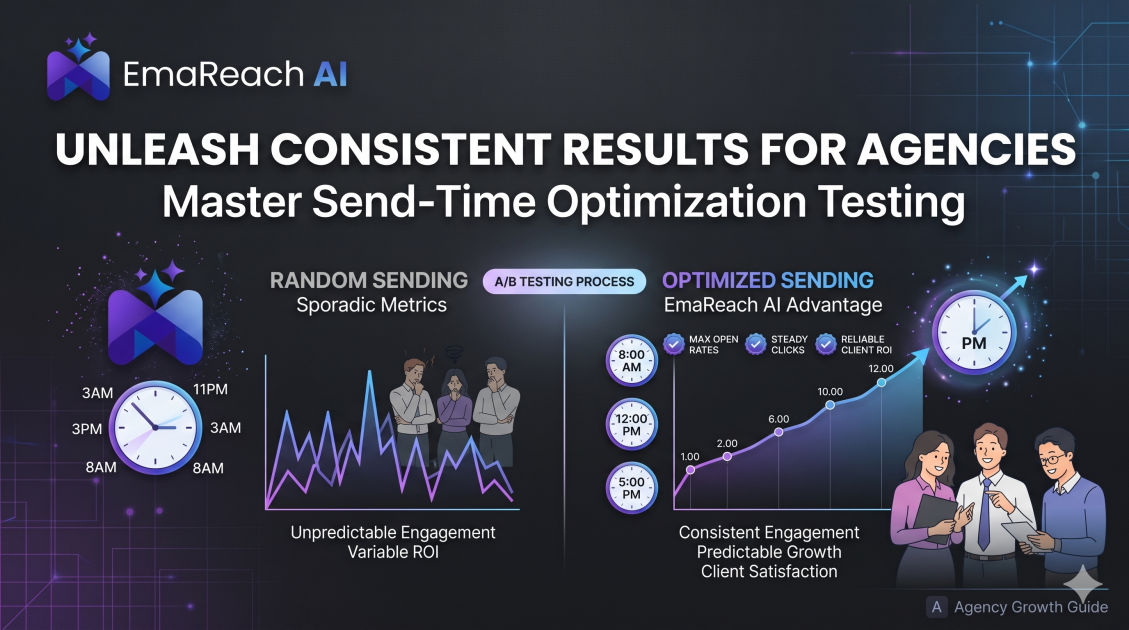
Send-Time Optimization Testing for Agencies That Need Consistent Client Results
send-time optimizationemail marketingagency growthcold outreachemail deliverabilityab testing
Introduction to Send-Time Optimization (STO) for Agencies
For marketing and lead generation agencies, client retention is directly tied to the consistency of your results. When a client hires an agency, they are not just buying a service; they are buying predictable growth. However, achieving consistent open rates, click-through rates, and conversions across a diverse portfolio of clients is one of the most significant challenges agency leaders face today.
Every audience behaves differently. A medical device executive opens emails at vastly different times than a software engineer or a local restaurant owner. If your agency uses a one-size-fits-all scheduling strategy, you are leaving your clients' campaign performance to chance.
This is where Send-Time Optimization (STO) comes into play. STO is the data-driven process of analyzing when specific segments of an audience are most likely to engage with an email and automatically delivering messages at those precise moments. For agencies, moving from manual scheduling to systematic STO testing is the key to stabilizing campaign performance, scaling operations, and proving undeniable value to clients.
Why Standard Sending Windows Fail Agency Portfolios
Many agencies fall into the habit of relying on general industry benchmarks. You have likely read studies suggesting that Tuesday mornings at 10:00 AM is the universal sweet spot for B2B emails. While these benchmarks provide a baseline for beginners, they present major flaws for scaling agencies:
- The Influx Problem: Because everyone reads the same benchmarks, Tuesday at 10:00 AM is often when your prospect's inbox is most crowded. Your client's email gets buried under dozens of competing messages.
- Global Time Zone Friction: If your client is based in New York but targeting prospects in London, Tokyo, and Los Angeles, a single send time guarantees that a massive portion of the list will receive the email in the middle of the night or during a chaotic morning commute.
- Behavioral Divergence: Decision-makers do not all share the same habits. C-level executives often clear their inboxes early in the morning before meetings start, while mid-level managers might handle non-urgent outreach late in the afternoon.
When you manage multiple clients, relying on generic assumptions leads to erratic performance graphs. One client thrives while another plummets, creating fires that your account managers must constantly put out.
The Anatomy of an Effective STO Testing Framework
To build an agency-grade STO framework, you cannot rely on guesswork. You need a structured, scientific approach to testing that can be replicated across every new client onboarded. An effective framework breaks down into four distinct phases.
1. Baseline Data Gathering
Before running advanced time optimization tests, you need a control variable. Allocate the first two to three weeks of a new campaign to gather baseline engagement data. Divide your client's target list into equal, randomized segments and send the identical email variant at completely different times of the day and days of the week.
2. Micro-Segmenting by Demographics and Behavior
An executive in finance will have a different digital footprint than a creative director at an advertising agency. Your testing framework must segment audiences based on:
- Job Title and Seniority: High-level stakeholders require different timing windows than end-users.
- Geographic Location: Grouping leads by their local time zones is the bare minimum for modern outreach.
- Historical Activity: Tracking when a specific contact has previously opened emails or filled out forms on a website.
3. Statistical Significance vs. Vanity Metrics
Agencies often make the mistake of changing their entire strategy based on a minor spike in opens from a small list sample. Ensure your sample sizes are large enough to achieve statistical significance. A 35% open rate on 100 sent emails is a fluke; a 35% open rate on 5,000 sent emails is a verifiable trend.
Step-by-Step Guide to Implementing STO Testing
Implementing an STO testing program across your client base requires a systematic rollout. Use this step-by-step roadmap to align your team and execute flawlessly.
Step 1: Audit Current Client Audiences
Begin by mapping out the target personas for each of your clients. Document their geographic distribution, typical working hours, and industry-specific habits. For example, if you are running an outreach campaign for a client targeting real estate agents, consider that these prospects are often out on property tours during normal business hours and may check emails more frequently during evenings or weekends.
Step 2: Establish the Testing Matrix
Create a clear matrix that outlines the variables you will test. A robust testing matrix typically looks at three core dimensions:
| Dimension | Variables to Test | Purpose |
|---|---|---|
| Days of the Week | Mid-week (Tue-Thu) vs. Shoulder days (Mon/Fri) vs. Weekends | Identify structural weekly habits |
| Time Blocks | Early Morning (6AM-9AM) vs. Mid-Day (11AM-2PM) vs. Late Afternoon (4PM-6PM) | Pinpoint daily productivity dips |
| Contextual Moments | Pre-work hours vs. Post-work unwinding windows | Capitalize on casual browsing states |
Step 3: Isolate Variables
When executing these tests, ensure that the email subject line, body copy, and sender name remain exactly the same. If you change both the send time and the subject line simultaneously, it becomes impossible to determine which variable caused the shift in performance.
Step 4: Analyze and Document the Winners
Review your data bi-weekly. Look for clear patterns where open rates and reply rates trend higher. Once a winning time window is identified for a specific niche, document it in an internal agency playbook. This knowledge base becomes a massive competitive advantage for your agency, allowing you to get faster results for future clients in similar industries.
Overcoming the Deliverability Hurdle in Timing Tests
When testing different send times, agencies frequently run into a hidden roadblock: email deliverability. It does not matter how perfectly optimized your send time is if your emails are landing straight into the junk or spam folders.
When you send a large volume of emails at a specific time during your testing phase, email service providers (like Google and Microsoft) may flag this sudden burst of activity as suspicious behavior, hurting your sender reputation. For agencies handling high-volume cold outreach and lead generation, keeping your infrastructure healthy while hunting for the optimal send time is a delicate balancing act.
To combat this, your agency should look at platforms designed to handle complex outreach mechanics seamlessly. For instance, EmaReach offers a complete solution to this exact problem: "Stop Landing in Spam. Cold Emails That Reach the Inbox." EmaReach AI combines AI-written cold outreach with inbox warm-up and multi-account sending—so your emails land in the primary tab and get replies. By distributing your outreach across multiple warmed-up accounts, you can test various send-time windows without triggering spam filters, ensuring your data is accurate and your clients' campaigns remain highly effective.
Deep Dive: B2B vs. B2C Send-Time Dynamics
The rules of engagement shift radically depending on whether your agency serves B2B or B2C clients. Understanding these structural differences prevents costly strategic mistakes.
B2B Dynamics: Navigating the Corporate Guardrails
In B2B campaigns, your main goal is to catch prospects when they are in a professional, decision-making mindset but not overwhelmed by internal meetings.
- The Mid-Day Slump: The hours between 1:30 PM and 3:00 PM are often incredibly effective for B2B outreach. Prospects have returned from lunch, caught up on their morning tasks, and are frequently looking for a distraction or completing lighter administrative work.
- The Sunday Night Strategy: Many driving executives prepare for their week on Sunday evening. Sending a highly personalized, soft-pitch email around 8:00 PM on Sunday can place your client at the absolute top of the prospect's inbox on Monday morning.
B2C Dynamics: Capitalizing on Personal Leisure
For B2C clients, the corporate schedule is inverted. You want to reach consumers when they are relaxed, autonomous, and free to make personal purchasing decisions.
- Commute Windows: Early morning transit times (7:30 AM - 8:30 AM) and evening commutes (5:00 PM - 6:30 PM) show massive spikes in mobile email opens.
- The Weekend Paradox: While B2B campaigns fall off a cliff on weekends, B2C campaigns often thrive on Saturday mornings and Sunday afternoons, when consumers are browsing their phones without the pressure of workplace deadlines.
Scaling STO Testing Across Multiple Clients
As your agency grows from managing 5 clients to 50, managing manual send-time variations becomes completely unsustainable. You cannot have your account managers manually hitting 'send' or scheduling individual batches every hour of the day. To scale successfully, you must automate and industrialize the process.
Automate Through Predictive Modeling
Modern marketing automation platforms utilize machine learning to track individual contact interactions over time. Instead of setting a blanket time for a list, the software waits to send the email to "Contact A" until their specific historical open window arrives, while sending the exact same email to "Contact B" four hours later.
Create Standardized Standard Operating Procedures (SOPs)
Build an internal SOP that dictates exactly how long an STO test should run, what metrics justify moving a client to a new sending schedule, and how to report these wins to the client. When your team follows a uniform process, onboarding new clients becomes seamless, and operational errors drop dramatically.
Visualizing Data for Client Reports
Clients love data, but they hate confusion. When presenting the results of your send-time optimization testing, avoid dumping raw data spreadsheets on them. Instead, use clear visual charts to illustrate the "before and after" of your testing efforts. Show them how moving from an unoptimized schedule to an STO model directly increased their open rates and lowered their cost per acquisition. This level of sophistication justifies your retainer fees and builds long-term institutional trust.
Best Practices for Maintaining Consistent Agency Results
To wrap up, keep these core principles in mind to ensure your Send-Time Optimization efforts continuously yield predictable, high-value results for your client portfolio:
- Never Stop Testing: Consumer behavior evolves. A send time that worked perfectly during the winter months might underperform during summer vacations. Review your optimization data at least once a quarter.
- Prioritize Deliverability Above All: A perfectly timed email that goes to spam is completely useless. Keep your sending domains pristine, use multi-account sending architectures, and integrate reliable warm-up systems into your workflow.
- Focus on Downstream Metrics: High open rates are a great indicator of a successful send time, but always verify that these opens translate into clicks, replies, and actual revenue for your clients. Optimization should always serve the bottom line.
By transforming how your agency handles scheduling through systematic Send-Time Optimization testing, you protect your campaigns from unpredictable market fluctuations, maximize delivery infrastructure, and provide the steady, scalable results your clients count on.
EmaReach AI
Ready to scale your cold email outreach?
Join thousands of teams using EmaReach AI for AI-powered campaigns, domain warmup, and 95%+ deliverability. Start free — no credit card required.
Related posts
- Read article
The Instantly Alternative That Impressed Even the Biggest Instantly Fans
Discover why top outbound growth marketers and lead generation agencies are migrating from legacy cold email platforms to advanced alternatives built for superior deliverability, white-label client management, and robust API workflows.
- Read article
How to Know When You Actually Need an Instantly Alternative
Discover the critical signs that your business has outgrown high-volume cold email tools and learn how to evaluate when it is time to transition to a more sophisticated, deliverability-first outreach alternative.