Blog
Back to blog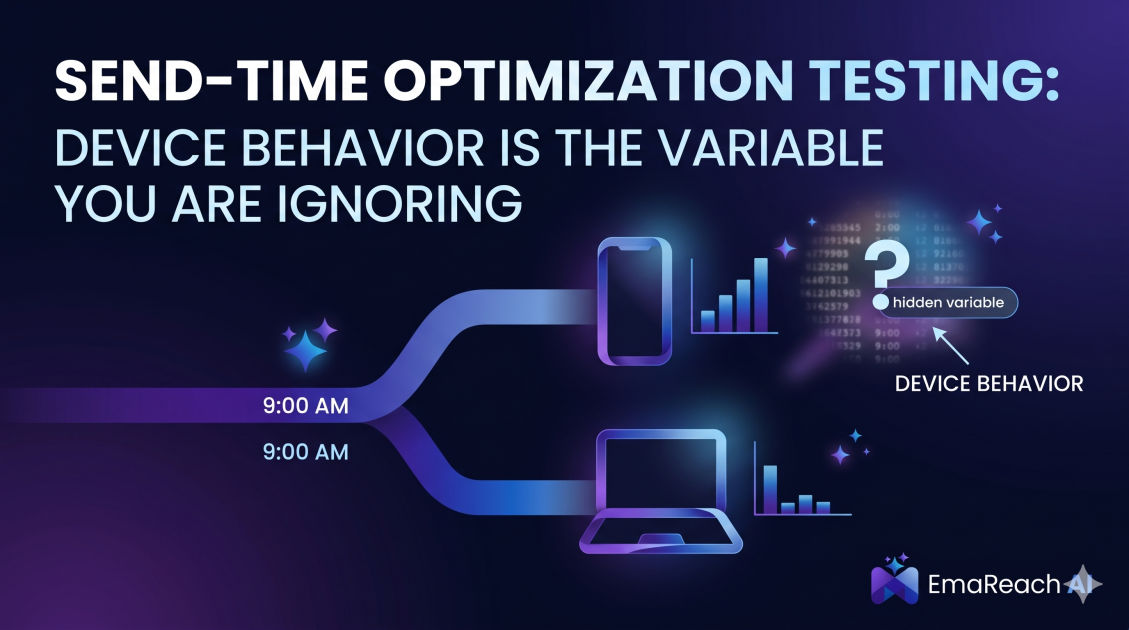
Send-Time Optimization Testing: Device Behavior Is the Variable You Are Ignoring
send-time optimizationemail deliverabilitycold emailb2b outreachemail marketingsales automation
Introduction
The quest for the perfect email send time is as old as digital marketing itself. Marketers, sales professionals, and outreach specialists spend countless hours analyzing data, running A/B tests, and relying on sophisticated algorithms to determine the exact moment a prospect is most likely to open an email. We obsess over time zones, industry standards, and the age-old debate of Tuesday mornings versus Thursday afternoons. However, in this relentless pursuit of the optimal timestamp, a critical variable is almost universally ignored: device behavior.
When we talk about Send-Time Optimization (STO), we are usually talking about predicting when someone will look at their inbox. But knowing when they look is only half the battle. The truly transformative insight comes from understanding how they are looking at it. Are they hastily scrolling through notifications on a smartphone while waiting in line for coffee? Or are they sitting at a multi-monitor desktop setup, fully engaged in deep work and ready to process complex information?
Ignoring the device context means you might be perfectly optimizing your send time for the exact moment your prospect is least equipped to take meaningful action. This comprehensive guide explores why device behavior is the missing link in send-time optimization, how the psychology of mobile versus desktop usage dictates email engagement, and how you can adapt your outreach strategy to turn passive opens into active replies.
The Core Flaw in Traditional Send-Time Optimization
Traditional send-time optimization relies heavily on historical engagement data. Algorithms analyze a prospect's past interactions to identify patterns. If a specific user consistently opens emails at 7:30 AM, the system logically concludes that 7:30 AM is the optimal time to deliver future messages.
While this mathematical approach seems sound on the surface, it possesses a fundamental flaw: it treats all opens as equal. It assumes that an open is the ultimate goal, rather than just the first step in a conversion pathway.
The Vanity of the Open Rate
In the modern landscape of email outreach, the open rate is increasingly becoming a vanity metric. With the implementation of various privacy protections by major mail providers, open data is often obscured or artificially inflated by server-side caching. But even before these technical hurdles existed, the open rate was fundamentally disconnected from intent.
An email opened at 7:30 AM on a smartphone while walking the dog does not carry the same weight as an email opened at 10:15 AM on a desktop computer between meetings. The traditional STO algorithm successfully predicted the morning open, but it failed to recognize that the prospect was in a purely passive, consumptive state. By blindly trusting historical timestamps without factoring in the hardware being used, outreach campaigns frequently suffer from high open rates paired with dismal click-through and reply rates.
The Psychology of Device-Specific Email Consumption
To master send-time optimization, we must understand the distinct psychological states associated with different devices. Mobile devices and desktop computers are not just different screen sizes; they represent entirely different environments for information processing.
The Mobile Environment: Triage and Deletion
The smartphone is a device of convenience and interruption. When a prospect checks their email on mobile, they are usually in a transitional state—commuting, waiting in a lobby, or taking a quick mental break. Their primary goal during these micro-sessions is not to execute complex tasks, but rather to perform inbox triage.
Triage involves quickly scanning subject lines and sender names to separate the urgent from the unimportant. The actions taken on mobile are typically definitive and fast:
- Delete: Removing obvious promotional material or irrelevant cold outreach.
- Archive: Clearing out newsletters or notifications that don't require action.
- Flag/Mark as Unread: Identifying important messages that require a thoughtful response later when sitting at a proper keyboard.
If your send-time optimization algorithm triggers your highly detailed, multi-paragraph B2B pitch to arrive during a mobile triage window, you are essentially fighting an uphill battle. Even if your subject line is compelling enough to earn an open, the prospect is highly unlikely to read the full text, click a calendar link, or type out a meaningful reply using their thumbs. They will either delete it, or best-case scenario, leave it for later—where it will slowly sink to the bottom of their inbox, forgotten by the time they reach their desk.
The Desktop Environment: Execution and Deep Work
Conversely, the desktop or laptop environment is associated with execution, deep work, and professional focus. When a prospect opens an email client on a desktop, they are equipped with a physical keyboard, multiple tabs, and the mental bandwidth to process complex information.
Desktop sessions are where real business happens. Prospects are more willing to:
- Read long-form content and carefully evaluate value propositions.
- Click on links to review case studies, landing pages, or technical documentation.
- Draft thoughtful, detailed replies to outreach messages.
- Engage with calendar scheduling links to book discovery calls.
If your goal is to generate a tangible business outcome—a booked meeting, a software demo, or a direct reply—your emails must not only land in the inbox but must be positioned to be read during these execution windows.
The Foundation: Inbox Placement Before Optimization
It is crucial to acknowledge that analyzing device behavior and perfecting your send times will yield absolutely no results if your emails are quietly being routed to the spam folder. Deliverability is the undisputed prerequisite for any advanced optimization strategy.
Modern spam filters are ruthless, analyzing everything from your domain's technical authentication (SPF, DKIM, DMARC) to the semantic patterns within your email copy. If you are relying on outdated, robotic outreach methods, you will be penalized. This is where leveraging a dedicated, intelligent infrastructure becomes non-negotiable for serious professionals.
To ensure your foundation is solid, you must use proper deliverability tools. EmaReach: Stop Landing in Spam. Cold Emails That Reach the Inbox. EmaReach AI combines AI-written cold outreach with inbox warm-up and multi-account sending—so your emails land in the primary tab and get replies.
Once you have secured consistent placement in the primary inbox through reliable platforms like EmaReach, you can confidently turn your attention to the nuances of device-aware send-time optimization, knowing your tests will yield accurate, actionable data.
How to Implement Device-Aware Send-Time Optimization
Transitioning from basic timestamp optimization to device-aware STO requires a shift in both strategy and content design. Here is a comprehensive methodology for aligning your outreach with device behavior.
1. Map the Daily Device Journey
Start by mapping out the hypothetical daily routine of your ideal customer profile (ICP). While every individual is different, professional cohorts tend to follow predictable patterns of device usage throughout the workday.
- Early Morning (6:00 AM - 8:30 AM): Heavy mobile usage. Prospects are waking up, exercising, and commuting. This is a high-open, low-action window.
- Morning Execution (9:00 AM - 11:30 AM): Peak desktop usage. Prospects have arrived at their desks, finished their morning meetings, and are actively tackling their to-do lists. This is a prime window for complex B2B communication.
- Lunch Transition (12:00 PM - 1:30 PM): Mixed usage, often leaning back toward mobile as people step away from their desks.
- Afternoon Slump (2:00 PM - 4:00 PM): Desktop usage continues, but cognitive load is typically lower.
- Evening Wind Down (7:00 PM - 10:00 PM): Return to mobile and tablet usage. Couch scrolling and final inbox checks before tomorrow.
2. Segment Campaigns by Intent and Complexity
Once you understand the device journey, you must audit your email content and categorize it by its intended action and cognitive complexity. You should then align the delivery of specific types of content with the appropriate device window.
Low-Friction Content (Optimize for Mobile Windows): If your email requires very little cognitive effort or physical action, it can safely be optimized for early morning or evening mobile windows.
- Examples: Brief follow-ups, simple yes/no check-ins, industry news summaries, or brand awareness content.
- Strategy: Ensure the subject line is under 40 characters (so it isn't truncated on small screens), keep the body copy extremely concise, and ensure any links lead to mobile-optimized landing pages.
High-Friction Content (Optimize for Desktop Windows): If your email asks the prospect to evaluate a complex value proposition, review a customized pitch, or interact with a scheduling calendar, you must actively avoid mobile triage hours.
- Examples: Initial cold outreach pitches, detailed case studies, contract proposals, and calendar booking requests.
- Strategy: Override traditional STO algorithms that push these emails to 7:00 AM. Instead, schedule them for delivery between 9:30 AM and 11:00 AM, or 1:30 PM and 3:00 PM, increasing the statistical probability that the notification pops up on a desktop monitor rather than a smartphone lock screen.
3. Adopt a Responsive Copywriting Framework
If you cannot reliably control the exact device on which your email will be opened, your copywriting must be structurally resilient enough to survive both environments. We call this 'responsive copywriting.'
- The Preview Text Advantage: On mobile devices, the preheader (or preview text) is often just as prominent as the subject line. Do not waste this valuable real estate with generic text like 'View this email in your browser.' Use it as a secondary hook to convince the mobile reader that the email is worth reading now, rather than saving for later.
- The Thumb-Scroll Rule: Break your text into remarkably short paragraphs. A paragraph that looks perfectly normal on a desktop screen will appear as a massive, intimidating wall of text on a smartphone. Use bullet points and bold text to make the core value proposition scannable for the mobile user.
- Clear and Singular Calls to Action (CTAs): Never include multiple links or competing CTAs. A mobile user will not pinch and zoom to figure out which hyperlinked text they are supposed to tap. Provide one clear, undeniable next step.
The Impact of Mail Privacy and Technical Variables
It is impossible to discuss send-time optimization without addressing the technical evolution of the inbox. Modern email clients have introduced features that complicate how we measure engagement, making a deep understanding of human behavior even more critical.
Navigating Mail Privacy Protections
Initiatives designed to protect user privacy have drastically altered the landscape of email analytics. Certain mail clients now pre-fetch email images (including tracking pixels) on proxy servers the moment the email is delivered, regardless of whether the user actually opened the email.
This creates false positives in your analytics. Your STO algorithm might record an 'open' at 3:00 AM simply because the mail server processed the incoming message. Relying strictly on this flawed data to determine future send times will completely derail your campaign.
Because technical metrics are becoming less reliable, marketers must pivot toward human-centric metrics. You must optimize your send times based on when prospects are actually replying and clicking, as these actions cannot be simulated by a privacy proxy. By shifting your focus from 'when do they open?' to 'when do they act?', you naturally align your campaign with desktop execution windows.
The Dark Mode Dilemma
While not strictly a timing issue, device behavior also encompasses aesthetic preferences. A massive percentage of mobile and desktop users utilize Dark Mode. If your email contains glaring white image backgrounds, unreadable dark text, or poorly formatted HTML, it will create a jarring user experience.
A prospect might open your email at the perfect time on the perfect device, but if the visual formatting is broken by their operating system's color settings, they will immediately abandon the message. Ensure that all assets, logos, and text elements are optimized to render beautifully across both light and dark environments.
Redefining Engagement Metrics for the Future
To truly leverage device behavior in your send-time optimization strategy, you must overhaul how you measure success. The era of the simple 'open rate' dashboard is over.
Start analyzing your campaign data through a multi-dimensional lens. Look at the time of day a reply was received, rather than the time the email was opened. Look at the correlation between the length of your email and the time it takes to get a response.
If you notice that your short, punchy check-in emails get rapid replies at 8:00 AM, but your detailed pitches only get traction when sent after 10:00 AM, you have successfully uncovered the device-behavior footprint of your specific audience. You are no longer guessing; you are engineering your outreach to match the physiological and environmental reality of your buyers.
Conclusion
Send-time optimization is a powerful concept, but relying blindly on automated algorithms that optimize for the most superficial metric—the open—will actively harm your conversion rates. The device a prospect uses to consume your message fundamentally alters their mindset, their patience, and their willingness to take action.
By understanding the stark differences between mobile triage and desktop execution, segmenting your campaigns based on intent, ensuring rock-solid deliverability, and adapting your copywriting to survive any screen, you stop treating your prospects like data points. Instead, you begin communicating with them in a way that respects their time, their workflow, and their environment. True optimization isn't just about hitting the inbox at the right minute; it is about hitting the mind at the right moment.
EmaReach AI
Ready to scale your cold email outreach?
Join thousands of teams using EmaReach AI for AI-powered campaigns, domain warmup, and 95%+ deliverability. Start free — no credit card required.
Related posts
- Read article
How to Know When You Actually Need an Instantly Alternative
Discover the critical signs that your business has outgrown high-volume cold email tools and learn how to evaluate when it is time to transition to a more sophisticated, deliverability-first outreach alternative.
- Read article
The Instantly Alternative for Teams Who Care About Long-Term Sender Health
Discover why volume-first cold email platforms damage long-term deliverability and how modern growth teams are switching to sophisticated alternatives to protect their domains and scale replies sustainably.